30초 요약
In November 2024, Matthew Berman discusses an MIT preprint on test-time training for abstract reasoning. It uses the examples supplied with each ARC puzzle to train a temporary adapter and reports improved public validation results. The study reports 53% for an 8B model with its method and 61.9% when combined with a program-synthesis approach. Berman argues that this kind of extra computation may help scale AI toward AGI. The ARC results are specific to a public validation set and evaluation procedure, and neither the paper nor the video establishes that AGI has been achieved or that the technique is OpenAI's rumored Q*.
- 1A benchmark for novel puzzlesARC tasks ask a system to infer transformations from a few example grids. Performance measures this particular form of generalization rather than settling the definition of AGI.
- 2Temporary model updatesThe approach applies gradient updates to a lightweight adapter for each problem, then returns to the base parameters for the next task.
- 3Three ingredientsThe paper emphasizes initial fine-tuning on similar tasks, augmented auxiliary examples and per-instance training.
- 4Deriving training examplesLeave-one-out examples and geometric transformations expand the given demonstration pairs without requiring the unknown test answer.
- 5What the scores actually meanThe authors report 53% for their 8B neural setup and 61.9% when combined with program synthesis, both on the ARC public validation set.
핵심 정리
- Test-time training temporarily updates model parameters using data constructed from a problem's provided examples.
- The study combines prior fine-tuning, leave-one-out examples, transformations and task-specific adapter training.
- Its 8B model scored 53% on ARC's public validation set; 61.9% required an ensemble with a program-synthesis method.
- A public validation score and a competition leaderboard score can use different data and procedures and should not be treated as directly interchangeable.
- Extra training, transformed predictions and voting incur inference-time computation; success on ARC does not establish general intelligence.
- The title's Q* association is not established by the independent MIT paper.
챕터별로 다듬은 전문 읽기
Scaling compute and the ARC benchmark
Berman contrasts inference-time reasoning with test-time training and introduces ARC's grid puzzles. He discusses historical leaderboard and human figures.
A new paper suggests another way to spend computation when a language model encounters a difficult problem. I am interested in test-time training as a possible scaling lever, especially after OpenAI's o1 models brought attention to spending more computation during inference. Whether any particular technique leads to artificial general intelligence is still an open question.
I contrast ordinary training with approaches that give a model more time and computation to work through a prompt. Chain-of-thought generation, sampling and search can improve performance without necessarily changing the model's parameters. Test-time training is different: it makes temporary gradient-based updates using information available with the current problem.
The paper evaluates the method on the Abstraction and Reasoning Corpus, or ARC. Each puzzle supplies a few example input and output grids; the solver must infer a transformation and apply it to a new grid. ARC was designed to probe a particular kind of flexible generalization, but no single benchmark can conclusively define or demonstrate AGI.
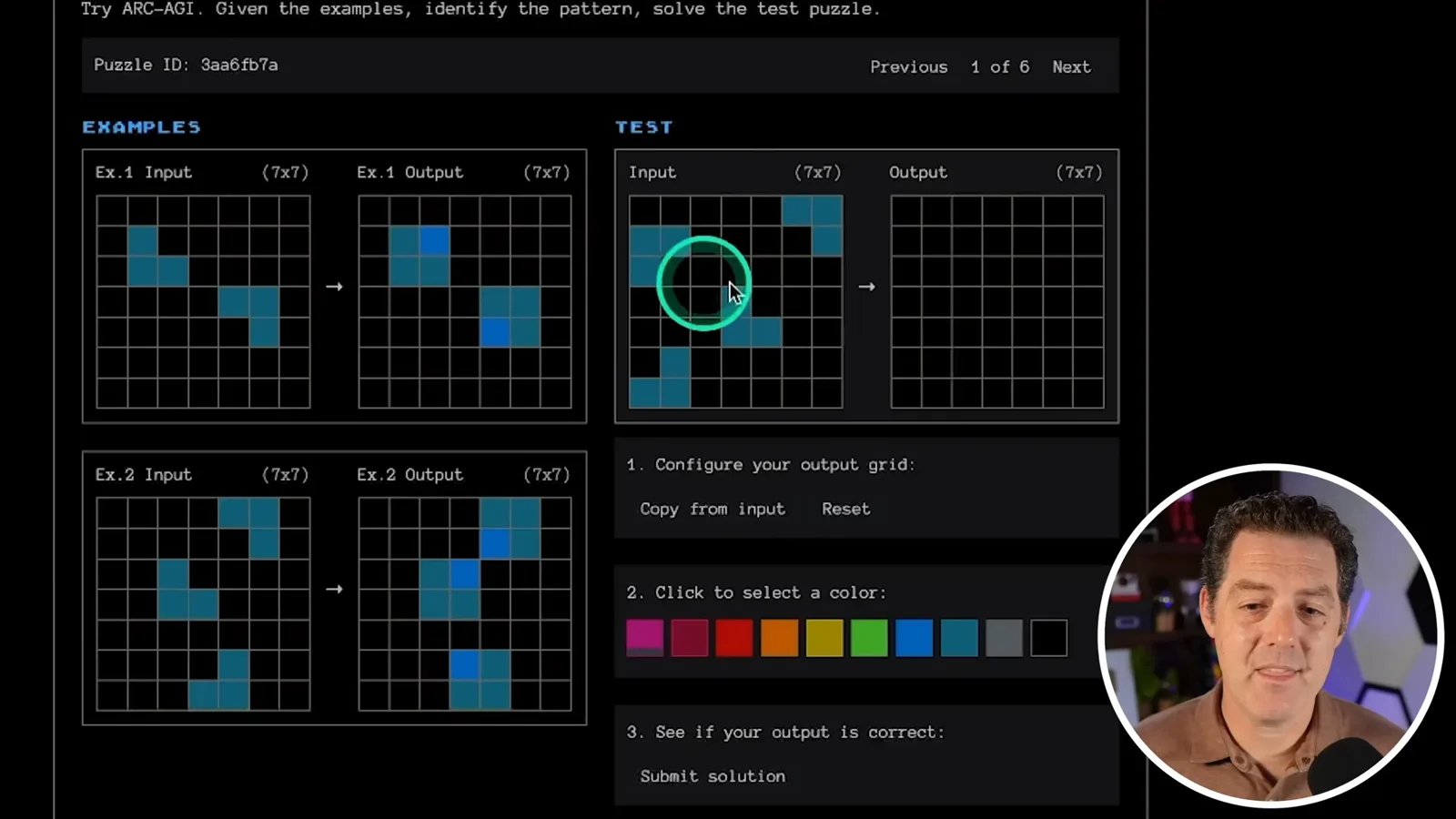
In the example on screen, the training pairs show three colored squares arranged as an L, with a differently colored square filling the missing corner in the output. The task is to apply that pattern to the shapes in a new grid. What looks straightforward in this case can be difficult for a model because each puzzle can require a different rule.
I mention a then-leading competition score of about 42%, along with reported human figures of roughly 60% on average and nearly 98% for the best human. The paper's result is on the public validation set, while a competition leaderboard can use a different set and submission protocol. The numbers illustrate the historical context but are not a clean head-to-head comparison.
The paper and test-time training
He introduces the MIT preprint and its reported results. The technique temporarily updates an adapter using examples associated with a test problem.
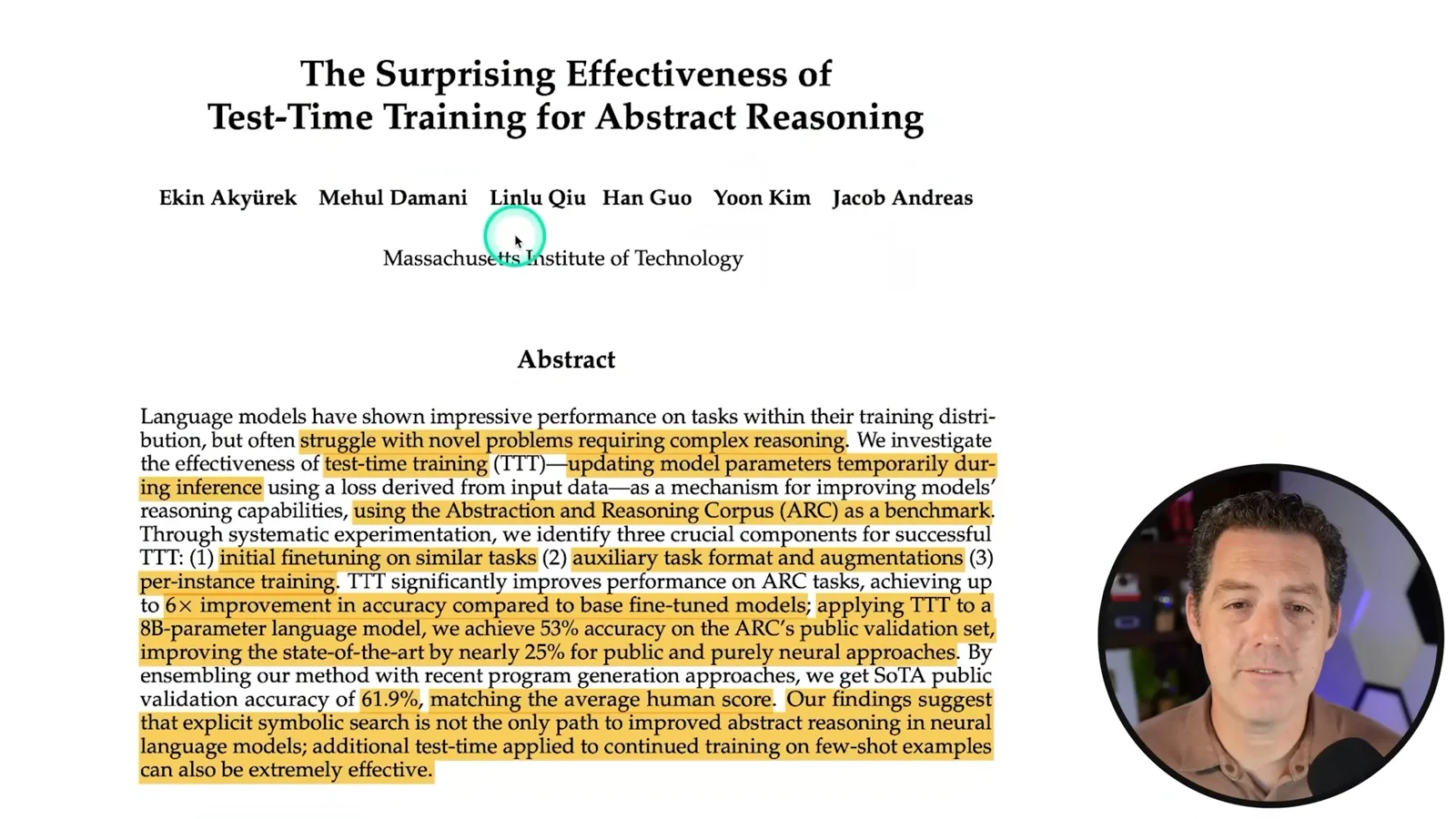
The MIT preprint, [The Surprising Effectiveness of Test-Time Training for Abstract Reasoning](https://arxiv.org/html/2411.07279v1), reports up to sixfold accuracy improvements over certain fine-tuned baselines. Its 8B-parameter language-model setup reaches 53% on ARC's public validation set. Combining the method with program generation raises the reported score to 61.9%; that higher figure is not the result of test-time training alone.
The method updates model parameters temporarily during inference. The authors use LoRA, or low-rank adaptation, to train a small task-specific adapter while keeping the original model weights fixed. That makes the adaptation more targeted, although training and multiple predictions still require compute and time.
The researchers identify three important ingredients: initial fine-tuning on similar tasks, a way to construct and augment auxiliary examples, and training separately for each instance. The resulting gains depend on these choices, the starting model and the benchmark. An eight-billion-parameter model can therefore benefit from the surrounding training and inference procedure, not simply from being small.
I frame the underlying challenge as learning from examples that differ from a model's familiar training distribution. A model may handle small variations of familiar patterns while struggling with an unfamiliar rule. The research tests whether using a puzzle's provided examples for adaptation helps, rather than showing that a model can solve every novel problem without prior knowledge.
Other ways to increase test-time computation include chain-of-thought prompting, majority voting, code execution and search. Those techniques can be combined with a model at inference without necessarily training it again. Test-time training instead changes adapter parameters through gradient steps, using a very small amount of task-specific data.
Constructing data and predicting
Berman explains per-instance training, leave-one-out tasks and geometric augmentations. He then describes transformed inference and voting.
For each problem, the system starts from a previously fine-tuned model, constructs a temporary dataset from the examples supplied with that task, and optimizes its adapter on that data. It then uses the adapted model to predict the answer. For the next task, the process returns to the original base state and trains a fresh task-specific adapter.
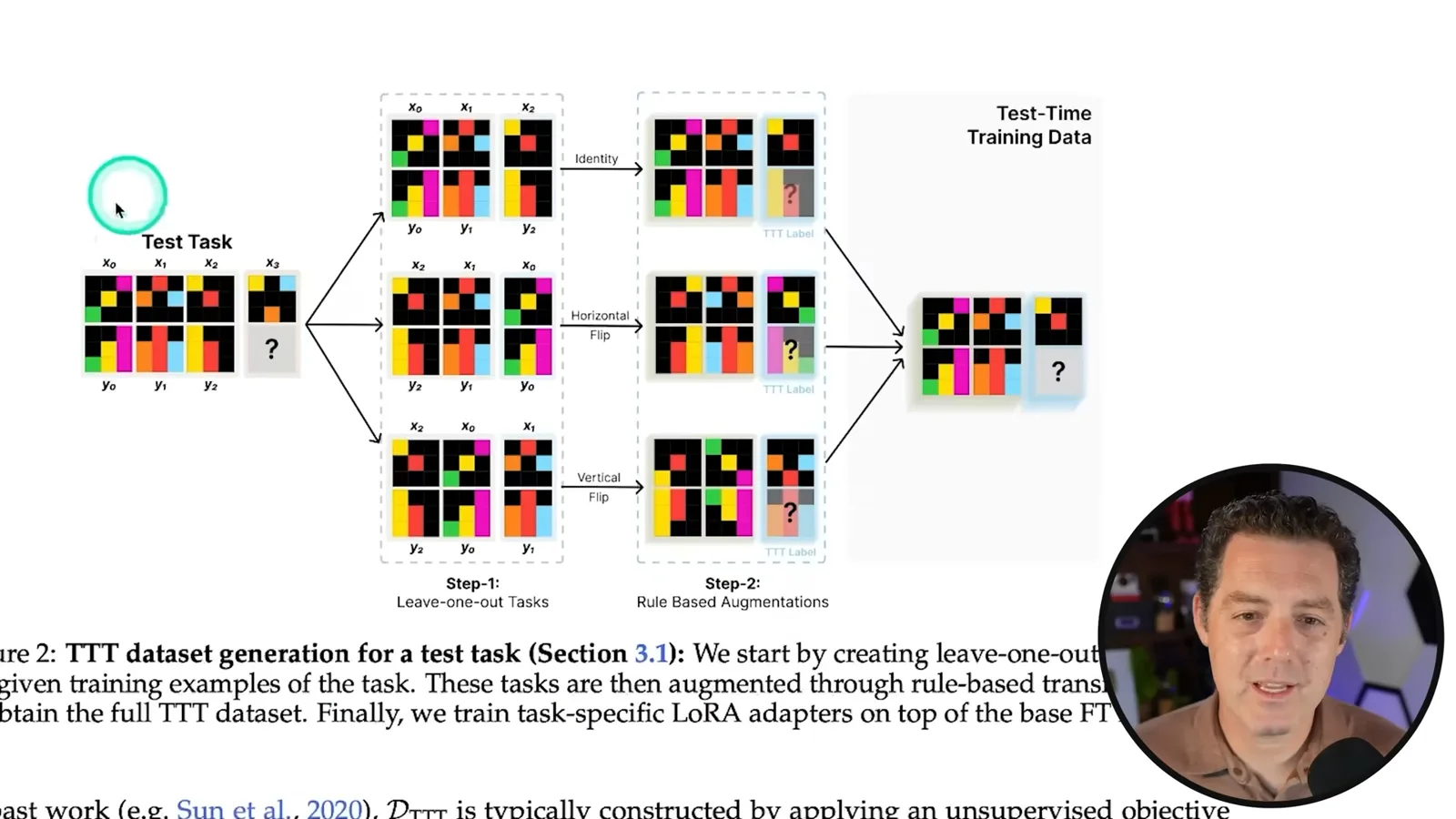
The diagram shows how to create extra training tasks without knowing the answer to the actual test grid. One demonstration pair is held out in turn as a synthetic question while the others provide examples; its known output supplies the target. The researchers also transform the grids, including flips and other rule-preserving changes, to expand the training set.
The system also uses augmented inference. It transforms the same puzzle in multiple ways, generates candidate predictions and maps them back into the original form. This is distinct from the gradient updates: it is an additional way of spending inference computation and obtaining candidate answers.
A voting procedure first selects frequent predictions within each transformation and then combines candidates across transformations. Multiple predictions can improve robustness, although a vote can still select the wrong answer and the procedure increases compute costs.
Results and implications
The paper combines the adapted model with a program synthesizer for its highest public validation result. Berman offers his view on data and future scaling.
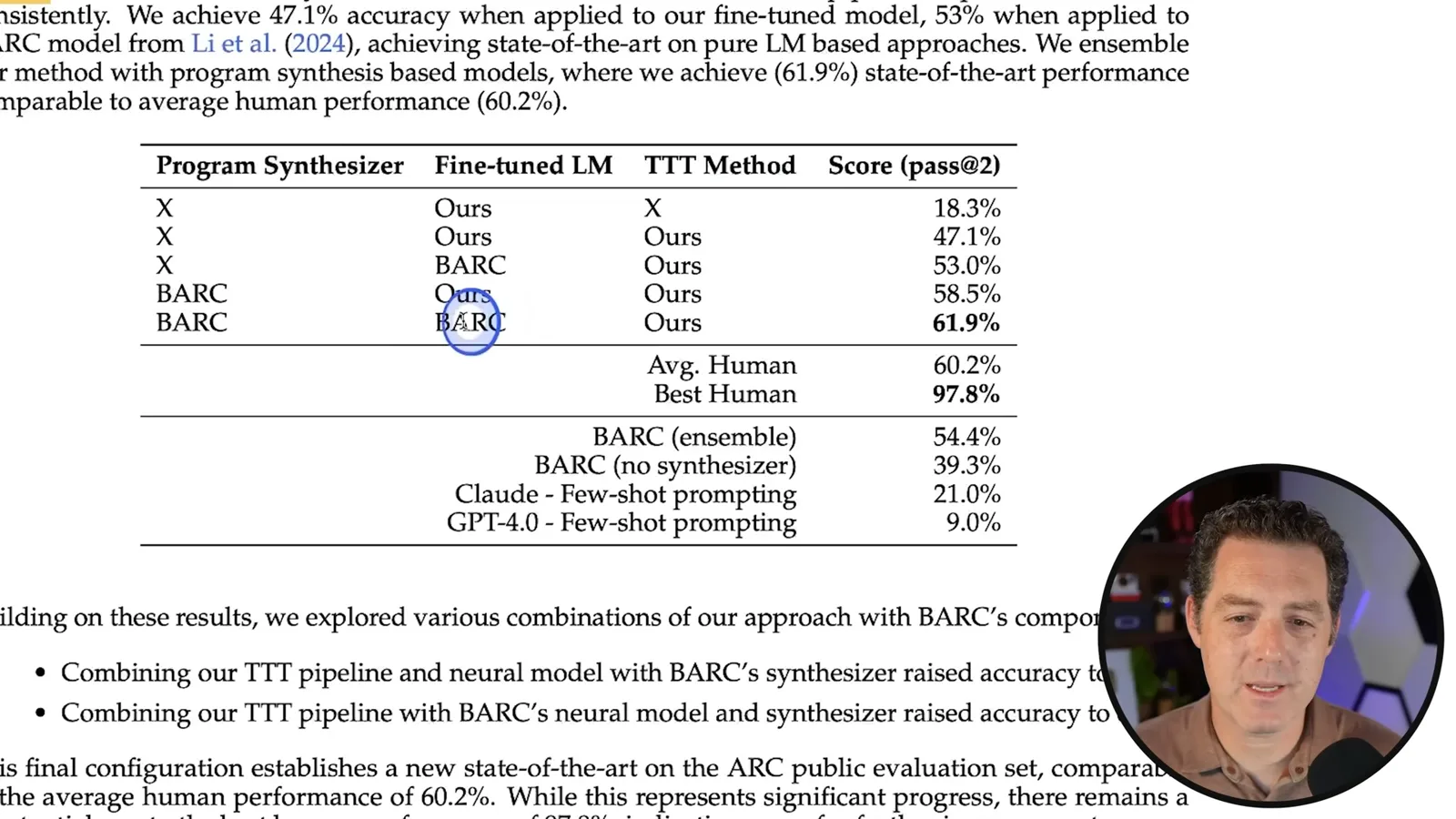
The results table distinguishes the pieces of the system. An 8B model using the BARC fine-tuned model and test-time training reaches 53.0% on the public validation set; combining it with BARC's program synthesizer reaches 61.9%. The table also lists 60.2% as average human performance and 97.8% for the best human under its comparison, but similar percentages on this benchmark do not establish human-equivalent general intelligence.
I find the work exciting because it makes more use of available examples instead of relying only on collecting ever more pretraining data. I speculate that approaches like this, alongside synthetic data, could be important for scaling toward AGI. The paper demonstrates a specific benchmark improvement; it does not establish that public data has run out, prove a new universal scaling law, or identify the method with OpenAI's rumored Q*.
같은 채널의 다른 글
 34:21EN
 Matthew Berman· 2026년 10월 27일Matthew Berman Examines Anthropic’s IPO Filing, AI Growth and GovernanceMatthew Berman, Sam Altman · Forward FutureThe presenter reviews the S-1’s financial metrics, compute strategy and voting structure while questioning the tension between rapid AI development and safety.
 0:26ENMatthew Berman· 2026년 10월 25일Sam Altman on Human Values and Problem-Solving in an AI WorldSam Altman · OpenAIIn a short interview excerpt, Altman considers the enjoyment of solving hard problems and the human role in interpreting results.
 0:36ENMatthew Berman· 2026년 10월 25일Kimi K3.1 and a Rubik’s Cube Solver DemonstrationMatthew Berman · Forward FutureMatthew Berman shows a scrambled virtual cube being solved and gives the Kimi K3.1 test a favorable assessment.
 0:21ENMatthew Berman· 2026년 10월 24일An AI-Generated Kimi Benchmark Chart Used Invented ScoresMatthew Berman · Forward FutureMatthew Berman asks for a graph of Kimi K3.1 Pro benchmarks, then discovers that the displayed figures are illustrative placeholders.
 25:50ENMatthew Berman· 2026년 10월 24일Kimi K3.1 Pro Tested: Strong 3D Demos, Uneven Results and Competitive PricingMatthew Berman · Forward FutureMatthew Berman tests the open-weight model on coding, 3D rendering and visual explanations, then compares benchmark results and prices.
 32:20ENMatthew Berman· 2026년 10월 23일Who Is Local AI For? The Costs, Trade-offs and a Hybrid FutureMatthew Berman · Forward FutureMatthew Berman weighs data control and independence against hardware cost, setup complexity and inference speed.