30초 요약
In August 2025, Matthew Berman reviews early online experiments with Gemini 2.5 Flash Image, also known as Nano Banana. He is impressed by its ability to combine references, edit existing pictures, and maintain visual continuity, though he points out mistakes in labels, composition, and typography. Several examples use separate tools to turn generated images into 3D assets or video. Berman also includes a paid Zapier promotion; its product comparisons are sponsor claims, not independent test results.
- 1Landmarks as generated interfacesBilawal Sidhu's San Francisco images add labels and apparent controls to landmarks. Berman likes the presentation but notices errors and notes that the controls are part of the image.
- 2From images to 3DA building is restyled into an isometric-looking image, then a separate Hunyuan 3D model produces a rotatable mesh. Hidden surfaces are inferred, not measured.
- 3Creative reconstructionThe examples mix character references and reinterpret an early photograph, demonstrating visual synthesis rather than historical proof.
- 4Where editing falls shortCommunity tests include color, lighting and text edits; Berman notes irregular lettering, transparency effects and a failed face-replacement attempt.
- 5Still images become videoA separate Seedance model animates generated reference images into a clip. The example suggests a workflow, not a guaranteed level of continuity.
핵심 정리
- An image can convincingly imitate an annotated interface while containing spelling errors, imprecise highlights, and nonfunctional controls.
- Image editing, 3D reconstruction, and video animation can form a creative pipeline, but the 3D and motion examples use separate models.
- Restoring a historical photograph with generative AI invents details and color that the original image does not establish.
- Examples of styling and compositing look promising but do not establish that the model can reproduce every professional editing task.
- The model comparison at the end is an informal visual impression, not a benchmark or general ranking.
챕터별로 다듬은 전문 읽기
Landmarks, isometric edits, and 3D
Berman surveys early Nano Banana experiments involving annotated landmarks and isometric buildings. A separate model turns one edited image into a rotatable 3D object.
Google's Nano Banana image model has prompted a flood of creative experiments. I want to walk through some of the reactions and examples people have posted, from labeled landmarks and 3D workflows to fashion and short films. These are individual demonstrations, not a systematic test of the model.
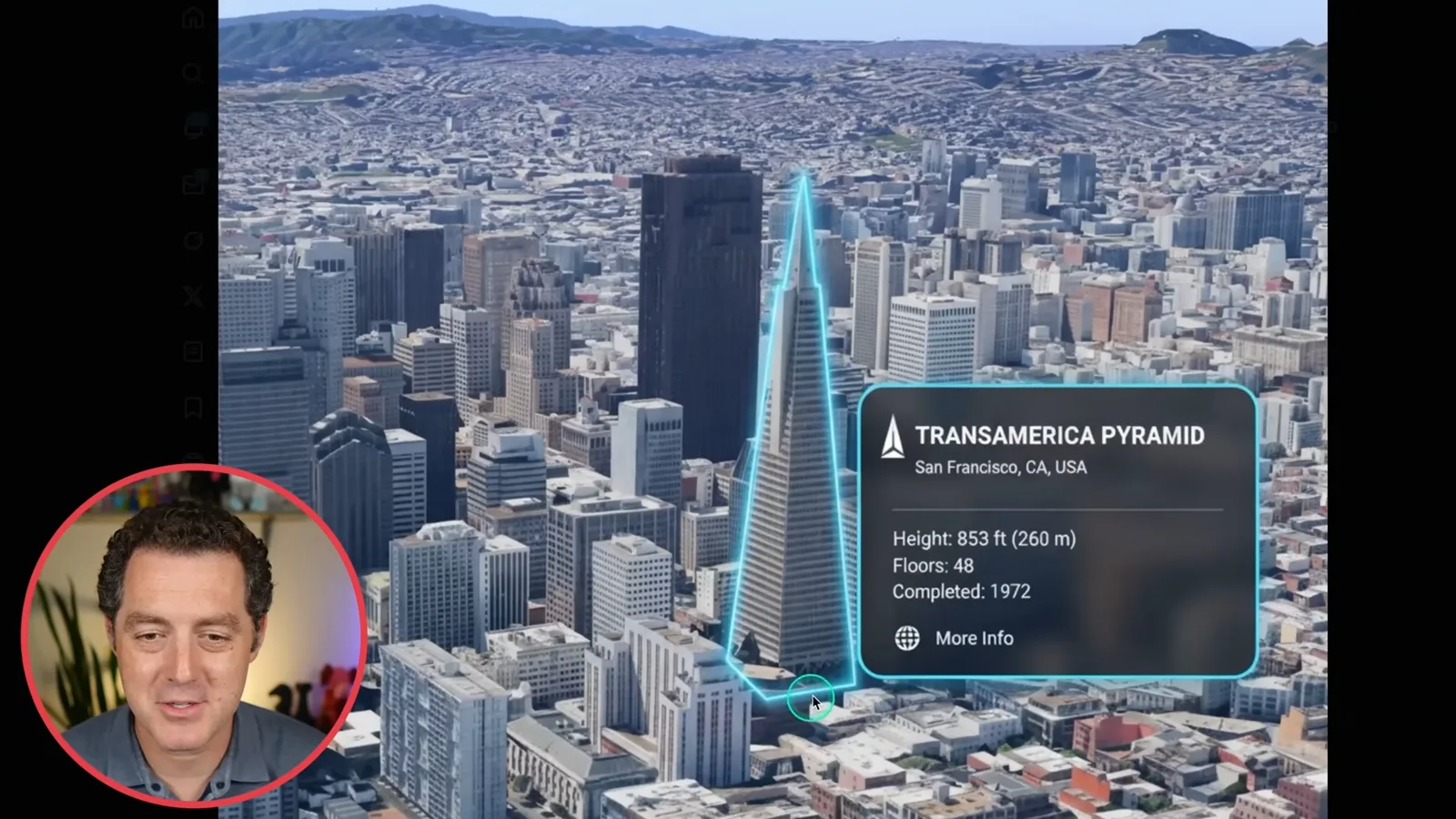
Bilawal Sidhu shows San Francisco landmarks with names, outlines, and small information panels generated into the image. The Transamerica Pyramid, Ferry Building, and Palace of Fine Arts examples make an ordinary photograph look like a spatial interface. The visual treatment is compelling, but some labels are misspelled and the highlighting is not always precise. The apparent buttons are pixels in a picture, not functioning links; any generated factual information also needs verification.
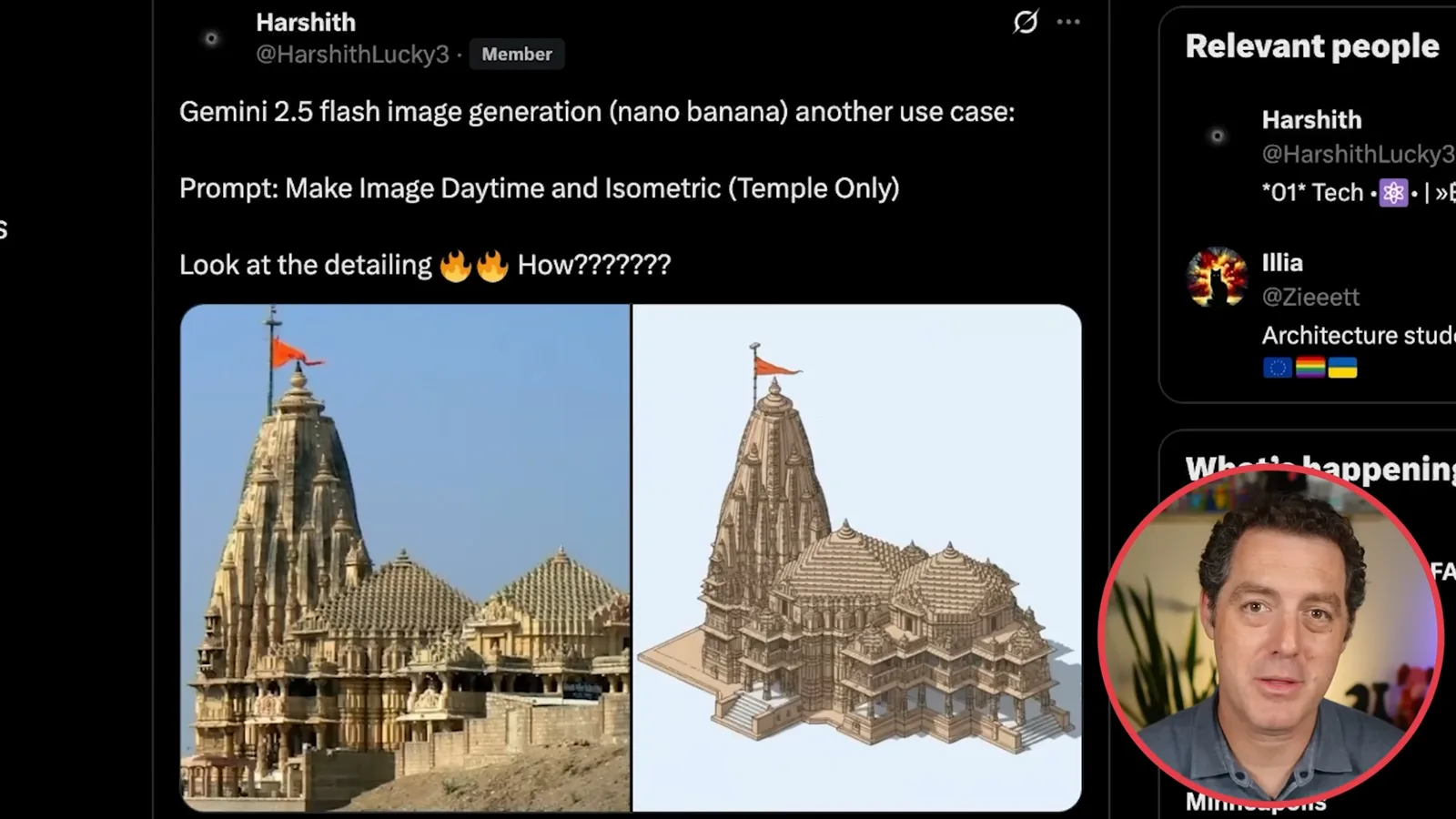
Another example transforms a temple and other buildings into an isometric-looking style and then adds imaginative features, including a roller coaster. The output is still an image: the illusion of depth is not itself an editable 3D model. It is useful as a visual concept, though details can change as the picture is restyled.
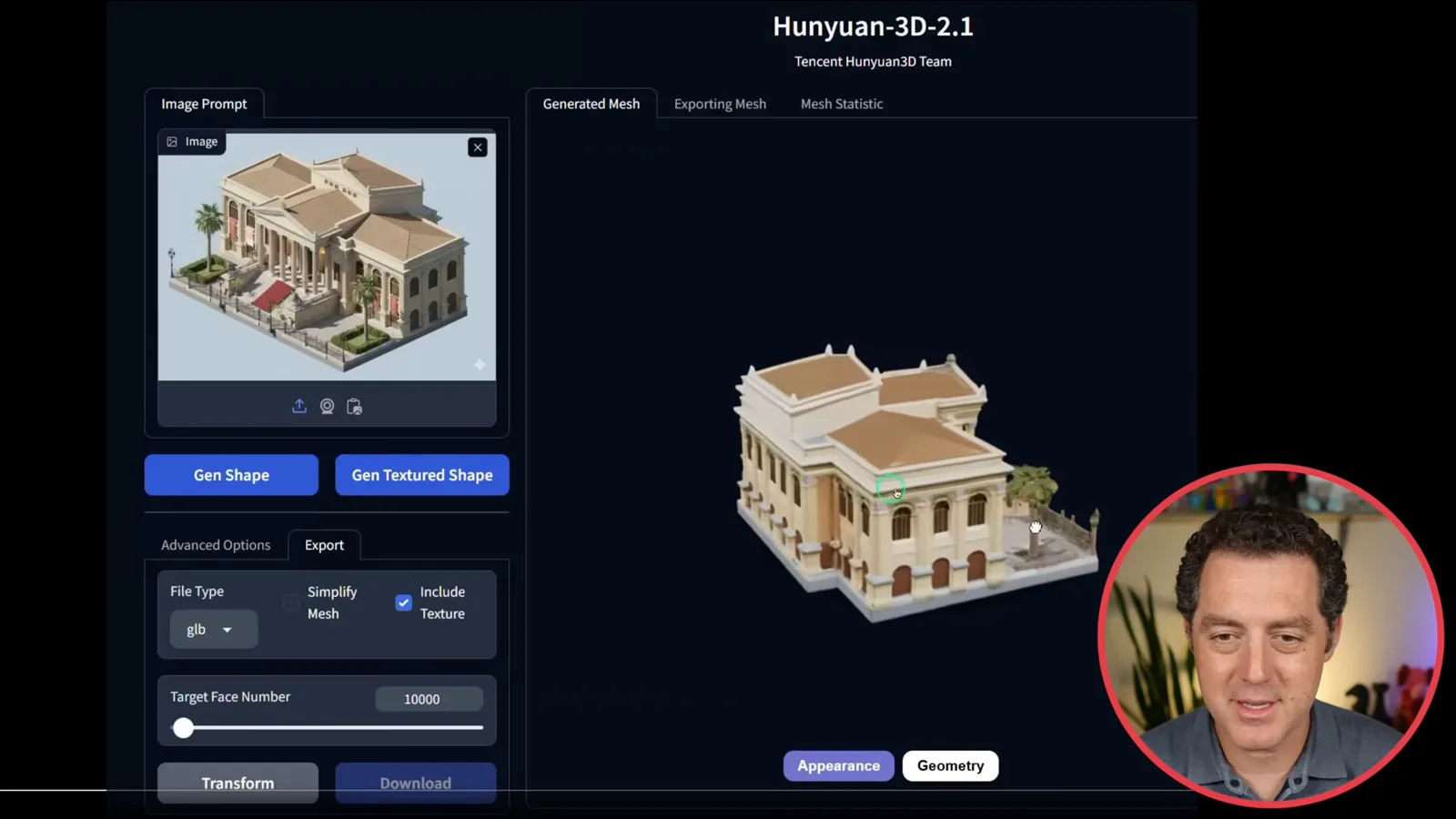
The next step brings the picture into Hunyuan-3D-2.1, a separate 3D generation tool, to produce an object that can be rotated. That combination is what makes the workflow interesting: Nano Banana supplies the edited image, and another model builds geometry from it. Parts of a building hidden in the source have to be inferred, so the mesh should not be treated as an accurate survey.
Composites, history, and creative workflows
Examples combine reference images, reinterpret an early photograph, and explore model safety boundaries. Other demonstrations combine generated images with 3D tools and AI video.
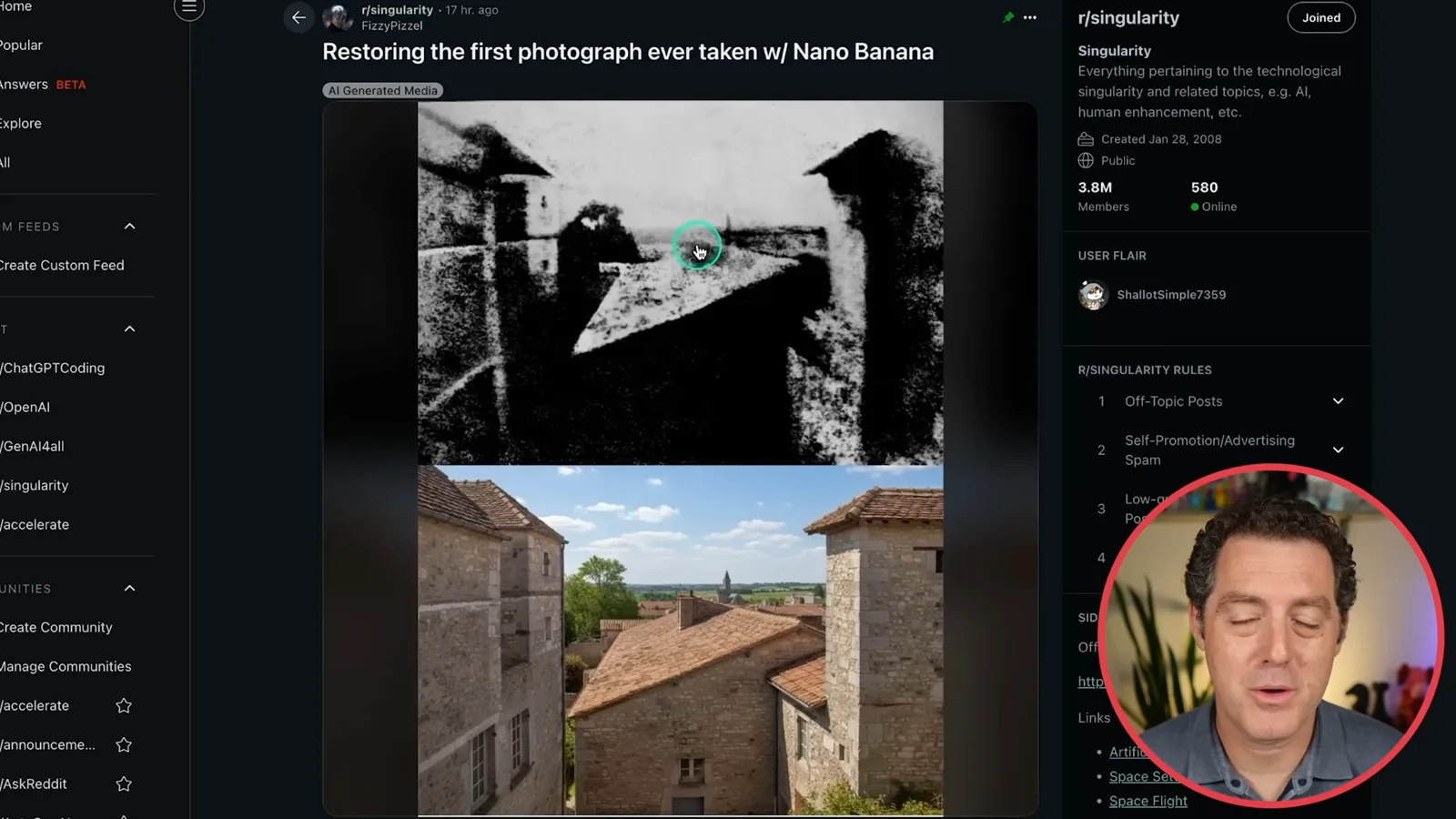
The reference-image examples also combine characters with a rough sketch to create a finished scene. In another post, a creator asks the model to reinterpret Nicéphore Niépce's View from the Window at Le Gras, generally considered the earliest surviving photograph made in a camera. The result invents color and visual details; as I note, the model takes liberties. It is a creative reconstruction, not evidence of exactly what the scene looked like.
One creator claims to have found a way around an image safety restriction. A posted result may reveal a weakness in a particular interaction, but it does not establish that safeguards are always bypassable or that a future version behaves the same way. Other examples continue the image-to-3D workflow, using generated source images and an additional model to produce a mesh.
Sidhu argues that natural-language image editing could change workflows that today require extensive manual work in applications such as Photoshop. The examples show why creators are excited: composition and visual changes can be requested in language rather than built layer by layer. They do not prove full feature parity, precision, or reliability across professional editing jobs.
A short advertising-style video combines imagery made with Nano Banana and Google's Veo 3. The generated character and voice demonstrate how a still-image model and a video model can be assembled into a commercial-looking clip. The fictional presentation is a demonstration of production technique, not evidence for any product claim made in it.
Sponsored workflow automation segment
Berman presents a paid Zapier promotion and compares automation products. His service and pricing assertions are promotional claims from the recording period.
This video also contains a paid Zapier sponsor segment. I discuss hosted automation, integrations, reliability, and pricing in comparison with alternatives; those statements are promotional claims made at the time, not results of an independent comparison. Availability, integration counts, service reliability, and prices can change.
Fashion, editing tests, and animated scenes
Community examples explore virtual clothing, stylized characters, relighting, text and other edits. A separate video model animates reference images into a short sequence.
Linus Ekenstam shares fashion experiments in which the model places clothes on a person and makes stylized variations, including a Simpsons-like treatment. These examples suggest a quick way to preview combinations or explore a visual style. The model does not always obey every instruction: in one result, the pose differs from what was requested.
Kol Tregaskes posts a series of editing tests, changing color and contrast, relighting scenes, and modifying text and other details. The range of requested edits is striking, but some outputs have visual artifacts: typography can look smoothed or wrong, and an apparently transparent effect may not be a usable transparent layer. A convincing picture should be checked against the actual requirements of the edit.
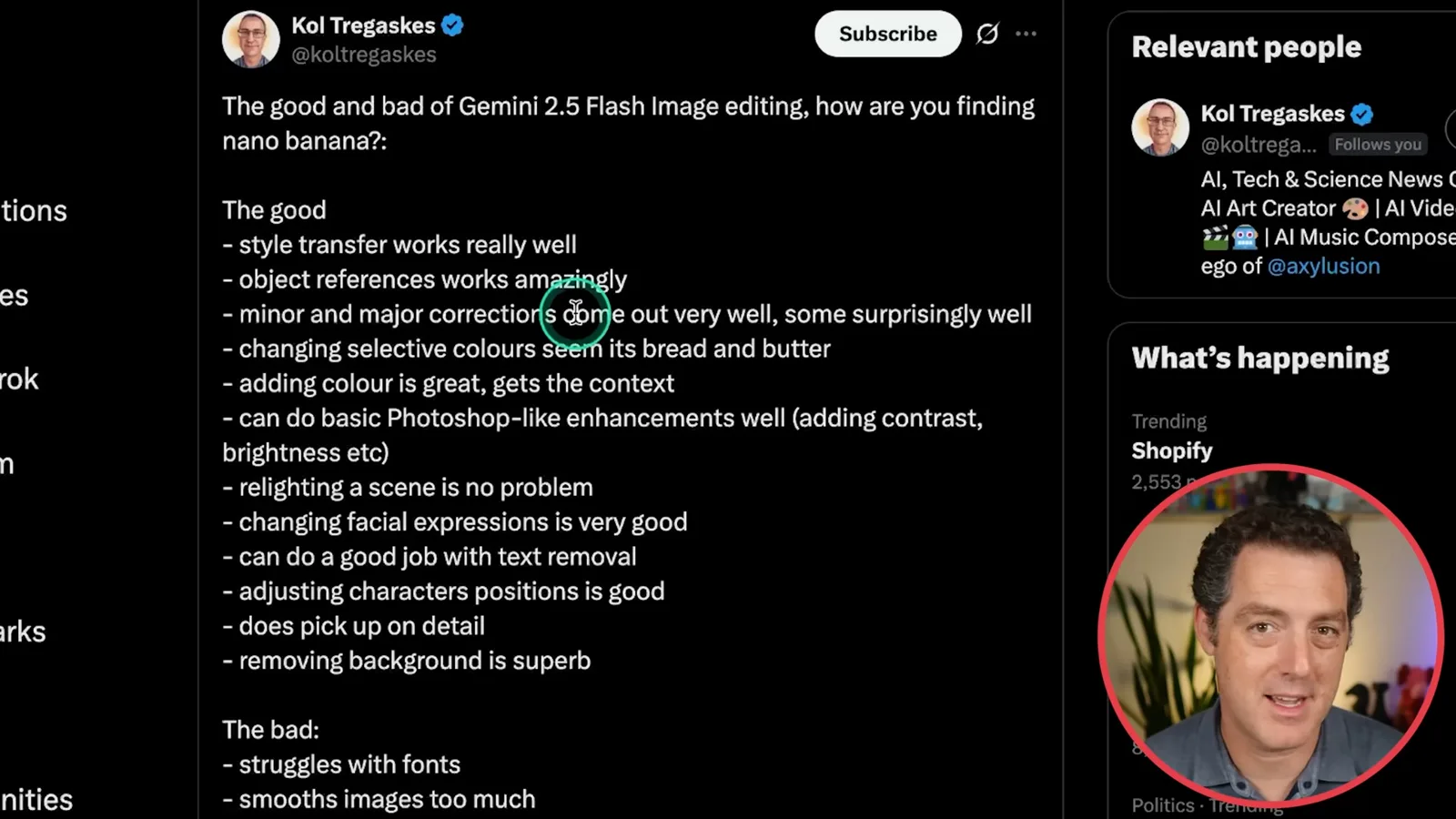
The tests also run into safety boundaries, including a face-replacement attempt that does not produce the requested result. An unsuccessful or refused request can reflect a safety policy, an interpretation issue, or a model limitation; a single output does not distinguish all of those causes. The examples are useful clues about how the tool behaved in these interactions.
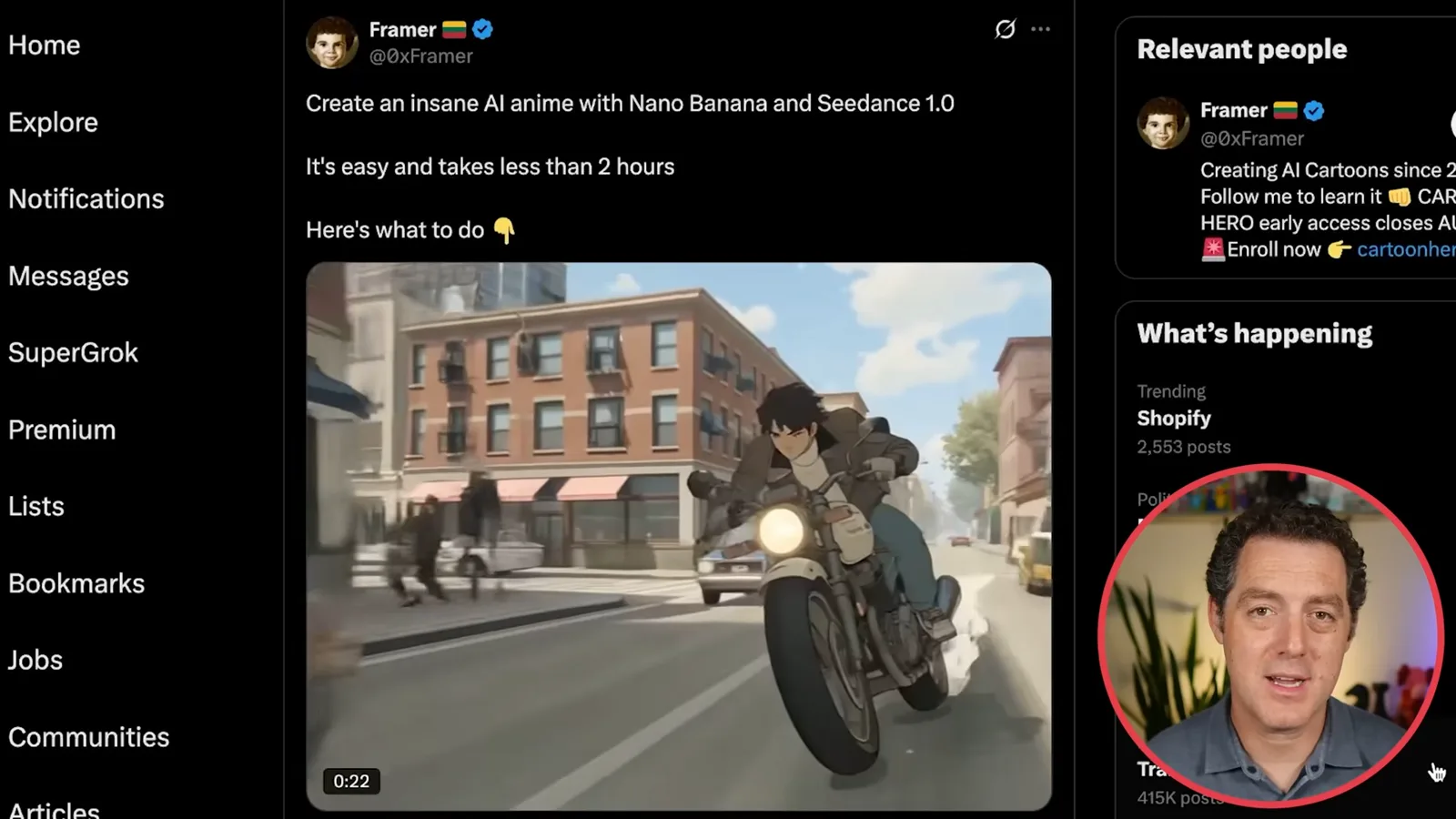
Another creator uses reference images generated with Nano Banana and then animates them with the separate Seedance 1.0 video model. The short sequence maintains a recognizable visual style across cuts and angles, which makes the combination attractive for storyboarding and filmmaking. That is one selected demonstration, not a guarantee that every character, camera move, or scene will remain consistent.
A side-by-side comparison
Berman considers sample cat images from Nano Banana and Grok Imagine. He does not see a clear difference in this small example and discusses a predicted future improvement.
Finally, Elon Musk shares a comparison involving cats in front of the Eiffel Tower and discusses an upcoming Grok Imagine version. Looking at the images, I cannot see a decisive difference between the two examples. This is a subjective look at a tiny sample, not an overall model ranking; a promised future improvement is a prediction rather than an observed result.
The early response suggests that image editing is becoming a flexible component in broader creative workflows. The best examples are exciting, but generated labels, invented details, policy restrictions, and errors still call for close review. I expect people to keep finding new combinations as they experiment with these tools.
같은 채널의 다른 글
 34:21EN
 Matthew Berman· 2026년 10월 27일Matthew Berman Examines Anthropic’s IPO Filing, AI Growth and GovernanceMatthew Berman, Sam Altman · Forward FutureThe presenter reviews the S-1’s financial metrics, compute strategy and voting structure while questioning the tension between rapid AI development and safety.
 0:26ENMatthew Berman· 2026년 10월 25일Sam Altman on Human Values and Problem-Solving in an AI WorldSam Altman · OpenAIIn a short interview excerpt, Altman considers the enjoyment of solving hard problems and the human role in interpreting results.
 0:36ENMatthew Berman· 2026년 10월 25일Kimi K3.1 and a Rubik’s Cube Solver DemonstrationMatthew Berman · Forward FutureMatthew Berman shows a scrambled virtual cube being solved and gives the Kimi K3.1 test a favorable assessment.
 0:21ENMatthew Berman· 2026년 10월 24일An AI-Generated Kimi Benchmark Chart Used Invented ScoresMatthew Berman · Forward FutureMatthew Berman asks for a graph of Kimi K3.1 Pro benchmarks, then discovers that the displayed figures are illustrative placeholders.
 25:50ENMatthew Berman· 2026년 10월 24일Kimi K3.1 Pro Tested: Strong 3D Demos, Uneven Results and Competitive PricingMatthew Berman · Forward FutureMatthew Berman tests the open-weight model on coding, 3D rendering and visual explanations, then compares benchmark results and prices.
 32:20ENMatthew Berman· 2026년 10월 23일Who Is Local AI For? The Costs, Trade-offs and a Hybrid FutureMatthew Berman · Forward FutureMatthew Berman weighs data control and independence against hardware cost, setup complexity and inference speed.