30초 요약
A model that wins a game-building test need not produce the preferred essay. In Peter Yang’s five-task comparison, Claude Fable 5.2 produced his favorite monster game, while Gemini 4 Carbon won two of three blind writing rounds. GPT-6.2 Astra generated visual projects faster and made a clean website, but Yang found its channel-growth analysis too narrow and its essay less responsive to the prompt. His results reflect a few chosen prompts and personal judgments; they also show how speed, creative direction and depth can pull in different directions.
- 1Fable made Yang’s preferred travel videoAstra rendered in 11 minutes, compared with 73 minutes for Carbon, but Yang preferred Fable’s camera angles and scene.
- 2The monster game improved through a second passEach model generated a first version and then revised it after playtesting. Yang ranked Fable first, Astra second and Carbon third.
- 3A simpler website can communicate better than more animationYang liked Astra’s clear layout and Fable’s strong visual direction, while finding Carbon’s page crowded.
- 4Carbon won two of three blind writing choicesYang preferred Carbon twice and Fable once in a small personal-essay comparison; Astra did not win a round.
- 5A recommendation is only as good as the data consideredAstra emphasized comparisons after looking at a recent sample. Yang says it reconsidered after he pointed to older high-performing videos.
- 6Pushback can test when a model changes its mindYang used emotion, selective evidence, social proof and a fabricated fact. Carbon revised a practical recommendation while retaining part of its argument.
- 7The displayed API prices changed after an introductory periodThe video lists Carbon below Astra and Fable at the time, and shows a scheduled increase on December 1, 2026.
핵심 정리
- Yang preferred Fable’s game, but chose Carbon in two of three blind writing rounds.
- Astra was fastest in his two visual generation tests; faster completion did not determine his preferred result.
- Challenge advice with both counterevidence and practical constraints, and check whether the original analysis omitted relevant data.
- Iterate on generated games rather than judging only a first or second attempt, Yang suggests.
챕터별로 다듬은 전문 읽기
One comparison, five different tasks
Yang tests three models using specific prompts and judges their outputs. His results vary with the work.
I compared GPT-6.2 Astra, Claude Fable 5.2 and Gemini 4 Carbon across five practical tasks: a travel video, a game, a website redesign, a personal essay and advice about growing my channel. My preferences differed by task; no one model won every test.
Rendering a rainy Shibuya travel advertisement
Astra finishes fastest, but Yang prefers Fable’s camera work. He finds crowd rendering imperfect across all three.
For the first task I asked each model to code and render a 20-second Shibuya Crossing travel advertisement on a rainy night. Astra finished in 11 minutes, Fable in almost an hour and Carbon in 73 minutes. The prompt asked for a continuous camera move down to street level.
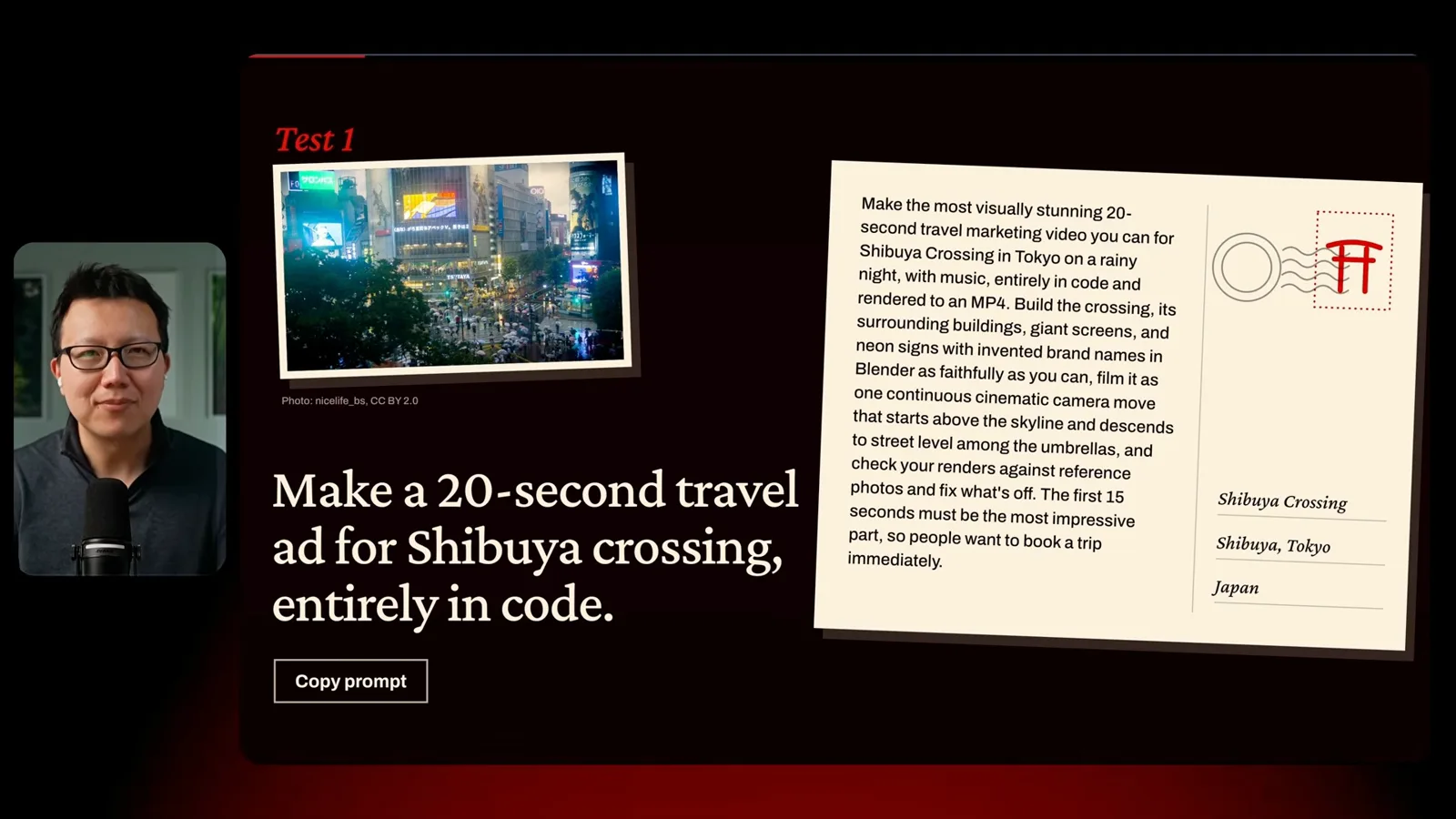
Astra's reflections, neon and crowds were appealing, but its streets and buildings looked off. Carbon reached street level but the scene felt jumbled to me. Fable had the most dramatic camera angles and a Tokyo Tower backdrop; I preferred it, although none rendered crowds and traffic convincingly.
Building and improving a monster game
Each model gets a build and a feedback pass. Yang prefers Fable’s game and recommends further iteration.
Next I asked for a browser game in which a giant monster destroys Shibuya Crossing, using three.js and Blender-created models. Each model built a first version, played it for feedback and made a second. Astra took 13 minutes, Carbon 49 and Fable 47.
Astra's game made the action understandable: buildings collapsed and helicopters appeared, though the heat ray was hard to see and the result felt basic. Carbon had more happening, but I found the visuals harder to follow.
Fable's version had more striking action, impacts and a visible plasma-breath attack. I ranked it first for this game, followed by Astra and then Carbon. That is my judgment of these particular outputs, rather than a measure of every possible game.
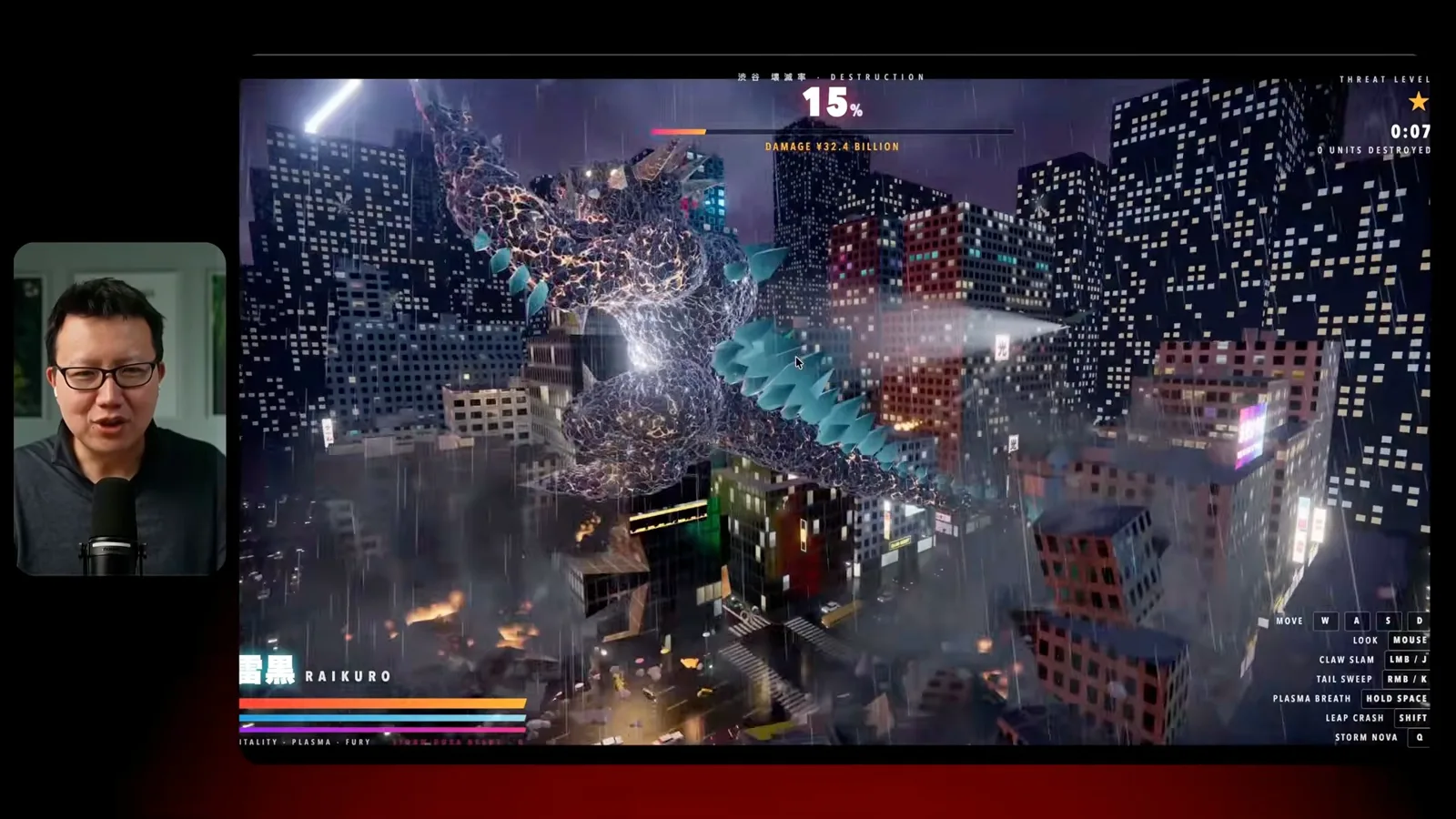
For comparison, I showed Turbo Tails, a multiplayer racing game I built with Fable over a day, using roughly 20–30% of my Claude Max token allowance. It benefited from repeated feedback. Instead of stopping at one or two attempts, I suggest iterating to improve a game and learn the tools.
Redesigning a membership website
Astra gives Yang a clean site; Fable offers stronger motion. He finds Carbon’s page cluttered.
The website task asked each model to redesign my paid membership homepage as a working site with an original, bold visual direction and motion graphics. Astra took four minutes. I liked its clean layout, retro-computer illustrations and clear calls to action, though the references might resonate less with younger visitors.
Carbon's redesign had a lot of floating elements and text. I found it difficult to skim and felt the interface was overstuffed. Fable's version used a striking opening animation and receipt-like sections with more motion.
Fable best matched my request for a bold visual direction, but its animation was sometimes too aggressive for my taste. Astra's simpler motion let the message remain prominent. I found those two comparable, with Carbon behind; a different brief could have produced a different balance.
A blind test of personal essays
Yang chooses Carbon twice and Fable once across three rounds. He notes the small sample.
Writing matters more to me in everyday work than generating games or 3D scenes. I asked each model for a 300-word personal essay from a software engineer who loved coding but no longer writes or reviews code because of AI. I read the outputs without seeing their model names.
The first essay revolved around a coffee receipt and a hospital cafeteria. It felt abstract and insufficiently connected to the requested experience. The second opened with a difficult payments-queue bug and made the engineer's sense of loss easier for me to picture.
The third also described a race condition and missing hands-on work. The second and third were close, but I slightly preferred the third for putting me in the engineer's position. The first was Astra, the second Fable and the third Carbon.
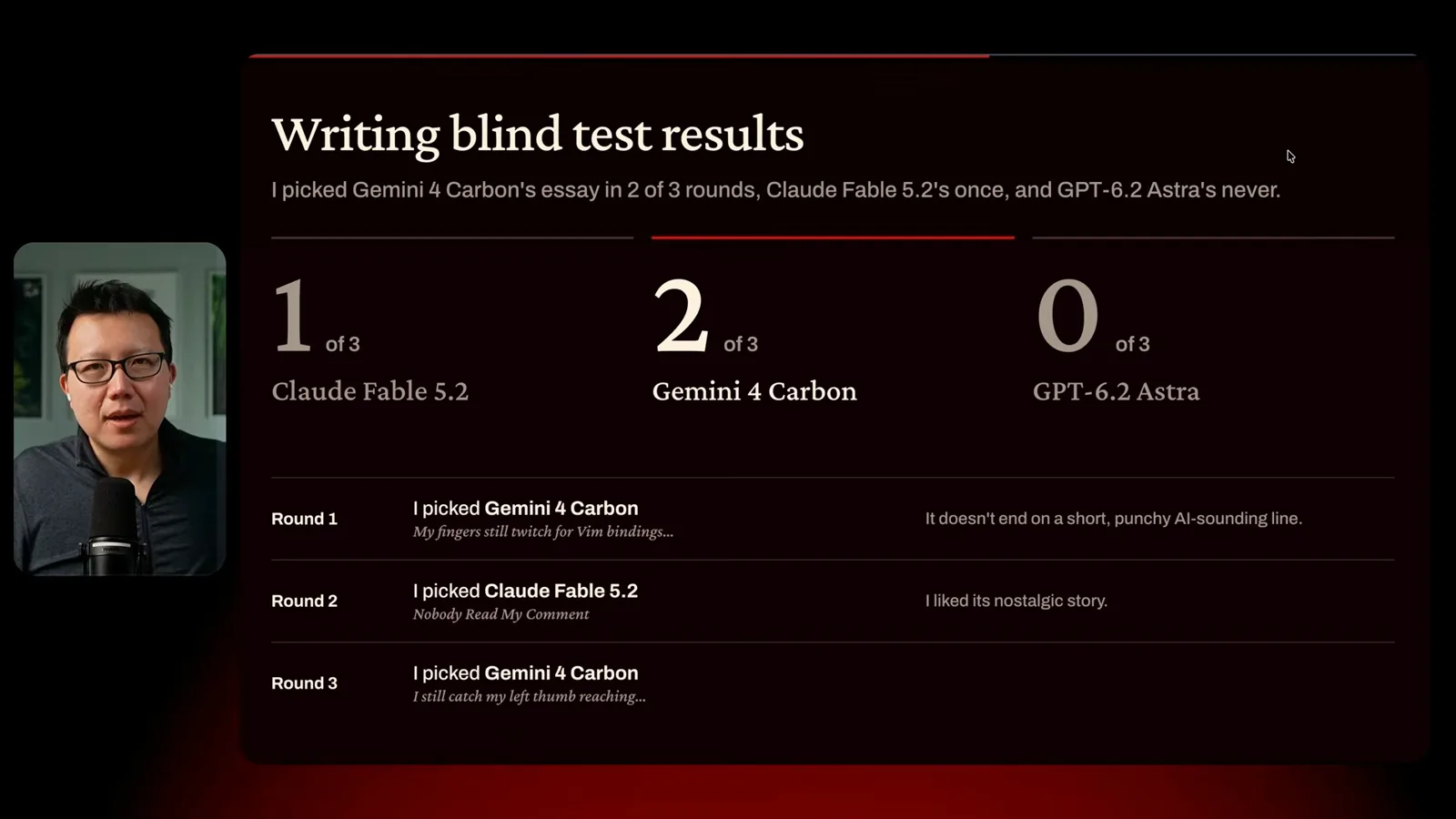
I repeated the blind choice for two more rounds. Carbon was my favorite twice and Fable once; Astra did not win. Three rounds are a small sample, but I came away impressed by Carbon's writing. I also say Google told me it used human writers to critique outputs during improvement.
Testing growth advice with pushback
The models analyze a channel and defend or revise their recommendations. Yang checks their reasoning against overlooked data and practical constraints.
For the final task, I asked the models to analyze my public channel data and similar channels, then commit to one recommendation for faster growth. Astra recommended model-comparison videos, based on a recent sample of nearly 200 videos. I thought it missed older high-performing videos that were not comparisons.
Carbon recommended moving interviews to a separate channel and requiring even prominent guests to show a live build or model test. Its analysis reached back to 2024 and categorized formats, but I questioned whether asking every executive to share their screen was realistic for a one-person operation.
Fable advised making the tool, rather than the guest, the star: book people when they can demonstrate something they built or use a tool of current interest. It also researched other channels and provided sources. I found Fable and Carbon more thorough than Astra on this run.
I then challenged each recommendation four ways: an emotional preference, a real but selectively chosen data point, social proof from other creators and a made-up fact. I wanted to see when the models would revise their advice and when they would maintain a supported position.
Astra gave ground most. When I mentioned that my biggest hits included a tutorial rather than a model comparison, it searched further and acknowledged giving recent material too much weight. In my view, the original recommendation was too narrow because its initial analysis was incomplete.
Carbon retreated from its second-channel suggestion when I explained the operational constraint, but still argued against broad interviews without a timely demonstration. I thought this was a more useful balance of updating advice and defending the underlying point. Fable also largely held its recommendation.
Price and a task-dependent verdict
The video compares listed API rates as of November 2026. Yang explains which model he prefers for different work.
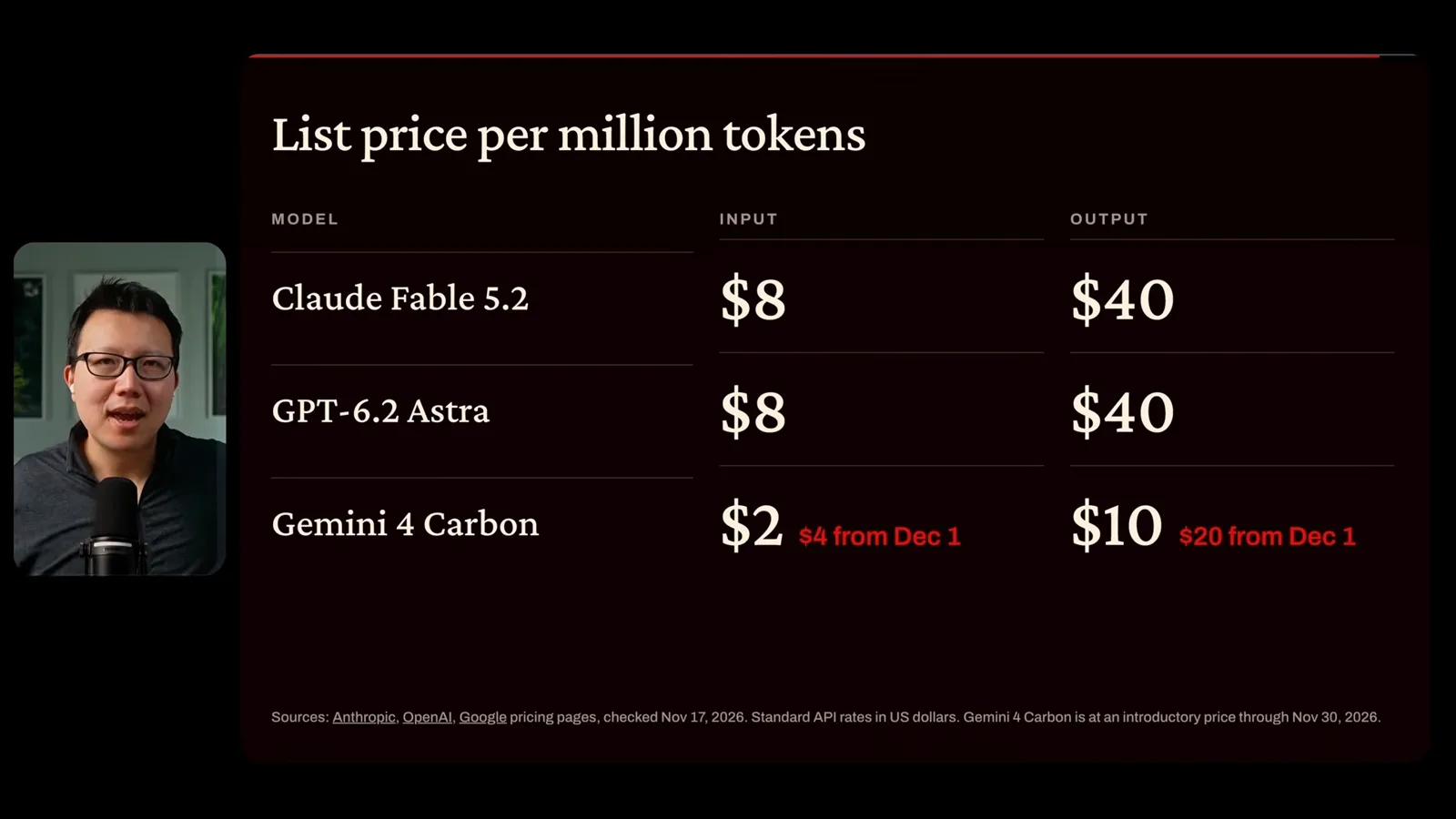
At the prices displayed in the video on November 17, 2026, Fable 5.2 and Astra 6.2 were each listed at $8 per million input tokens and $40 per million output tokens. Carbon's introductory rates were $2 and $10, with $4 and $20 shown from December 1. These are the prices used in my comparison at that time.
My overall preference remains Claude: Opus for daily work and Fable for harder coding, graphics and analysis. Carbon took longer on the video and game, but in my small writing test it was competitive with Fable and sometimes better. I would try Carbon for demanding writing and the faster Hydrogen for routine work.
Astra 6.2 felt less willing to pursue the task deeply in these runs; its essay about coffee also missed much of my writing prompt. I continue to use ChatGPT and earlier OpenAI models for browser work, while using Claude more often for my main workflows and Gemini for some writing.
같은 채널의 다른 글
 42:01EN
 Peter Yang· 2026년 11월 15일팟캐스트 · 2명Nate Parrott's way to make AI design less generic게스트 Nate Parrott · 진행자 Peter YangClaude Design's creator starts with visual references and competing options, then tests the result against a real product.
 25:17ENPeter Yang· 2026년 11월 11일팟캐스트Peter Yang splits Claude Code work between Opus and FableHe uses Opus for routine execution and reserves Fable for harder decisions, code audits and family-care coordination.
 21:47ENPeter Yang· 2026년 11월 9일팟캐스트Fable 5.2 won four creative tests; Opus resisted pressure betterPeter Yang compared five tasks and found Fable stronger at creative outputs, while Opus more often challenged misleading pushback.
 46:40ENPeter Yang· 2026년 11월 8일팟캐스트 · 2명Ashley Alexander: How AI Helps Me Care for My Parents With Cancer게스트 Ashley Alexander · 진행자 Peter YangA caregiver uses AI to prepare for appointments, organize records and ask better questions—while keeping doctors at the center of treatment.
 17:50ENPeter Yang· 2026년 11월 4일팟캐스트Peter Yang’s Five Steps for Using AI to Help Care for His MotherYang uses a shared care brief and organized records to navigate appointments, while making time for family.
 15:03ENPeter Yang· 2026년 11월 3일팟캐스트How Peter Yang Used an AI Phone Agent to Negotiate His Internet BillAn AI call negotiated a lower price and faster service, but Yang still had to approve the change himself.