30초 요약
In November 2023, Matthew Berman connects reports about OpenAI’s Q* project with Sam Altman’s brief removal and explores public work on reasoning, search, self-play and synthetic data. The video also repeats a purported leak and speculative claims about cryptography. The Q* architecture, alleged capabilities and connection to the board decision were not established by the material presented. OpenAI’s later published summary of an outside review attributed the leadership decision to a breakdown of trust and said it did not arise from product safety, security or development pace; the full review was not published. A purported online letter and a joke about P=NP do not establish a cryptographic breakthrough.
- 1The board decisionThe video’s safety-dispute explanation was speculative; OpenAI’s later summary described a breakdown of trust and said the decision was not caused by product safety or development pace.
- 2What the reporting establishedReuters cited unnamed sources but did not see the alleged letter or independently verify Q* capabilities.
- 3STaR is a separate paperIts reasoning bootstrap loop does not establish that Q* used the method.
- 4A bounded math resultOpenAI’s process-supervision study reported 78% on a representative MATH subset under its own evaluation.
- 5Unverified cryptography claimsA joke about P=NP and a purported anonymous letter are not evidence of a proof or broken AES.
- 6Self-play and languageKarpathy contrasts Go’s clear reward with the harder problem of evaluating open-ended language.
핵심 정리
- Reuters’ 2023 account relied on sources and did not independently verify Q* capabilities or inspect the alleged letter.
- OpenAI’s later review summary attributed Altman’s removal to a breakdown of trust, not product safety or development pace; the full report was not public.
- STaR and process-supervision papers are public research, not proof of Q*’s implementation.
- The 78% result in Let’s Verify Step by Step concerns a representative MATH test subset under that study’s conditions.
- An unverified online letter and a social-media joke do not prove AES was broken or P=NP.
- AlphaGo self-play has a clear game reward, while open-ended language feedback is harder to define and verify.
- Berman’s proposals about synthetic data, model understanding and AGI are speculation rather than established findings.
챕터별로 다듬은 전문 읽기
The Q* reports and leadership crisis
Berman reviews the 2023 reports and suggests a link to Altman’s removal. That causal claim was disputed, and a later published review summary described a breakdown of trust.
In this November 2023 video, Matthew Berman examines reporting and online speculation about an OpenAI project called Q*. He connects the rumors to Sam Altman’s brief removal as CEO and discusses mathematical reasoning, search, self-play and synthetic data. Much of the alleged project’s design and capability was not publicly verified; the video’s title and opening do not establish an AGI breakthrough.
Berman plays an earlier clip of Altman describing moments of discovery at OpenAI, then interprets it alongside the November leadership crisis. Altman’s general remarks do not identify Q* or explain the board’s decision. OpenAI’s [November 17 announcement](https://openai.com/blog/openai-announces-leadership-transition/) said the board had lost confidence in his communications; he subsequently returned as CEO.
Berman speculates that a dispute over commercialization and safety drove Altman’s removal and says the board was prepared to sacrifice the company over a discovery. These claims were not established by the contemporaneous public evidence. In March 2024, OpenAI’s published [summary of a WilmerHale review](https://openai.com/index/review-completed-altman-brockman-to-continue-to-lead-openai/) attributed the decision to a breakdown of trust and said it did not arise from product safety, security or the pace of development; the full report was not released.
Reuters reported, citing two people familiar with the matter, that researchers had written the board about a discovery and that the letter was among issues raised before the firing. Reuters said it had not seen the letter or independently verified Q*’s capabilities. OpenAI said its internal communication alerted employees to media stories without confirming their accuracy; reporting about the supposed causal link was disputed.
The reported capability involved solving certain mathematics problems with substantial compute. Berman sees mathematics as a possible indicator of stronger reasoning, while noting how little was known. Success on unspecified problems does not establish a system’s general reasoning, a proof breakthrough or a path to AGI.
Berman acknowledges a report from The Verge’s Alex Heath that OpenAI sources disputed the claim that a letter about the breakthrough precipitated the firing. He then surveys possible explanations, including new architectures, synthetic data and game-like search. These are hypotheses raised by commentators, not disclosed facts about Q*.
Reasoning and process supervision
Berman explores logical reasoning, STaR and OpenAI’s mathematics paper. These published methods are not verified details of Q*.
He discusses transformer-based language models and argues that next-token prediction alone is different from mathematical understanding. Models can fail simple reasoning tests, but a correct answer cannot by itself prove either genuine understanding or mere memorization; their capabilities and mechanisms require careful evaluation.
His example compares three runners: if Jane is faster than Joe and Joe faster than Sam, Sam is not faster than Jane. Berman uses the transitive relationship to distinguish a valid chain of reasoning from guessing an answer. The example is illustrative, not a measurement of Q*.
Berman reads online speculation connecting Q* to [STaR: Bootstrapping Reasoning With Reasoning](https://arxiv.org/abs/2203.14465), a 2022 paper by researchers including Eric Zelikman and Noah Goodman. A resemblance in names or concepts does not establish that OpenAI used STaR. The paper is a separate, public research result.
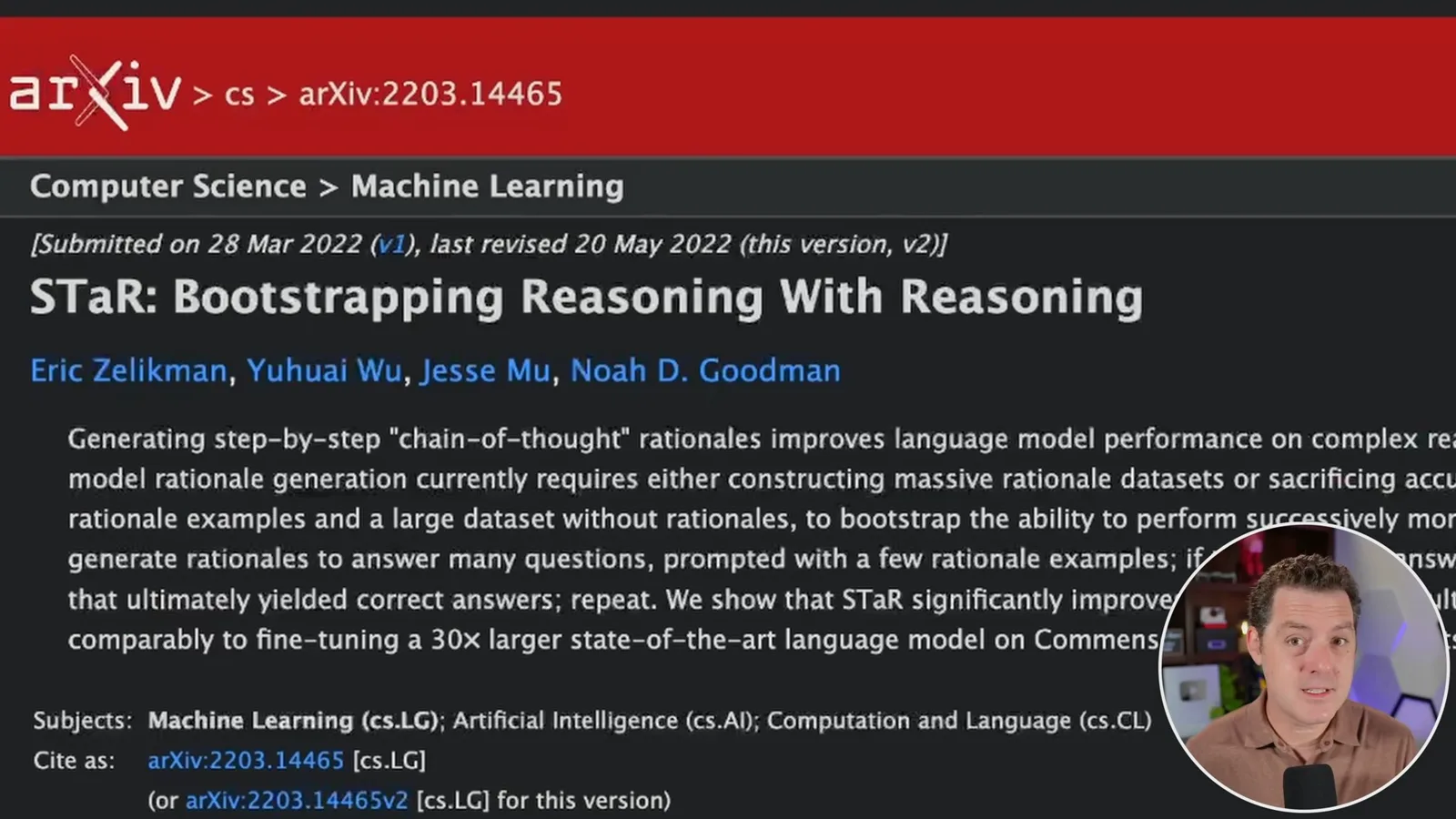
Chain-of-thought prompting asks for intermediate reasoning steps before a final answer. Berman says that approach helped on his own informal model tests and uses breaking a mathematics problem into parts as an example. Improvements depend on the task and method, and generated steps can themselves contain errors.
STaR generates candidate rationales from a small set of examples, uses the known answer to retry when needed, and fine-tunes on rationales that produced correct answers. The paper reports improvements on its evaluated datasets and a comparison on CommonsenseQA. This is supervised bootstrapping with an answer signal, not proof of unconstrained autonomous self-improvement.
The illustrated example asks what could carry a small dog: the rationale identifies a basket as an object that can hold things. Correct answers provide training examples, and a failed attempt can be regenerated with a hint. Berman sees the approach as a possible ingredient in Q*, but the connection remains conjectural.
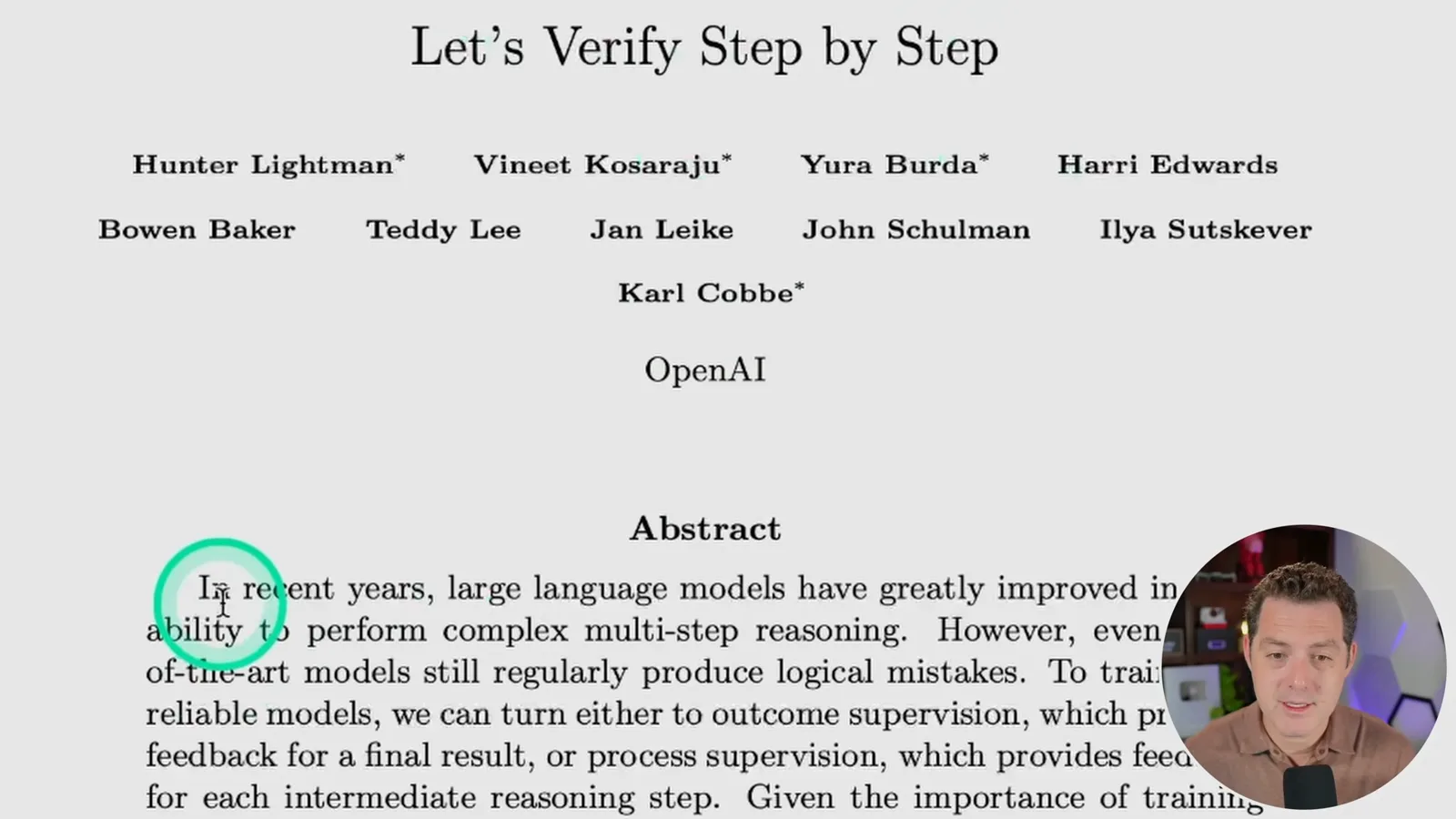
He next discusses OpenAI’s [Let’s Verify Step by Step](https://arxiv.org/abs/2305.20050), which compares feedback on final answers with feedback on intermediate steps. Its process-supervised model solved 78% on a representative subset of the MATH test set under the paper’s evaluation setup. That historical result is not a Q* score and does not establish performance on all mathematics.
Search, feedback and cryptography speculation
He discusses a speculative combination of search and reward models. Online claims about P=NP and encryption lack verified evidence.
Berman reviews researcher Nathan Lambert’s speculative account of what Q* could combine: search over reasoning steps, process reward models and synthetic data. Lambert’s suggested interpretation of the name using Q-learning and A* is a hypothesis, not evidence that the codename reveals the implementation.
The proposed search analogy draws on self-play and look-ahead planning in game systems such as AlphaGo. A system can explore candidate actions and use feedback to select them; applying such ideas to open-ended language tasks presents a different problem. No source shown proves that Q* implements the proposed combination.
Berman describes self-play as an agent improving through repeated encounters with versions of itself, and considers AI-generated feedback as a way to augment human labels. Automatic feedback may scale, but its quality and verification still matter. A second model’s critique is not automatically correct or equivalent to a reliable reward signal.
Look-ahead planning considers possible consequences of actions before choosing one. Berman mentions model predictive control and Monte Carlo tree search and contrasts them with the behavior he observed in his 2023 language-model tests. These methods have different assumptions and do not, by association, identify the architecture of Q*.
He returns to process reward models, which assess intermediate steps, and discusses Lambert’s proposed combination with search and offline reinforcement learning. The proposed pipeline is an informed speculation about possible techniques; no public evidence in the video confirms its use by the project.
Berman then speculates about cryptography, arguing that much stronger mathematical AI could threaten encryption. Improved math benchmarks do not imply that modern encryption is broken. Real attacks require a demonstrated method, assumptions and independent verification; a broad forecast of collapse is not evidence of one.
A social-media joke claims Q* proved P=NP. Berman recognizes the post as tongue-in-cheek and discusses possible consequences of a hypothetical proof. As of this discussion, it was not evidence of a proof: P versus NP remains an open problem, and even a proof of equality alone would not necessarily provide a practical attack on every cryptosystem.
He reads a purported leaked “Qualia” letter posted online, while acknowledging that its authenticity is unknown. Its claims of metacognition and cryptographic breakthroughs are unverified and should not be treated as evidence that AES was broken or that the document came from OpenAI. Berman’s interpretation of those claims cannot establish the alleged result.
World models and self-play
LeCun’s planning argument and a Karpathy excerpt explain different research ideas. Game self-play does not automatically transfer to open-ended language.
Berman turns to Yann LeCun’s criticism of online Q* speculation and his argument that more reliable systems need planning. LeCun proposes world models that predict consequences of actions, while noting that learning sufficiently general models is difficult. That is a research position, not confirmation of what OpenAI built.
Berman contrasts quick token generation with more deliberate search and compares it to a human fast-versus-slow thinking analogy. Additional inference-time computation is a research approach, but a model’s outward reasoning text does not by itself demonstrate consciousness or self-understanding. Claims about models being unable to produce anything novel are also contested.
The video returns to AlphaGo and self-play. The original AlphaGo used human games and reinforcement learning; its later successor AlphaGo Zero learned from self-play without human game data. Berman uses them to ask whether a similarly useful feedback loop can be built for language systems, while the relationship to Q* remains unknown.
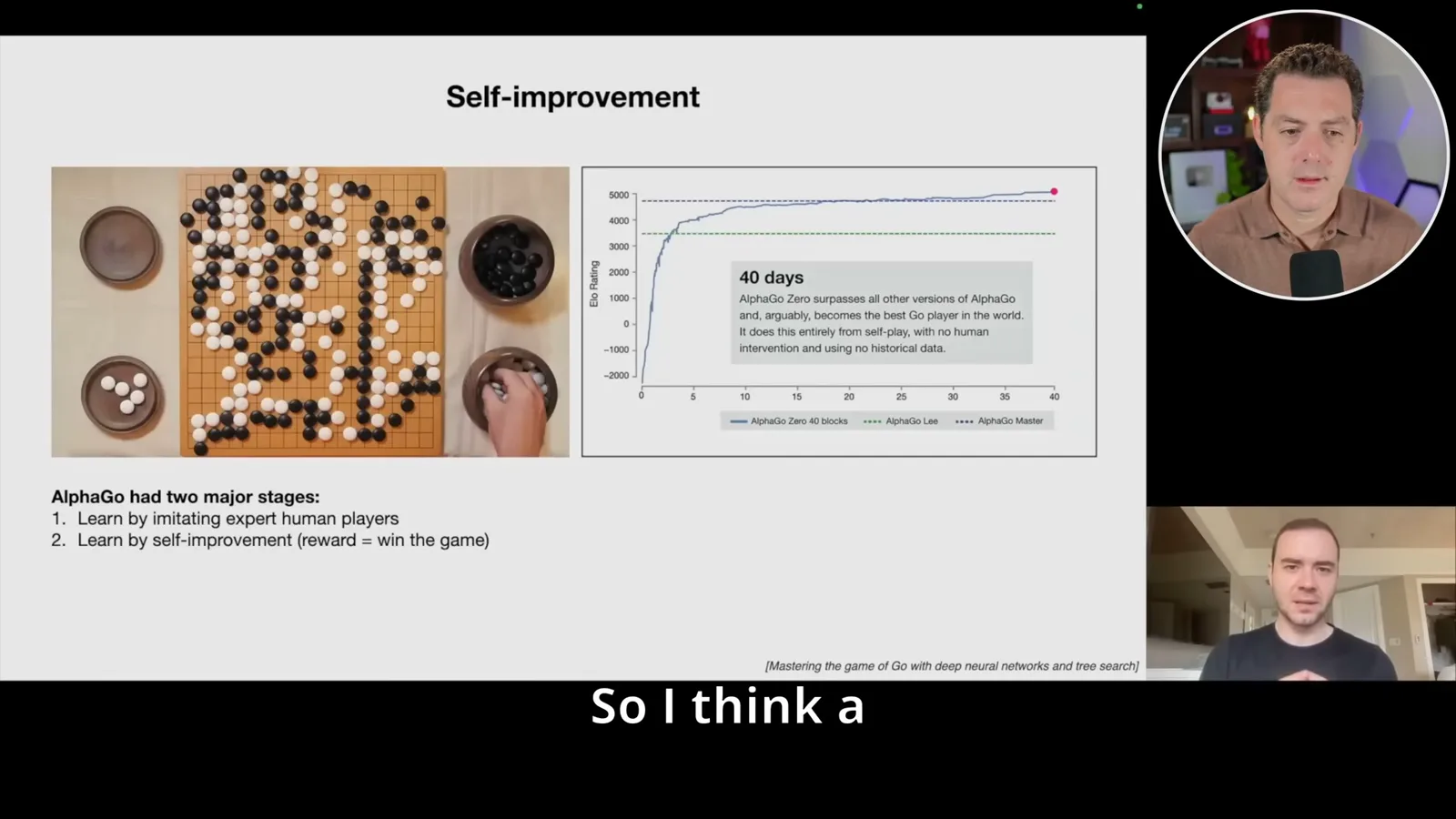
In an excerpt, researcher Andrej Karpathy explains why Go offers a comparatively clear reward: a game ends in a win or loss, so repeated self-play can be evaluated automatically. The chart shown refers to AlphaGo Zero’s 40-day training run; that is a specific game result, not a language-model benchmark.
Karpathy contrasts that setting with open-ended language tasks, where there may be no single cheap and reliable reward criterion. He suggests narrower domains may permit self-improvement while the general case remained an open research question. Berman connects the challenge to contemporary speculation about Q*.
Berman also cites Demis Hassabis’s 2023 comments about combining game-system ideas with large language models, and mentions using one agent to critique another’s code. Both are examples of approaches researchers were exploring, not verification that a particular hidden project used them or that feedback always improves results.
Synthetic data and unresolved questions
Berman considers generated training data and whether models can create novel ideas. He closes with possibilities rather than confirmed technical details.
The last possibility Berman considers is synthetic data: generating new training examples rather than relying only on collected human material. He discusses the scarcity and value of datasets, and cites a prediction that synthetic data could provide many more training tokens. The amount, diversity and quality of useful synthetic data remain empirical questions.
Berman is skeptical that a model trained on a fixed dataset can produce genuinely new ideas, though he acknowledges he may be wrong. That philosophical and empirical question cannot be settled simply by noting that a model predicts tokens. He closes by suggesting Q* might combine reasoning, self-training and synthetic data, while its actual design and significance remained unconfirmed in the video.
같은 채널의 다른 글
 34:21EN
 Matthew Berman· 2026년 10월 27일Matthew Berman Examines Anthropic’s IPO Filing, AI Growth and GovernanceMatthew Berman, Sam Altman · Forward FutureThe presenter reviews the S-1’s financial metrics, compute strategy and voting structure while questioning the tension between rapid AI development and safety.
 0:26ENMatthew Berman· 2026년 10월 25일Sam Altman on Human Values and Problem-Solving in an AI WorldSam Altman · OpenAIIn a short interview excerpt, Altman considers the enjoyment of solving hard problems and the human role in interpreting results.
 0:36ENMatthew Berman· 2026년 10월 25일Kimi K3.1 and a Rubik’s Cube Solver DemonstrationMatthew Berman · Forward FutureMatthew Berman shows a scrambled virtual cube being solved and gives the Kimi K3.1 test a favorable assessment.
 0:21ENMatthew Berman· 2026년 10월 24일An AI-Generated Kimi Benchmark Chart Used Invented ScoresMatthew Berman · Forward FutureMatthew Berman asks for a graph of Kimi K3.1 Pro benchmarks, then discovers that the displayed figures are illustrative placeholders.
 25:50ENMatthew Berman· 2026년 10월 24일Kimi K3.1 Pro Tested: Strong 3D Demos, Uneven Results and Competitive PricingMatthew Berman · Forward FutureMatthew Berman tests the open-weight model on coding, 3D rendering and visual explanations, then compares benchmark results and prices.
 32:20ENMatthew Berman· 2026년 10월 23일Who Is Local AI For? The Costs, Trade-offs and a Hybrid FutureMatthew Berman · Forward FutureMatthew Berman weighs data control and independence against hardware cost, setup complexity and inference speed.