30초 요약
In this January 2026 livestream, the hosts discuss NVIDIA’s driving research and interview Reflection AI co-founder Ioannis Antonoglou, Microsoft deputy CTO Sam Schillace and Cerebras CEO Andrew Feldman. They also debate AI companies and ChatGPT Health. Forecasts, anecdotes, commercial claims and competitive views are attributed to the speakers; they are not established outcomes.
- 1Driving researchThe hosts discuss NVIDIA Alpamayo and synthetic data, but a demonstration does not prove unsupervised driving or broad safety benefits.
- 2AlphaGo and rewardsAntonoglou compares human games, self-play and value functions with today’s model training, and explains reward hacking.
- 3Open weightsReflection AI plans to release model weights; Antonoglou distinguishes this from making all components open source.
- 4Scaffolding and human attentionSchillace says tools around models can improve their utility, but coordinating agents can create new bottlenecks.
- 5Health and privacyThe hosts discuss potential usefulness and sensitive medical-data tradeoffs. ChatGPT Health is intended to support, not replace, medical care.
- 6A vendor’s inference argumentFeldman presents Cerebras’s memory architecture and interprets NVIDIA’s Groq deal; both performance and transaction claims require context.
핵심 정리
- Antonoglou links modern AI training to AlphaGo’s combination of human examples, reinforcement learning and search, while noting reward hacking in subjective tasks.
- He advocates open-weight models and enterprise support, but open access alone does not establish a safety outcome.
- Schillace sees agent scaffolding, human oversight and organizational bottlenecks as important to adoption.
- The hosts discuss ChatGPT Health as an aid to medical conversations, not a substitute for clinical care.
- Feldman argues that inference speed and memory bandwidth matter for interactive AI; performance depends on models and workloads.
- Groq described its NVIDIA arrangement as a non-exclusive technology license, while Feldman offered his own competing interpretation.
챕터별로 다듬은 전문 읽기
Driving models and CES
The hosts return from the holiday and discuss NVIDIA’s Alpamayo, autonomous-driving approaches and synthetic data. They distinguish a demo from real-world proof.
Matthew Berman and Nick Wentz return from the holiday and introduce guests Ioannis Antonoglou of Reflection AI, Sam Schillace of Microsoft and Andrew Feldman of Cerebras. Their conversations will range from reinforcement learning and productivity to inference hardware.
Wentz recalls visiting Cerebras’s Oklahoma City data center, including its generators and battery room. The batteries bridge the brief interval before backup generators start when power fails.
Berman describes attending NVIDIA events at CES and says companies often show technology at private gatherings outside the main floor. The hosts also plan to ask Feldman about the NVIDIA–Groq arrangement; Wentz mentions that he owns Groq shares.
The first news topic is NVIDIA Alpamayo, a driving research model released with open weights and code. The hosts consider synthetic data potentially useful, but a model release or a demonstration is not proof of safe autonomous deployment.
Berman cites 1,700 hours and suggests the data is almost entirely synthetic. NVIDIA’s January 2026 announcement instead describes a released dataset containing more than 1,700 hours of collected driving data; it also released simulation tools. The announcement does not establish that this dataset is the model’s entire training mix. Berman says the Mercedes footage is a demo requiring real-world validation.
Wentz contrasts Waymo’s combination of sensors and maps with Tesla’s camera-focused approach. He wonders whether simulation could reduce the advantage of accumulated road data, though that remains an empirical question rather than a demonstrated elimination of the data advantage.
Berman describes Alpamayo as primarily vision-based and compares it with Tesla’s approach. He notes that other automakers have added lidar, and argues that vehicles using fewer sensors might be less expensive; the hosts do not establish comparative safety or actual deployment costs.
Wentz imagines a future in which more vehicles use automated driving and reduce crashes, traffic or emissions. These are potential benefits rather than measured results. Berman wonders whether coordination between vehicles could further improve traffic flow.
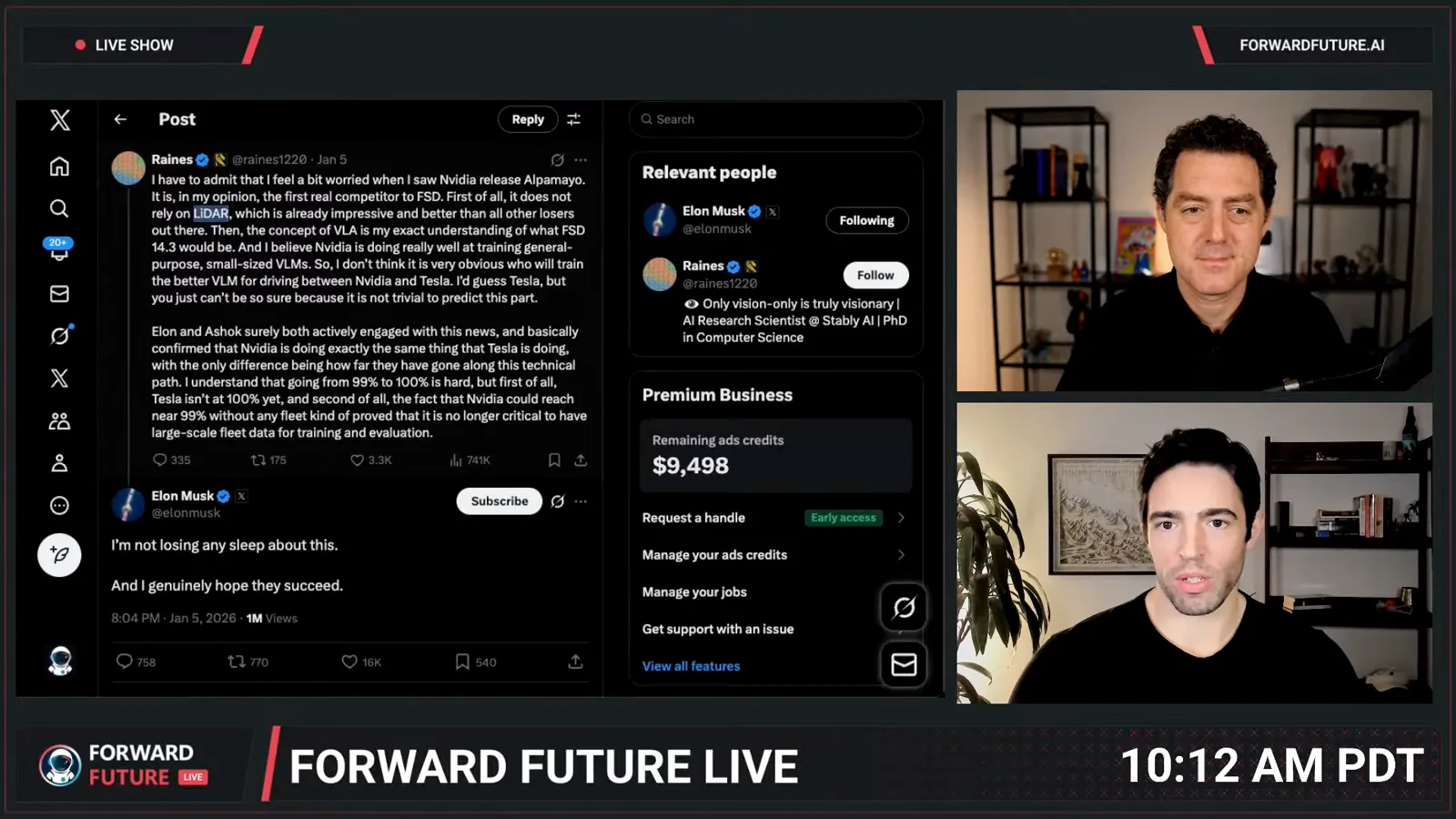
The hosts read an online opinion comparing Alpamayo and Tesla Full Self-Driving, followed by Elon Musk’s response wishing NVIDIA success. The posts express opinions and do not establish a head-to-head safety or capability result.
Berman describes an impressive rainy ride in a Tesla on winding streets and highways. He says it strengthened his confidence in vision-based systems, while a personal trip cannot establish safety across drivers, conditions or vehicles.
Reflection AI: reinforcement learning and open weights
Ioannis Antonoglou traces AlphaGo’s training and discusses verifiable rewards, open models, enterprise adoption and safety.
The hosts welcome Ioannis Antonoglou, Reflection AI co-founder, CTO and president. They ask how the field has changed since his early years at DeepMind and the developments shown in The Thinking Game.
The guest remembers DeepMind’s early team as a group of dreamers pursuing a goal many thought exceptionally ambitious. Looking back, he is struck by how much changed in roughly fifteen years.
Antonoglou recalls joining DeepMind in 2012 when the company was small and its goals felt extremely ambitious. He remembers how quickly expectations changed around AlphaGo: some experts thought professional-level Go was many years away shortly before the result was published.
He says larger models, more computation and reinforcement learning continue to improve systems. He points to progress on mathematics and software, while these examples are his assessment of capabilities, not proof that systems match top experts on every task.
Antonoglou contrasts earlier expectations with current coding agents that can work on tasks taking humans hours. These examples describe selected tasks and do not show reliable autonomous performance across all software work.
Asked about scaling limits, Antonoglou says he sees room for improvement across the stack and considers compute a major driver alongside ideas. He does not offer a guarantee that any particular scaling trajectory will continue.
Antonoglou explains that the original AlphaGo first learned to predict professional human moves. The team then used self-play and reinforcement learning to develop a value function estimating the strength of a board position, combining those components with look-ahead search.
A value function gives an estimate of how favorable a board state is. Antonoglou says AlphaGo combined predictions of promising human-like moves with a learned value estimate to look ahead through possible play.
Berman asks how reinforcement learning works without an objectively verifiable outcome, as in creative writing. Antonoglou says humans or AI judges can compare answers and provide preference feedback, though subjective judgments differ from a game’s win or loss.
Antonoglou warns that a model can exploit weaknesses in a reward model: a judge may prefer length, bullet points or another superficial feature. Human raters can have biases too, making objective evaluation particularly valuable where it is available.
The guest notes that a reward can still be constructed for subjective work through human or AI preferences. The tradeoff is that such judgments can be gamed and do not provide the same objective signal as winning a board game.
He adds that subjective tasks raise a measurement problem: even deciding what it means to be much better at creative writing is difficult. By contrast, game results and ratings provide a clearer, though task-specific, way to compare systems.
Antonoglou says he helped lead RLHF for Gemini 1.0 and co-founded Reflection AI with Misha Laskin in 2024. His bet was that reinforcement learning would be a major complement to pretraining in building more autonomous systems.
Reflection began with a bet that pretraining alone would not solve the full problem. Antonoglou views scaled reinforcement learning as a route toward more capable agents, while presenting that claim as his research outlook.
He describes meeting Laskin while looking for someone to lead reward-model work on his Gemini team. Their collaboration on verifiers and reward models led them to start Reflection AI together.
Antonoglou distinguishes open weights from full open source: releasing weights does not necessarily disclose the entire training process and supporting materials. He argues that sharing models can support research, broader access and an open infrastructure layer.
He says open research historically helped the field exchange and build on ideas. He also wants advanced models to be accessible to researchers and users beyond a small set of companies.
Asked about the gap between open and closed models, he estimates six months to a year and predicts the gap could narrow within one or two years. These are his January 2026 estimates and forecasts, not a verified universal ranking.
Antonoglou attributes part of the gap he perceives to differences in resources and compute, and predicts a stronger US open-weight frontier. His account reflects the position of a company building in that market.
Antonoglou argues that sustaining open-weight models requires a compatible commercial strategy. He says Reflection intends to serve enterprise and sovereign customers and offer hosted endpoints so users can try its models.
He argues that a company releasing weights still needs revenue to finance continued research. Reflection plans hosted access and says it is working with partners, although he does not disclose all planned arrangements.
The hosts cite an MIT-linked estimate about enterprise AI adoption. That figure comes from a limited study and is not a census of all implementations. Antonoglou says the practical gap often lies between a model’s capabilities and an organization’s ability to turn them into a working end-to-end solution.
Antonoglou says a model or an API alone may not give a business the skills needed to create value. Providers can help customers integrate the tools into workflows and understand where they do and do not work.
Berman suggests company culture and iterative experimentation matter. Antonoglou agrees that even technically capable enterprises may need providers to help integrate models, understand limitations and deploy useful workflows.
On safety, Antonoglou acknowledges the argument for concentrating access but favors open research, saying wider scrutiny can expose blind spots. His view is a policy argument; broad access can also introduce misuse risks, and openness alone does not prove a model is safer.
He compares open models to open software, where many researchers can look for weaknesses. The comparison is his argument; AI weight releases also raise different questions about misuse and control.
After the interview, the hosts reflect on The Thinking Game and DeepMind’s work on StarCraft and games. They see the examples as reminders that progress may follow repeated experimentation, rather than evidence that reinforcement learning guarantees success on every problem.
Berman recalls the game Black & White and the hosts discuss simulated characters in Theme Park. Their anecdotes connect earlier game AI with the research ambitions that later drew them to DeepMind’s work.
Microsoft: documents, agents and productivity
Sam Schillace recalls early Google Docs and argues for experimentation with AI. He discusses scaffolding, workflow bottlenecks, skills and software economics.
The hosts introduce Sam Schillace, Microsoft’s deputy CTO and a co-founder of Writely, which became part of Google Docs. Schillace says he still has the first document, though the underlying application has been rewritten and migrated over the years.
Schillace says the key early problem was making shared documents easier than emailing files or locking them on a file server. Building reliable collaboration took months because browsers and JavaScript tooling were immature.
Schillace recalls that concurrent editing could not use a simple last-write-wins approach without participants overwriting one another. The team had to solve coordination as well as build the initial web interface.
The team started around 2005 with JavaScript in the browser and a C# server. Schillace says the concept looked obvious only in retrospect: users and developers initially questioned both browser applications and cloud-stored documents.
At the time, users had to learn several unfamiliar concepts at once: a document could be a web application, editable by several people, with data stored elsewhere. Schillace says that experience shaped how he evaluates technological change.
Asked what people may underestimate today, Schillace points to generative AI. He argues that a habit of asking only why a technology cannot work can obscure what becomes possible as the technology improves.
Berman asks why coding has changed faster than many other fields. Schillace says the web also took years to mature and that AI tools, infrastructure and practices are still developing. Code is especially accessible because it is language-based and connects naturally to files and APIs.
Schillace sees programming as unusually well suited to current models because languages and tools are already structured and accessible. He expects improvements to integration and practice in other fields, without specifying that those transitions are inevitable.
Schillace describes Microsoft’s open Amplifier project and a product manager who used it to coordinate a small survey, analyze results and draft a research document during a flight. This is his anecdote about a particular workflow, not a verified assessment of the research quality.
He says he also uses the tool to build HTML presentation decks. Berman recounts a startup founder who began implementing a requested feature during a customer conversation, illustrating the potential for rapid iteration.
Schillace describes another engineer producing many changes with AI tools and argues that some developers now generate substantially more output. A count of changes alone does not establish quality, productivity or reliability.
Asked whether better models or better tools matter most, Schillace emphasizes scaffolding: control planes, work patterns and recipes that combine code with model calls. His research team uses existing models and explores the additional leverage surrounding tools can provide.
His team calls some reusable combinations of control code and model behavior recipes. The surrounding system can manage how work proceeds while a model performs individual tasks.
On collaboration, Schillace expects humans to remain involved. He describes running multiple coding sessions in parallel, including an application the system reported as successfully tested, but says he still needs time to inspect and evaluate the result.
He says even an agent that believes it has succeeded can leave the human with substantial validation work. More parallel sessions can increase the amount of output awaiting review, not just the amount produced.
The hosts ask whether agents can review one another to relieve human bottlenecks. Schillace expects hierarchical coordination to grow, but says the cases escalated to a human may be harder, and complexity does not simply disappear.
For organizations outside engineering, Schillace recommends finding internal champions and improving one bottleneck at a time. Speeding up most of a workflow has limited effect if another step still constrains the whole system.
Schillace advises examining the workflow as a system rather than assuming local speedups automatically improve end-to-end results. The next bottleneck may move as other parts of the organization adapt.
He expects AI-native startups may have advantages, while older organizations also need approaches for existing systems. He describes teams experimenting with agent-generated code and reviewing the surrounding system rather than every line.
Schillace compares treating code as output to earlier layers of programming abstraction. He says he personally builds more with these tools than in the past, but this observation is not a general measurement of productivity across engineering teams.
For students, his practical advice is to use the tools and build things. He considers design, clear specifications, higher-level reasoning and thinking about the desired outcome increasingly valuable.
Drawing on the personal-computer and early-web eras, he urges newcomers to experiment hands-on rather than accept established practitioners’ skepticism as conclusive. That does not make every new tool or claim correct.
He says he now spends more time reflecting on goals and organization before starting work. If generated code fails, he may ask the system for a postmortem and start again rather than preserving the implementation.
Schillace predicts that some software will become lighter and more specialized, with durable intent and specifications outliving individual generated implementations. This is a forecast, not evidence that maintainable applications or human review are obsolete.
He likens a durable specification to source code and individual generated implementations to compiler output. His proposed future makes changing or discarding an implementation easier, provided the intended behavior remains explicit.
He also notes that AI features have per-use inference costs, so their value must justify the expense. His comparison with traditional software is a simplified economic model; conventional services also have operating and support costs.
Asked about Satya Nadella’s view that agents could absorb much of the application layer, Schillace agrees that behavior may migrate to agents but says user habits and the necessary scaffolding make the outcome uncertain.
Schillace describes generating single-file HTML presentations from a conversation and its context. He says the industry has not yet settled on the right user experiences, comparing today’s stage to the early web.
Discussing software-as-a-service, he argues that dependable back-end services, data management, rollback and compliance may remain valuable even if users can generate more of their own interfaces. Safe and compliant operation would need to be designed and verified, not assumed.
He imagines users creating customized interfaces on reliable shared services. In his view, safeguards such as rollback and compliance controls would become part of the product value beneath those interfaces.
Schillace says the pace of new models and tools is exciting but exhausting. He identifies with developers who feel they have been perpetual early adopters for several years and says burnout is understandable.
Schillace says the rapid release cadence can feel like constantly falling behind despite sustained effort. He considers both the excitement and fatigue a real part of the current moment.
Wentz asks about public skepticism and fear of AI, including a film-school anecdote. Schillace compares it to the polarized response to early cloud documents and hopes useful, accessible tools will help people see value; skepticism can also reflect substantive concerns.
After the interview, the hosts describe themselves as optimistic about AI while acknowledging concerns about rollout and inequality. They then move to a speculative comparison of AI businesses.
AI company outlook and health
The hosts compare speculative business cases, prediction markets and ChatGPT Health. They discuss personal health data and clinical assistance.
Berman compares OpenAI, Anthropic and xAI as hypothetical investments and says he holds shares in none. The discussion is opinion rather than investment advice; he weighs distribution, product focus, funding needs and competition.
OpenAI’s scale and consumer distribution are important to Berman’s analysis, while a wide range of simultaneous products could be either an asset or a distraction. He emphasizes that his comparison is speculative.
He views Anthropic’s coding focus as both a strength and a risk if competitors saturate the same market. He sees xAI’s rapid infrastructure buildout as a strength, while questioning its enterprise adoption and relative model standing.
For xAI, Berman points to the speed with which the company built data-center capacity and developed models. He also says he hears less about its enterprise use than about some competitors, which is anecdotal rather than a market survey.
Wentz notes that Google and Microsoft have other large businesses that can fund AI investment, unlike the three companies in his question. The hosts debate whether OpenAI’s broad product ambitions could spread its resources too thin.
Berman says he would choose OpenAI because he uses ChatGPT regularly and believes a broad portfolio could create valuable businesses. That is a personal hypothesis, not a forecast of future returns.
Wentz points out that the question concerns privately financed AI companies rather than companies with substantial established revenue streams. Their financing and ability to sustain multiple product lines are part of the hosts’ debate.
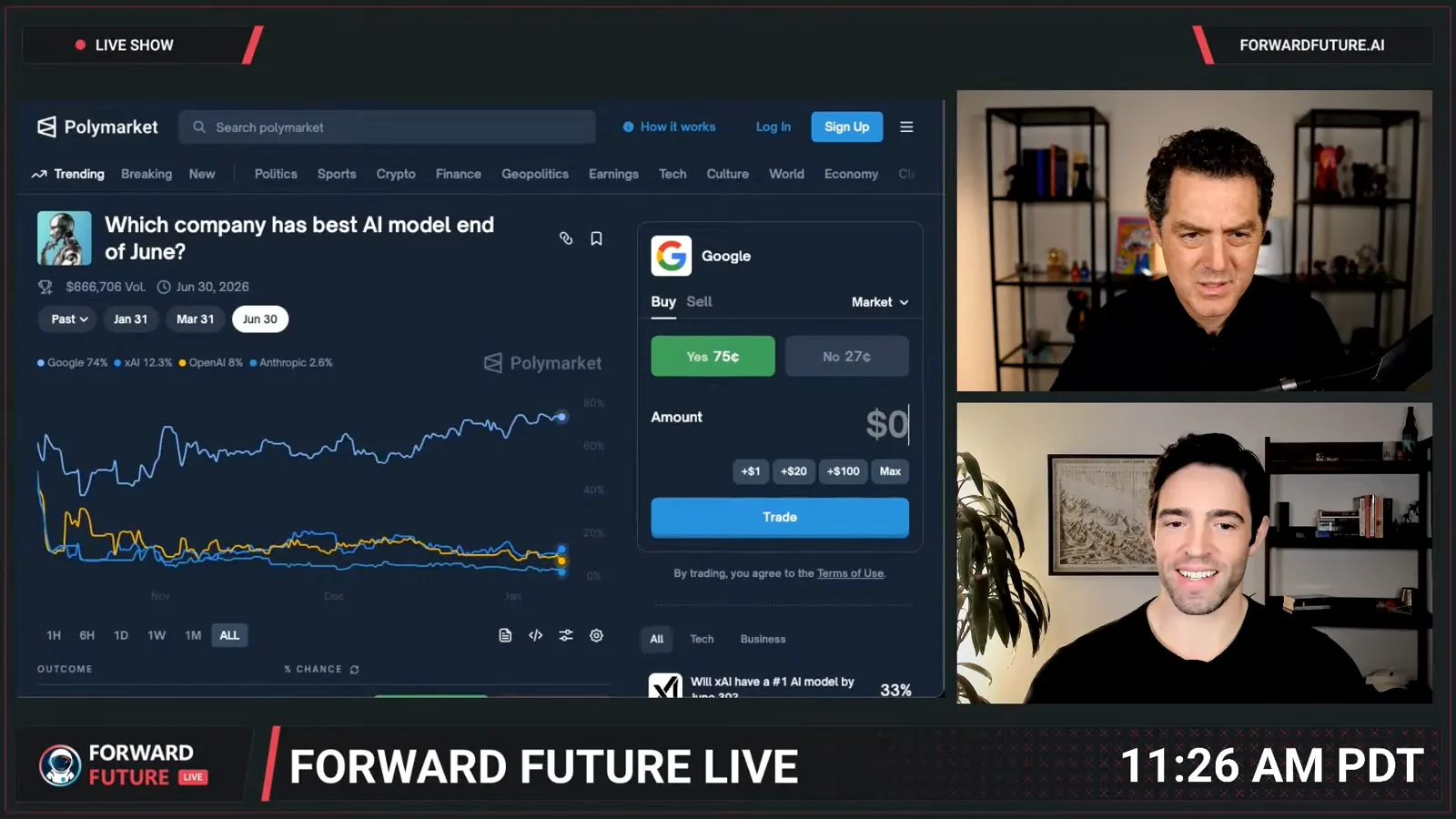
The hosts inspect a Polymarket contract about which company will lead a particular model leaderboard by the end of June. They observe that prices change with news, and a prediction market reflects traders’ expectations rather than a direct measurement of general intelligence.
They discuss how human preference voting shapes an arena leaderboard and how a model can be optimized for evaluation conditions. Neither a single leaderboard nor a market price determines the best model for every use case.
The hosts question whether a single benchmark can identify the best model. They recognize that usefulness depends on the task and that human preference rankings and benchmark scores capture different aspects of performance.
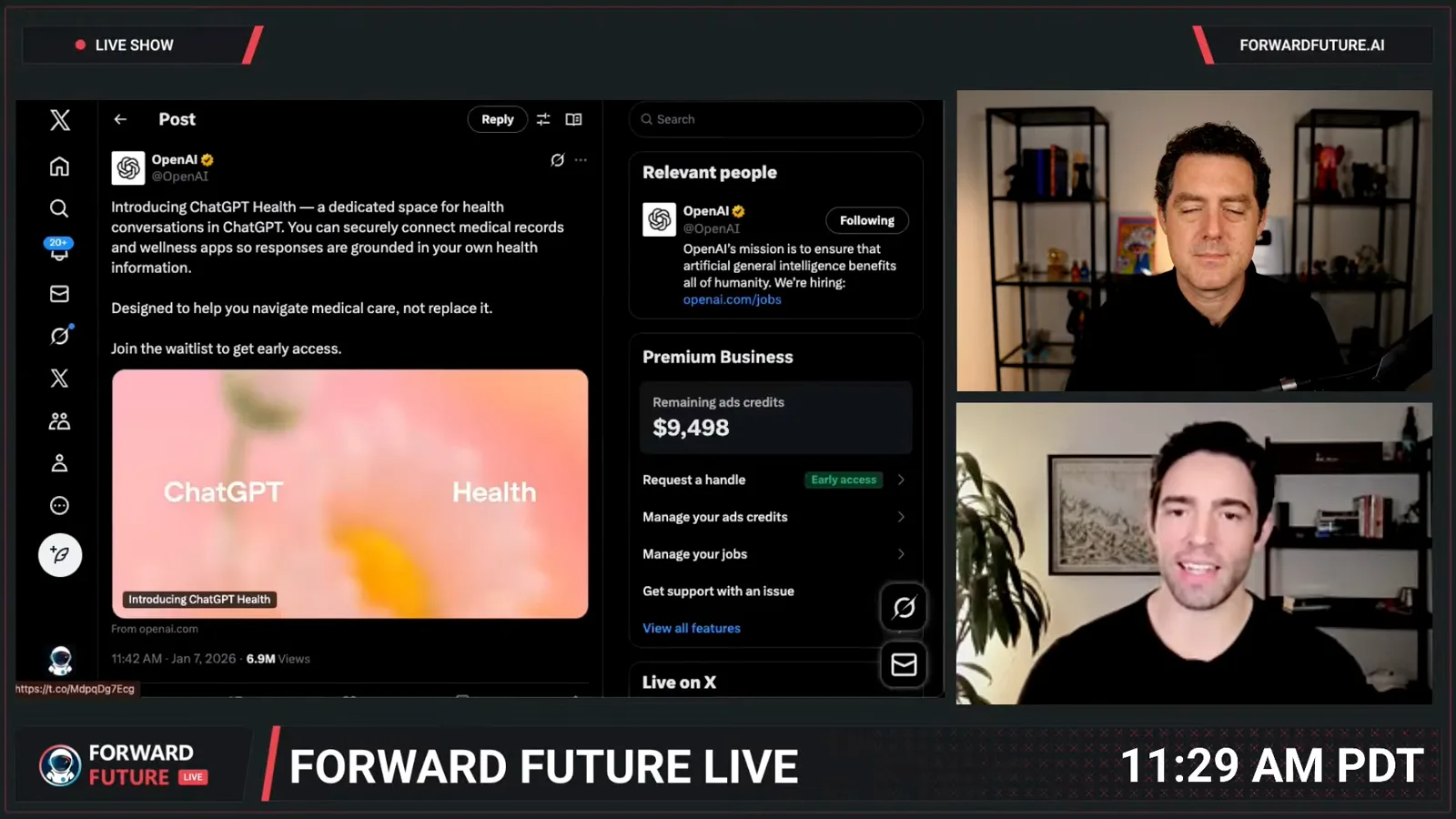
The next story is ChatGPT Health. Berman says he has just gained access and describes friction while trying to connect his records. OpenAI presents Health as a way to support health conversations and prepare for care, not as a replacement for medical professionals.
Wentz is conflicted about sharing sensitive information and recalls wishing he had considered privacy more carefully before using a genetic-testing service. He also sees potential in tools that help patients prepare questions for clinicians.
Wentz sees potential in a tool that can help people understand results and prepare for appointments, while recognizing that sharing medical data involves sensitive privacy decisions. His personal experience does not establish how any provider handles all data.
Berman says he uses AI to help explain test results before talking with his doctor, not instead of that conversation. He imagines reminders and more personalized preventive support, but those examples are aspirations rather than proven clinical outcomes.
Berman imagines prompts to schedule checkups or follow up on an older blood-test result. Those are examples of a hoped-for assistant, not a demonstration that the product independently monitors all records or provides reliable medical advice.
The hosts return to the importance of asking informed questions and navigating care. AI explanations can be wrong, and the video’s hopes for proactive support should not be mistaken for evidence of diagnosis or a substitute for medical judgment.
Cerebras: speed, chips and energy
Andrew Feldman discusses inference, wafer-scale hardware, the NVIDIA–Groq arrangement and the power required for data centers. His competitive and regulatory claims are his own.
The hosts welcome Andrew Feldman, founder and CEO of Cerebras, and recall visiting the company’s Oklahoma City data center. They ask about its large-chip approach and the role of inference speed.
Feldman reports new data-center deployments and claims Cerebras provides the fastest inference across models. As a vendor claim, that broad comparison needs model-specific, hardware-specific and workload-specific benchmarks.
He gives a coding example in which a prompt produces a simple game quickly. A short generated demo may be useful, but its speed does not establish correctness, security or performance on larger software projects.
Berman describes himself as a speed enthusiast but says quality should not be sacrificed. Feldman compares faster inference with faster internet enabling new services: his argument is that reduced latency can change the kinds of applications people build.
Feldman recounts praise for an interactive coding setup using Cerebras infrastructure and says responsiveness creates a tangible user experience. The testimonial is an anecdote rather than an independently controlled benchmark.
Feldman says memory movement motivated Cerebras’s architecture. He uses a 70-billion-parameter model at 16 bits per weight as an illustration of approximately 140 GB of weights; actual memory traffic and throughput depend on precision, batching, caching and implementation.
He explains that Cerebras places substantial memory near compute on a large piece of silicon. That does not mean all model data is always held on one wafer: system design and workload determine how memory and external resources are used.
The hosts ask about NVIDIA and Groq. Feldman interprets the deal as evidence that NVIDIA needed help with fast inference. That is a competitor’s interpretation, not an established statement of NVIDIA’s motives.
Feldman calls NVIDIA’s dominant position a mental moat and argues that moving certain inference workloads to Cerebras’s cloud can be simple. CUDA and software portability vary by workload; his short migration example does not establish that every application can be moved as easily.
He distinguishes training, which produces models, from inference, which runs them. He expects inference demand to grow with the number of users, frequency of use and compute per request; the relative mix and economics remain uncertain.
He models demand as users multiplied by usage frequency and compute per use. This framework explains a possible source of growth, but each input can change independently and model size alone does not determine inference cost.
Feldman argues that memory bandwidth constrains GPU inference and claims specialized hardware can deliver speed advantages. Comparisons depend on the model, batching, service conditions, latency and cost, so his broad claims should not be read as universal benchmarks.
Asked whether GPUs are merely transitional, he says they still have value for training, high-performance computing and batch inference where immediate response is less important. He predicts specialized hardware will be strong in fast interactive use.
The hosts raise high-bandwidth-memory prices and supply. Feldman says Cerebras does not use HBM and expects supply pressure to persist; he cautions that forecasting memory markets is difficult.
He says constraints in memory supply can advantage a competitor that uses a different memory architecture. The broader market effect also depends on procurement, deployment and the design of each system.
The hosts ask about the structure of the NVIDIA–Groq deal. Groq’s December 2025 announcement described a non-exclusive inference-technology license and said some leaders and employees would join NVIDIA while Groq continued operating. Feldman calls it effectively an acquisition and suggests regulatory avoidance; those characterizations and his numerical staffing and tax claims are not established by the public announcement.
Feldman claims a large fraction of Groq’s people moved and treats the deal as an acquisition in substance. Those numbers and his interpretation should be distinguished from the companies’ disclosed licensing arrangement.
Feldman argues that complex deal structures can disadvantage shareholders and calls for more targeted, less burdensome oversight. These are his views about the transaction and regulatory process, not a legal or tax conclusion.
On energy, Feldman says the United States has substantial energy resources but underinvested in the grid and fiber connections needed to bring power and data to facilities. He cites remote natural-gas and hydro resources as examples.
He describes behind-the-meter generation, where a data center produces electricity on site, often using natural gas. He also says the industry should communicate better with local communities about construction jobs, noise, operating jobs and other effects.
He acknowledges that large data centers can be noisy, create many construction jobs and employ fewer people after completion. He thinks community engagement should improve when proposing facilities.
Asked about nuclear power, Feldman favors it for long-term generation and is optimistic about small reactors. Costs, safety, construction timelines and waste management depend on the project and technology; his prediction is not a guarantee of cheap or rapid deployment.
The Genesis Mission and practical use
Feldman describes a US science and AI initiative and argues that usefulness drives adoption. The hosts close the show.
Feldman describes the US Genesis Mission, led through the Department of Energy, as an effort to coordinate government laboratories and industry around AI-enabled scientific progress and national priorities. He sees Cerebras’s participation as an opportunity to support researchers.
The Department of Energy oversees national laboratories and major computing resources, making it a natural organizer in Feldman’s account. He describes collaboration among federal research leaders and private-sector companies.
He says the mission aims to connect government resources, national laboratories and industry rather than leave related efforts fragmented. His description presents the initiative’s ambitions, not verified evidence that its scientific goals have already been achieved.
Asked how to build public enthusiasm, Feldman argues that people adopt technology when it improves practical work and daily life. He points to agents that search literature and the possibility of reducing tedious data transfers between business systems.
Feldman argues that transferring data between enterprise systems consumes workers’ time and that automation may reduce repetitive tasks. How much time is saved, and whether systems operate safely, requires measurement in each workflow.
He imagines the aggregate productivity impact if workers regained time each day, alongside more ambitious scientific applications. The illustrative arithmetic is a scenario, not evidence of measured economy-wide savings.
Feldman compares adoption with mobile payments becoming useful to people across different ages and circumstances. He believes usefulness can change perceptions of AI, while the hosts acknowledge the broader question of public trust.
The hosts thank Feldman and the other guests, close the January 9 show and invite viewers to follow Forward Future. The discussion leaves open questions about model evaluation, deployment risks, infrastructure economics and real-world outcomes.
같은 채널의 다른 글
 34:21EN
 Matthew Berman· 2026년 10월 27일Matthew Berman Examines Anthropic’s IPO Filing, AI Growth and GovernanceMatthew Berman, Sam Altman · Forward FutureThe presenter reviews the S-1’s financial metrics, compute strategy and voting structure while questioning the tension between rapid AI development and safety.
 0:26ENMatthew Berman· 2026년 10월 25일Sam Altman on Human Values and Problem-Solving in an AI WorldSam Altman · OpenAIIn a short interview excerpt, Altman considers the enjoyment of solving hard problems and the human role in interpreting results.
 0:36ENMatthew Berman· 2026년 10월 25일Kimi K3.1 and a Rubik’s Cube Solver DemonstrationMatthew Berman · Forward FutureMatthew Berman shows a scrambled virtual cube being solved and gives the Kimi K3.1 test a favorable assessment.
 0:21ENMatthew Berman· 2026년 10월 24일An AI-Generated Kimi Benchmark Chart Used Invented ScoresMatthew Berman · Forward FutureMatthew Berman asks for a graph of Kimi K3.1 Pro benchmarks, then discovers that the displayed figures are illustrative placeholders.
 25:50ENMatthew Berman· 2026년 10월 24일Kimi K3.1 Pro Tested: Strong 3D Demos, Uneven Results and Competitive PricingMatthew Berman · Forward FutureMatthew Berman tests the open-weight model on coding, 3D rendering and visual explanations, then compares benchmark results and prices.
 32:20ENMatthew Berman· 2026년 10월 23일Who Is Local AI For? The Costs, Trade-offs and a Hybrid FutureMatthew Berman · Forward FutureMatthew Berman weighs data control and independence against hardware cost, setup complexity and inference speed.