30초 요약
Matthew Berman and Nick Wentz cover AI news, then interview Emily Glassberg Sands about agentic commerce, Eric Simons about Bolt and AI coding, and Matt Hicks about open source and inference. They also conduct a playful comparison of generated videos. Company statistics, product descriptions and forecasts are attributed to their speakers, and the historical news is presented in its 2025 context.
- 1Commerce inside AI interfacesSands explains the Agentic Commerce Protocol and Shared Payment Tokens, while the hosts ask about manipulation and spending risks.
- 2Interpreting Stripe’s scalePayment volume compared with GDP is not itself a measure of Stripe’s share of value added.
- 3Bolt’s professional focusSimons describes agent orchestration, infrastructure and the company’s commercial claims; successful production use still requires verification.
- 4A playful video comparisonThe hosts vote on selected clips from several video models, with no claim of a systematic benchmark.
- 5Inference and many modelsHicks argues smaller specialized models and efficient infrastructure will remain important alongside frontier systems.
- 6Open weights and collaborationHicks distinguishes challenges at the pretraining layer from collaboration on datasets and specialized models.
핵심 정리
- Agentic checkout needs both payment security and defenses against manipulation of the agent’s instructions.
- Stripe compares transaction volume with world GDP; transaction volume is not the same as economic value added.
- Simons sees AI coding broadening participation while retaining a role for engineering review; his company’s growth and deployment figures are self-reported.
- The video comparison uses selected clips and subjective preferences, not a controlled model benchmark.
- Hicks expects many specialized models and emphasizes reliable, cost-efficient inference across cloud, on-premises and edge systems.
- Open weights do not necessarily include all the components or rights associated with open-source software.
챕터별로 다듬은 전문 읽기
Sora, coding and AI news
The hosts discuss Sora 2, Claude Sonnet 4.5 and speculation about Gemini. The dates and model claims reflect the 2025 broadcast.
On October 3, 2025, Matthew Berman and Nick Wentz introduce three guests: Stripe’s Emily Glassberg Sands on agentic commerce, Bolt CEO Eric Simons on AI development, and Red Hat CEO Matt Hicks on open source and inference. The news and product availability discussed reflect that date.
The hosts begin with OpenAI’s Sora 2 launch and its then invite-only app. They enjoy generated blooper videos and the ability to remix a clip with new prompts.
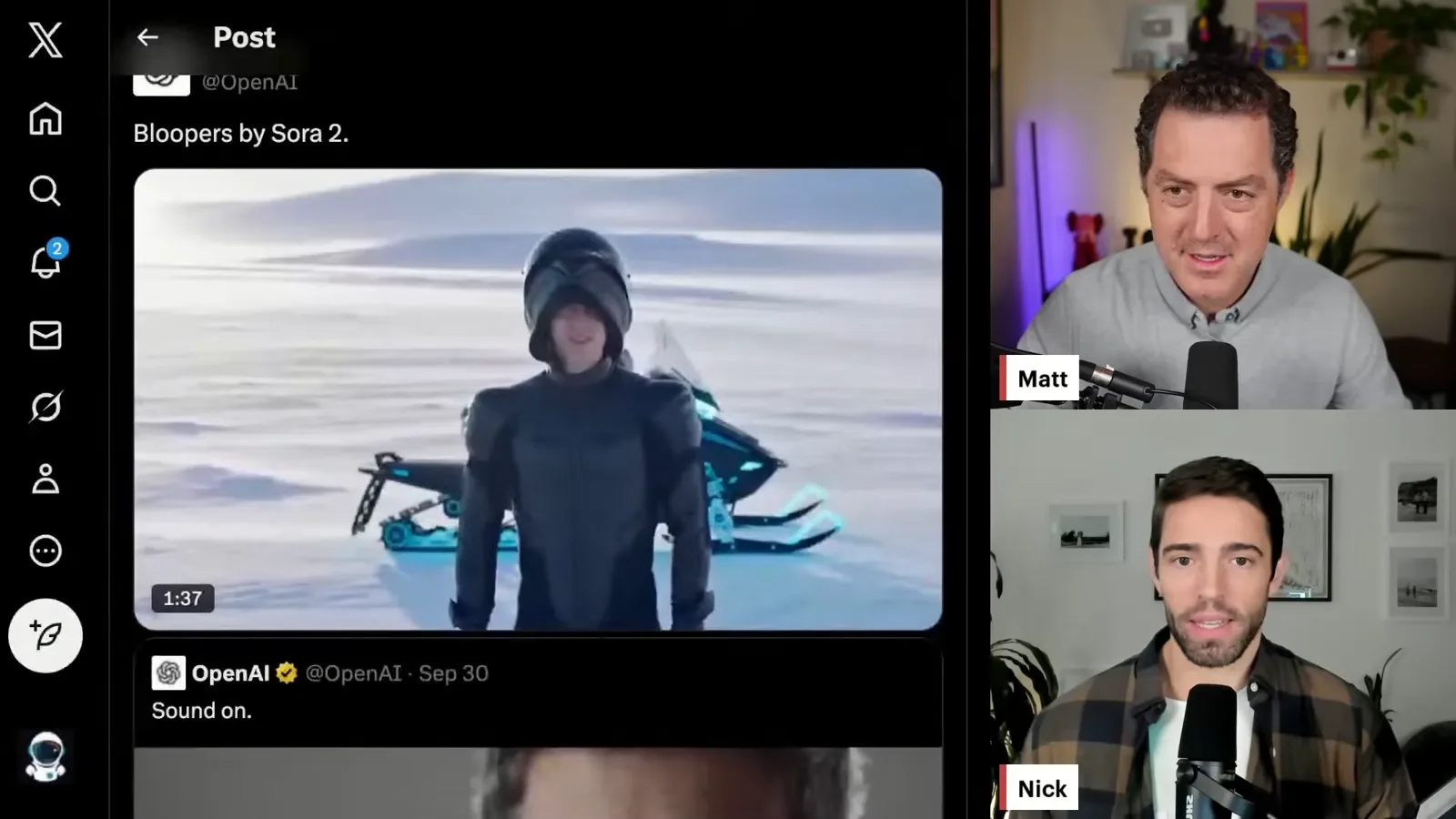
Berman suggests creative products can attract users and revenue while a lab pursues longer-term goals; that is his interpretation of the business.
They turn to Claude Sonnet 4.5. Berman first describes a 30-hour coding workflow as model thinking without an agent framework, then corrects himself that agent capabilities may be involved.
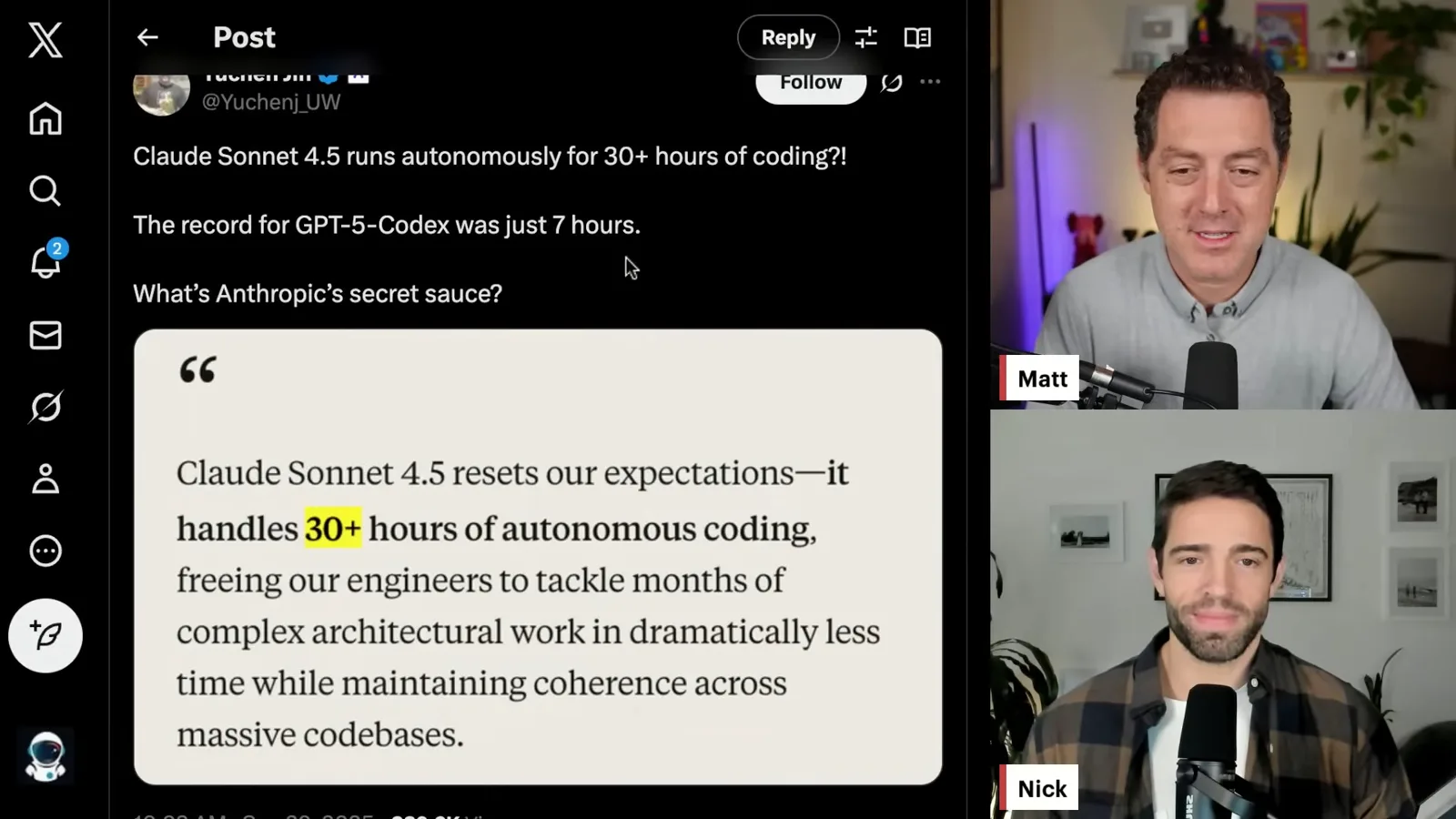
Anthropic’s launch quotes a customer describing 30-plus hours of autonomous coding; that is a specific customer claim, not evidence of uninterrupted unaided model reasoning or a universal success rate.
The hosts discuss efficiency and the value of measuring useful output as well as run time.
They also speculate about Gemini 3 release timing. Wentz’s October 28 guess is a prediction made during the 2025 show, not a confirmed launch date.
Emily Glassberg Sands on agentic commerce
The Stripe executive explains payment tokens, merchant integration and fraud signals. The hosts ask about prompt injection, spending, discovery and employment.
Stripe head of data and AI Emily Glassberg Sands joins to discuss Instant Checkout and the Agentic Commerce Protocol, developed with OpenAI.
She says the initial US rollout allowed purchases from US Etsy sellers in ChatGPT and anticipated Shopify support. These were historical launch arrangements, not a guarantee of current availability.
Sands says Stripe provides checkout, payments and fraud tools, and describes a Shared Payment Token that enables a payment without exposing underlying payment credentials to the agent.
The protocol aims to let merchants present catalogs and checkout flows to compatible agents and payment providers.
She names AI and platform partners and says established marketplaces can give smaller merchants a path into agentic commerce.
She adds that payment infrastructure can serve both checkout within an AI interface and agents visiting merchant sites.
Berman raises prompt injection with an example asking an assistant to buy expensive candles.
Sands says model-side resistance to instructions embedded in content is the model provider’s responsibility. Stripe’s payment token limits credential exposure, but this does not by itself prevent a manipulated or unauthorized purchase.
The hosts press on how such a purchase could be induced.
Sands says she would need to work through the scenario and describes Link’s one-click flow and other payment options. The conversation does not establish that the attack is impossible or that every transaction happens without user authorization.
Sands says fraud detection must distinguish legitimate agents acting for customers from malicious bots, instead of blocking every bot.
She describes fraud signals that Stripe can share with other payment processors and Stripe Radar screening for its own merchants. These are Stripe’s descriptions of its design, not a guarantee against fraud.
Sands confirms the hosts’ 2024 figure comparing Stripe payment volume to roughly 1.3% of world GDP and says Stripe businesses grew faster than the S&P 500.
Payment volume is a transaction-flow comparison, not Stripe’s share of world production or a direct contribution to GDP; the growth figure is a company comparison, not evidence of causation.
Asked why merchants grow quickly, Sands identifies selection effects: Stripe serves many digital businesses and fast-growing AI companies.
She also argues its payment methods, billing and global reach help customers grow, while acknowledging the comparison is not entirely causal.
For traditional enterprises she highlights checkout optimization, payment methods, currency conversion, combining online and in-person data, and new subscription or usage-based products.
Her claimed conversion improvements are Stripe’s business claims and are not a guarantee for every merchant.
Asked how commerce could change, Sands emphasizes that the market is early.
Her team is building standardized interfaces for product data, payment and fraud checks while remaining responsive to changing agent capabilities.
Without speaking as a product commitment, she imagines an assistant handling back-to-school shopping using children’s sizes, preferences and a budget.
For developers, she imagines buying and integrating tools within the coding environment, with transparent charges.
Berman asks whether making payment frictionless could encourage overspending or debt.
Sands says she has thought less about credit, and predicts that wealthy consumers may spend more if the time cost of shopping falls. Her prediction about consumption and GDP is speculative and does not resolve the overspending concern.
On small businesses, Sands argues that agents could help shoppers discover niche sellers, using an Etsy artist in her family as an example.
Wentz asks whether larger companies’ resources still give them an advantage. Sands says open interfaces and existing marketplaces could reduce integration barriers, though equal discovery is not guaranteed.
Berman asks whether agents will separate people from the websites they once browsed.
Sands anticipates both human-facing and agent-facing experiences, pointing to MCP and Stripe’s development sandboxes as examples. She also expects AI services’ inference costs to change how businesses charge customers.
The hosts ask if agents could pay publishers small amounts for content.
Sands says card fees have historically made very small transactions difficult and suggests wallets, stored balances or stablecoins might change the economics. These are potential designs, with costs and user authorization still important.
Sands describes usage-based and hybrid billing: a fixed subscription can provide predictable entry and revenue, while usage charges reflect variable demand and model costs.
She also describes a Stripe API for businesses to add a markup to underlying model costs as prices change.
Asked about employment, Sands expects judgment, good questions and collaboration to become more valuable alongside technical skills.
She is concerned about entry-level pathways and mentorship. Her own team was hiring more new graduates, largely PhDs, but this is one employer’s experience and does not settle the broader labor-market outcome.
After she leaves, the hosts interpret their interviews as suggesting a transition in work rather than wholesale replacement.
They acknowledge examples such as a young intern hired for AI skills; these anecdotes are not representative labor-market data.
More technology and policy news
The hosts discuss AI browsers, Tinker, a reported OpenAI valuation and California SB 53. They distinguish their opinions from the announcements.
In the next news segment, the hosts discuss a proposed Grokipedia and the difficulty of removing bias from any model or knowledge source. They also describe trying Perplexity’s Comet browser and Claude for Chrome but say neither has yet become a daily habit for them.
They summarize Thinking Machines Lab’s Tinker as a Python-based service intended to make model fine-tuning easier without managing all infrastructure, while giving researchers control over algorithms.
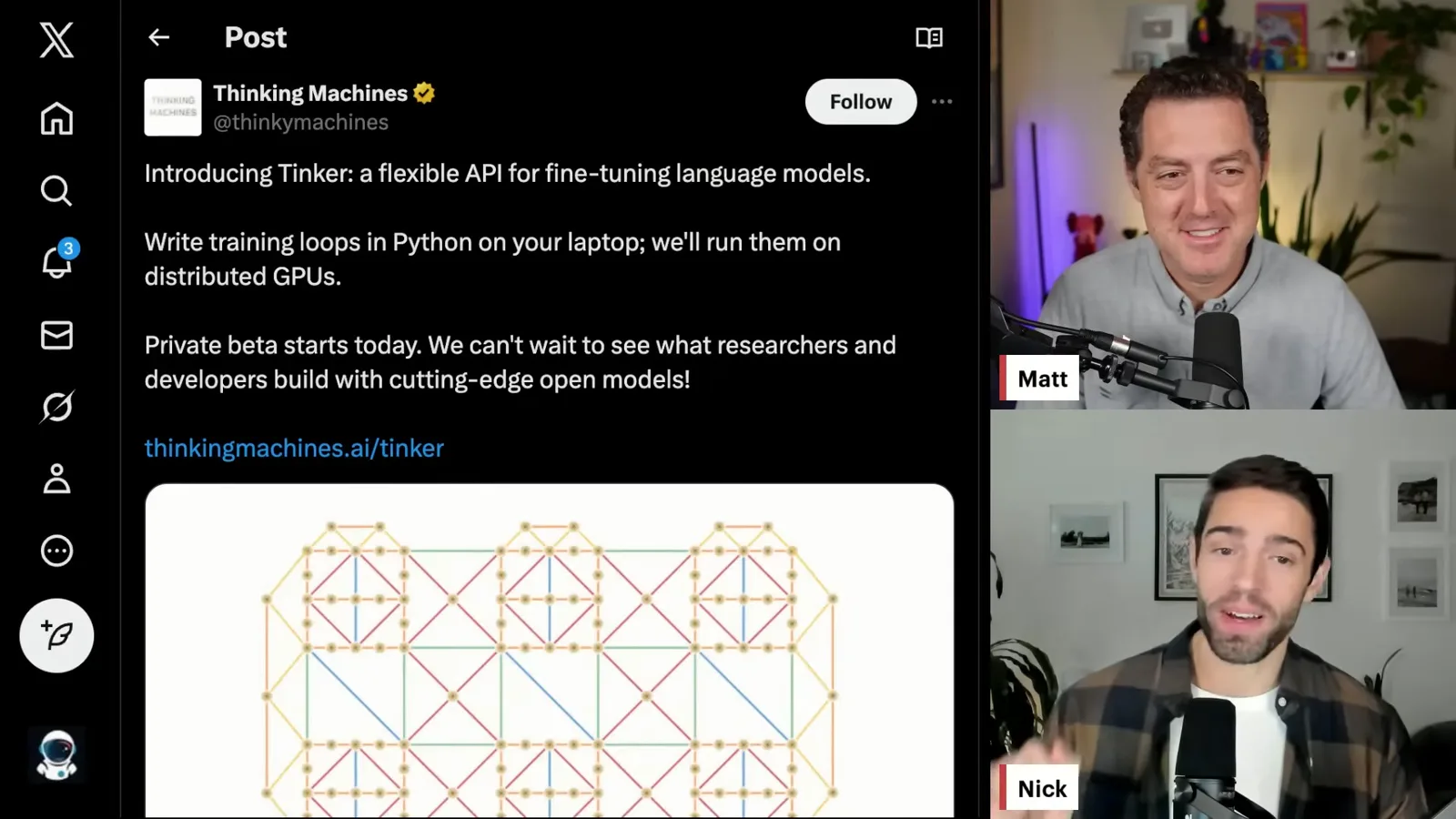
They present their understanding rather than a hands-on assessment.
The hosts discuss a reported OpenAI employee share sale and a $500 billion valuation.
These are transaction-era figures, not a present valuation; their comparison with other private companies and the claim about buying all San Francisco property are not independently established.
They discuss California’s SB 53, signed September 29, 2025.
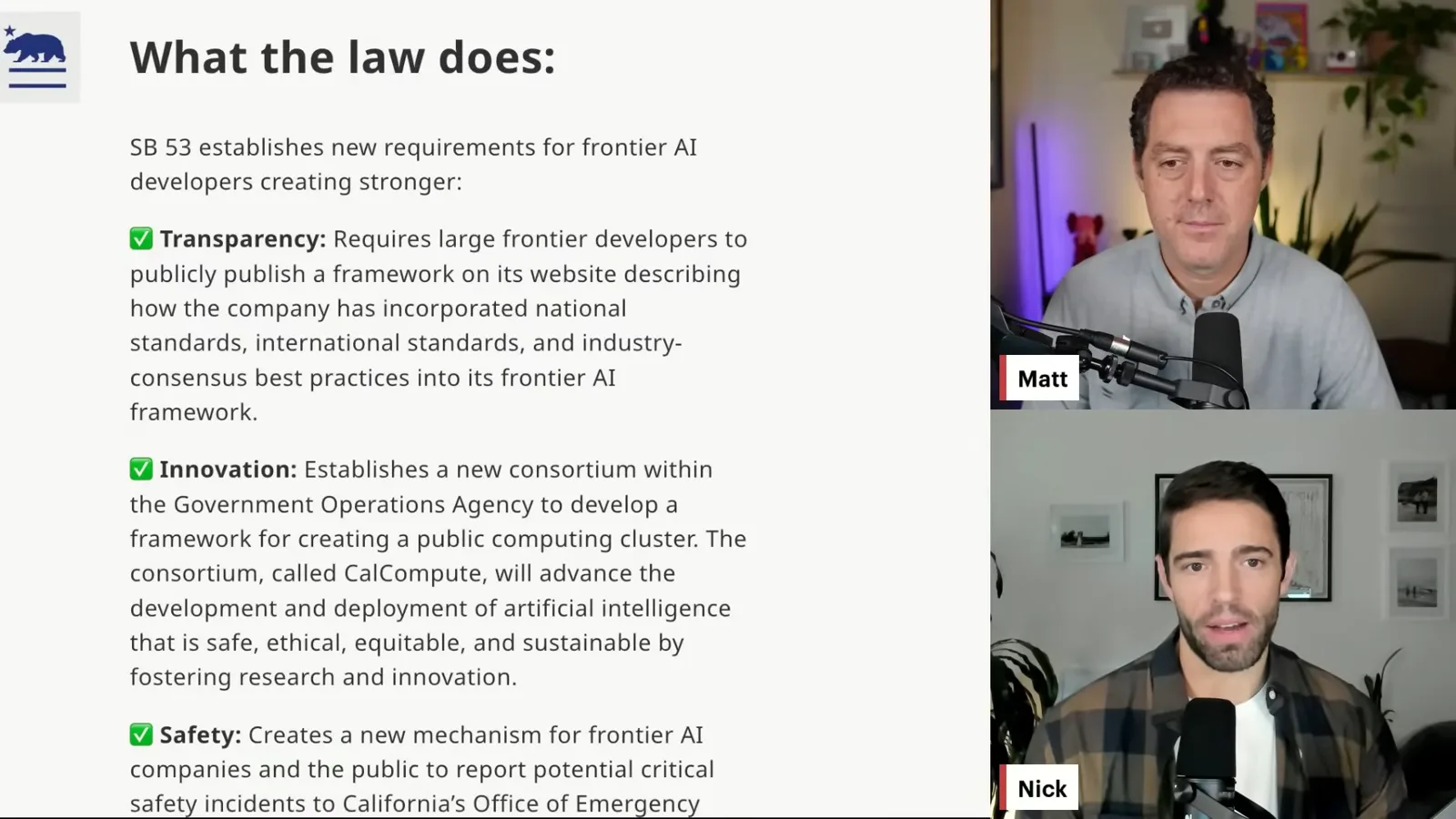
The law includes safety-framework transparency, a mechanism for reporting critical incidents, whistleblower protections and a public-compute initiative. Berman expresses concern about excessive regulation while acknowledging the need for safety; the balance is a policy opinion.
Eric Simons on Bolt and AI development
Simons explains Bolt V2, the company’s history and its professional strategy. He considers model-provider competition, software interfaces and jobs.
Eric Simons joins on Bolt’s first anniversary to discuss Bolt V2.
He describes a browser-based tool that turns prompts into web applications and says V2 combines coding agents with Netlify and Supabase infrastructure. His description is a product claim, and generated applications still require testing and security review.
Simons says early vibe-coding tools were fun prototypes but increasingly attract professional product teams.
He argues the gap with developer-oriented agents narrowed when Bolt integrated Claude Code and OpenAI Codex through its own orchestration.
Asked about scale, Simons says 72% of Fortune 500 companies use Bolt and products built with it have generated over $1 billion in revenue.
These are company-reported figures with unspecified usage and attribution definitions, not independently audited evidence of widespread production deployment.
Simons traces StackBlitz to his childhood friendship with co-founder Albert Pai and their shared interest in programming.
He recalls watching Figma’s early vision for browser-based design and seeing a similar opportunity for web development in the browser.
He describes building browser-based development technology and a runtime that could start inside a tab.
Developers liked it, he says, but the browser IDE business struggled to monetize. His security characterization is a product view, not a guarantee that code or deployments are secure.
Simons says that after seven years the company had roughly $700,000 in annual recurring revenue and was considering winding down.
In 2024 a preview of Claude 3.5 Sonnet convinced the team to build Bolt; he says it launched about a month before a planned shutdown discussion.
He reports Bolt reaching $4 million in annualized recurring revenue in its first month and $20 million the next.
He cautions that rapid headline ARR is not the same as durable revenue: consumer churn matters, so he prefers measuring retention and customer value. These figures are his company’s account.
Simons says Bolt’s focus on professional product teams follows a belief that a tool valuable to people using it daily can attract others as well.
He expects this focus to improve retention and generate demanding feedback.
Asked what an agentic coder can build, Simons says sophisticated web and mobile SaaS apps with payments are possible, but outcomes depend on effort and scope.
He acknowledges that a single request to recreate Google’s search engine will not simply produce it; broad claims about building virtually any app should not be mistaken for reliable performance.
Simons describes examples including a browser-based 3D modeling tool and says Booking.com used Bolt for product functionality.
He also cites startups with substantial revenue. These examples and customer claims were not independently evaluated in the show.
On dependence on frontier providers that also sell their own products, Simons says Bolt can select between agents and models according to the task.
He sees the integrated workflow and a focus on professional product builders as differentiators, while acknowledging substantial competition.
Wentz asks how to design for non-developers.
Simons says the first request must yield something useful, errors must be understandable, and infrastructure should require little manual setup. He claims early V2 traffic and signups doubled; the show does not provide independent metrics.
On the future of the application layer, Simons expects some tasks to move into agent interfaces, such as asking questions of analytics rather than navigating dashboards.
Other interfaces may become simpler or new applications may emerge; he does not claim every application will disappear.
Asked about software generated dynamically, he imagines an agent producing a small task-specific interface or workflow, for example for a salesperson.
This is a prospective design, not a demonstration of an entirely neural operating system or a prediction with a firm timeline.
Simons predicts more non-developers will create software.
He expects product managers and designers to direct agents on some front-end tasks, potentially reducing some entry-level work, while skilled engineers remain important for architecture, review and quality. His employment forecast is uncertain.
He compares the transition to automation in manufacturing: less manual assembly, more oversight and machinery design, and potentially new roles.
The hosts agree with his view of job transformation, but this analogy does not quantify future employment.
An informal video-generation comparison
Producer Alex and the hosts compare selected clips across several models. Their votes are subjective and do not form a controlled evaluation.
Producer Alex joins a playful blind comparison of Sora 2, Kling 2.5 Turbo, Veo 3 and Wan 2.5. The team says it applied Sora watermarks to more than one clip and muted audio to avoid revealing models.
These selected samples and subjective votes are not a controlled benchmark.
The first round uses a wrestling-style prompt. The panel favors the first example, revealed as Sora; one other clip has little movement.
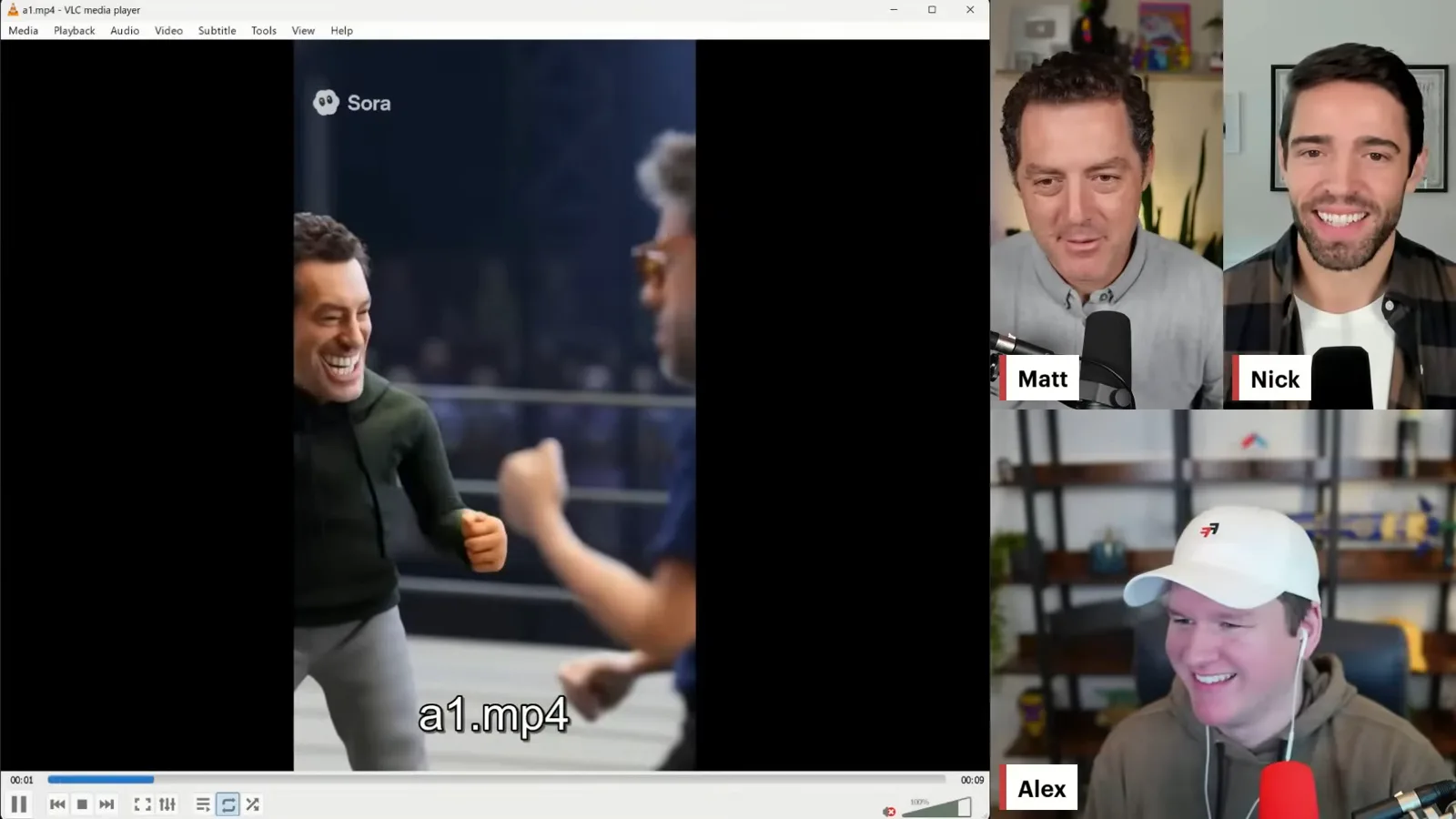
A second round uses a Popeye-like character eating spinach, with different panelists preferring different clips.
For a DJ-festival prompt the hosts notice morphing artifacts and favor one clip identified as Sora. In the concert round they differ: one preferred clip is identified as Wan 2.5, another as Kling, and Sora appears in a different sample.
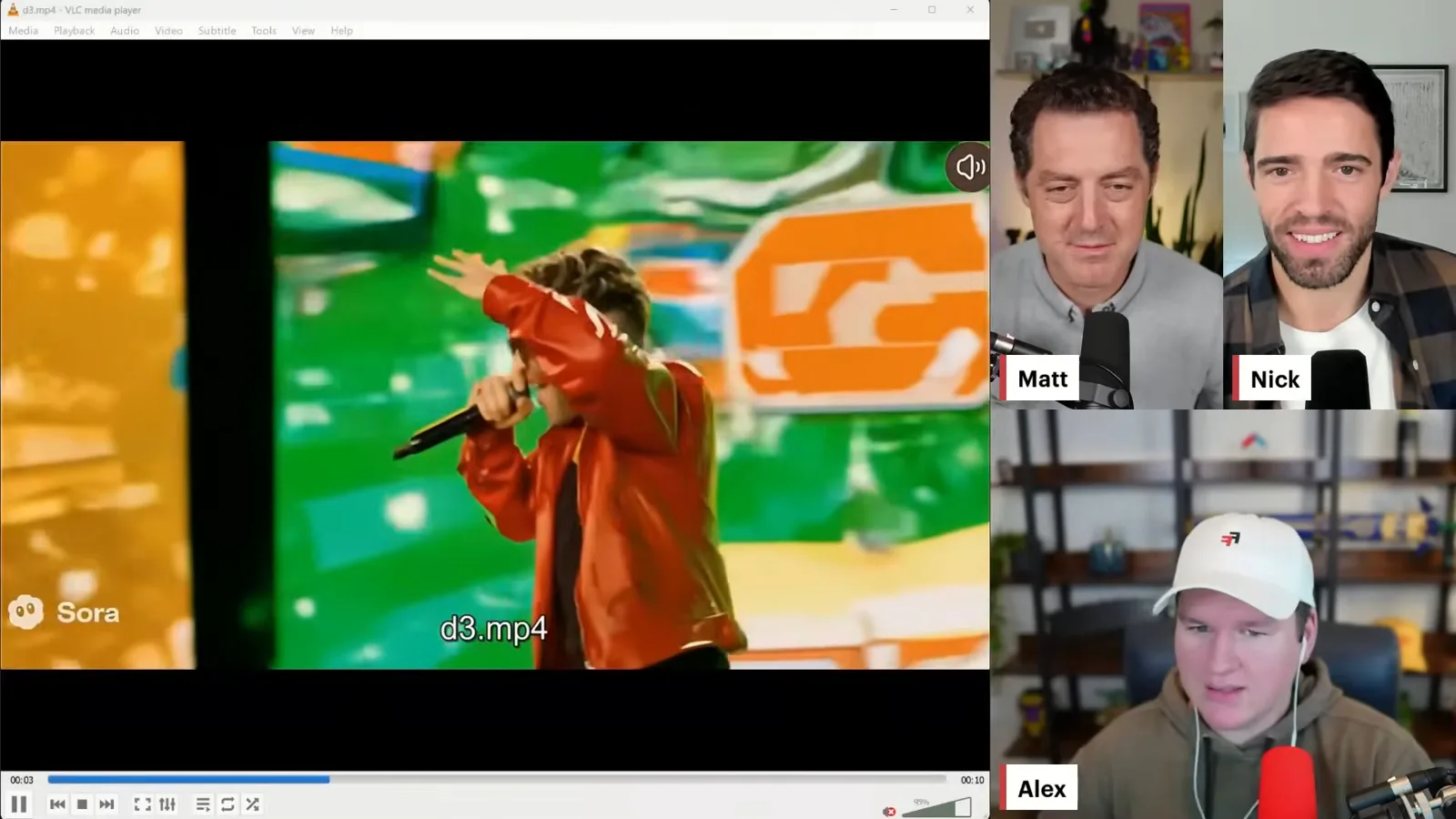
They note missing audio and limitations of the informal test.
Matt Hicks on open source and inference
The Red Hat CEO discusses stable infrastructure, model efficiency, open weights and edge computing. He closes with career advice and robotics prospects.
Red Hat president and CEO Matt Hicks joins after a short audio interruption.
Asked whether an operating system might be generated entirely on the fly, he says AI can accelerate open-source work, but complex systems still benefit from stable foundations. He leaves fully dynamic systems as a possibility rather than a present capability.
Hicks describes Red Hat Enterprise Linux for servers, OpenShift for clusters, Ansible for automation and Red Hat AI for running models.
He separates analyzing code and support issues—already useful in his experience—from fully automating tasks that demand consistent precision.
He sees AI as lowering barriers to coding, much as open source widened access to software.
On Red Hat’s business model, he says enterprises still need support and a stable path from fast-moving open-source projects into production, even if AI accelerates both sides.
Hicks says Red Hat concentrates on inference infrastructure, including vLLM and llm-d, and expects many models rather than only a few.
He argues specialized smaller models can be cheaper and faster than frontier models for particular jobs.
Hicks gives an illustrative 100-times-faster and cheaper comparison for a smaller model.
This is not a general benchmark: performance and cost depend on the models, hardware, workload and required quality. His framework is to establish what is possible, then make a solution production-ready and economically viable.
The hosts discuss routing between models and running models in the cloud, on premises and at the edge.
Hicks says sensitive data or bandwidth constraints can make local inference useful, citing factories, vehicles and the International Space Station. Whether a model fits any particular environment depends on its resources and task.
Hicks calls inference a “game of pennies”: reasoning and agent workflows can increase token consumption, so lowering the cost per token matters to adoption.
His examples of tenfold increases are illustrative rather than universal multipliers.
Asked whether all frontier models should be open, Hicks supports collaboration but notes the high resource cost of pretraining.
He thinks smaller models, fine-tuning, datasets and layers above a base model offer more practical places for community participation.
The hosts raise the distinction between open weights and open-source software.
Hicks agrees that releasing weights alone may not yield contributions back to the original frontier model, while arguing that datasets and specialized adaptations can support collaboration. Access to weights does not automatically include training data, code or rights needed for a fully open system.
Asked whether a parameter threshold makes release unsafe, Hicks says he does not use size alone as the safety test and favors broad scrutiny.
He asserts Linux is the most secure operating system; that is an opinion, not a demonstrated universal ranking, and the safety trade-offs of model release require their own evidence.
On competition for researchers, Hicks says large compensation may draw talent into the field but does not expect it to eliminate open communities.
He sees thriving work in smaller models and inference, while his prediction about compensation and talent remains uncertain.
For young people considering careers, Hicks advises pursuing a domain they enjoy and learning to use AI as an amplifier.
He says his own engineering background still helps him use coding tools; that is career advice and a prediction about the future of work.
Turning to robotics, Hicks says Red Hat’s edge and real-time operating-system work could apply to vehicles and machines that need stable controls in power-constrained environments.
The hosts discuss their hopes and reservations about home robots; widespread humanoid deployment remains a forecast.
Hicks closes by discussing Red Hat’s Neural Magic acquisition and llm-d, an effort to run model inference across clusters.
He sees distributed inference as a near-term challenge and opportunity. The hosts thank their guests and end the show.
같은 채널의 다른 글
 34:21EN
 Matthew Berman· 2026년 10월 27일Matthew Berman Examines Anthropic’s IPO Filing, AI Growth and GovernanceMatthew Berman, Sam Altman · Forward FutureThe presenter reviews the S-1’s financial metrics, compute strategy and voting structure while questioning the tension between rapid AI development and safety.
 0:26ENMatthew Berman· 2026년 10월 25일Sam Altman on Human Values and Problem-Solving in an AI WorldSam Altman · OpenAIIn a short interview excerpt, Altman considers the enjoyment of solving hard problems and the human role in interpreting results.
 0:36ENMatthew Berman· 2026년 10월 25일Kimi K3.1 and a Rubik’s Cube Solver DemonstrationMatthew Berman · Forward FutureMatthew Berman shows a scrambled virtual cube being solved and gives the Kimi K3.1 test a favorable assessment.
 0:21ENMatthew Berman· 2026년 10월 24일An AI-Generated Kimi Benchmark Chart Used Invented ScoresMatthew Berman · Forward FutureMatthew Berman asks for a graph of Kimi K3.1 Pro benchmarks, then discovers that the displayed figures are illustrative placeholders.
 25:50ENMatthew Berman· 2026년 10월 24일Kimi K3.1 Pro Tested: Strong 3D Demos, Uneven Results and Competitive PricingMatthew Berman · Forward FutureMatthew Berman tests the open-weight model on coding, 3D rendering and visual explanations, then compares benchmark results and prices.
 32:20ENMatthew Berman· 2026년 10월 23일Who Is Local AI For? The Costs, Trade-offs and a Hybrid FutureMatthew Berman · Forward FutureMatthew Berman weighs data control and independence against hardware cost, setup complexity and inference speed.