30초 요약
Mislav Ivanda observed a common pattern while integrating Daytona into competing agent frameworks: create a sandbox, execute a task, then delete it. He argues that the harder architectural decision is not which framework to use but where generated code and its tool calls execute. He contrasts command approvals and embedded runtimes with separate sandboxed machines, and stresses designing the execution boundary before a prototype becomes production infrastructure.
- 1Competing frameworks share a sandbox lifecycleAlthough integration APIs vary, Ivanda sees the same three operations: create, execute and delete.
- 2An approved interpreter can still access broad capabilitiesApproving a Python command does not by itself restrict its network or filesystem access.
- 3Tool calls can cross an embedded runtime boundaryEven if generated code is isolated, database or email tools may execute elsewhere with their own permissions.
- 4A sandboxed machine creates a stronger separationIvanda recommends a separate execution environment; the actual protection depends on its configuration and access grants.
- 5Retrofitting the execution boundary changes architectureTools written for unrestricted local access can be difficult to move into a sandbox after a prototype reaches production.
핵심 정리
- Different agent frameworks often integrate sandbox providers through the same create, execute and delete lifecycle.
- Allowing a general-purpose interpreter can grant capabilities well beyond the apparent command name.
- An embedded runtime can isolate generated code while tool calls still execute outside that boundary.
- A separate sandbox needs carefully scoped networking, credentials and tool permissions to provide meaningful isolation.
- The execution boundary shapes architecture and can be harder to change later than a model or framework.
챕터별로 다듬은 전문 읽기
The common pattern across frameworks
Ivanda describes integrating Daytona with different agent frameworks. Their sandbox APIs vary, but their lifecycle has recurring operations.
Mislav Ivanda introduces his work integrating Daytona sandboxes into agent frameworks, coding-agent harnesses and developer tools. Across these integrations he noticed a repeated pattern, despite substantial differences between the frameworks.
He shows a code sample and asks the audience to guess the framework. Several answers are plausible, he says, because the sandbox-related contributions look very similar even when one framework uses a tool, another a plugin and another a client class.
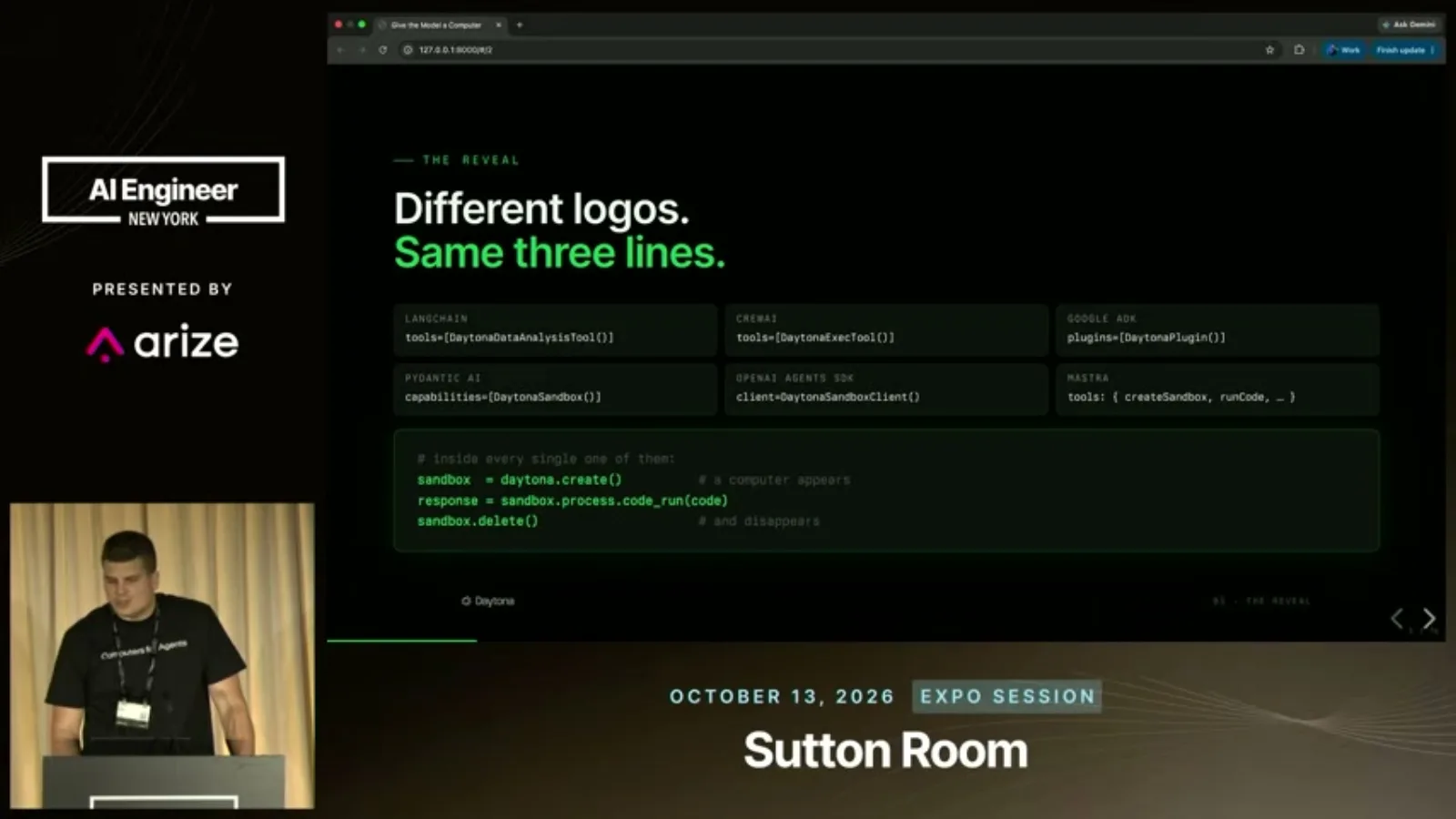
Under those different interfaces, the same operations recur: create a sandbox, run code or a task within it, and delete it. Ivanda finds that agreement striking because competing frameworks disagree on many other fundamentals.
He contrasts frameworks that describe agents as graphs, collections of role-playing agents, model loops or more complete products. They differ in languages and in whether developers explicitly specify workflows or agents decide their own steps.
Three places to run generated code
He compares local command approvals, embedded runtimes and a separate sandboxed machine. The discussion focuses on where permissions and tool calls cross boundaries.
Ivanda argues that useful agent workflows eventually need some form of code execution or shell access. The next architectural question is where that code should run and what capabilities it should have.
The first approach is local execution with command allowlists, approval prompts and hooks. Those checks can constrain interactions, but approving a general-purpose interpreter can still let the invoked code access files, open network connections or execute additional code.
The distinction, he says, is between specifying which command the model should use and controlling what the resulting process can actually do. If the process has broad host permissions, a compromised step can exploit those permissions.
The second approach runs generated code in an embedded runtime such as V8 or QuickJS. That can provide filesystem and network isolation for the code running inside the runtime.
Ivanda warns that isolation of generated code is not automatically isolation of every tool it calls. An email or database tool may execute outside the embedded runtime, with its own permissions; a harmful action can therefore cross the boundary through an exposed tool.
His recommended alternative is a separate sandboxed computer or virtual machine managed through an API. The execution environment can be created, used and discarded without deliberately sharing all the application’s host resources.
Ivanda presents this as a way to contain a compromised execution step instead of exposing the entire application. In practice that protection depends on the sandbox’s configuration, network access, credentials and the capabilities of any connected tools.
How frameworks and sandbox usage evolved
Ivanda gives examples of frameworks moving toward isolation and describes sandboxes as execution environments for complete agents and parallel workloads.
He gives examples of agent frameworks changing their code execution support, including CrewAI, AG2 and OpenAI’s Agents SDK. His point is that isolation has moved from an optional add-on toward a central execution choice.
Ivanda describes an evolution in sandbox use. Early agents often created a short-lived environment for one task and deleted it; more capable agents can instead run their broader workflow inside an isolated environment.
Running many environments concurrently can also support reinforcement learning, fine-tuning, benchmarks and parallel subagents. These workloads use the same basic ability to provision isolated execution at scale.
Choose the hard-to-change boundary first
Models, prompts and some features can be replaced, he argues. Moving execution out of the host can require a deeper architectural change.
This history makes him reconsider the usual question, “Which agent framework should I pick?” He argues that many factors developers compare can be changed later, while the execution boundary is often more fundamental.
Frameworks written in the same language can be migrated through refactoring, he says, and models and prompts can also be changed with tuning and regression tests. Missing features can sometimes be implemented or supplied by external tools.
Ivanda singles out durable execution as a more difficult feature to reproduce quickly because it affects architecture. He regards evaluation, tracing and memory integrations as examples teams can often add separately.
Sandbox providers can also share a basic create-run-delete interface, though they differ in capabilities and performance. He contrasts that with the harder decision of executing locally versus in an external environment.
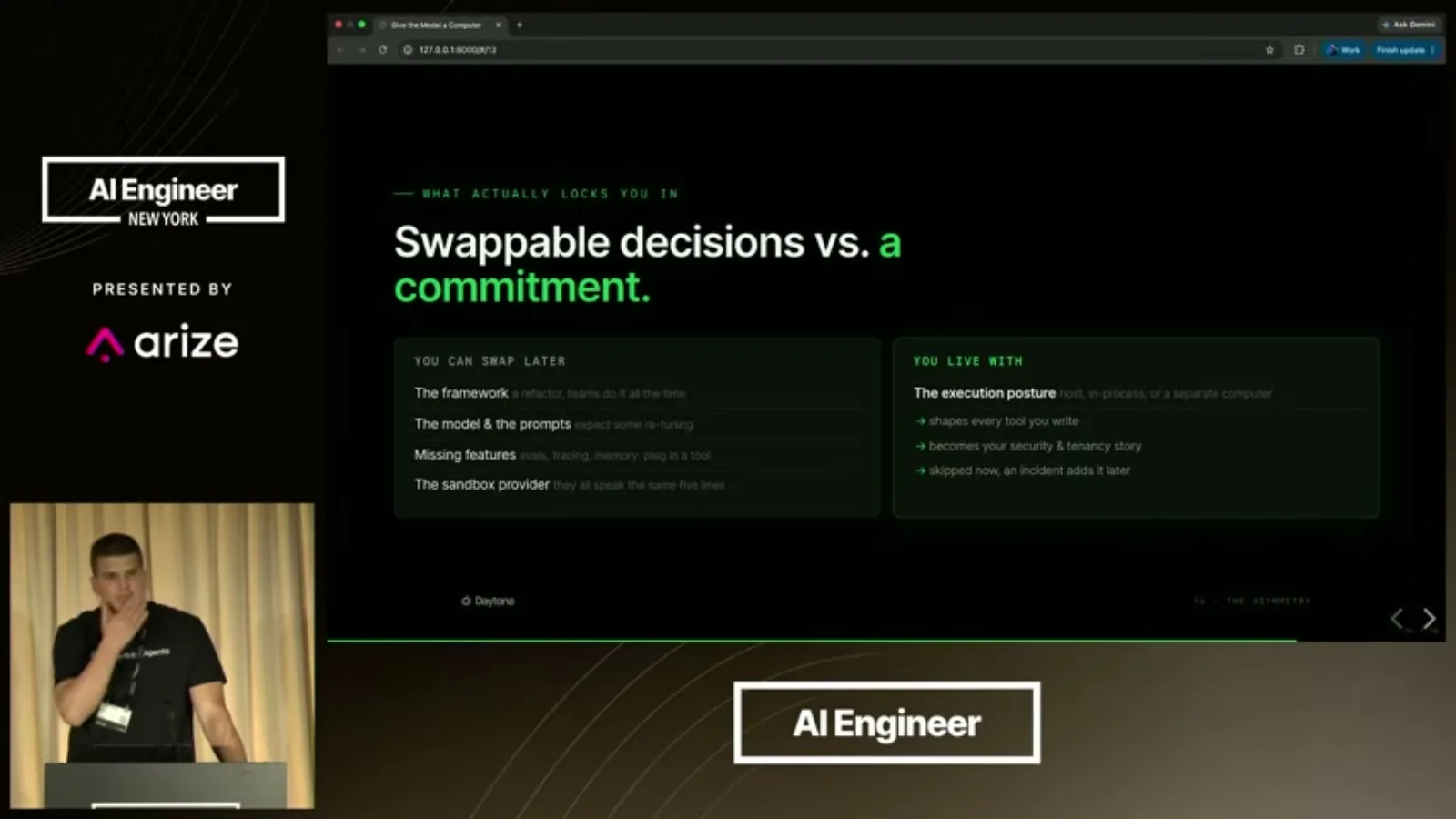
A local-first prototype may build tools around the host filesystem and application process. If those assumptions persist into production, moving execution behind a separate boundary can require changes across the system.
Ivanda closes with his central advice: choose an execution boundary before choosing a framework. Frameworks express changeable design preferences; execution boundaries become commitments embedded in the architecture.
같은 채널의 다른 글
 19:41EN
 AI Engineer· 2026년 11월 9일A high-reliability automation starts by routing the hard cases awayMatthew Jewkes · Standard CyberneticsMatthew Jewkes describes separating critical errors, ambiguous decisions and unusual exceptions in a biopharma indexing workflow.
 22:01ENAI Engineer· 2026년 11월 9일Zach Lloyd: make the software factory measurable and editableZach Lloyd · WarpWarp’s CEO proposes recording agent runs, scoring failures and testing changes to the workflow on real tasks.
 27:35ENAI Engineer· 2026년 11월 9일Uber traded an always-green trunk for faster AI-scale mergesPreetam Dwivedi, Manjari Akella · UberIts merge queue now relaxes some conflicts and validates the combined state after landing, with a verified-good fallback.
 15:25ENAI Engineer· 2026년 11월 9일Hassan and Omar El Mghari: When an AI financial forecast is right for the wrong reasonsHassan El Mghari, Omar El Mghari · Together AIA Costco membership-fee model passed basic checks and landed close to reported results, but an audit uncovered offsetting assumptions.
 14:38ENAI Engineer· 2026년 11월 9일Jemima Abu: Give coding agents accessibility rules from the startJemima Abu · CAISA product engineer shows how semantic HTML, reusable components and explicit agent skills can help teams build more usable interfaces.
 21:12ENAI Engineer· 2026년 11월 9일Tom Moor: Give coding agents the product context that code cannot showTom Moor · LinearLinear’s workflow carries customer requests, past decisions, review history and human feedback from intake through implementation and review.