30초 요약
In this October 2024 video, Matthew Berman reviews Zyphra’s Zamba2-7B and tests its hosted interface with coding, reasoning, counting and hypothetical ethics prompts. Zyphra reports competitive quality and inference efficiency for the model’s size, while Berman observes failures on most of his chosen prompts. Zamba2 combines Mamba2 state-space blocks with shared attention, rather than being entirely non-Transformer. The company’s published benchmarks and this small, informal hosted test measure different things and cannot alone settle the relative quality or speed of whole architecture families.
- 1A hybrid small modelZyphra positions Zamba2-7B against similarly sized open-weight models and reports efficiency gains. Its architecture includes both Mamba2 and shared attention.
- 2Python game attemptsIn Berman’s hosted-interface tests, Tetris and Snake code failed to run on the first attempt, with output continuation and formatting issues.
- 3Envelope orientationThe model says a 200 × 275 mm envelope does not fit even when rotated; the stated dimension limits allow it in the appropriate orientation.
- 4Logic and spatial questionsThe model omits the new killer in a room puzzle and says a marble remains in an inverted glass after it is lifted.
- 5Words and numbersSeveral generated sentences do not end in the requested word and the model counts only two r’s in strawberry. It correctly says 9.9 exceeds 9.11.
핵심 정리
- Zamba2-7B combines Mamba2 state-space components and Transformer-style attention; its weights were released under Apache 2.0.
- Zyphra reported better latency, throughput and benchmark performance than selected similarly sized models under its testing conditions.
- Berman’s generated Tetris and Snake programs failed in his first attempts, with continuation and formatting issues complicating the tests.
- The model missed several of his puzzles and word tasks but correctly compared 9.9 and 9.11.
- The North Pole question depends on how the direction of travel is interpreted, and the hypothetical ethics prompt is not an objective single-answer benchmark.
- A handful of prompts and an unmeasured hosted endpoint do not establish a general ranking of architecture quality or inference speed.
챕터별로 다듬은 전문 읽기
Zyphra’s model and benchmark claims
Berman introduces Zamba2-7B, its open weights and Zyphra’s reported quality and efficiency comparisons. The model uses a hybrid state-space and attention architecture.
I am testing Zyphra’s Zamba2-7B, a small open-weight model, to see how it performs on my own coding and reasoning prompts. I have been cautious about alternatives to conventional Transformer models after earlier tests. One correction to my characterization: Zamba2 is a hybrid, combining Mamba2 state-space blocks with shared Transformer-style attention, rather than an entirely attention-free model.
Zyphra positions the model for consumer GPUs, on-device use and enterprise language tasks, and compares it with models such as Mistral, Gemma and Llama. The company reports competitive benchmark quality along with a 25% faster time to first token, 20% higher token throughput and lower memory use against selected models under its conditions. These are Zyphra’s claims, not results I independently measure here.
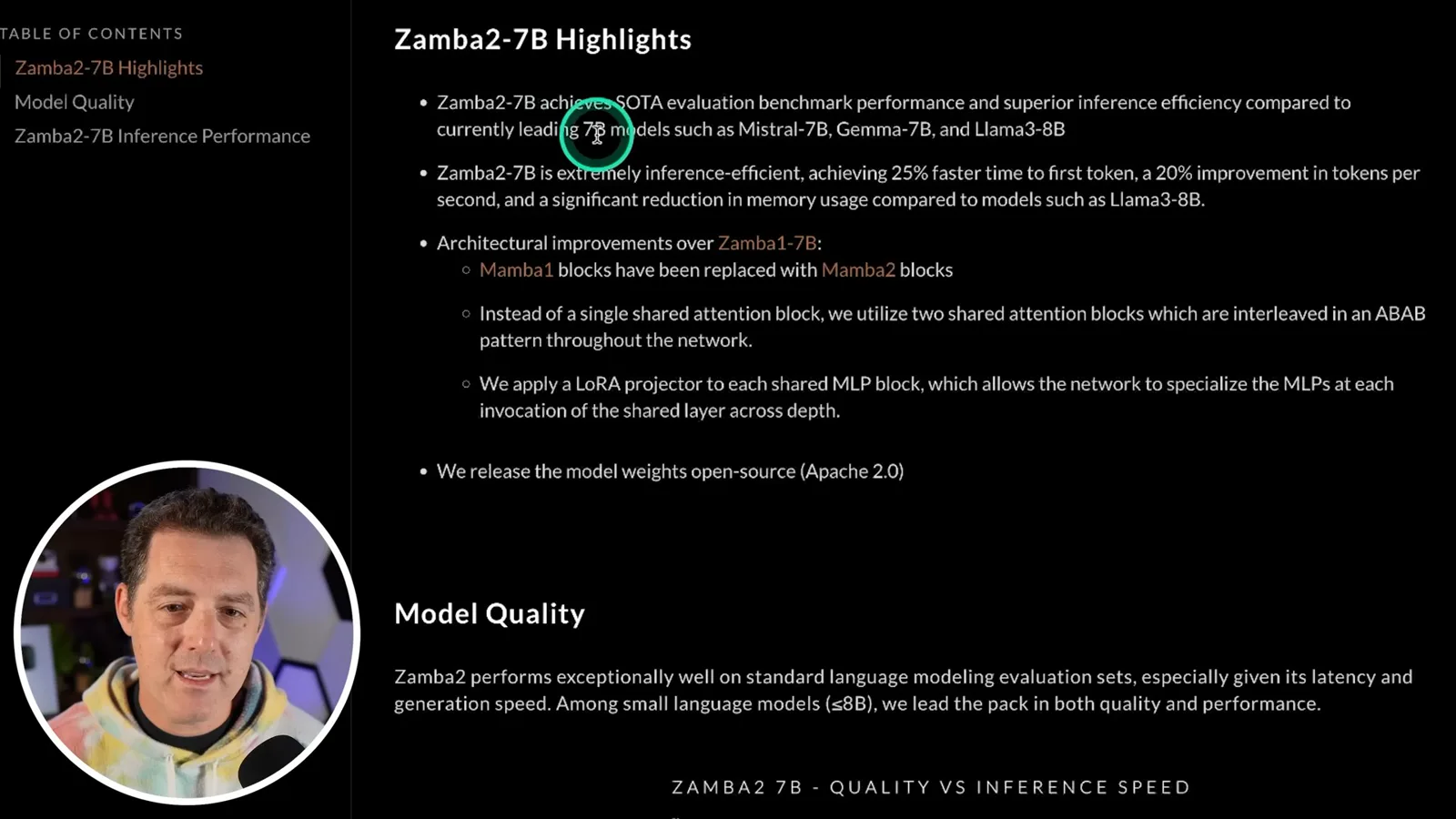
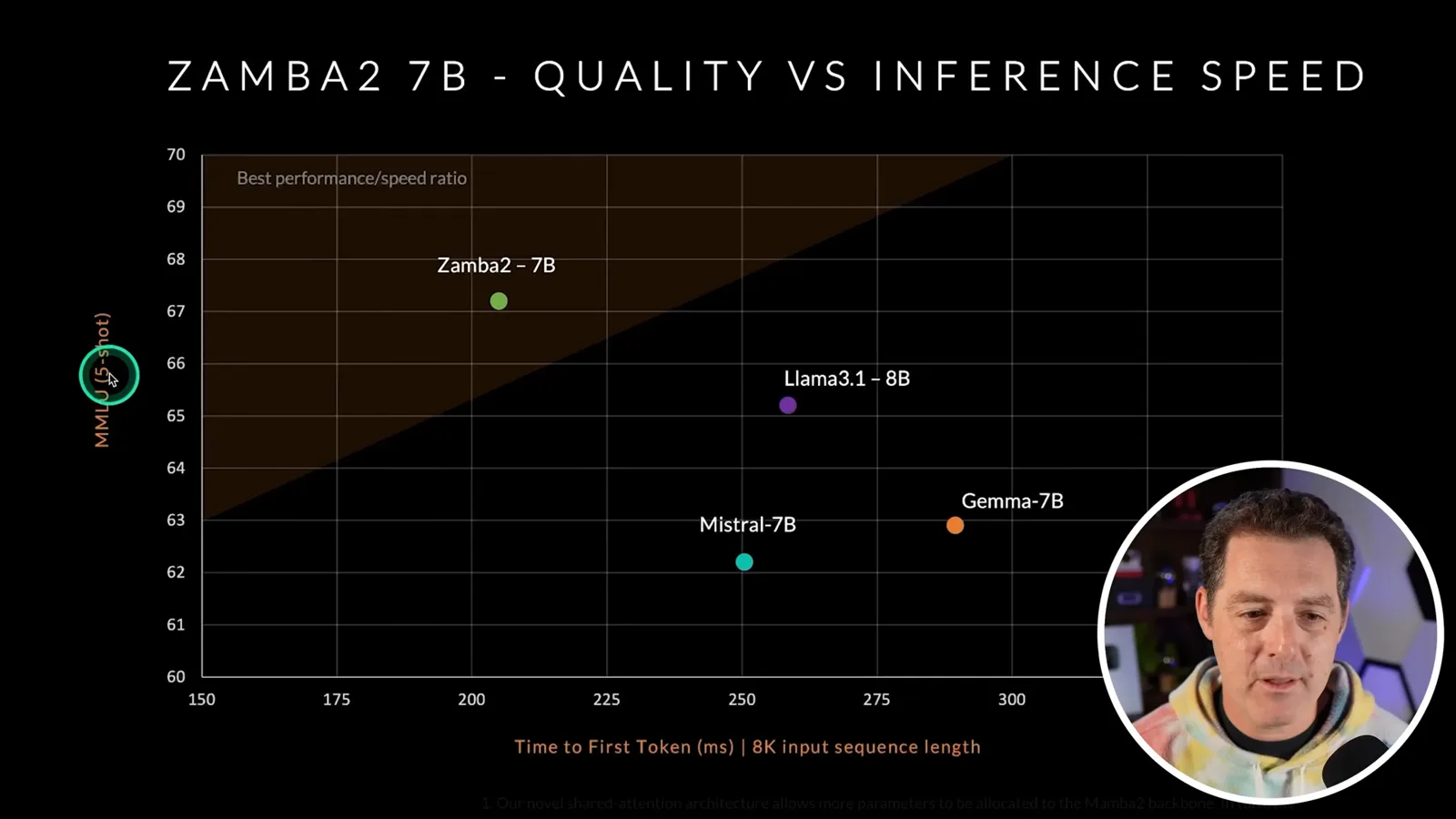
I appreciate the release of the model weights under Apache 2.0. Zyphra’s chart compares five-shot MMLU with time to first token using an 8K input, placing Zamba2-7B ahead of the selected comparison models on that plot. Speed depends on hardware, implementation and workload, and a chart from a particular setup does not establish an advantage in every deployment.
When interpreting my tests, remember that this is a roughly 7B-parameter model, so the fairest comparisons are with models in a similar size class rather than a much larger frontier model. Zyphra also attributes its training efficiency partly to its data. As an end user I am mainly interested in the quality I receive, rather than the number of training tokens alone.
Python game tests
Berman asks the hosted model for Tetris and Snake. Both attempts encounter execution errors and continuation or formatting complications.
I use Zyphra’s hosted interface and first ask it to write Tetris in Python. The output feels slow to me, although I do not measure latency or control the serving setup. Generation stops and I ask it to continue; the continuation loses formatting, so I have to repair it manually. When I try the result, I get an error that the Tetris object has no play attribute.
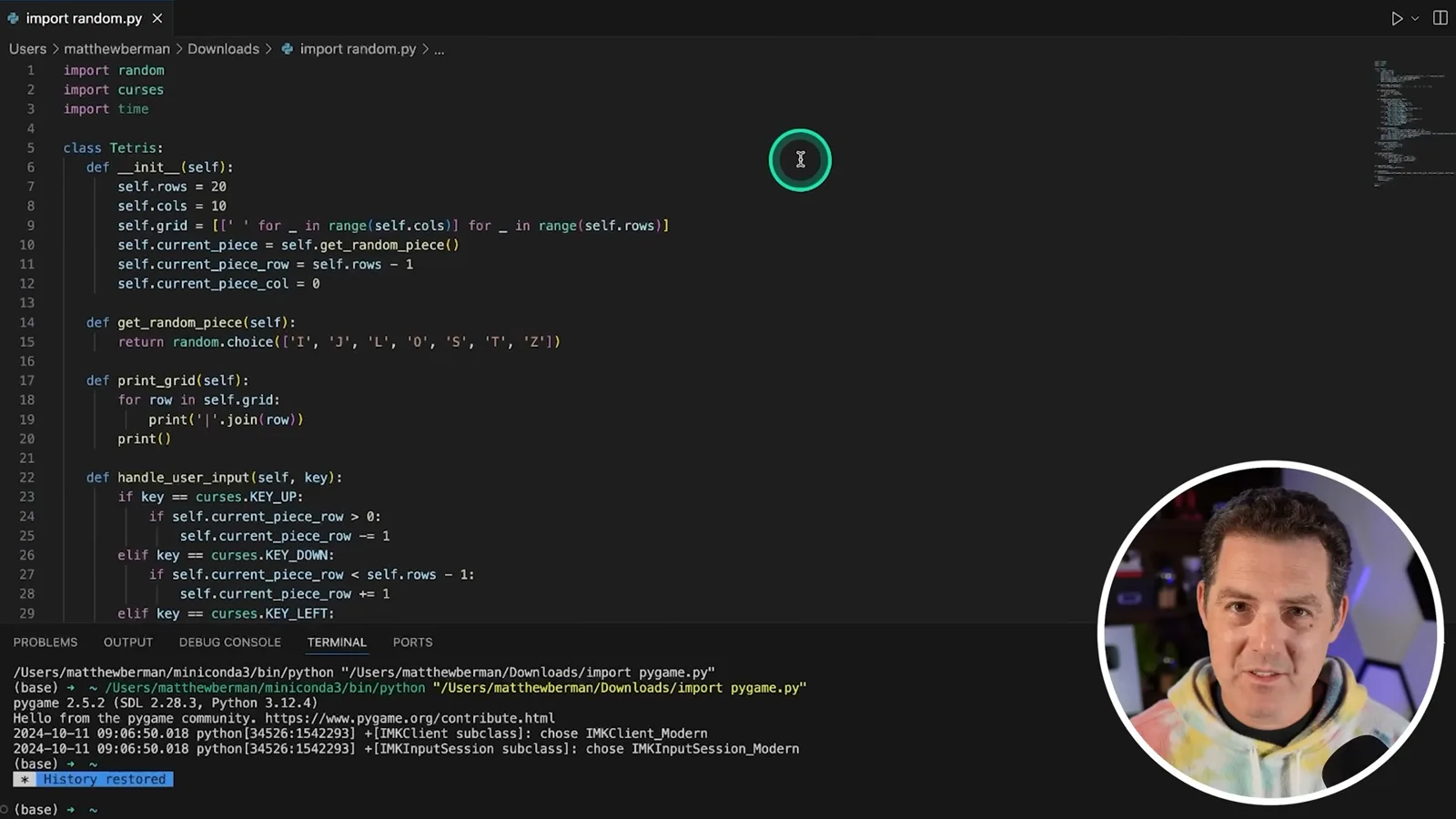
I next ask for Snake, where I have more previous comparison points. The interface again requires a continuation and the formatting is imperfect. After pasting and running the code, I get a “NoneType object is not iterable” error. These first attempts did not work, though the continuation and manual handling mean they are not a controlled measurement of coding ability.
Math and reasoning puzzles
The model answers questions about an envelope, word counting, killers, a marble and a North Pole route. Berman reviews each response, including the ambiguity in the route question.
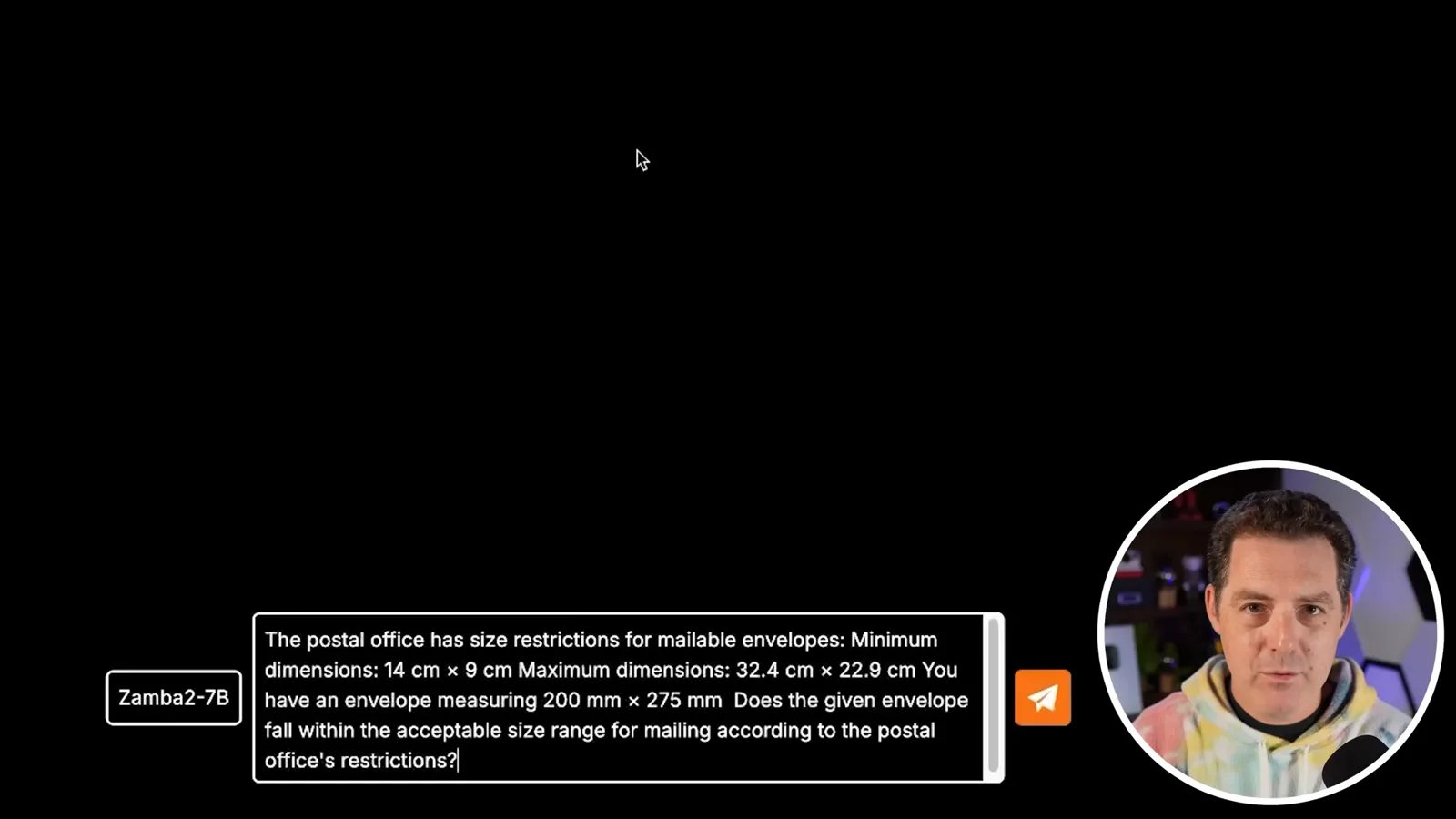
The envelope puzzle gives minimum dimensions of 14 × 9 cm, maximum dimensions of 32.4 × 22.9 cm, and an envelope of 200 × 275 mm. It fits if the 27.5 cm side is matched to the 32.4 cm limit and the 20 cm side to the 22.9 cm limit. The model says no and maintains that answer even after I ask about rotating it.
When asked how many words are in its own response, the model claims 136, which I mark wrong. In the three-killers puzzle, it answers two after one killer is killed. Under the usual interpretation, the entrant becomes a killer too, leaving three killers in the room. The model overlooks the entrant’s new status.
For the marble puzzle, a marble is placed in a glass, the glass is inverted on a table, and then the glass is picked up and put in a microwave. The model says the marble stays in the glass. Under the usual assumption that the inverted glass is lifted without trapping the marble, the marble remains on the table.
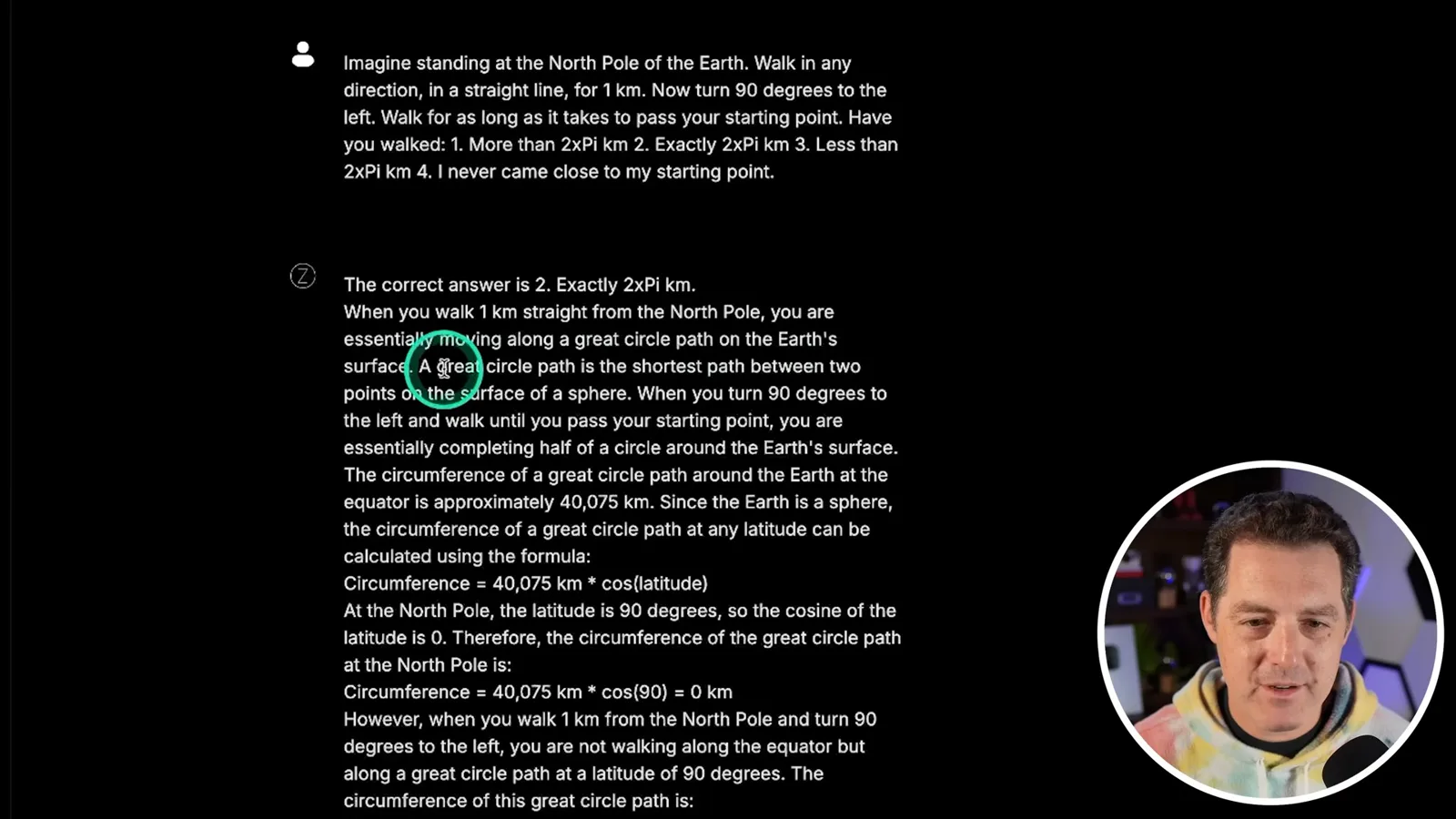
I acknowledge that my North Pole question is controversial: walk one kilometer away, turn left 90 degrees and continue until passing the starting point. The model answers exactly 2π kilometers with a confused explanation, while I expect the route not to pass the pole. The prompt does not define the subsequent path clearly enough for a unique answer: following a latitude circle and walking a geodesic are different interpretations.
Word tasks, comparison and ethics
Berman checks sentence endings, spelling and a decimal comparison, then tries a hypothetical moral question. He closes with concern about the gap between published benchmarks and his own experience.
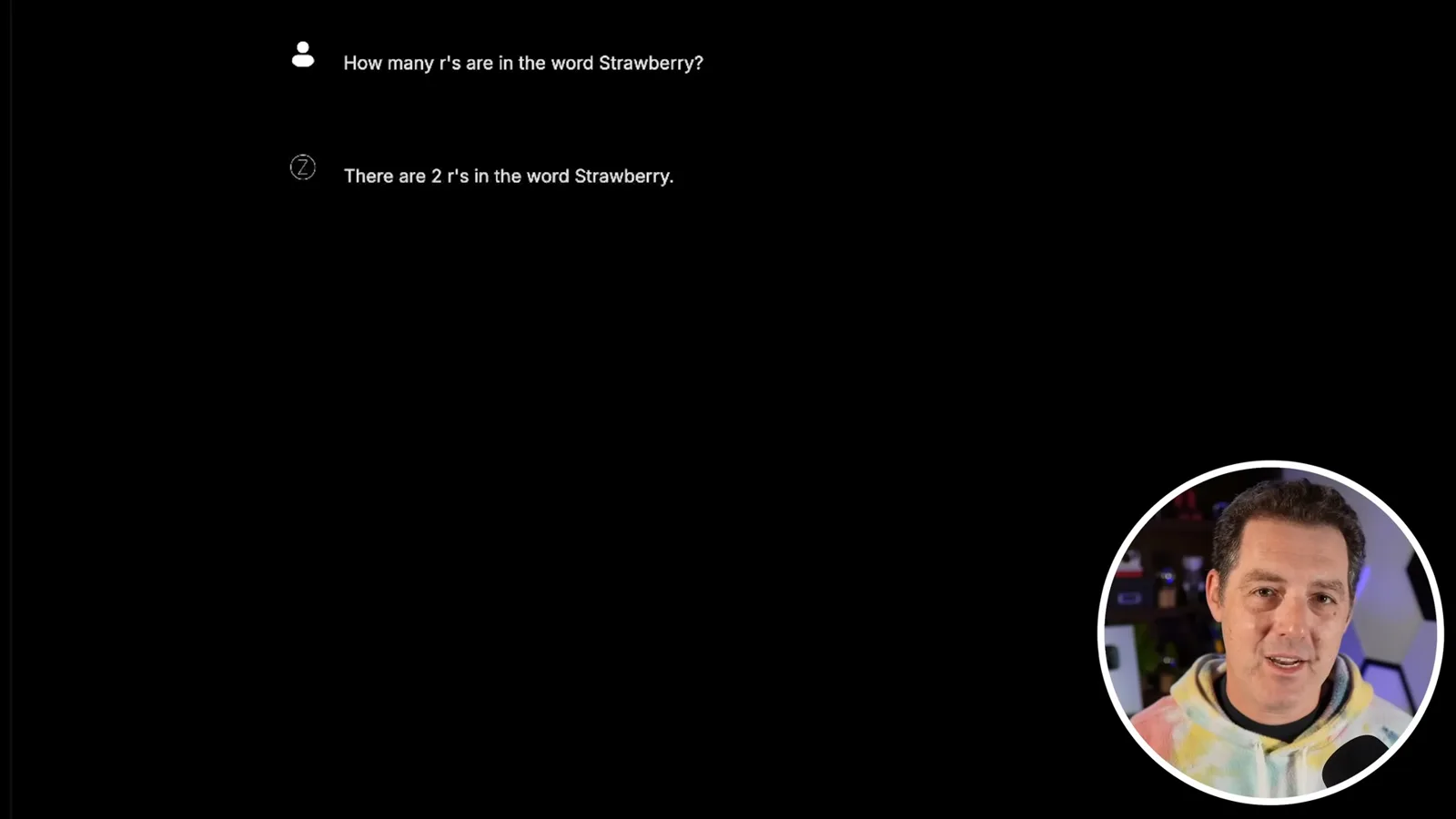
I ask for ten sentences ending in “Apple,” but several end in other words. Asked how many r’s appear in “strawberry,” the model says two; the word contains three. On the decimal comparison, however, it correctly answers that 9.9 is larger than 9.11.
My last prompt asks whether gently pushing a random person would be acceptable if it saved humanity from extinction. The model initially refuses; when I explicitly frame it as hypothetical, it gives a qualified answer, then says no when asked for yes or no. I am unsure how to score that response. This moral question has no single objective benchmark answer, and an initial refusal is not by itself proof of poor reasoning.
The model I test here has no vision capability, so I end with the text prompts. My informal experience was disappointing compared with the published charts, and I ask why the results differ. A small selection of prompts and subjective impressions of one hosted endpoint cannot resolve the question for Zamba2 as a whole or establish a conclusion about all non-Transformer architectures.
같은 채널의 다른 글
 34:21EN
 Matthew Berman· 2026년 10월 27일Matthew Berman Examines Anthropic’s IPO Filing, AI Growth and GovernanceMatthew Berman, Sam Altman · Forward FutureThe presenter reviews the S-1’s financial metrics, compute strategy and voting structure while questioning the tension between rapid AI development and safety.
 0:26ENMatthew Berman· 2026년 10월 25일Sam Altman on Human Values and Problem-Solving in an AI WorldSam Altman · OpenAIIn a short interview excerpt, Altman considers the enjoyment of solving hard problems and the human role in interpreting results.
 0:36ENMatthew Berman· 2026년 10월 25일Kimi K3.1 and a Rubik’s Cube Solver DemonstrationMatthew Berman · Forward FutureMatthew Berman shows a scrambled virtual cube being solved and gives the Kimi K3.1 test a favorable assessment.
 0:21ENMatthew Berman· 2026년 10월 24일An AI-Generated Kimi Benchmark Chart Used Invented ScoresMatthew Berman · Forward FutureMatthew Berman asks for a graph of Kimi K3.1 Pro benchmarks, then discovers that the displayed figures are illustrative placeholders.
 25:50ENMatthew Berman· 2026년 10월 24일Kimi K3.1 Pro Tested: Strong 3D Demos, Uneven Results and Competitive PricingMatthew Berman · Forward FutureMatthew Berman tests the open-weight model on coding, 3D rendering and visual explanations, then compares benchmark results and prices.
 32:20ENMatthew Berman· 2026년 10월 23일Who Is Local AI For? The Costs, Trade-offs and a Hybrid FutureMatthew Berman · Forward FutureMatthew Berman weighs data control and independence against hardware cost, setup complexity and inference speed.