30초 요약
Theo says Gemini 4 Carbon made substantially fewer false claims than Argon in his code-analysis tests, yet still produced too many for him to rely on it for routine reviews. He also found it slow and questioned its pricing and caching. A security report against his T3 Code project changed his assessment: Carbon proposed a fix close to the one he wanted, even though he had struggled with other models on the same task. He calls the result promising for security work, while retaining Opus as his preferred daily coding model.
- 1False claims fell in his tests but remained frequentTheo counted 23 false claims among 79 statements in one Carbon review and reports an aggregate decline from 36% to 18% versus Argon.
- 2Introductory prices were scheduled to doubleHe cites a December 1 change and argues that cache misses and token use affect the cost of an entire task.
- 3An integration problem contributed to some hallucinationsTheo says older T3 Code bindings omitted information such as line numbers; DeepMind engineers helped investigate and improve them.
- 4A real security report gave him a different resultAfter trying other models, he says Carbon proposed a separation of connection flows close to the fix he wanted.
- 5A promising security result did not change his default modelHe still prefers Opus for everyday coding because of his experience with Carbon’s latency, cost and codebase errors.
핵심 정리
- In Theo’s tests, Carbon reduced but did not eliminate false claims about existing code; inspect review findings against the actual code.
- Compare elapsed task time and cost per completed task, including cache behavior, rather than only token speed or list price.
- A model that disappoints in one workflow may still be useful on a different, narrowly defined task.
- Theo says Google’s introductory API prices were scheduled to rise on December 1; check current terms before comparing costs.
- Limit conclusions from a security fix to the particular report and configuration tested, and review the resulting changes.
챕터별로 다듬은 전문 읽기
A better benchmark score did not settle the question
Theo receives early access to Carbon and compares public benchmarks with his own code-analysis tests. He finds fewer false claims than Argon, but still sees reliability problems.
Theo received early access to Google’s Gemini 4 Carbon and initially found it disappointing compared with the improvement he wanted over Gemini 4 Argon. After further testing, however, a security-related coding task gave him a result he had not expected.
He notes that Carbon appeared near the top of a public model ranking when announced, before newer competing models arrived. In his view, benchmark scores and the models selected for a chart do not on their own determine whether a model is the right tool for a particular job.
Google describes Carbon as a model for software engineering, long-running agent work, scientific reasoning and cybersecurity. Theo says he initially paid too little attention to the security claim, even as the model’s score on a coding benchmark seemed much better than his own experience.
His tests focus on analyzing existing codebases and reviewing proposed changes. In a Rust architecture review, he counted 23 false claims among 79 statements from Carbon, compared with 24 among 36 for Argon. He says several competing models made far fewer false claims on the same task.
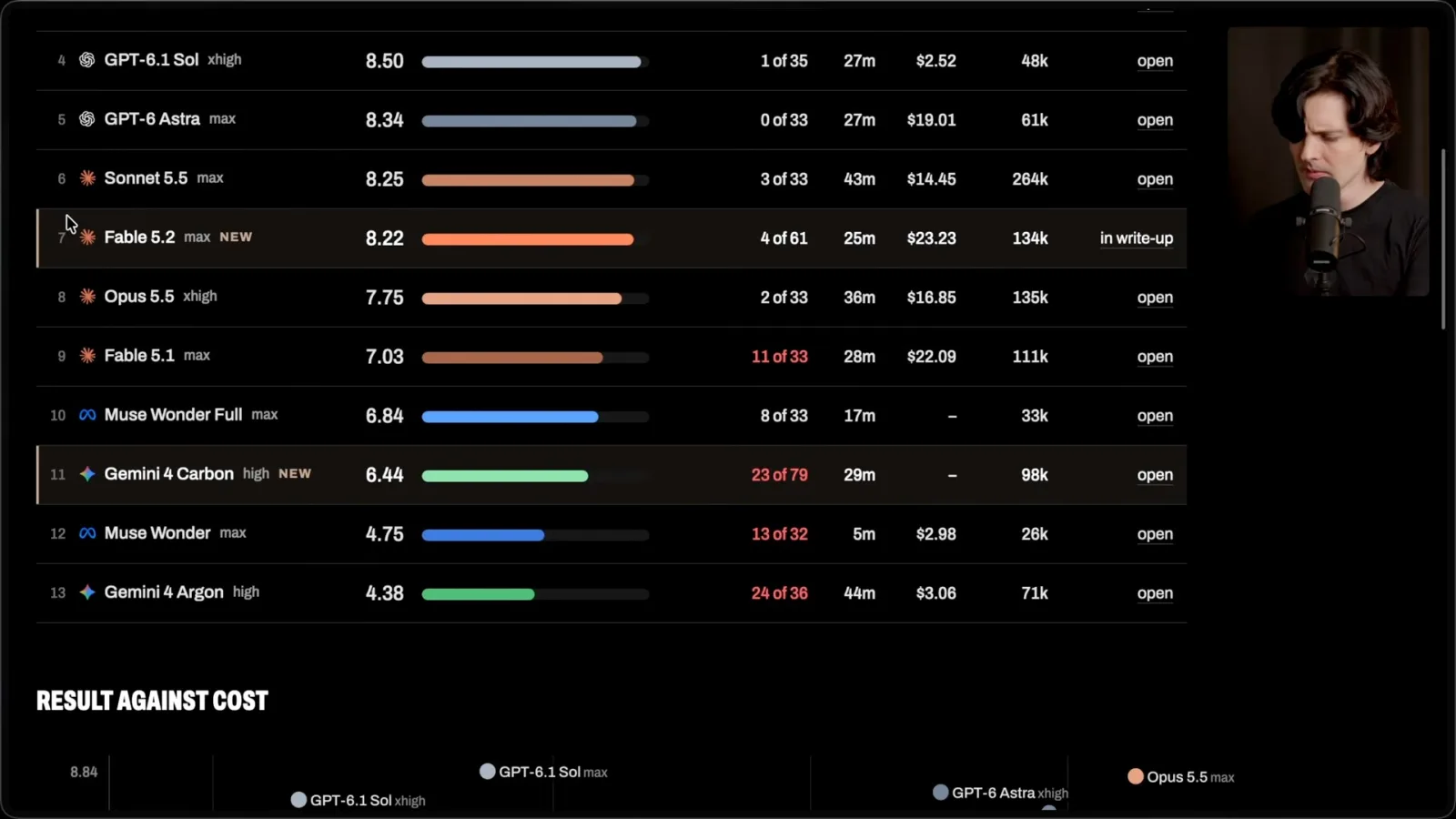
For a separate T3 Code analysis, he counted 23 false claims among 86 for Carbon, versus 47 among 92 for Argon. Across his evaluations he says the share of false claims fell from 36% to 18%: a major improvement in his tests, but still too high for him to trust without checking.
Latency, pricing and cache behavior
He argues that end-to-end task time and cost matter more than token throughput. The advertised introductory API prices are scheduled to change.
He also complains about elapsed task time. Citing a third-party test, he says Carbon averaged about 22 minutes on low effort and 27 minutes on high, while an Opus comparison ranged from about three to 25 minutes. In his view, output tokens per second alone do not capture the wait a user experiences.
Theo reads an introductory API price of $2 per million input tokens and $10 per million output tokens, with cached reads at $0.10 per million. He says the listed prices double on December 1. He questions the value at either price and urges viewers to account for the scheduled change.
He says his own API tests also found inconsistent cache hits, reporting misses after five- and 30-second intervals. Because a miss can increase the cost of repeating context, he argues for comparing cost per completed task rather than relying solely on the advertised token price.
Generated interfaces and a 3D test
Theo finds repeated patterns in generated interfaces and asks Carbon to fix a flawed 3D scene. Early access limits prevent a reliable subscription-usage comparison.
Google highlights knowledge-work and data-analysis capabilities as well as a multimodal benchmark developed with Artificial Analysis. Theo then turns to interfaces and coding, where his assessment is based on the examples he inspected rather than every possible task.
Looking at generated website designs, he finds many use similar layouts: centered two-line text, a pill-shaped element and a cropped product screenshot. He sees some variation but thinks the results become repetitive, whether or not he applies a design skill.
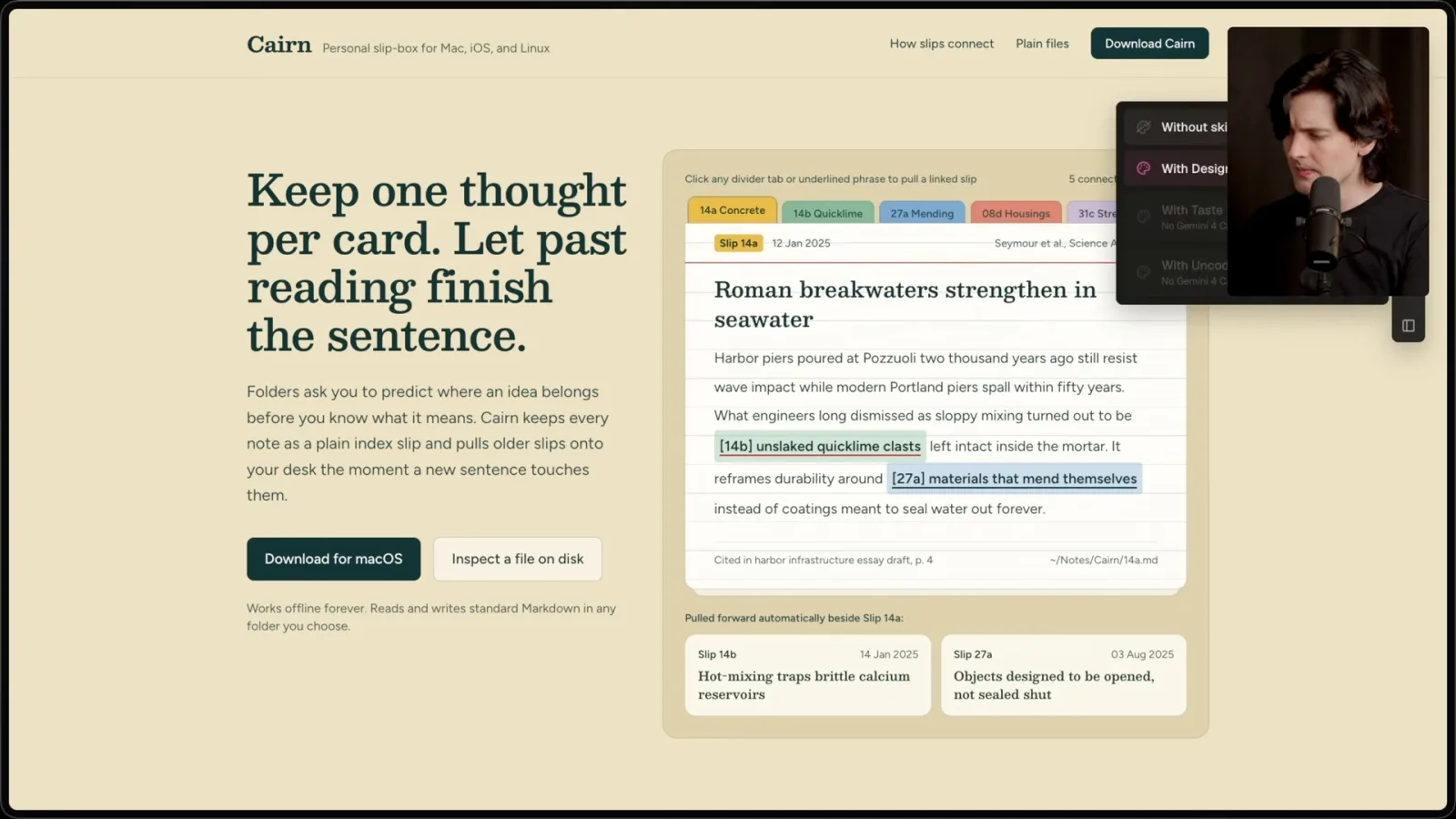
He contrasts Google’s claims about complex coding work with his own difficulty trusting long code analysis. He says he had reverted changes made by the preceding Argon model, and wants to know how other teams obtained better results. Google’s examples also include 3D scenes.
In a 3D test involving fish and water, the first result does not impress him. A request to make it beautiful improves the water but breaks other elements, so he asks Carbon itself to repair the scene instead of letting a different model fix its mistakes.
Theo says his early-access status prevents him from reliably measuring how much Carbon usage a paid Gemini subscription permits. He plans to revisit the question when he can obtain ordinary usage figures, while noting his past experience with subscription limits.
Security claims and the T3 Code integration
He reviews Google’s security claims and explains how an older integration contributed to some of his observed errors. DeepMind engineers helped improve it.
He summarizes Google’s claims about cybersecurity benchmarks, reported open-source findings and improvements on some safety evaluations. These are claims he is discussing from the release, distinct from the security work he later tried himself.
For codebase analysis and review, he says Carbon still invents database column names, line numbers and architectural details in some sessions. Those failures make it hard for him to trust a result even when the model displays strengths elsewhere.
Theo mainly uses Gemini through T3 Code. He says subscription access in other tools should be used only where Google permits it, and describes working with the DeepMind team on bindings that let a tool control the authorized interface.
Some hallucinations he encountered came from an older integration that did not send the model all the information it needed, including line numbers. He credits DeepMind engineers with investigating and improving the connection after his feedback, while saying the end-to-end experience remains slow for him.
A security report changes the evaluation
An outside researcher reports two issues in T3 Code. Carbon proposes an approach that Theo says fits his workflow better than the initial alternatives.
A security report from an independent developer changed the shape of his evaluation. The reporter had used an Anthropic security program to audit T3 Code and identified two issues; Theo says fixes had been released by the time the video went live and asks users to update.
He first worked through the report with Anthropic’s Mythos. One proposed response would have required a user to retrieve a code from the other machine before approving a connection. Theo considered that too burdensome for his remote-machine workflow and continued discussing an alternative with the model.
After several exchanges, he says they reached a solution that treated connections through T3 Code’s trusted service differently from raw links. Before the work was finished, he gave the same report to Carbon to compare its response.
Carbon described the issue in a way he understood and proposed separating known-machine flows from raw URL flows. Theo says this matched the approach he wanted and identified additional concerns. He was surprised because other models had refused the task or initially suggested a less convenient design.
He remains critical of the time and back-and-forth required to use Carbon. He asked other models to review its work, supplied feedback and stopped the process to film before it had fully finished. He considers security incident response a potentially useful application, while noting his early-access status could affect the experience.
Theo thanks the independent reporter, Brandon, for a clear and actionable report. He says the researcher asked for little in return and highlights the value of outside contributions to an open-source project’s security.
A useful specialist, not his default
He continues to test security and Windows-related work but prefers another model for routine coding. The 3D repair still falls short in his assessment.
In another test, he asked Carbon to implement an investigation concerning remote updates on Windows. He says the work was progressing well and received favorable reviews from other models, though those scores reflect those particular reviews rather than a complete assessment.
Despite the security examples, Theo would not make Carbon his default coding model. In his experience Opus remains more pleasant for routine work, while Carbon can be slow, expensive and prone to mistakes or invented details in larger codebases.
He nevertheless considers Carbon a substantial improvement over Argon in staying on task and following a conversation. He plans to keep testing how useful its feedback is over time rather than treating one result as a complete verdict.
The 3D repair task eventually finishes after roughly 25 minutes. Theo finds the scene somewhat changed but still flawed: elements around the fish do not appear where he expected. Based on this example, he would choose other tools for similar 3D work.
His conclusion is that Carbon may be useful for security development and is an improvement for people already committed to Gemini, but he still prefers alternatives for much of his coding. He remains hopeful that later releases will address the problems he encountered.
같은 채널의 다른 글
 48:20EN
 Theo - t3․gg· 2026년 11월 10일Fable 5.2 is powerful, but Theo Browne still prefers Opus for everyday codingTheo Browne · T3After a day of tests, Browne compares benchmarks, usage limits and the mistakes that still require a human reviewer.
 45:21ENTheo - t3․gg· 2026년 11월 9일Theo: AI coding makes maintaining the development environment the jobTheo Browne · Ping LabsFrom Twitch to T3 Code, Theo argues that engineers must remove the friction and feedback failures that block agents.
 42:14ENTheo - t3․gg· 2026년 11월 6일Theo Browne on How Claude Code Reviews Its Own ChangesTheo Browne · Ping LabsTheo compares Anthropic’s layered review process with T3 Code, highlighting verification, rollback and stopping rules for agent review.
 41:02ENTheo - t3․gg· 2026년 11월 5일Theo on PewDiePie’s Local AI Project, Training Data and Model SafetyTheo, PewDiePieA reaction to the Ajax and Odysius project becomes a discussion of opt-in data, agent traces, fine-tuning and local model tradeoffs.
 31:44ENTheo - t3․gg· 2026년 11월 3일Theo on Improving Agent-Generated UI With Iterative ReviewsTheoA T3 Code experiment uses multiple model reviewers, screenshots and repeated changes to improve an interface, while exposing the limits of subjective scores.
 15:50ENTheo - t3․gg· 2026년 11월 3일Theo Compares Codex and Claude Subscription Value After Limit ChangesTheoTheo looks at estimated allowances, per-task costs and his own review experiments, while arguing that model quality remains decisive.