30초 요약
Pim de Witte outlines General Intuition’s proposal to train continuous visual-action models on game frames and labeled inputs collected through Medal. He discusses robot control, generated environments, proposed applications and a comparison with JEPA; performance and data-scale claims are attributed to the company and are not independently verified in the talk.
- 1A common controllerSome games and robots use similar human-facing controls, though transferring skill remains a separate challenge.
- 2Continuous observationThe proposed model repeatedly takes in visual frames and predicts actions while the environment changes.
- 3Company-reported data scaleDe Witte cites more than 1.5 trillion action tokens per month from Medal data.
- 4A broad capability claimHe says one model handles games and more than ten robot types; no independent benchmark is shown in the talk.
- 5Action labels and JEPAHe contrasts explicit action labels with inferred actions and acknowledges tradeoffs.
핵심 정리
- A visual-action model can be designed to observe continuously while producing controller actions.
- Game recordings paired with input labels provide a possible source of action training data.
- A shared controller interface does not by itself prove reliable transfer from games to physical robots.
- The company’s claims about data scale and support for multiple robot types are not accompanied by an independent benchmark in this talk.
- Possible applications include computer interaction and accessibility, alongside longer-term planning by an orchestrator.
챕터별로 다듬은 전문 읽기
Why continuous action?
De Witte contrasts turn-based language interaction with systems that observe as they act.
Imagine training on existing information and using the result on problems not explicitly represented in the training data. General Intuition is pursuing an analogous idea with interactive visual data from video games, though whether it generalizes to a particular robot is an empirical question.
I use a scene from Frozen to illustrate continuous observation while acting. Unlike a purely turn-based exchange, an embodied system needs to respond to a world that keeps changing while it moves.
I argue that purpose-built action models can fit this setting better than treating a text language model as the entire control loop. This is our architectural thesis, not a controlled comparison presented in the talk.
Game data and a shared control interface
Medal provides frames paired with actions, and controllers offer a possible bridge to robot teleoperation.
Our starting point is Medal, a game-recording platform whose users record play across many games. We associate frames with controller or keyboard actions and label what the actions mean, creating training examples for a vision-based model.
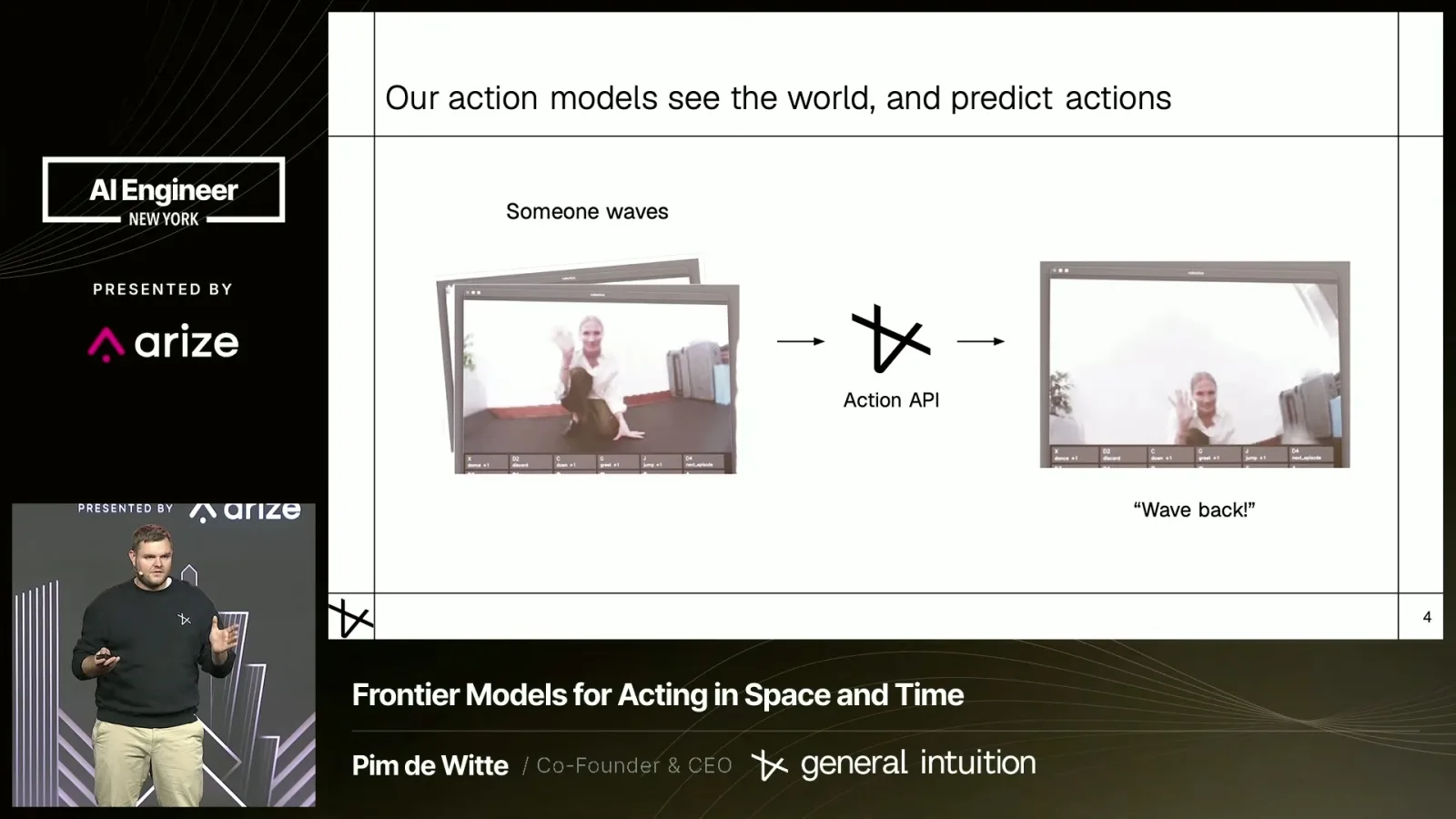
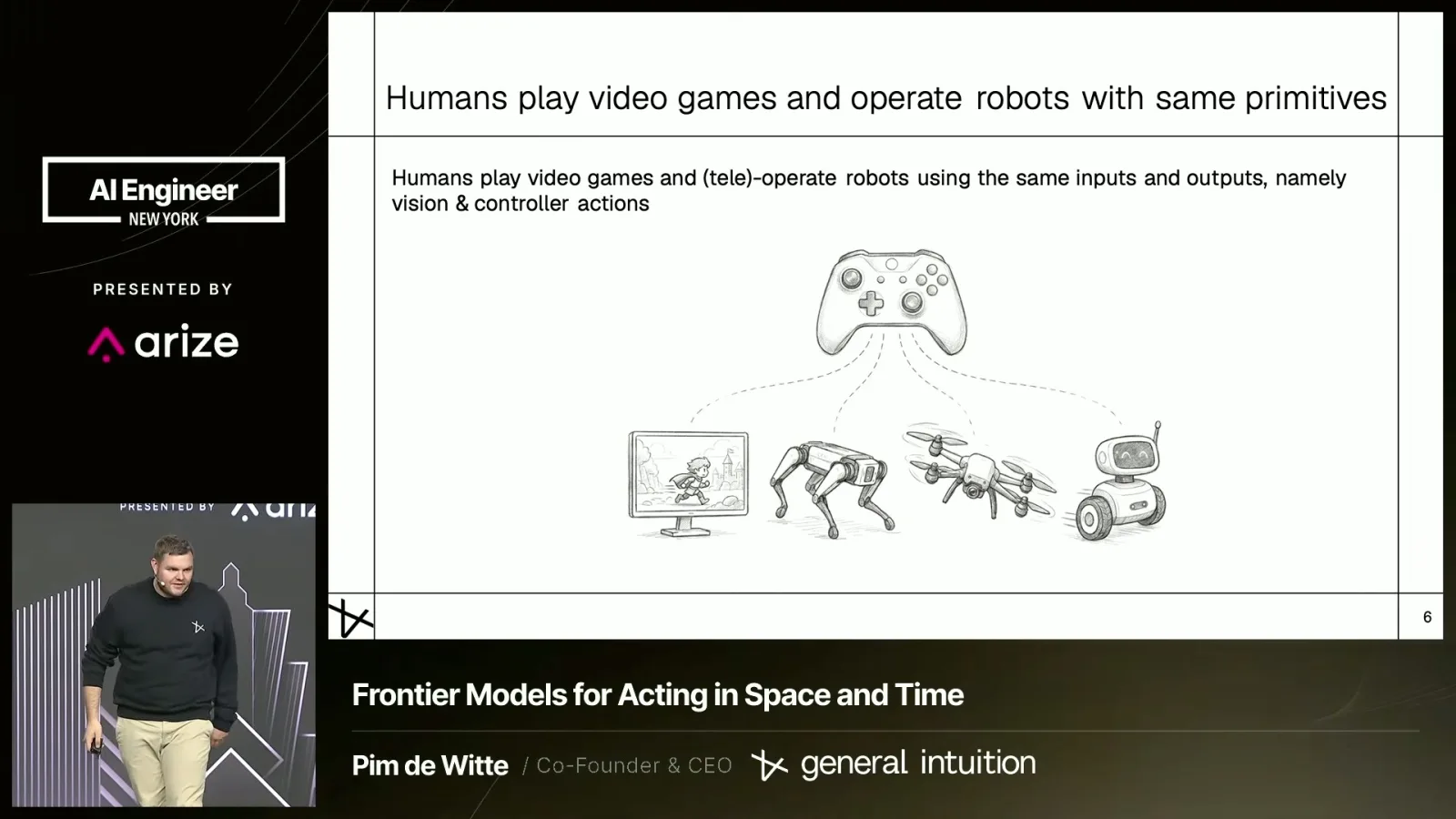
The intuition is that a person can use a game controller both in a game and to teleoperate some robots. This provides a potentially shared interface, although a familiar controller does not eliminate differences between simulated and physical environments.
The model receives frames and a set of available controls, optionally with a text instruction. In a simple example, an instruction to wave back can be mapped to an available greeting action. The result is an action rather than a paragraph of text.
Pixels in, actions out
The speaker describes a model that repeatedly observes visual input and emits controls.
I contrast this with text generation, where a model often produces a response and waits for the next turn. Our design repeatedly receives visual observations and predicts controller actions, aiming to operate while the scene continues to unfold.
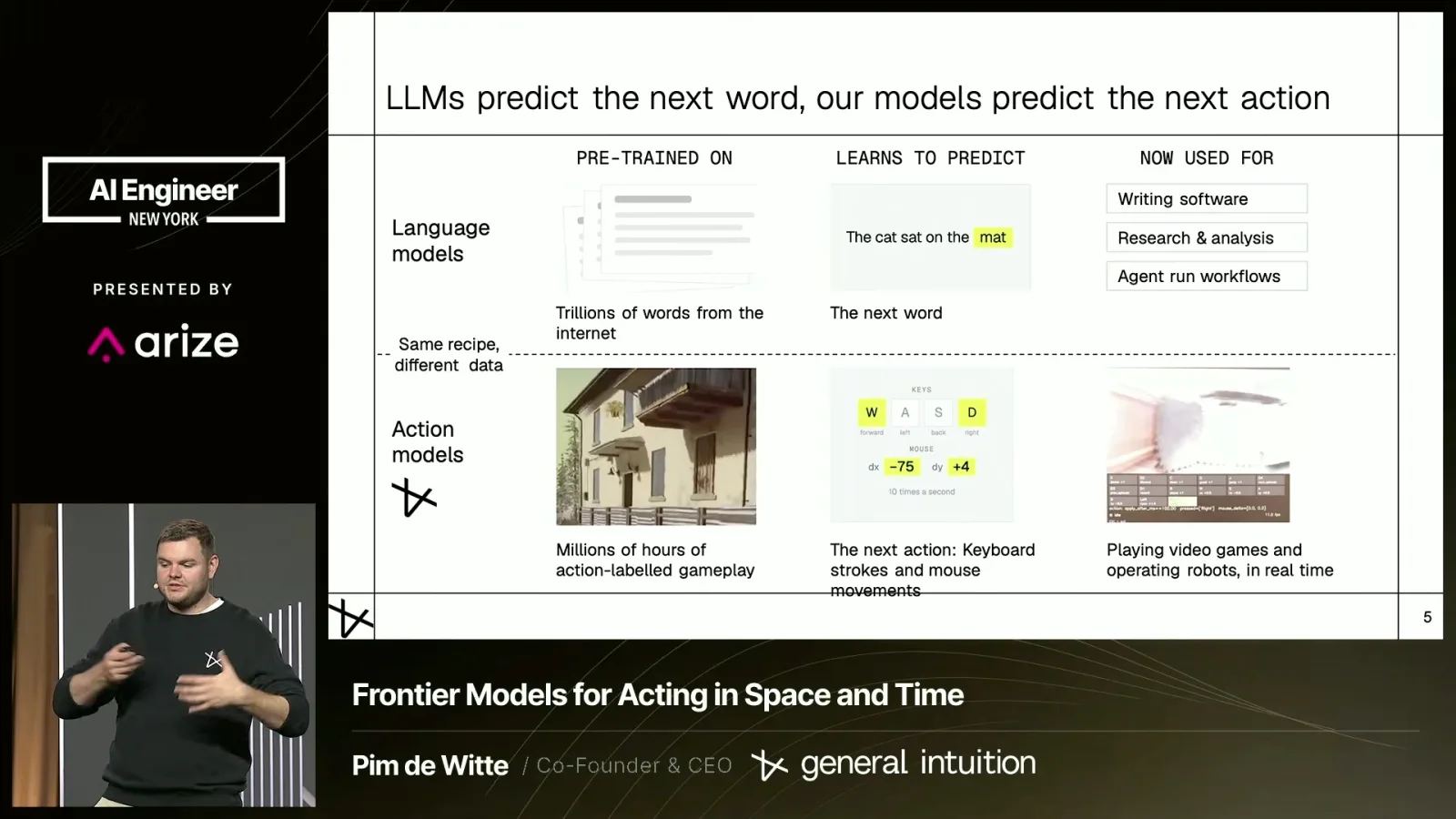
Our bet is that many problems can be expressed as pixels in and actions out. The output space can include keyboard, mouse or game-controller actions, extending the intuition of computer-use models to a wider set of controls.
Robots already have control interfaces that translate human commands into low-level motor behavior. Rather than predicting every motor torque directly, our approach aims to use such interfaces where they exist.
Scale, environments and action density
Company-reported data scale and generated environments support the proposed training approach.
I say Medal currently sees about a billion video uploads per year and is on track for three billion, yielding more than 1.5 trillion action tokens per month. These are the company’s reported scale figures; the presentation does not independently establish how much data is suitable for every robotics task.
The training bet is that scale across games can help a single model handle a broad range of visual-action problems. I compare that bet to focusing on one modality and expecting users to bring more problems into it.
We also work on world models that generate additional environments for training. I argue that learning in visual space could reduce some translation steps involved in building a digital twin and checking whether a simulated task matches reality.
Games can contain dense sequences of actions. I suggest this may help with tasks such as drone control, where many small adjustments are needed, and that high action density provides a different training signal from slower teleoperation.
The action labels are intended to preserve semantic meaning as well as the key being pressed. I present this as useful for interpretation, although a label alone does not guarantee that a model’s internal reasoning is transparent.
Proposed uses and release plans
The company claims broad capabilities and proposes workflows and accessibility applications.
I say the company plans to release models later this year and is showing selected live demonstrations. I claim that one model can play games at a high level and control more than ten types of robots using the same primitives; the presentation does not provide an independent benchmark for that claim.
The proposed deployment still uses an orchestrator model for longer-term planning, with the visual-action model plugged into a workflow for real-time interaction. I suggest possible uses such as exploring a user interface, rather than claiming each use case is already validated.
One accessibility idea is to let a person control a mouse while the model supplies complementary keyboard actions, potentially making games easier to use with one arm. This is presented as an application idea, not a tested clinical or accessibility outcome.
I describe three teams working on world modeling, the policy or agent, and data and environment generation. I also discuss planned early access and events; those dates are plans stated at the time of the talk.
Questions about JEPA
De Witte compares training with action labels to approaches that infer actions.
Asked how the approach differs from JEPA, I say our training uses action labels, while I understand JEPA’s approach as relying more on inferred actions. I see each as an approach with different tradeoffs and expect ideas to flow in both directions.
For example, video frames alone may not reveal a pilot moving a rudder control. I argue that directly observed actions can help train action sequences, while the team also uses different methods for world modeling.
같은 채널의 다른 글
 20:45EN
 AI Engineer· 2026년 11월 5일John Stecher and Scott Worland on Building AI Systems That Can ChangeScott Worland, John Stecher · Norm AIThe Blackstone and Norm AI CTOs discuss data strategy, evaluations, production controls and when to wait for a better model.
 15:32ENAI Engineer· 2026년 11월 5일Emil Chetty on Letting Payment Agents Act Within Customer-Approved BoundariesEmil Chetty · WiseWise’s data and AI product lead describes an immutable job agreement that lets agents choose steps while trusted payment services enforce customer authorization.
 13:22ENAI Engineer· 2026년 11월 5일How Brainbase Improved a Competitor-Pricing Agent from 41% to 97%Milind Sunil Shah · BrainbaseMilind Sunil Shah describes an iterative workflow for collecting and evaluating competitor prices with a back-office agent.
 14:15ENAI Engineer· 2026년 11월 4일How Ramp Applies Smaller Models, KV-Cache Cartridges and Agent SwarmsAlexander Shevchenko · RampAlexander Shevchenko explains three applied research projects that trade latency and cost against task-specific accuracy and operational complexity.
 15:12ENAI Engineer· 2026년 11월 4일Dillon Rolnick on AI Vendor Lock-In and Open Agent FoundationsDillon Rolnick · Nous ResearchThe Nous Research CEO argues that businesses should retain control over their agent stack, presenting his company’s Hermes Agent as one option.
 19:12ENAI Engineer· 2026년 11월 4일Why AI Agents Need Reliable Processes to Scale Across a CompanyMitchell Troyanovsky · BasisBasis co-founder Mitchell Troyanovsky explains behavior specifications, trajectory forks and simulations for production agents.