30초 요약
Matthew Berman reviews Grok 4.7’s release claims, coding and knowledge-work benchmark comparisons, pricing and context window. He highlights strong results in some tasks, weaker results in others, and the importance of both token price and tokens used per task. His assessment is preliminary.
- 1CursorBench and costThe displayed score rises with reasoning effort; Berman notes xAI’s ownership of Cursor.
- 2A missing comparisonThe company’s DeepSWE table omits Astra, which Berman adds in a separate chart.
- 3Different tasks, different resultsThe displayed terminal and legal benchmarks show different relative strengths.
- 4Token pricingThe video quotes $2 per million input tokens and $6 per million output tokens.
- 5Practical limitsA third-party visual demo lacks clear settings, while higher token use can change task cost.
핵심 정리
- Grok 4.7 is competitive on several reported coding and knowledge-work tests but trails leading models on others.
- Benchmark charts can give different impressions depending on which models and settings are included.
- Cost per task depends on token consumption as well as the price per token.
- Berman had not thoroughly tested the model and treats his overall assessment as preliminary.
챕터별로 다듬은 전문 읽기
Release and coding comparisons
Berman reviews xAI’s claims and CursorBench results, then compares reported coding scores and cost.
Grok 4.7 has arrived, and I want to compare it with Elon Musk’s prediction that it would be roughly on par with Opus 5. The release claims improved coding and knowledge work at the same price and speed as Grok 4.6. I have not tested it thoroughly, so much of this assessment comes from reported benchmarks.
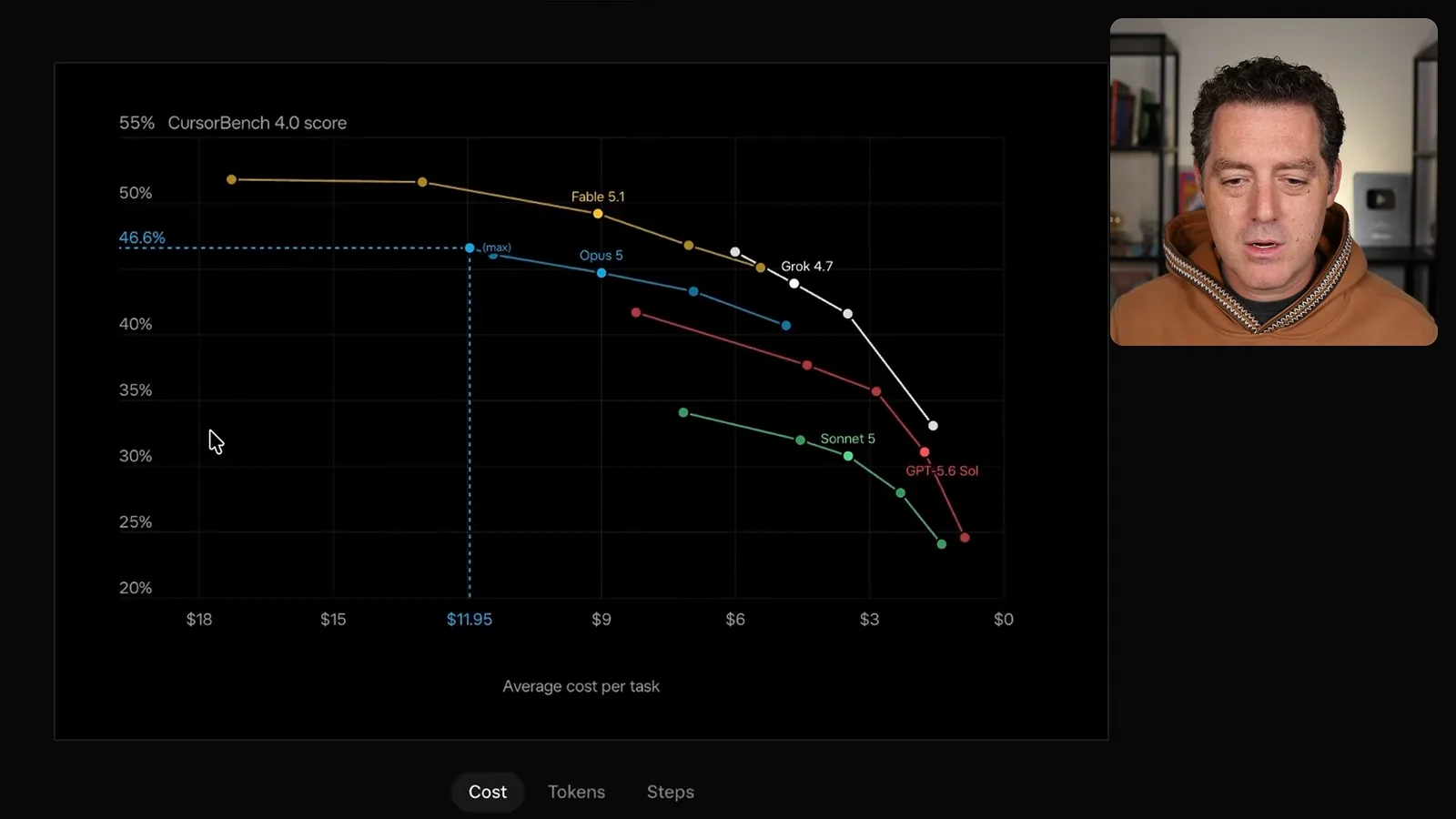
CursorBench plots score against average cost per task. xAI owns Cursor, a relationship to keep in mind when considering this comparison. The chart shows Grok 4.7 improving from roughly 33% at low effort to 46.3% at extra-high effort; its top setting is close to, but below, Opus 5 in the displayed comparison.
The chart also compares output tokens and steps per task. Cost depends on both token use and price, so a model that uses more tokens can still be cheaper if each token costs less. Fable 5.1 scores higher in the displayed coding comparison but is substantially more expensive.
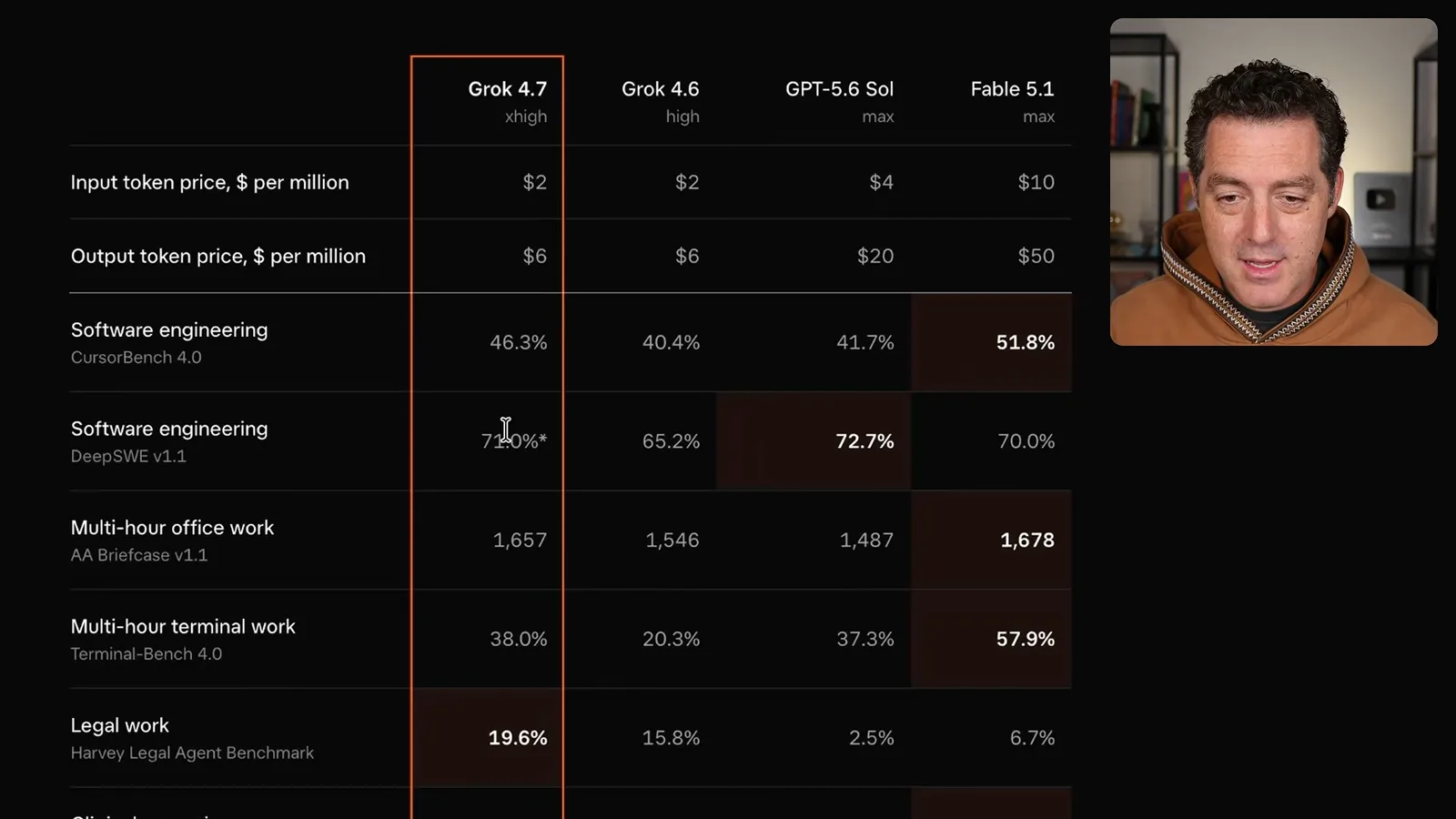
On the shown DeepSWE 1.1 table, Grok 4.7 scores 71%, GPT-5.6 Sol 72.7% and Fable 5.1 70%. I notice that GPT-6 Astra is missing from this particular company table, even though it appears elsewhere in the release material. Selecting which models to show affects the impression a chart gives.
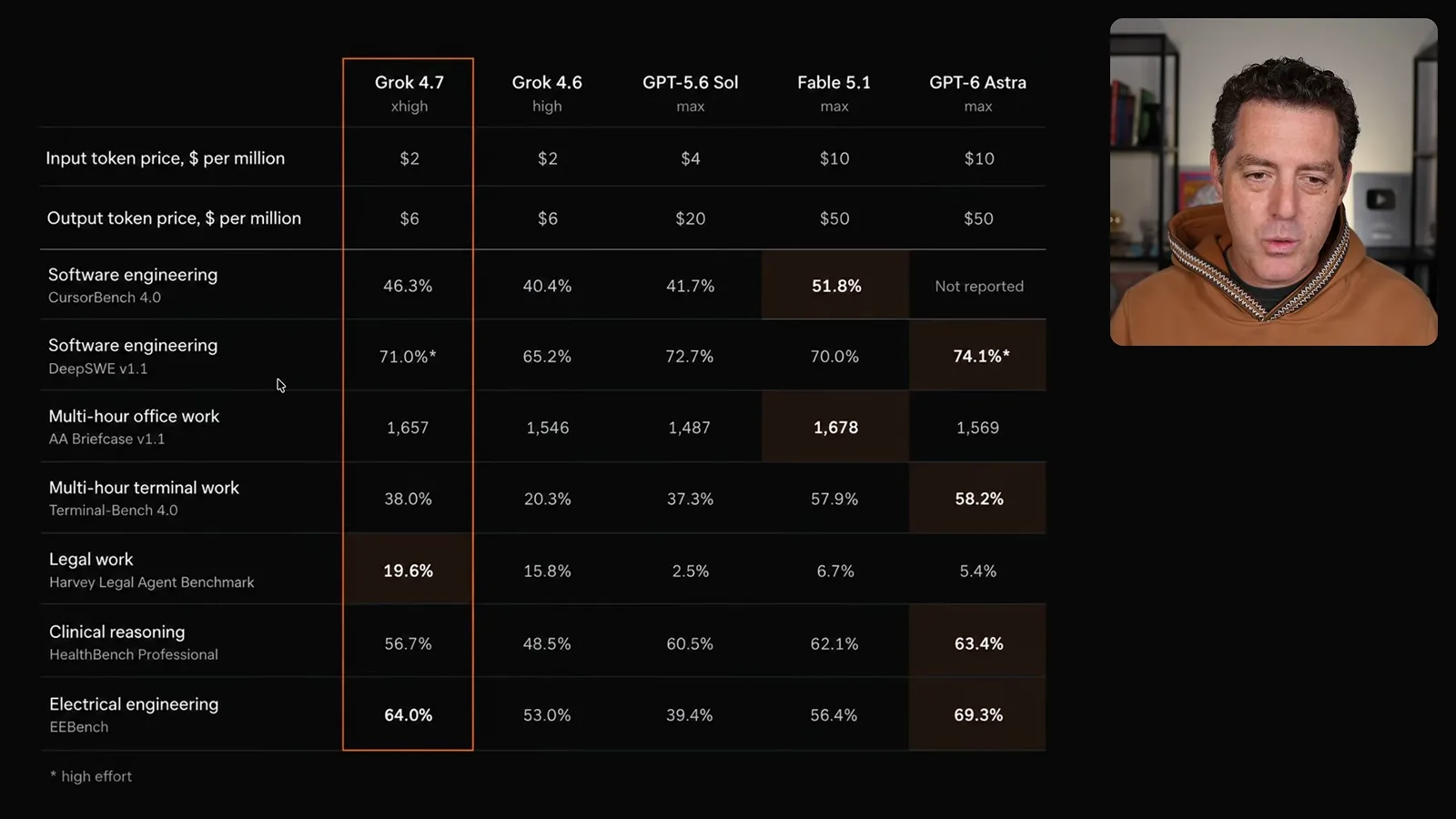
I asked Astra to recreate the table with its own score included. The resulting comparison shows Astra Max at 74.1% on DeepSWE, ahead of Grok’s 71%. This is a chart I assembled for comparison, and its figures and settings need to be understood in their respective evaluation contexts.
Knowledge work, price and safeguards
He examines legal and terminal results, token prices, knowledge-work scores and the company’s safeguard claims.
On Terminal-Bench 4.0, the table shows Grok at 38%, below Fable 5.1 at 57.9% and Astra at 58.2%. On the displayed Harvey legal-agent benchmark, Grok scores 19.6%, higher than the other models in that table. Berman also cites a separate Muse Spark result as higher still.
The video quotes Grok 4.7 at $2 per million input tokens and $6 per million output tokens. Berman sees a model near, though not always at, the leading edge for considerably less than some competing frontier models. Different users may rationally value the best answer or a lower cost differently.
Berman relates this to enterprise adoption of open-weight models, citing a chart in which usage volume and provider revenue follow different patterns. He argues that some workloads need efficient automation rather than the absolute highest score, while other users will pay more for a better result.
xAI’s release also shows Astra on other evaluations. On the reported GDPval comparison, Grok 4.7 scores 1695 Elo, between Fable 5.1 at 1735 and Astra at 1542. On AA Briefcase the displayed Grok and Fable scores are also close. The model is competitive on some tasks and further behind on others.
The company describes a new safeguard stack and reports improvements in refusal and jailbreak resistance, including dual-use domains. Those are the company’s claims about its evaluations. Berman also notes Musk’s explanation that the release was delayed because the model could give up too early or fail to check its work rigorously.
Independent index and practical limits
He reviews a composite ranking, a third-party demo and context limits, while emphasizing his limited testing.
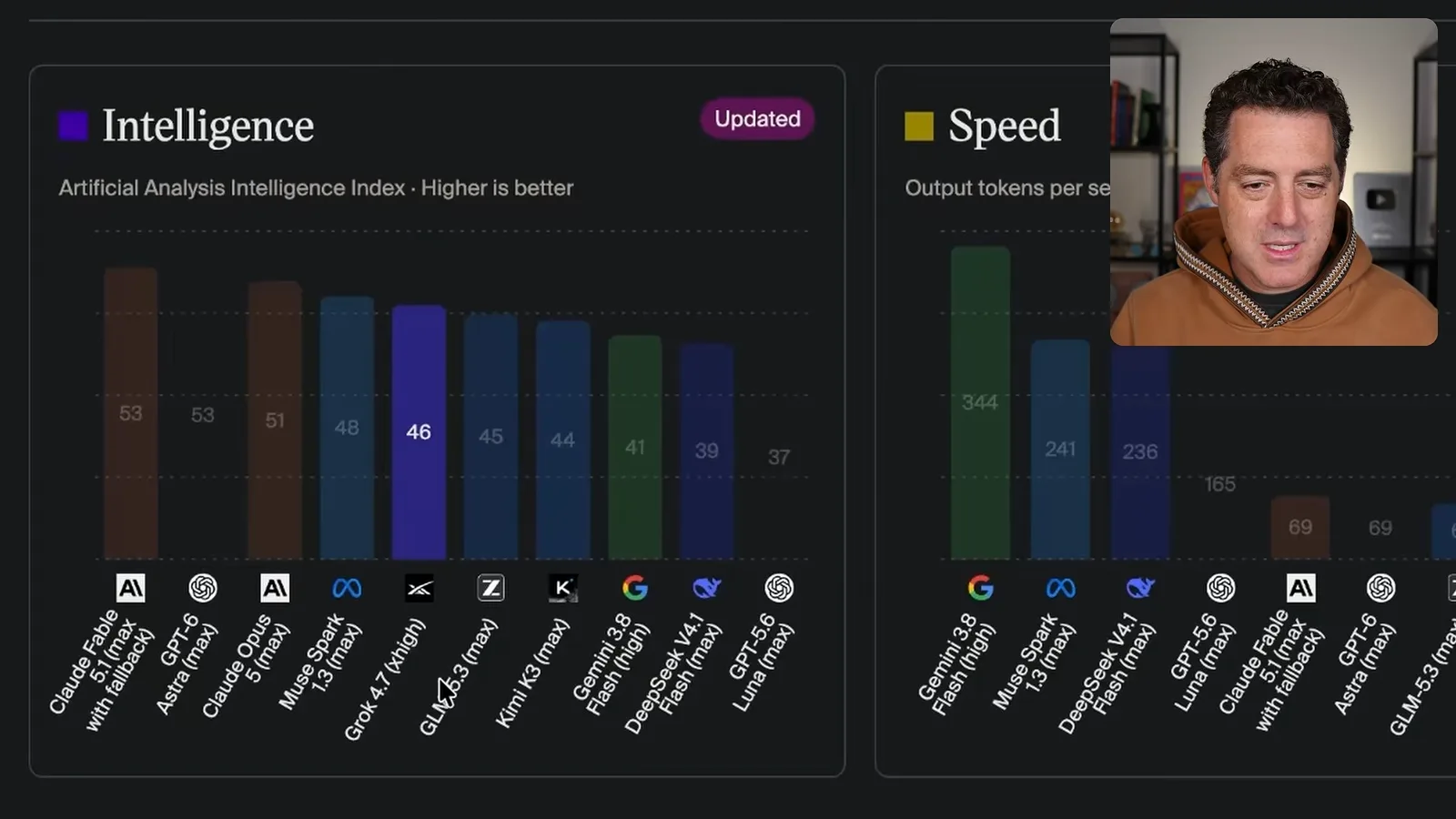
Artificial Analysis places Grok 4.7 fifth on the displayed intelligence index at 46, behind several models including Fable, Astra, Opus and Muse Spark. This composite provides another comparison, but it does not replace testing the model on the work a user actually cares about.
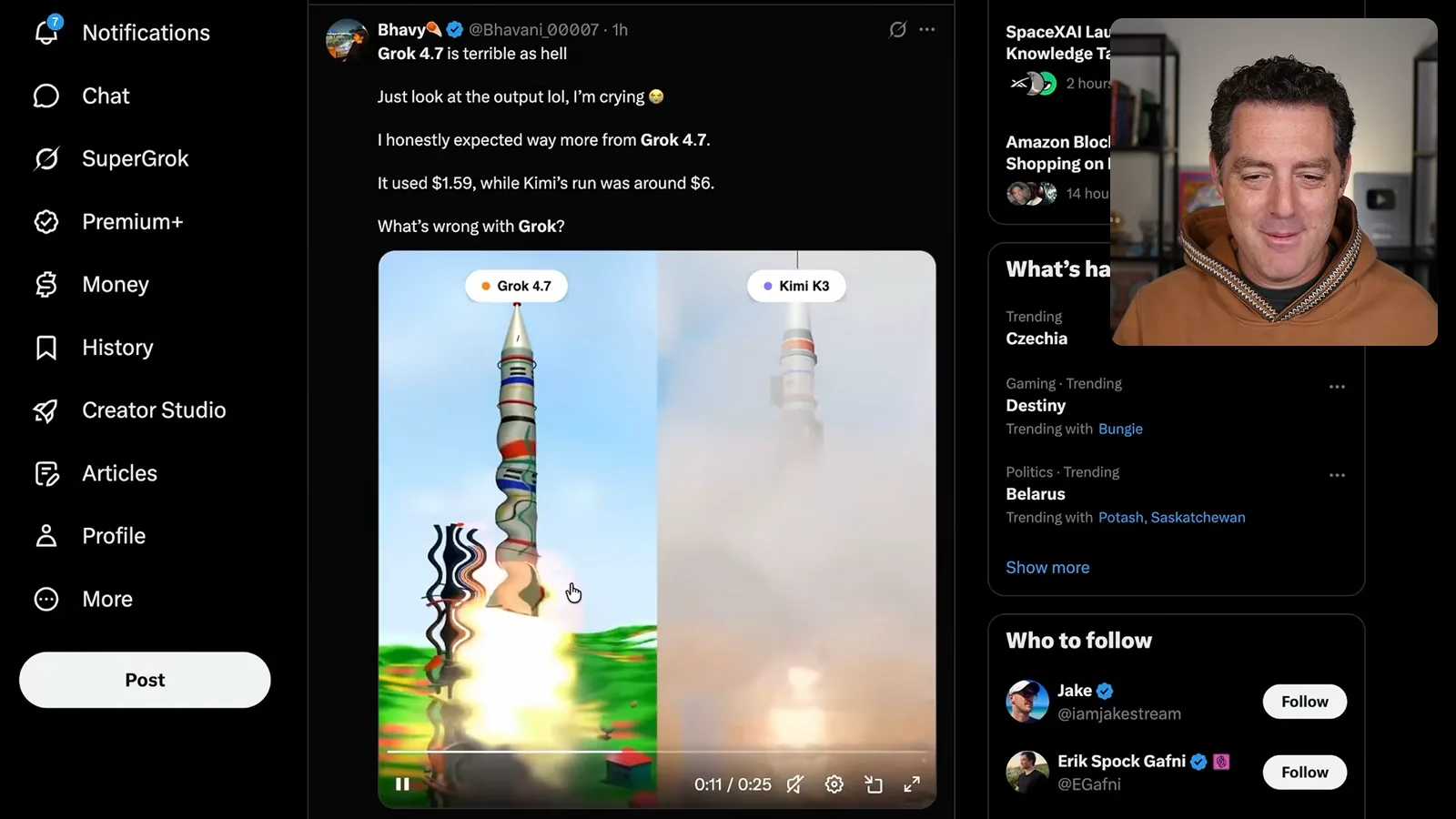
Berman shows a third-party rocket animation comparison in which Grok’s result looks poor beside Kimi K3. He cautions that he does not know the settings used. Artificial Analysis also reports higher token use for Grok 4.7, which can raise cost per completed task despite low token prices.
The quoted context window is 500,000 tokens, versus one million for several competing models. Berman considers Grok 4.7 a useful, cost-effective competitor that is close to the frontier in some areas, and hopes a future Grok Bot update will use it. His conclusion remains preliminary because his own testing was limited.
같은 채널의 다른 글
 25:50EN
 32:20EN
 45:08EN
 0:32EN
 12:14EN
 10:36EN