30초 요약
Matthew Berman and Nick Wentz explore creative agents with Fabian Stelzer, evaluate GPT-5.2 and GDPval with Tejal Patwardhan, and discuss enterprise trust with Vanta’s Christina Cacioppo and Jeremy Epling. Amplitude’s Spenser Skates closes with his view of AI analytics and the gap between hype and observed adoption. The discussion preserves claims and predictions as they stood at the December 12, 2025 broadcast.
- 1A multi-model creative workflowStelzer describes how Glif integrates specialized models and uses a knowledge repository to guide agent choices.
- 2A licensed experiment in fan mediaDisney and OpenAI announced a three-year character license and $1 billion investment; Stelzer’s ideas about new interactive formats are predictions.
- 3A benchmark for real tasksPatwardhan explains GDPval’s expert-judged, well-specified tasks and distinguishes them from complete jobs.
- 4Trust needs evidence and reviewEpling describes citations, expert evaluation and human approvals for security-related agent outputs.
- 5A gap between hype and practiceSkates says AI accelerates work but questions claims of immediate end-to-end automation; his company survey was self-reported.
핵심 정리
- Creative agents can combine specialized models and human-designed workflows while leaving people in charge of direction.
- GDPval measures selected, well-specified tasks, not the automation of entire occupations.
- Enterprise AI trust depends on evaluation, traceable evidence and human review.
- AI product teams need to monitor quality as models and inputs change.
- Skates sees data and integration as important to analytics while predicting that interfaces will evolve gradually.
챕터별로 다듬은 전문 읽기
AI news and prediction markets
The hosts discuss TIME’s AI selection, prediction markets and speculative economic forecasts.
On December 12, 2025, Matthew Berman and Nick Wentz open Forward Future Live with the week's AI news. They then speak with Glif co-founder Fabian Stelzer, OpenAI researcher Tejal Patwardhan, Vanta leaders Christina Cacioppo and Jeremy Epling, and Amplitude co-founder Spenser Skates about creative agents, evaluations, compliance and analytics.
The hosts discuss TIME's 2025 Person of the Year, the “Architects of AI,” and its cover echoing the famous photograph of construction workers above New York. Berman says prediction markets had anticipated the selection, while enterprise buyers were still questioning returns from AI investment.
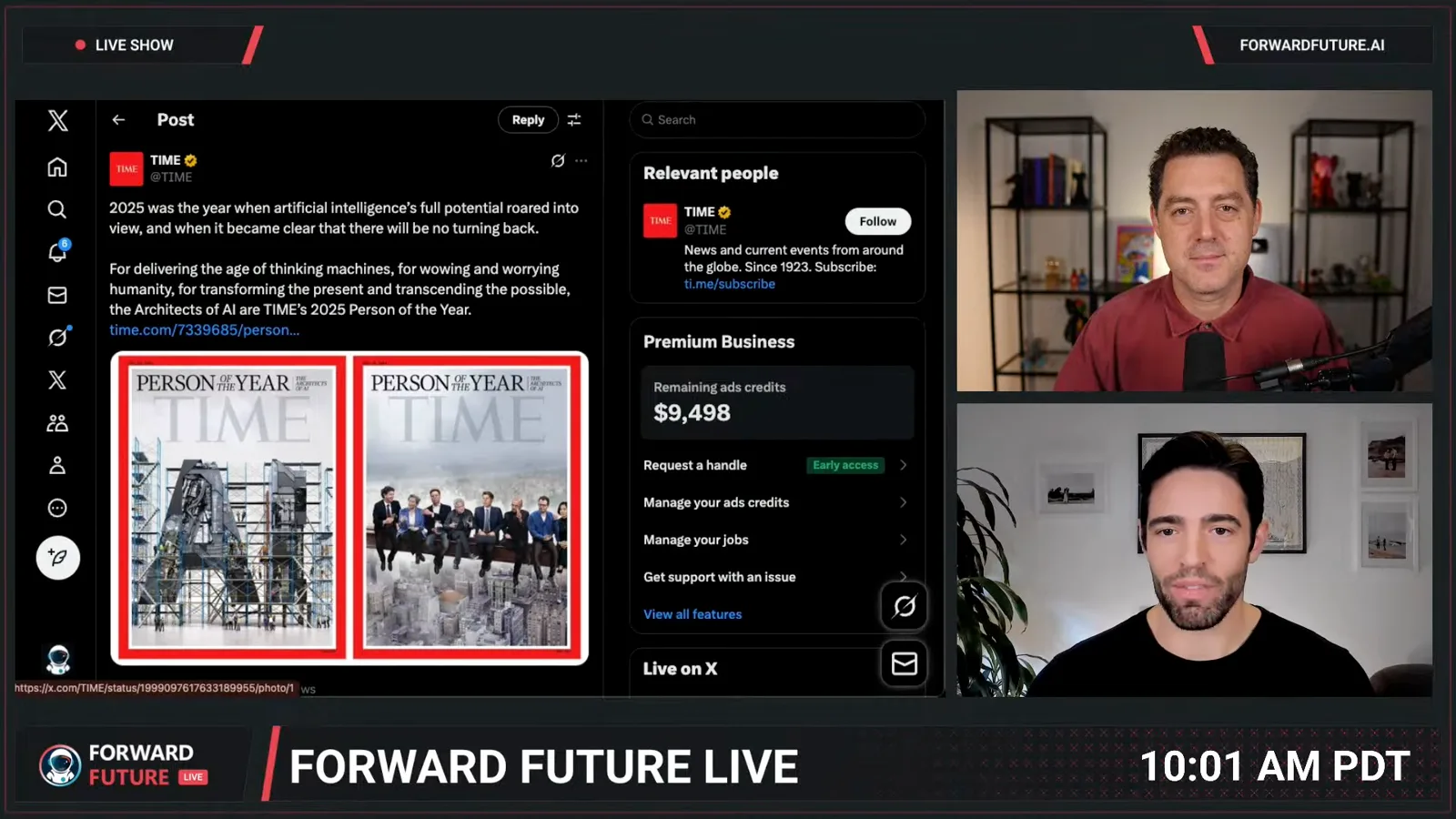
Wentz notes that the TIME cover borrows imagery from the 1932 photograph of workers lunching during Rockefeller Center construction. The hosts observe that the choice provoked a strong response online and discuss how prediction markets had anticipated the award.
Berman is intrigued by prediction markets' apparent accuracy on events such as model releases. The hosts speculate about whether informed traders might contribute to that accuracy, but offer no evidence of insider activity in this case; their exchange about legal rules is speculation, not a legal analysis.
The hosts also consider Nvidia CEO Jensen Huang's forecast that AI could expand world GDP from roughly $100 trillion to $500 trillion. Berman finds the possibility plausible but expects a rocky path; Wentz adds that Huang's advocacy of national AI infrastructure aligns with Nvidia's commercial interests. Both outcomes are predictions, not measured results.
Discussing the US and China, the hosts wonder whether competition for AI leadership could become winner-take-all. Berman says a hard takeoff by self-improving systems is one possible thought experiment, rather than a demonstrated outcome.
The hosts describe their enthusiasm for AI while acknowledging uncertainty around the economic transition and the distribution of gains. Wentz worries about countries becoming dependent on a small number of technology leaders, while Berman raises the possibility of concentrated outcomes if a self-improving system were to make a rapid leap.
Glif and creative agents
Fabian Stelzer explains orchestration, model selection and specialist workflows.
Fabian Stelzer describes Glif as a platform for building, finding and monetizing agents for creative work. Its immediate focus is marketing and AI video: a conversational agent can coordinate tools for generation, editing, voiceover and music, letting a person concentrate on creative direction.
Glif does not train its own foundation models, Stelzer says. Different video models have different strengths, so an agent builder can select among providers instead of committing every step to one model. At the time of the conversation, Glif was mostly using Claude 4.5 as the coordinating model while evaluating GPT-5.2.
Stelzer says no single video model is best for every task. In his experience some models are better suited to particular transitions or visual effects, so combining them is useful; a creative agent can carry out that selection on behalf of a user.
To help users choose without learning every tool, Glif is building a knowledge repository about model capabilities. Stelzer says the company feeds transcripts from its creators' weekly live discussions into that context, so agents can draw on working knowledge as the landscape changes.
Glif's weekly conversations among AI video creators become source material for the agents. Stelzer presents the transcripts as a growing context library, enabling the system to use practical observations from the people working with new tools rather than making every user track every model release.
The second layer of guidance comes from people who design specialized agents. Stelzer finds that specialized workflows often outperform general agents: their creators encode a repeatable process while leaving room for the model to adapt. Users benefit from the agent creator's expertise without needing to know every prompt or transition technique.
Disney, fan creativity and taste
Stelzer explores licensed characters, interactive media and creative judgment.
The hosts ask about Disney's newly announced OpenAI partnership. The December 11, 2025 agreement described a three-year license for Sora videos using more than 200 Disney, Pixar, Marvel and Star Wars characters, plus a $1 billion Disney equity investment in OpenAI; the companies said the license excluded performers' likenesses and voices.
Stelzer sees the agreement as a way for fans to experiment with familiar worlds, including creators whose ideas would not enter a conventional writers' room. He thinks studios could learn from popular fan work, but his larger prediction is that easy generation might change the medium itself rather than simply produce more conventional films.
Stelzer imagines an audience's experiments might inform established franchises, but he is more interested in what entirely new formats might emerge. He uses the printing press as an analogy for how a technology can generate new forms that its first users did not foresee.
Asked what personalized media might look like, Stelzer cautions that new technology often produces forms people do not anticipate. He imagines game-like experiences in which a rights holder defines characters and relationships while individuals create within those rules, perhaps for an audience of one.
One hypothetical is a persistent fictional universe with rules set by the intellectual-property owner. Fans might make their own experiences inside those rules, Stelzer says, allowing the individual to act as both creator and viewer. The particular format is a thought experiment, not a term of the announced deal.
Berman asks what happens when someone bypasses a model's safeguards and makes inappropriate content with a valuable character. Stelzer says Disney must weigh that risk against missing a generative-media transition. He expects the boundary to change over time; neither he nor the hosts knows the private revenue terms or whether licensed characters will be available through Glif's API.
The participants speculate about who benefits more from the Disney–OpenAI deal. Stelzer says he lacks enough information about the prior legal context to assess it confidently, though he sees a potential mutual benefit. The hosts also wonder about advertising or fees; no revenue-sharing arrangement is established in the conversation.
Berman asks whether Glif will be able to use the licensed characters through a Sora API. Stelzer doubts it, noting that some consumer features were not exposed through an API at the time, but acknowledges that he does not know the deal's details.
Stelzer argues that human ideas and creative judgment still matter when many people can access similar models. Tools can lower the cost of making an idea, but a distinctive idea and a creator's context may help work stand out amid abundant output.
Berman questions whether broad cultural taste remains as important if people make media for themselves. Stelzer suggests that creating something one personally loves can also be a starting point for finding others who share that taste. He mentions a short-form video agent under development as a possible workflow for the hosts.
After Stelzer leaves, the hosts revisit the question of taste. Berman says his view is still evolving: if people increasingly make media for themselves, it may change what it means for taste to differentiate a creator from everyone else.
GPT-5.2 and GDPval
Tejal Patwardhan explains practical task evaluations and their limitations.
The hosts welcome Tejal Patwardhan, an OpenAI researcher who co-led GDPval. She calls GPT-5.2 a substantial improvement on enterprise tasks, especially those producing slides, spreadsheets and other artifacts, and says the model's presentation and formatting can make its work easier for a human to inspect.
On spreadsheets, Patwardhan says formatting is more than decoration. A financial model with readable structure and clearly marked assumptions is easier for a supervising person to understand, so OpenAI treated presentation quality as part of useful output.
Patwardhan explains why GDPval was created: competition math and other academic tests are useful, but do not necessarily resemble the work people do. The evaluation compares outputs on well-specified tasks from 44 occupations with work by professionals, using expert judges. The tasks span multiple industries and artifact types.
She reports that GPT-5.2 Thinking won or tied the human expert in 70.9% of comparisons and GPT-5.2 Pro in 74.1%, versus 38.8% for GPT-5 in OpenAI's published table. These are the company's results on selected, well-specified tasks with substantial context, not a finding that whole jobs have been automated.
Patwardhan encourages people to try examples in fields they understand, whether accounting, law or media. She was surprised by how quickly the models improved, and says better performance on practical computer work may make progress visible to people who previously found chatbots unhelpful.
Berman asks whether GDPval can define when AGI has arrived. Patwardhan declines to set a threshold: an evaluation is evidence about a capability, not a perfect measure of a broad concept. She wants future versions to make the tasks more realistic and provide a clearer signal about the pace of progress.
For Patwardhan, unexpectedly fast benchmark gains also have a forecasting value. A test she expected to remain challenging for many months improved rapidly, which changed her own assessment of how quickly people might encounter more capable systems in their work.
Asked about a reported reduction in hallucinations, Patwardhan says she did not work on that particular evaluation and cannot explain its measurement. On prediction markets, she points to ForecastBench as a related evaluation and says testing model forecasts against real outcomes could be interesting. Berman describes an idea for a small experimental forecasting system, not a result.
Berman sketches an experiment that would use deep research to investigate prediction-market questions, make small bets and learn from results. Patwardhan treats this as an interesting proposed test; the hosts have not yet run it or established that the strategy works.
Generalization, compute and taste
Patwardhan considers different benchmarks, inference efficiency and measuring subjective judgment.
The discussion turns to ARC-AGI, which tests generalization on novel puzzles. Patwardhan says it serves a different purpose from measuring tasks encountered at work; she is especially interested in evaluating whether models accelerate science, research and practical tasks.
Patwardhan says people debate the meaning of generalization, but argues that models can already be useful without resolving that debate. She expects capabilities involving documents, spreadsheets and computer actions to matter because these artifacts are central to much knowledge work.
The researcher also describes a tradeoff between maximum capability and the compute spent at inference. A user may prefer a fast response for one task and accept a longer wait for a better answer on another. A useful comparison considers how effectively models use their token and compute budgets as well as their best attainable result.
Wentz asks whether an evaluation could measure creative taste. Patwardhan suggests first specifying the domain—research, music or visual design—and then choosing prompts, graders and evaluation methods. She thinks judgment can improve through experience, although the hosts note that broad popularity and the preferences of a small audience are different targets.
The group considers whether taste can have a single benchmark. A test would need to specify the audience as well as the domain: what appeals to a broad audience may differ from what a small group values. Patwardhan notes that judging some film and editorial tasks in GDPval already involves elements of expert taste.
Vanta and enterprise trust
Christina Cacioppo and Jeremy Epling explain compliance, security agents and human review.
Cacioppo introduces Vanta as a platform for security programs, audits and risk management. She explains that a software vendor selling to a business often needs to demonstrate controls, policies and independent audit evidence before the customer will trust it with sensitive data.
Cacioppo describes the sales cycle in concrete terms: a potential customer may ask a startup to explain security practices before entrusting it with important company data. Vanta helps assemble evidence of those practices and communicate it to that customer.
Vanta tried automating security questionnaires with earlier machine-learning systems and found the answers unsatisfactory, Cacioppo says. A later generation of language models made the product viable; the lesson was that a problem can remain real for years before the technology is good enough to address it.
The familiar questionnaire can contain hundreds of security questions. Cacioppo says AI can also help the recipient of those answers flag issues worth examining, rather than merely helping a vendor fill in the form. She presents this as an aid to a human review process.
For its first customers, the main obstacle was not explaining that compliance was painful. Cacioppo says companies were skeptical that software could make an audit easier while maintaining its quality. Early sales often involved convincing buyers that a software-based process could work where they expected professional services.
Epling says agents are changing both sides of security: attackers can use automation, while defenders can use agents to review vendors and prioritize alerts. He attributes Vanta's opportunity partly to the data and integrations it has accumulated, which he says can help tailor advice to a customer's systems.
Epling says agent systems depend heavily on relevant data. In Vanta's case, he says integrations and past security-program information help the company surface priorities and suggest improvements rather than leaving a team to sort through large volumes of alerts unaided.
On unreliable outputs, Epling describes using security experts to evaluate answers, tuning systems to decline when uncertain, and showing citations and the documents used. He says customers often start with human review and approval, handing off more responsibility only as they develop trust. These are the company's practices and aims, not a guarantee that answers are correct.
Epling gives policy drafting as a collaborative example. The system can ask a small business plain-language questions about vulnerabilities and incident response, then turn the answers into an artifact an auditor can understand. The human is involved during the work rather than only reviewing a final document.
Berman presses on responsibility when a subtle mistake reaches production. Cacioppo sees responsibility in the relationship between the person using the product and the product builder: vendors should make their systems understandable, provide opportunities to check work and improve after mistakes. She cautions that perfect detection is not realistic.
Cacioppo compares verification to reviewing code produced by a coding agent. The product builder should provide points where the person can understand and course-correct the work; even with checks, errors can still slip through, and repeated mistakes can erode trust in the product.
Adoption, evaluation and building software
The Vanta leaders discuss quality metrics, changing models and enterprise founders.
Cacioppo says the enterprise security teams she meets are interested in help with large workloads, but need to understand how much trust to place in an agent. Epling adds that a new model can raise answer quality or unlock computer-use tasks, so the team revisits problems that had previously seemed impractical.
Epling's preferred measure for questionnaire automation is the rate at which a person accepts an answer without editing it. He says Vanta also tests different models through an internal platform and compares them on its own evaluations. Switching to a better-suited model can sometimes improve results more than further prompt or retrieval tuning.
When reviewing a prospective vendor, Epling says the valuable outcome is not merely a fast document. A system should collect evidence, find questions specific to the customer's situation and bring humans to the decisions and conversations that matter.
Cacioppo says AI products require continuous evaluation because model behavior or incoming data can change even when the application team has not deliberately changed its code. In her account, this makes quality monitoring and ownership different from a conventional deterministic software workflow.
For founders building enterprise software, Cacioppo says personal relationships and trust still matter even if the product changes. She admires small, independent businesses as an alternative path and believes AI may help more founders pursue them. A prototype is easier to produce, she adds, but the rest of building a business remains difficult.
Cacioppo says the first stage of software creation may now be much faster, but reaching a working enterprise business still requires all the difficult follow-through. For her, access to customers and the trust built through personal interaction remain central even when the technical solution changes.
Amplitude and AI analytics
Spenser Skates describes the company’s history, product transformation and MCP interface.
Spenser Skates explains that Amplitude helps companies understand user behavior, run experiments and act on product insights. He recalls the 2015 decision to offer 10 million events free, enabled by the company's database economics, as a way to attract startups and grow adoption.
Skates recalls that Amplitude grew from an earlier voice app. Although speech recognition has improved, he is unsure whether voice will become a dominant interface: latency and the loss of immediate feedback can make a conversation with a computer feel less natural than one with a person.
Amplitude began with a voice-recognition product called Sonalight. Skates says the long delay between speaking and a system responding has been a persistent challenge for voice interfaces; Berman remains optimistic about wearables and voice, while Skates says the decisive use case is still uncertain.
Skates says Amplitude's AI transition gathered momentum around its 2024 acquisition of Command AI, which brought both product capabilities and AI experience. He describes further acquisitions and two reorganizations of engineering, product and design, replacing a long fixed roadmap with faster iteration around available capabilities and customer needs.
Skates says Amplitude shipped several AI features and was preparing additional releases. His larger point is that product development now requires repeatedly assessing the models' current capabilities and how people actually work, rather than simply executing a fixed multiyear plan.
Amplitude's MCP server, Skates says, gives external AI assistants an interface to query its data. An agent can break a question about onboarding or a popular feature into several queries and return a report. This is his description of the intended workflow, not an independent test of its reliability.
Asked whether external assistants threaten Amplitude's user interface, Skates welcomes reaching people through tools such as ChatGPT or Claude. He argues that the enduring value is access to behavioral data and the ability to query and act on it, rather than keeping users inside a particular dashboard.
The discussion connects Amplitude's strategy to data warehouses: Skates says the company focuses on behavioral data while other financial or customer data may live elsewhere. Its role, as he describes it, is to make behavioral information useful across tools rather than require every user to work in one interface.
Adoption, productivity and future interfaces
Skates discusses customer behavior, reported productivity and his predictions for analytics.
The hosts ask whether agents browsing for people are already changing website analytics. Skates says that, in the customer patterns he sees, conventional human web and app use remains relatively consistent, with chatbot use appearing as an additional pattern. He cautions that broad adoption is still early; this is an observation from his customer base, not a measurement of the entire internet.
Skates argues that AI hype has run ahead of practical deployment. In his view, existing tools can speed up work while falling short of replacing whole end-to-end jobs autonomously. At Amplitude, he says a self-reported engineering survey had a median perceived productivity improvement of 40%; it is not a controlled productivity measurement.
Skates says a median 40% improvement reported by Amplitude engineers would be significant, but emphasizes that it is very different from a thousand-percent transformation. His advice is to learn the tools while distinguishing measurable day-to-day gains from the most ambitious claims about replacement.
He sees a large opportunity for AI to surface analyses that nobody currently has time to request, and predicts a major shift in analytics over the following two years. He stresses product design and organizational adoption: the tool must fit existing work closely enough that people will use it.
For adoption, Skates favors simple improvements that fit an existing workflow. He cites meeting tools and coding autocomplete as examples of reducing friction before asking people to adopt a radically different interface. He sees product craftsmanship and understanding a user's work as key to the next step.
As an example, Skates contrasts an incremental coding interface with a more autonomous agent. He argues that starting with a familiar workflow and adding autocomplete gave users an accessible first step. Berman counters that building toward more capable autonomous agents could also be a strong long-term strategy.
For analytics, Skates predicts a similar sequence: first, a chat interface alongside familiar dashboards and controls, helping experienced users do their existing work faster; later, more people might ask questions without building dashboards at all. He labels this possible second phase “vibe analytics,” a forecast rather than a product outcome.
The hosts close the conversation by returning to the idea that information can reach users through whichever interface they choose. Skates thanks them, and Berman and Wentz wrap up the December 2025 broadcast after thanking all five guests.
같은 채널의 다른 글
 34:21EN
 Matthew Berman· 2026년 10월 27일Matthew Berman Examines Anthropic’s IPO Filing, AI Growth and GovernanceMatthew Berman, Sam Altman · Forward FutureThe presenter reviews the S-1’s financial metrics, compute strategy and voting structure while questioning the tension between rapid AI development and safety.
 25:50ENMatthew Berman· 2026년 10월 24일Kimi K3.1 Pro Tested: Strong 3D Demos, Uneven Results and Competitive PricingMatthew Berman · Forward FutureMatthew Berman tests the open-weight model on coding, 3D rendering and visual explanations, then compares benchmark results and prices.
 32:20ENMatthew Berman· 2026년 10월 23일Who Is Local AI For? The Costs, Trade-offs and a Hybrid FutureMatthew Berman · Forward FutureMatthew Berman weighs data control and independence against hardware cost, setup complexity and inference speed.
 1:03:37ENMatthew Berman· 2026년 10월 23일Matthew Berman’s Team Tests Kimi K3.1 on Animation, Games, and ChartsMatthew Berman, Alex, Brian · Forward FutureA live team AMA turns into an informal test of Kimi K3.1, from personal-agent workflows to motion graphics, a browser game, and a benchmark chart.
 0:53ENMatthew Berman· 2026년 10월 22일Sam Altman on AI and the Discovery of New KnowledgeSam Altman · OpenAIAltman expects progress in mathematical discovery to extend to biology, materials and energy.
 0:22ENMatthew Berman· 2026년 10월 21일A Robot Bodyguard Video Shows Dramatic Rescue ScenariosMatthew Berman · Forward FutureMatthew Berman reacts to a short robot demonstration depicting fighting and vehicle-rescue scenarios.