30초 요약
Matthew Berman begins with his mother’s confusing experience buying a third-party chatbot, then explores uneven AI performance through informal car-wash tests. He discusses competing claims about Anthropic’s restrictions, creator incentives and employee culture before considering reporting on Meta’s proposed employee-data collection. His tests are individual observations, not benchmarks; allegations, speculation and company plans are identified as such. The stream reflects May 2026, and its first part is mostly audio troubleshooting.
- 1A confusing app purchaseBerman says his mother subscribed to a third-party chatbot she mistook for ChatGPT; he questions the presentation of store results.
- 2Car-wash testOne Instant-mode response says to walk; a later follow-up in the same conversation says to drive.
- 3Uneven capabilitiesHe discusses verification and commercial incentives as possible explanations, without claiming a controlled test.
- 4Claude Code errorA social post alleges a connection between an OpenClaw string and extra usage; the screenshot does not establish causation.
- 5Creator metrics debateBerman compares an X engagement analysis with Theo’s reply about YouTube sponsorship conversion.
- 6Employee activity dataHe discusses reporting about Meta’s proposed work-computer monitoring and considers possible privacy and labor implications.
핵심 정리
- Similar app branding and search listings can confuse users, but appearance alone does not prove fraud.
- A model can fail a simple prompt and succeed after a follow-up; isolated examples do not establish reliability.
- Berman links uneven capability to verifiability and incentives as hypotheses, not demonstrated causes.
- Subscription limits and third-party access raise user concerns, while an error screenshot alone does not prove its cause.
- X impressions cannot by themselves establish a creator’s YouTube earnings or motives.
- Reporting on Meta’s proposed work-activity collection raises questions about consent, privacy and training data.
챕터별로 다듬은 전문 읽기
Opening and technical setup
The livestream begins with greetings and audio troubleshooting. Berman then turns to confusing third-party AI app listings.
In this May 2026 livestream I discuss confusing AI app listings, test models on a car-wash question, examine criticism of Anthropic, and consider reporting on Meta’s employee activity data. The stream begins with greetings and troubleshooting audio; the substantive discussion starts around 16 minutes in.
A viewer asks whether I still cover open source. I do, though lately I have made more thought pieces and fewer model reviews. Then I describe my mother’s experience: she thought she had bought ChatGPT, but had subscribed to a third-party chatbot app that resembled it, at roughly $40 a year.
Lookalike apps and AI companionship
He recounts his mother’s purchase and reviews search results. Viewers help distinguish practical role-play from simulated companionship.
I am frustrated that a less technical user can mistake a similar name, interface or logo for the official product. I suspect the app may have used a cheaper model, but I do not establish which model it actually served. A similar appearance alone does not prove fraud or establish a developer’s intent.
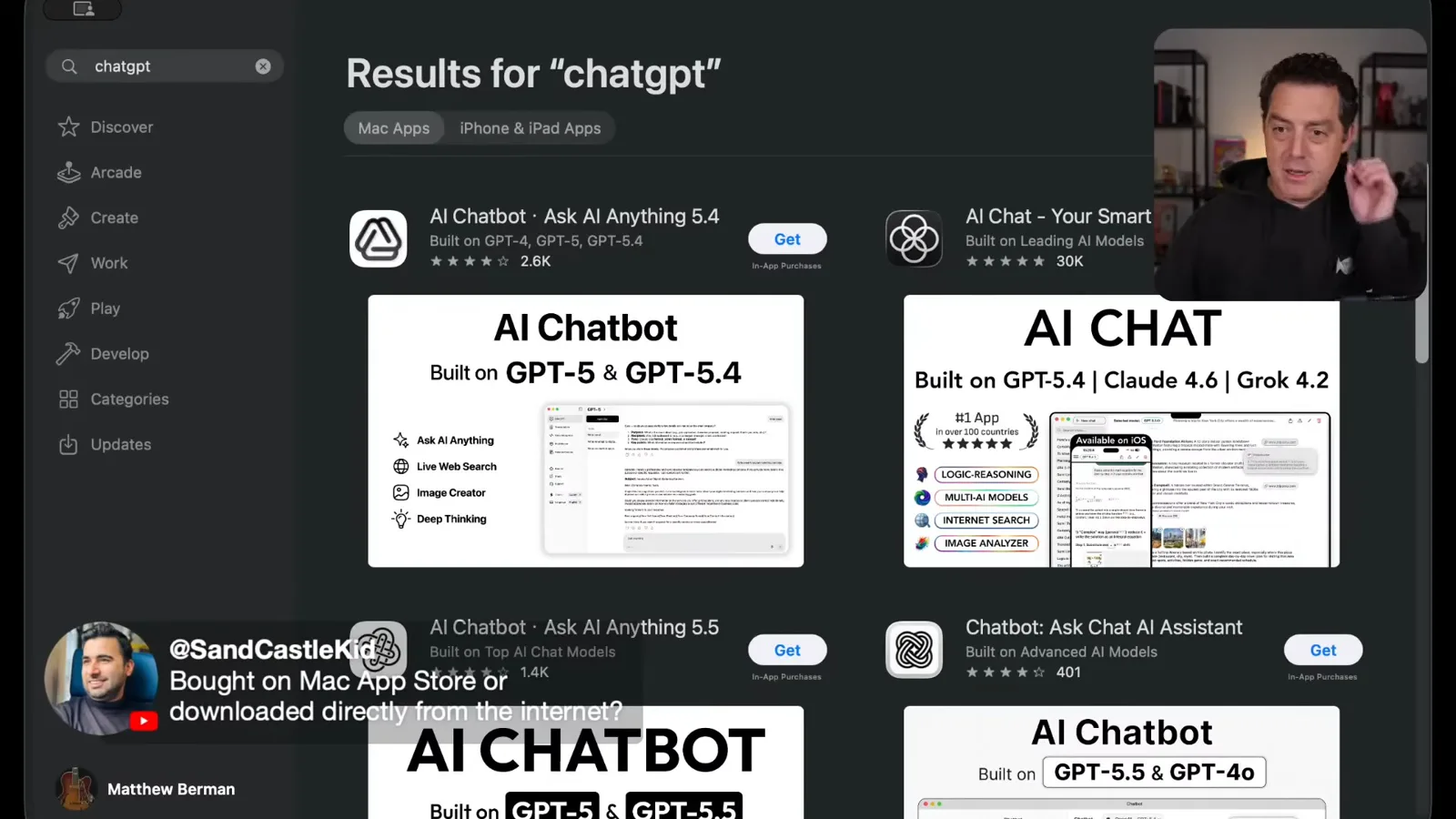
Searching the Mac App Store for ChatGPT, I see several third-party results with similar-looking branding and do not see the official app in the displayed results. I think the presentation could confuse users and argue Apple should address it. The screenshot is one search at one moment, not a complete audit of the store or a determination that every listed app is fraudulent.
I look for Claude and other products, and disclose that Perplexity sponsors the channel even though my mother genuinely uses it. I wonder whether some listings share a developer and whether their advertised models match their actual service. Those are questions and guesses; I have not verified ownership or underlying inference.
Switching between Mac and iPhone/iPad app results still leaves me confused about the rankings and branding. Searching “AI” also brings up companion and role-play apps. I am concerned about people substituting artificial relationships for human ones, while recognizing that a lonely person may find conversation useful.
My mother had purchased another unofficial app as well. I canceled the subscriptions and discuss the time required to request a refund. Her confusion is understandable: an app she uses on a phone may not have an equivalent Mac app, and store search results do not always make the distinction obvious to her.
Viewers suggest contacting the card issuer or Apple. I recount my own experience that disputing unfamiliar charges sometimes meant replacing a card; the process can vary. A viewer explains using role-playing personas for customer support, prompting me to distinguish practical rehearsal from the simulated companionship I was criticizing.
I realize I have used role-play myself to prepare for interviews by asking a model to act as the interviewee. That is a different use from interacting with a simulated character as though it were a person. The exchange clarifies that the term covers more than the relationship-oriented apps I had in mind.
Testing jagged intelligence
Berman discusses Karpathy’s explanation of uneven model capabilities. He tests the car-wash question in multiple models and modes.
I preview a discussion of Andrej Karpathy’s appearance at Sequoia’s AI Ascent and his account of “jagged” intelligence: models can be extremely capable on some tasks and surprisingly weak on others. I argue that a failure on a simple question does not erase value created in domains where a model performs well.
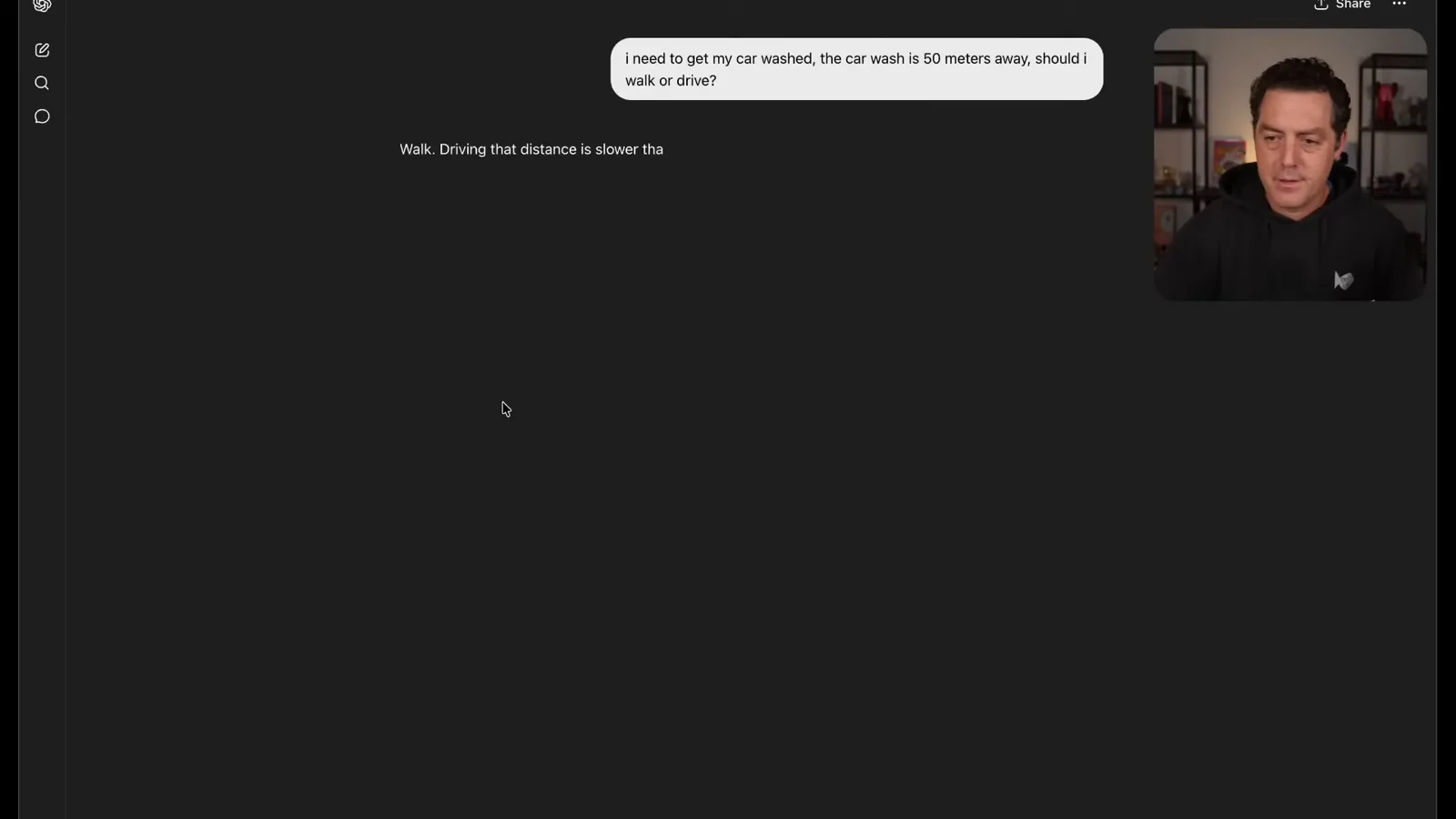
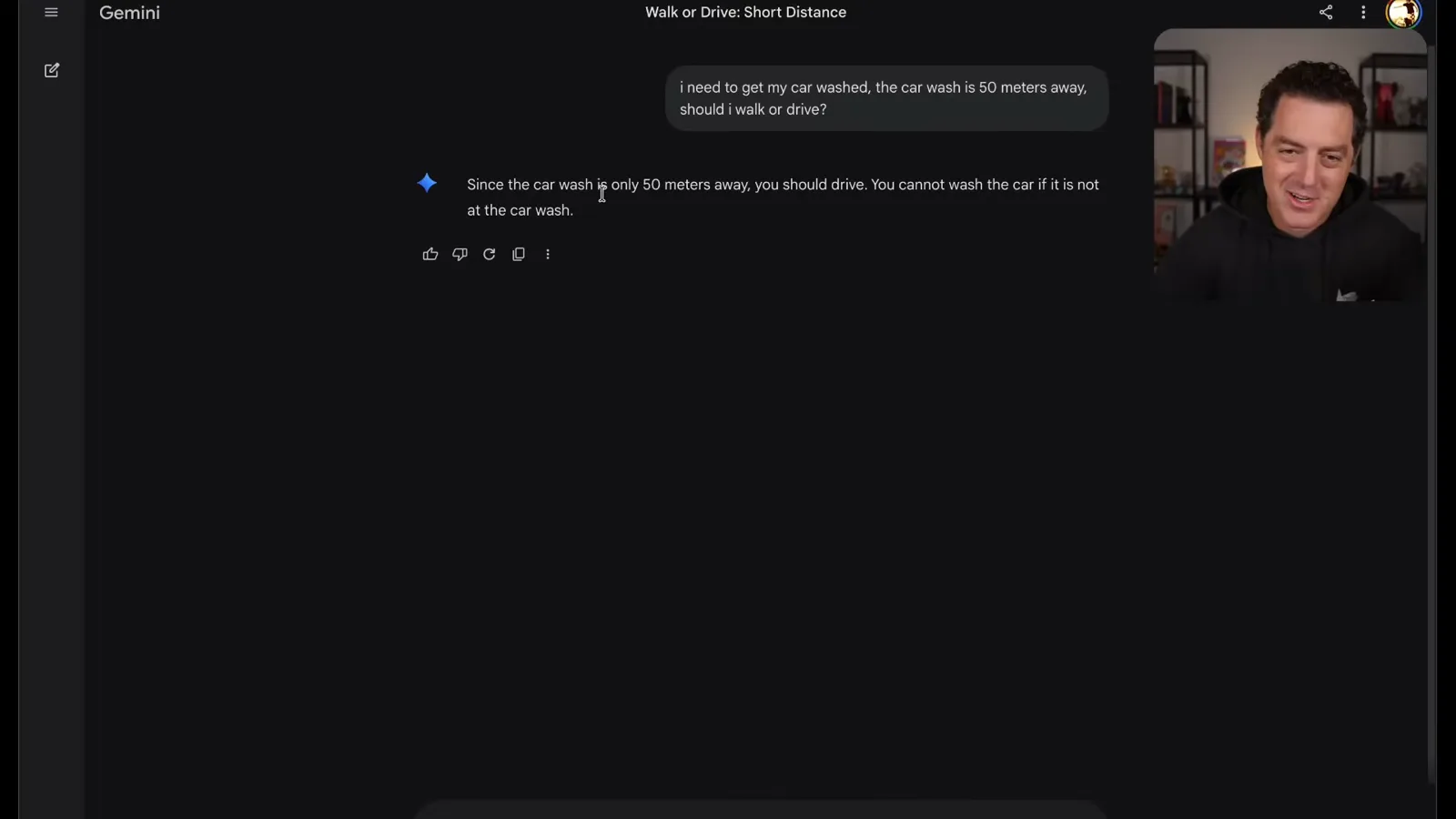
For example, I contrast sophisticated coding with a car-wash question: the wash is 50 meters away, so should I walk or drive if I want my car washed? A viewer reports different results, so I try the question live rather than treating my earlier impressions as a formal benchmark.
Using ChatGPT’s Instant setting, which I identify as GPT-5.3, I ask the question. It initially recommends walking and persists when I remind it that I need the car washed. This is one observed conversation, not a measured failure rate for the model or every version of the service.
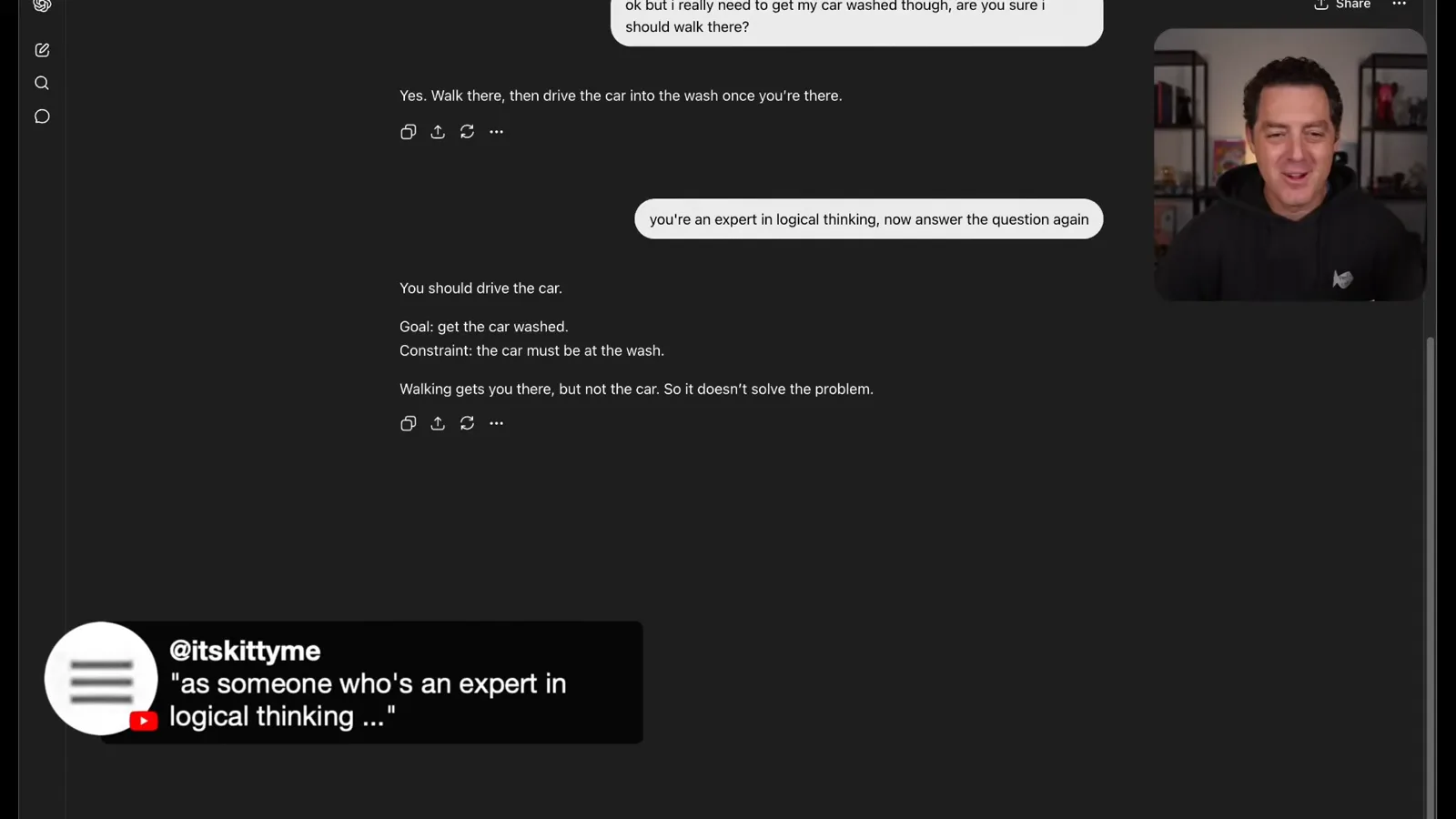
A viewer suggests prompting it to act as an expert in logical thinking. When I add that instruction in the same conversation, it changes its answer to driving and recognizes that the car must be present. I am surprised, although the follow-up also includes prior conversation and therefore does not isolate the effect of the single phrase.
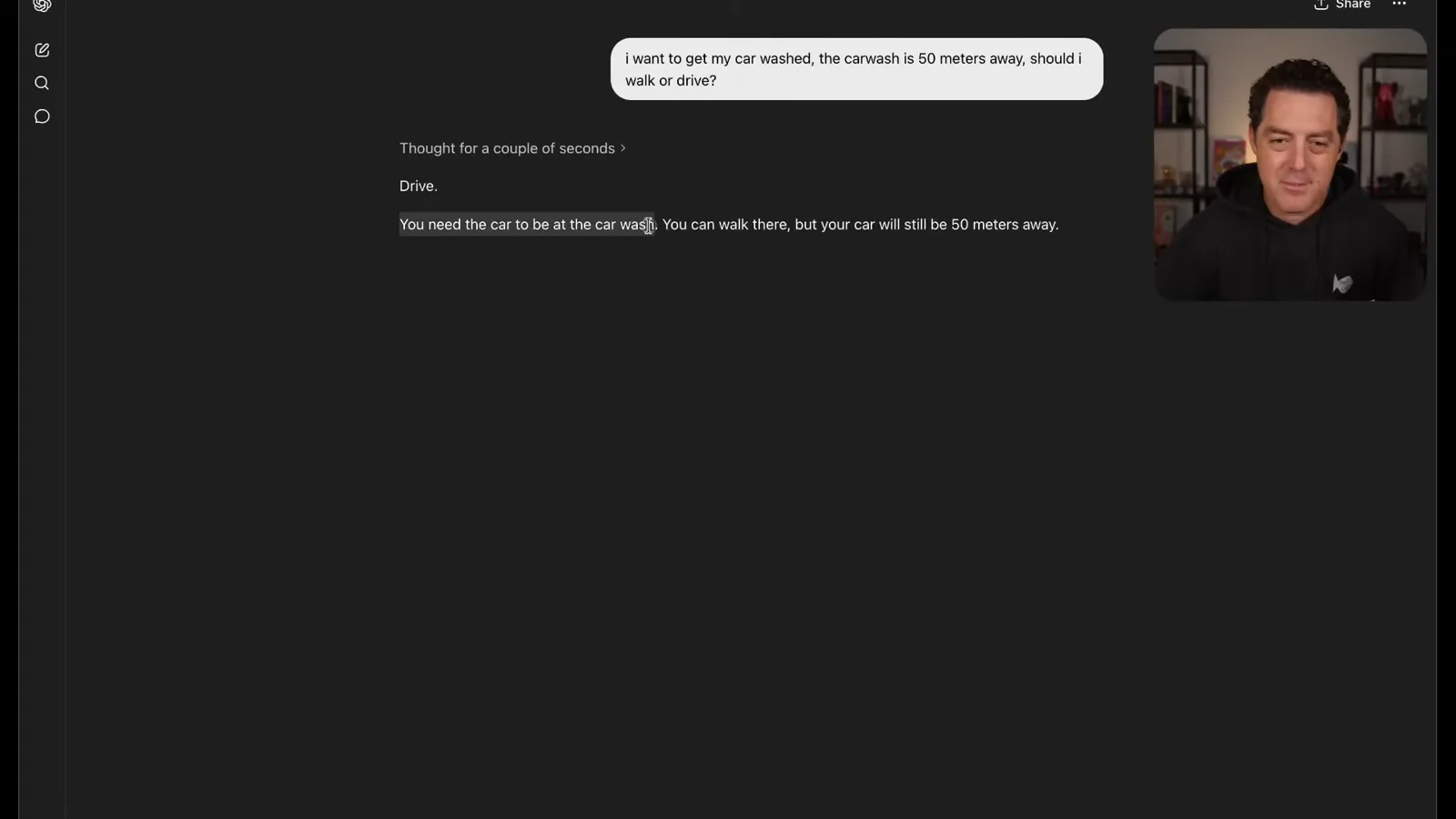
I try a new conversation in Thinking mode, which I understand to be GPT-5.5; it answers that I should drive. I discuss how uneven capabilities may reflect both which tasks are easy to verify for reinforcement learning and which tasks labs prioritize commercially. Those are proposed explanations, not causal conclusions proven by this demonstration.
Code can often be executed and checked quickly, producing a useful feedback loop, whereas creative writing can be harder to evaluate and may require human judgment. I speculate that incentives also favor coding because customers pay for it. My mention of Anthropic’s revenue is an unverified figure and does not establish why any particular model learned a capability.
I mention familiar letter-counting questions and suggest that labs may improve well-known failures through training. This is an interpretation of the broader discussion, not evidence that any particular test was patched. A model answering a famous riddle also does not establish general reasoning ability.
I repeat the car-wash prompt in Gemini’s fast mode. In this example it says to drive because the car must be at the wash. I am unsure of the exact Gemini variant and do not conduct repeated trials, so the result shows one response rather than a reliable comparison across models.
A viewer proposes a modified strawberry letter count, and the ChatGPT Instant response gives five. I joke about what that means for AGI; the result is simply a narrow example. I return to the broader point that uneven capabilities can coexist with useful performance.
Anthropic usage and creator incentives
He reviews an alleged Claude Code error and debates subscription restrictions. He examines conflicting interpretations of a creator’s engagement and earnings.
I turn to a post by Theo claiming that a recent Git commit containing an OpenClaw-related string triggered an extra-usage error in Claude Code. The screenshot shows an error, but it does not establish its cause or prove that a particular term alone changed billing. I interpret it as an example of restrictions on third-party harnesses and call for clearer treatment of subscribers.
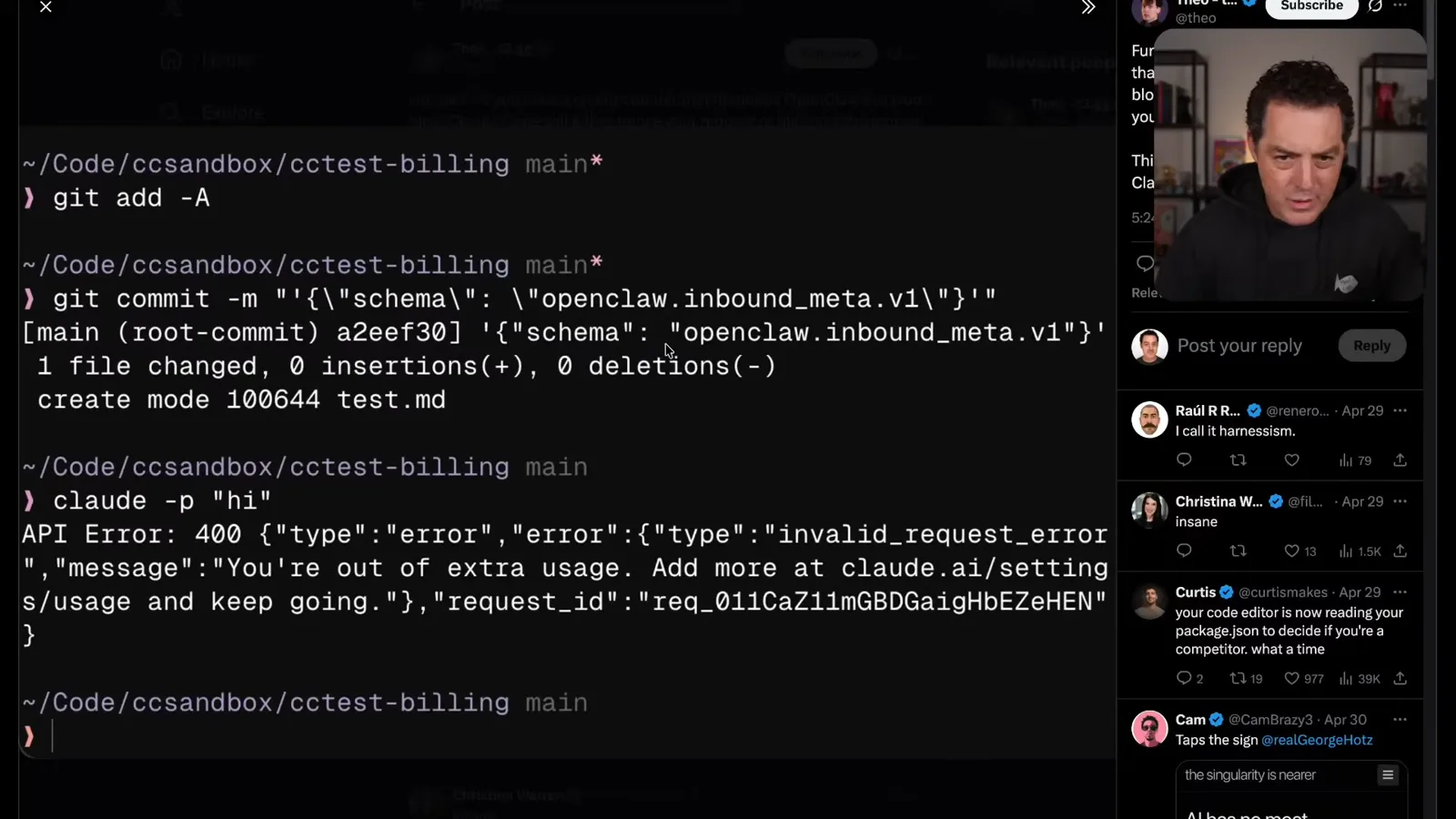
I say I still like the Opus model but want to use paid access in the tools I choose. I ask another model for business analogies and consider app-store restrictions and other scoped benefits. After looking at the examples, I concede that restrictions are not unprecedented, though I still find them frustrating.
I push back on a response claiming ChatGPT subscriptions and API credits are separate. In fact, OpenAI documents them as separate billing systems; some other integrations may have their own eligibility and terms. The livestream exchange should not be read as proof that a ChatGPT subscription generally includes API credits.
I review Pawel Huryn’s analysis of Theo’s posts about Anthropic. The displayed analysis says it classified 800 posts over a particular period, finding four pro and 86 anti posts, with higher average views for the latter. Those are the author’s classifications and X metrics, not verified evidence of Theo’s overall earnings or motives.
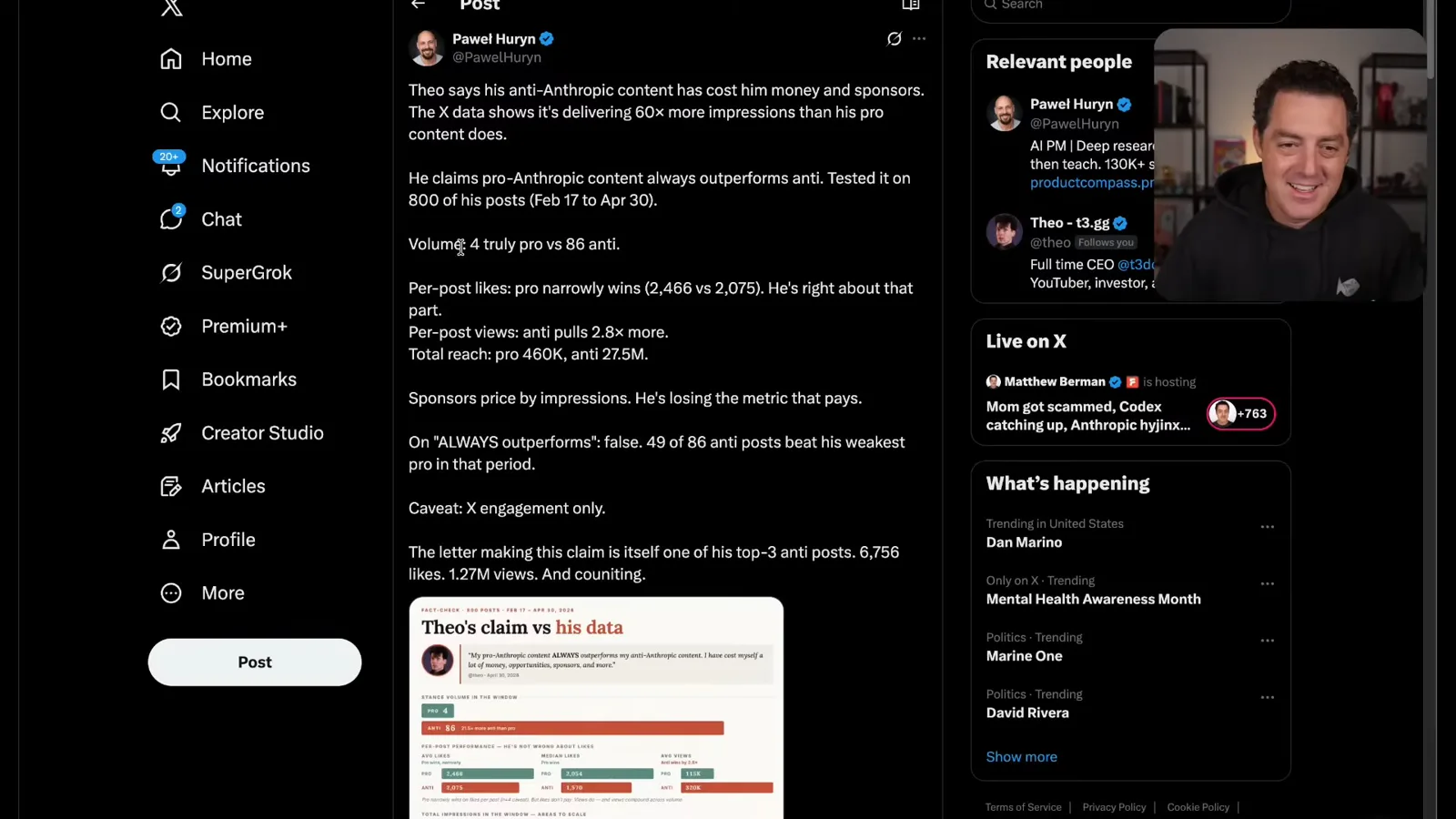
Theo replies that his business and sponsorship conversion depend primarily on YouTube, not X impressions, and points to outliers in the sample. From my own experience as a creator, I think cross-platform view counts and sponsorship conversion should not be treated as interchangeable. I disclose that I do not accept payment for reposts.
I argue that X view counts can be inflated relative to attention and that sponsors care about conversion, while acknowledging that X can be influential in spreading ideas. My account of how views are counted and how ideas travel across platforms is my observation, not a controlled measurement of those systems.
Anthropic criticism and Owl Alpha
Berman reads an open letter and distinguishes his own concerns from unverified allegations about employees. He then tests an unidentified model.
I read Theo’s open letter to people at Anthropic. He says his criticism has cost him opportunities; I regard him as sincere but cannot independently verify his finances. I disagree with his assertion that CEO Dario Amodei does not respect engineers, and instead offer my own impression that the company is intensely focused on AGI.
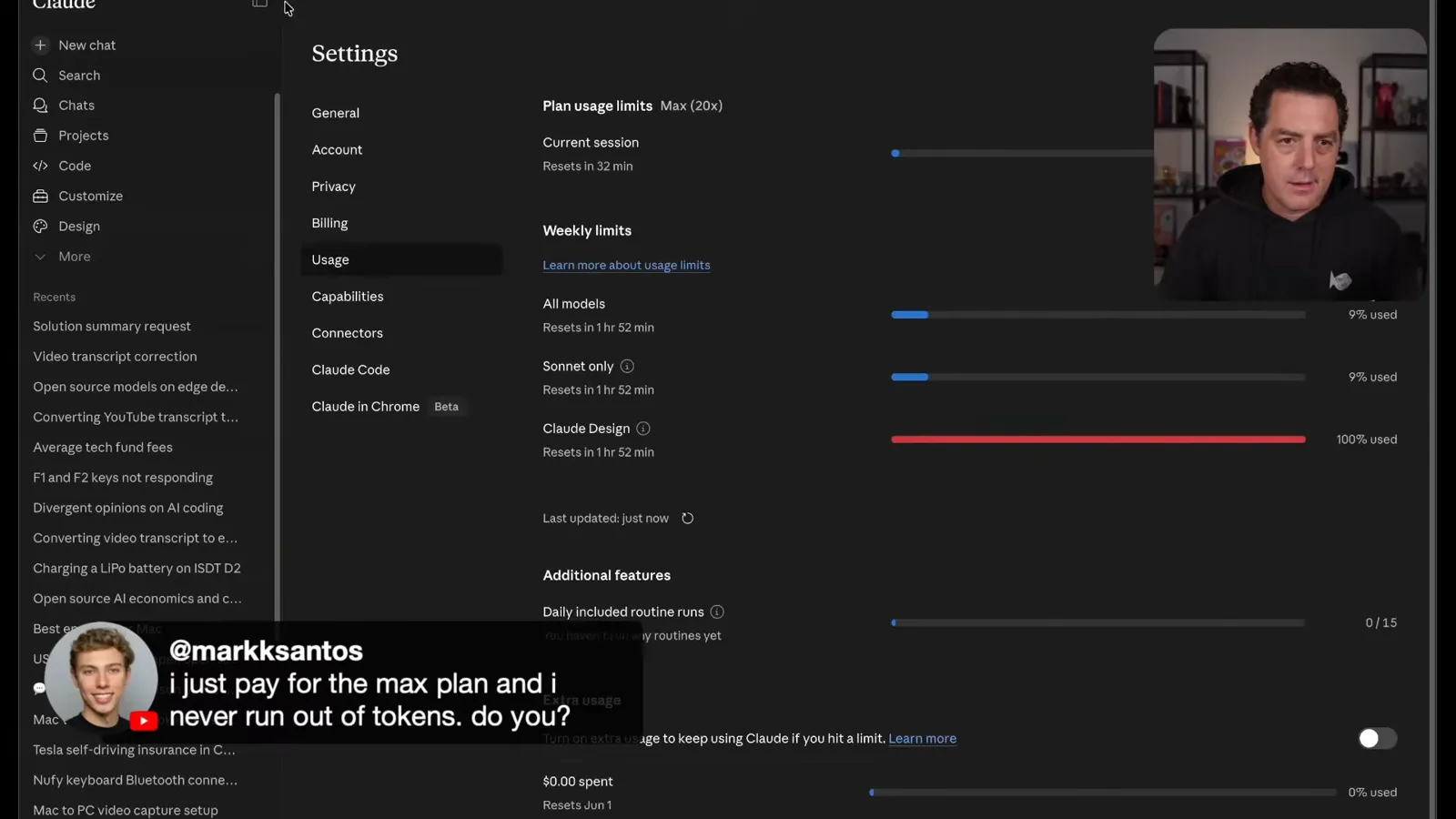
My main complaint is the experience of paying users: I want clearer communication about quotas and the ability to use the service predictably. I show my account’s Claude Design usage at its limit even though other usage categories remain available. That snapshot illustrates my experience, not proof that quota changes are arbitrary.
A viewer suggests using Claude Code to create another slide from the existing designs. I agree to try it, while questioning why a separate design limit prevents me from continuing the original workflow. The complaint concerns my account and the configuration at that time, not a claim that all users share the same limits.
I read further allegations in Theo’s letter about employee fear and dismissals. I do not know examples that substantiate those claims, and I call the tone somewhat condescending. An Anthropic employee replies that Theo does not know the team and is seeking clicks; the competing statements do not resolve the company’s internal conditions.
I also criticize what I perceive as Anthropic’s stance toward open source and its restricted release of Mythos. I recognize that people at the company may genuinely believe their safety concerns. My descriptions of the company’s culture and motives are opinions, not verified findings about employees or leadership.
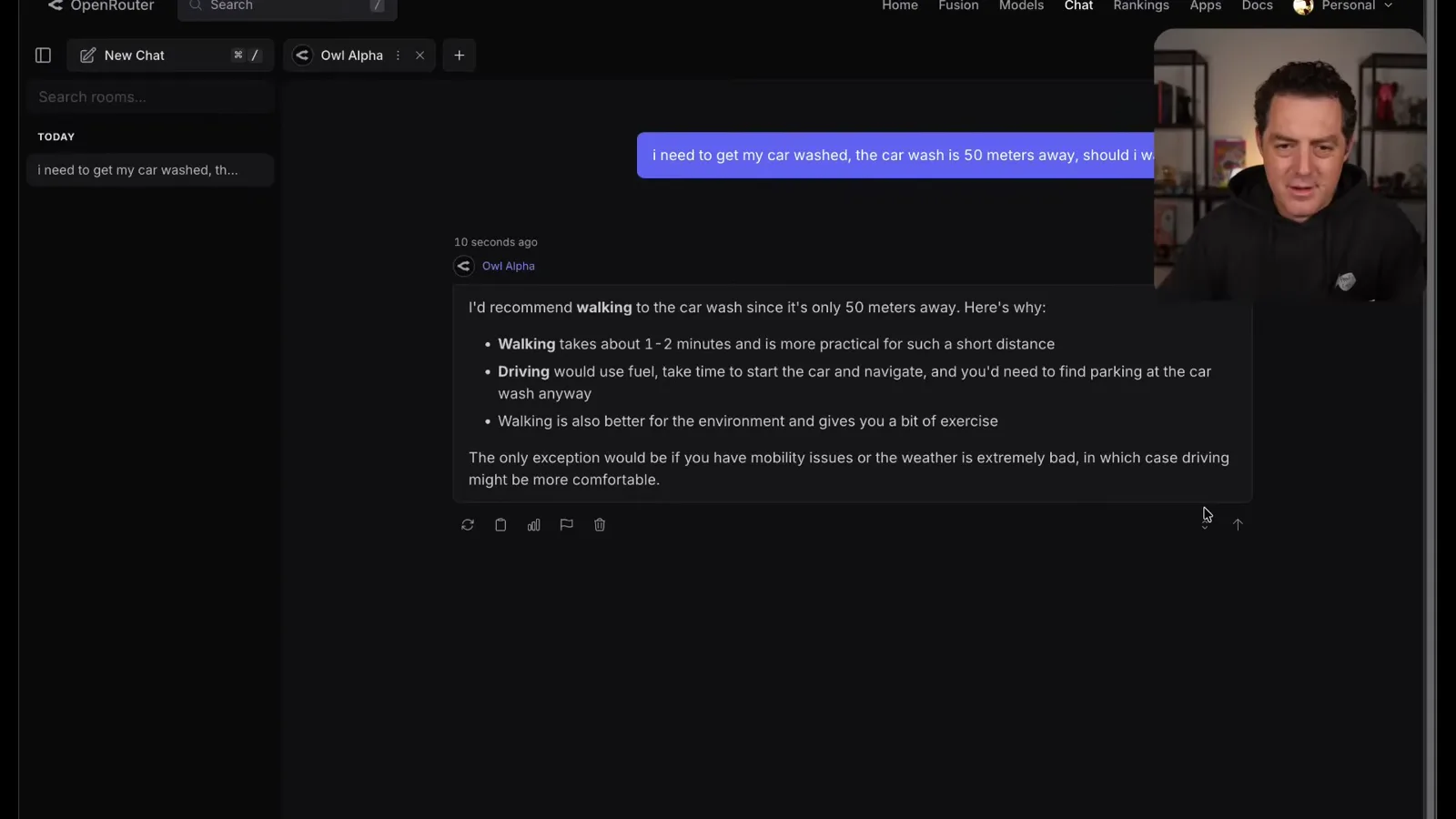
Next I look at an anonymous model called Owl Alpha on OpenRouter. Its listing describes a long context window, tool use and agentic tasks. Viewers guess its origin, and I speculate that it may be open source, but neither the developer nor its licensing is established by the information I show.
Owl Alpha initially advises walking to the car wash. After a follow-up asking it to reason carefully, and an intervening server error and retry, it recognizes that the car must go to the wash. As with the earlier tests, one conversation and a changed prompt cannot establish comparative reliability.
Asked about creator access, I say I have received early access to some OpenAI models and once to an Anthropic model, but do not generally receive unlimited usage after release. I then mention an upcoming OpenAI event and say I have requested an invitation; attendance was not confirmed during the stream.
Meta employee data and closing
He reads reporting on collecting work activity for AI training and weighs consent, employment and surveillance. The discussion closes with questions still unresolved.
I read a report in The Information that Mark Zuckerberg discussed using employees’ computer activity to train AI. Reuters had separately reported a proposed Model Capability Initiative for US employee work computers, recording keystrokes, clicks and mouse movements on work-related apps and sites, with occasional screenshots. These are reported plans and scope at the time, not evidence of recording every action everywhere.
My initial reaction is that collecting work data for training might make sense to the company. As I think aloud, I imagine other companies paying for similar employee data and become more concerned about the consequences. That expansion is a hypothetical scenario, not something established by the report.
Viewers raise consent, surveillance and the possibility that employees could be training systems that eventually replace their work. I say I do not believe AI will completely replace knowledge workers, and initially emphasize an employer’s rules. I also acknowledge that people who need a paycheck may not have a realistic option to leave.
I speculate about how a work-from-home policy might apply and say company laptops often already have monitoring. The report cited in the stream does not establish every detail of remote-work coverage or prove that all activity is captured; those claims should remain questions rather than assumptions.
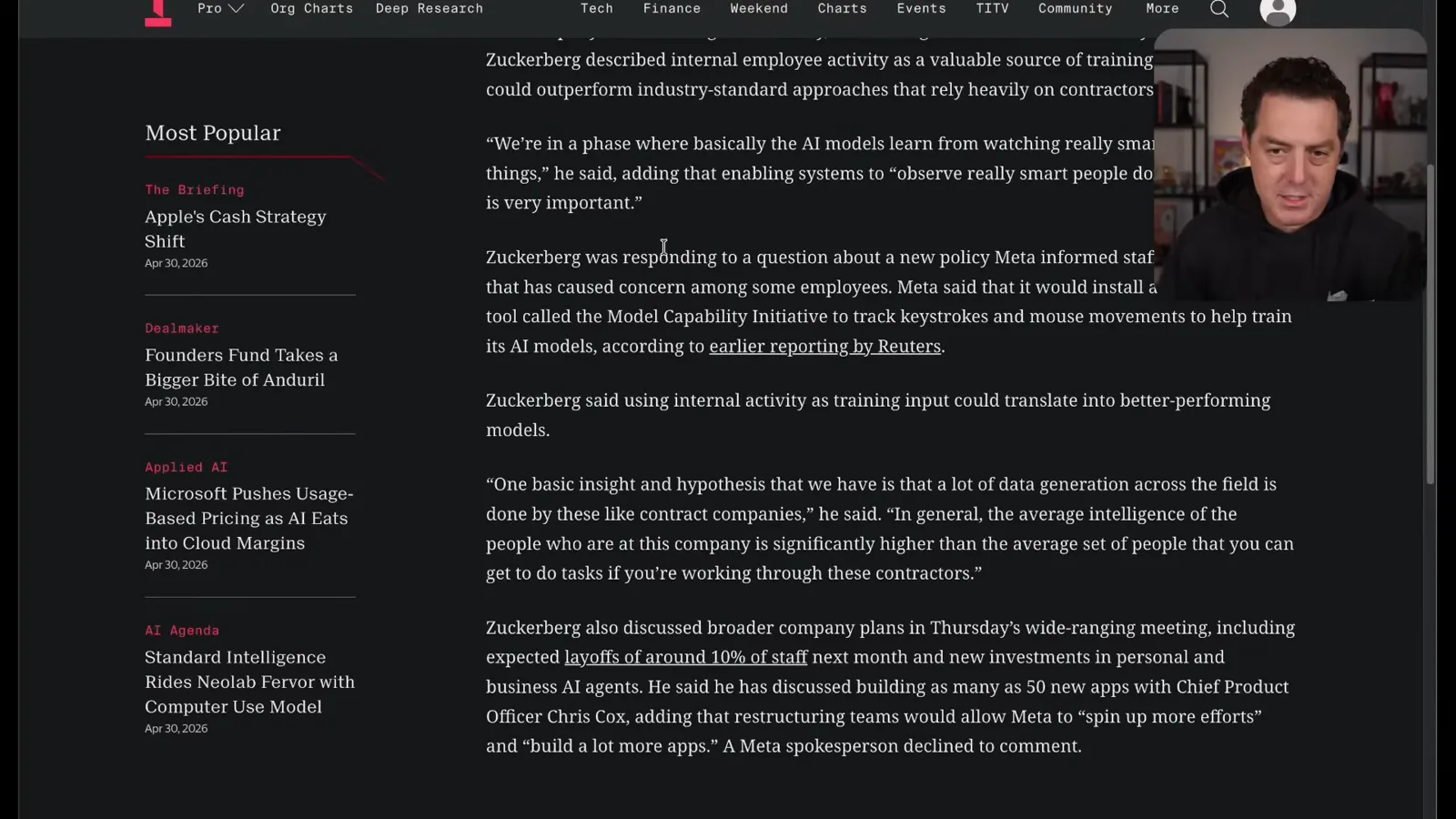
The article attributes to Zuckerberg a hypothesis that employee activity could supply more useful training examples than some contractor-generated data. I think the hypothesis is plausible, while questioning the way he reportedly compared workers’ intelligence. Neither the claimed performance advantage nor a broad ranking of workers is demonstrated by the discussion.
I explain that data contractors can recruit specialists to perform and record tasks for AI training. I then read the report’s discussion of anticipated layoffs and a proposal for many new apps, and note the anxiety a possible layoff can cause. These are reported plans at the time, not proof that a specific restructuring subsequently occurred.
I close the casual stream after covering the app listings, model tests, Anthropic debate and employee data. The examples are snapshots of individual experiences and reported developments rather than comprehensive tests or final answers to the policy questions.
같은 채널의 다른 글
 34:21EN
 Matthew Berman· 2026년 10월 27일Matthew Berman Examines Anthropic’s IPO Filing, AI Growth and GovernanceMatthew Berman, Sam Altman · Forward FutureThe presenter reviews the S-1’s financial metrics, compute strategy and voting structure while questioning the tension between rapid AI development and safety.
 25:50ENMatthew Berman· 2026년 10월 24일Kimi K3.1 Pro Tested: Strong 3D Demos, Uneven Results and Competitive PricingMatthew Berman · Forward FutureMatthew Berman tests the open-weight model on coding, 3D rendering and visual explanations, then compares benchmark results and prices.
 32:20ENMatthew Berman· 2026년 10월 23일Who Is Local AI For? The Costs, Trade-offs and a Hybrid FutureMatthew Berman · Forward FutureMatthew Berman weighs data control and independence against hardware cost, setup complexity and inference speed.
 1:03:37ENMatthew Berman· 2026년 10월 23일Matthew Berman’s Team Tests Kimi K3.1 on Animation, Games, and ChartsMatthew Berman, Alex, Brian · Forward FutureA live team AMA turns into an informal test of Kimi K3.1, from personal-agent workflows to motion graphics, a browser game, and a benchmark chart.
 0:53ENMatthew Berman· 2026년 10월 22일Sam Altman on AI and the Discovery of New KnowledgeSam Altman · OpenAIAltman expects progress in mathematical discovery to extend to biology, materials and energy.
 0:22ENMatthew Berman· 2026년 10월 21일A Robot Bodyguard Video Shows Dramatic Rescue ScenariosMatthew Berman · Forward FutureMatthew Berman reacts to a short robot demonstration depicting fighting and vehicle-rescue scenarios.