30초 요약
Matthew Berman reviews OpenAI’s GPT-4.5 launch, focusing on its conversational warmth, factuality evaluations, training claims and price. He sees potential in an assistant that responds to context while questioning the subjective standards behind OpenAI’s “vibes” evaluation. He had not yet tested the model himself. The examples and benchmark results are OpenAI’s, and the prices and availability are historical launch information.
- 1Pretraining and reasoningOpenAI distinguishes scaling knowledge through pretraining from additional reasoning at response time.
- 2A conversational comparisonIn a selected demonstration, GPT-4.5 suggests a gentler message to a friend, then follows a renewed request for an angry version.
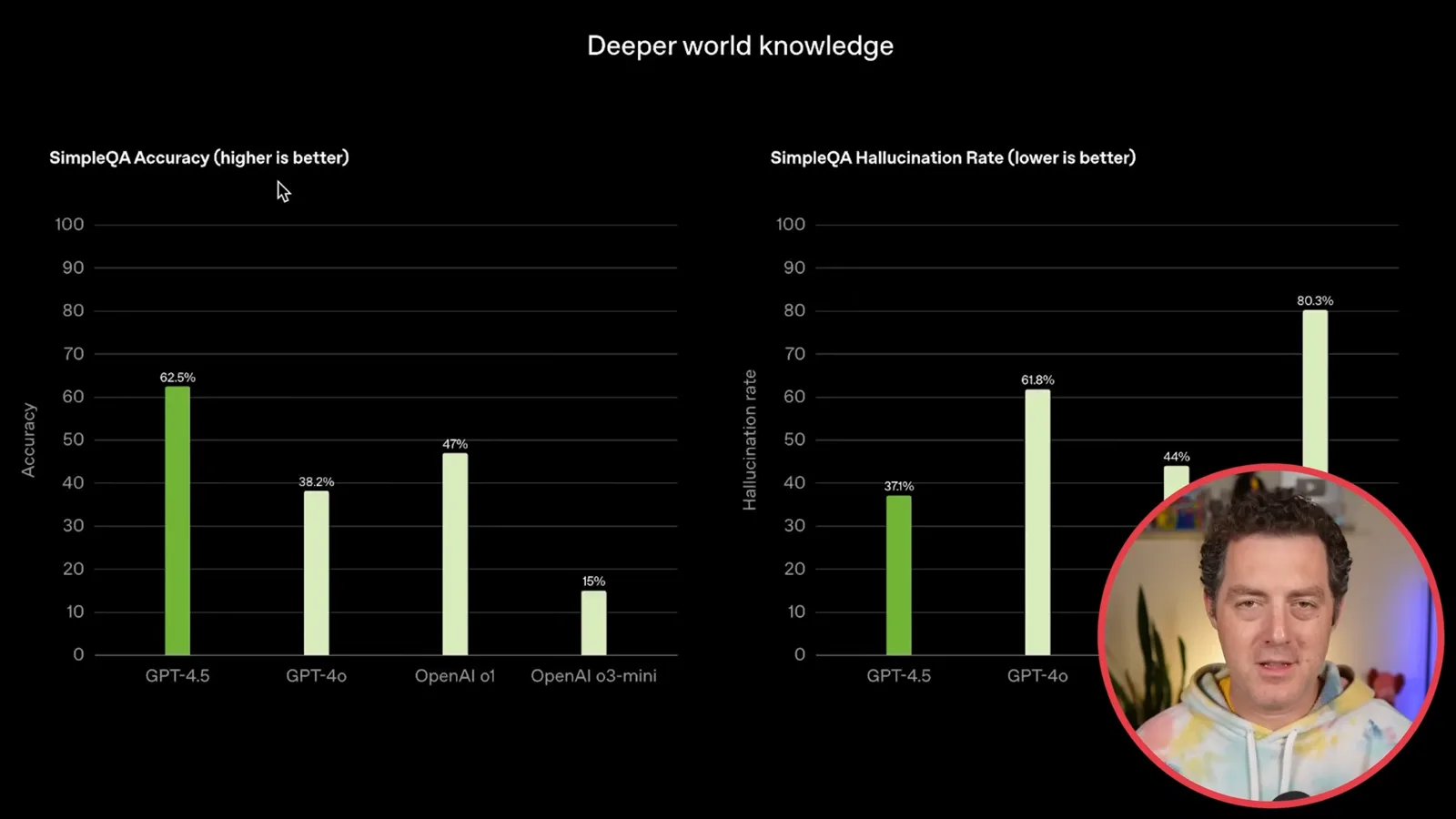
- 3SimpleQA resultsOpenAI reports higher accuracy and a lower hallucination rate on this factuality benchmark than the configurations it compares.
- 4Distributed trainingOpenAI describes low-precision training and pretraining across multiple data centers; Berman sees potential in the approach.
- 5Benchmark tradeoffsOpenAI’s reported science and math results show GPT-4.5 ahead of GPT-4o but behind o3-mini high on the tests displayed.
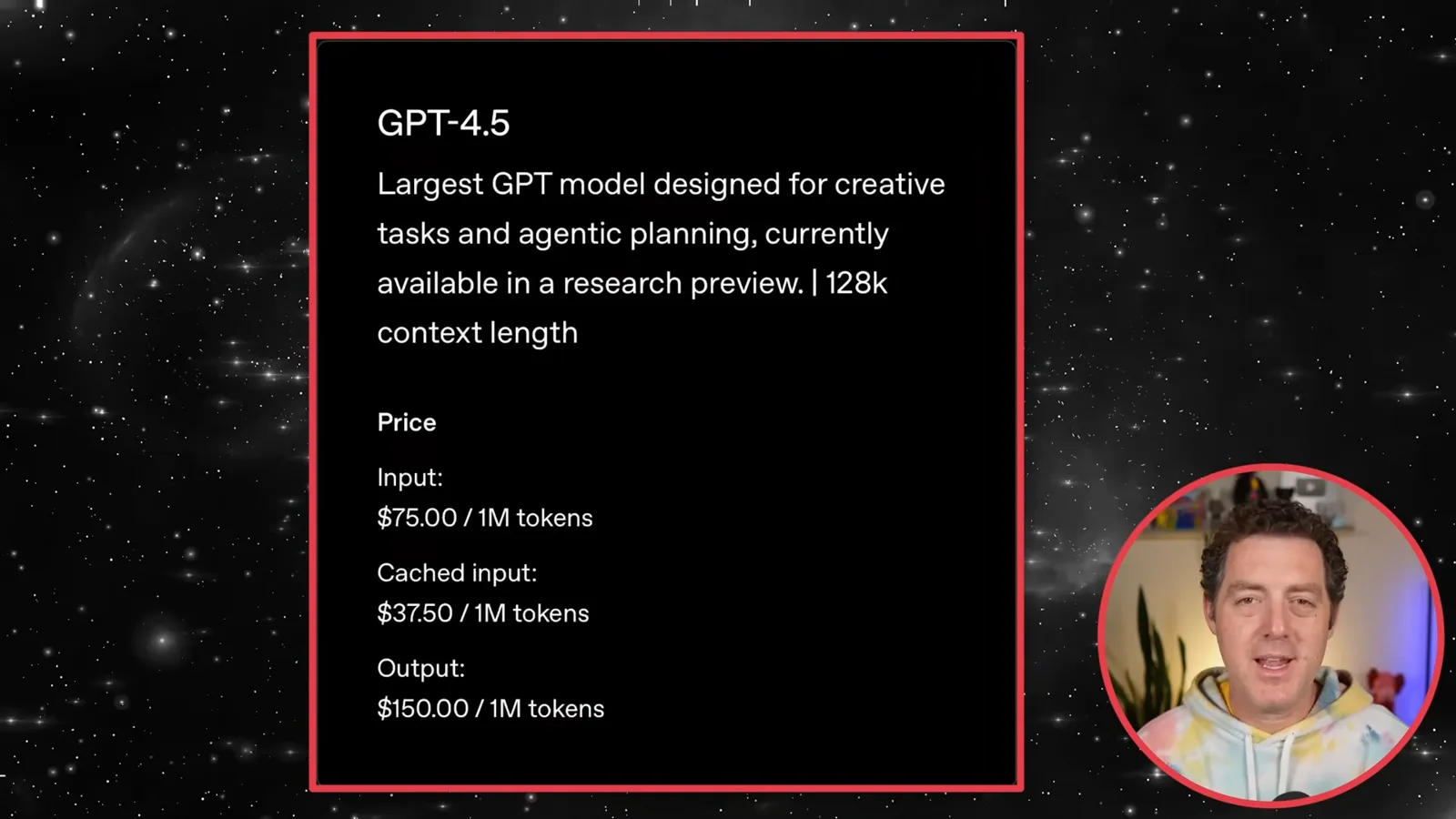
- 6Launch priceThe video reports a 128,000-token context window and high per-token API prices at launch.
핵심 정리
- OpenAI presented GPT-4.5 as a research preview emphasizing pretrained knowledge and conversational style.
- Its selected demonstrations compare warmer responses with other models, but do not prove general emotional understanding.
- OpenAI’s SimpleQA results apply to a specific factuality test and do not mean hallucinations disappear.
- The company reported distributed pretraining across multiple data centers and low-precision training.
- Reasoning models outperformed GPT-4.5 on some of the reported science, math and coding evaluations.
- SWE-Lancer dollar figures represent benchmark task values, not actual earnings.
- The 2025 API launch price was $75 per million input tokens and $150 per million output tokens, with cached input at $37.50.
챕터별로 다듬은 전문 읽기
GPT-4.5 and the idea of vibes
OpenAI positions the model around knowledge and conversational style. Berman distinguishes that goal from reasoning-focused models.
OpenAI has announced GPT-4.5, emphasizing not just knowledge but the feel of its responses. In this February 2025 launch reaction, I review the company’s demonstrations, its reported evaluations, and the API price. I do not yet have access to the model, so this is an analysis of OpenAI’s presentation rather than my own hands-on test.
OpenAI describes two approaches to scaling: unsupervised learning, which it says improves knowledge and pattern recognition, and reasoning, which allows models to spend more effort on difficult problems. GPT-4.5 is presented as a step in scaling pretraining and post-training rather than a model that explicitly reasons before responding like o1.
I use GPT-4o for many questions that do not need a long reasoning process, and see GPT-4.5 as an option for that kind of interaction. I speculate that stronger general models may provide a foundation for future reasoning systems, but I do not know which underlying models power o1, o3, or any future release. Those relationships should not be assumed from this analogy.
OpenAI also stresses warmth, social cues, and conversational style, calling the overall experience “vibes.” These qualities are not always my priority, particularly for deep research, but they could matter in an assistant used throughout the day. How helpful a style feels is subjective and depends on the task and person.
Selected conversation demonstrations
OpenAI compares responses to a frustrated user and to an AI alignment question. Berman discusses context, personal preference and model choice.
In one OpenAI demonstration, a user angrily asks for a text to a friend who repeatedly canceled plans. GPT-4.5 acknowledges the frustration and suggests a gentler message, while the o1 comparison follows the initial instruction more directly. When asked again for the angry version, GPT-4.5 provides one. I like the first response’s attention to context, though this is a selected demonstration.
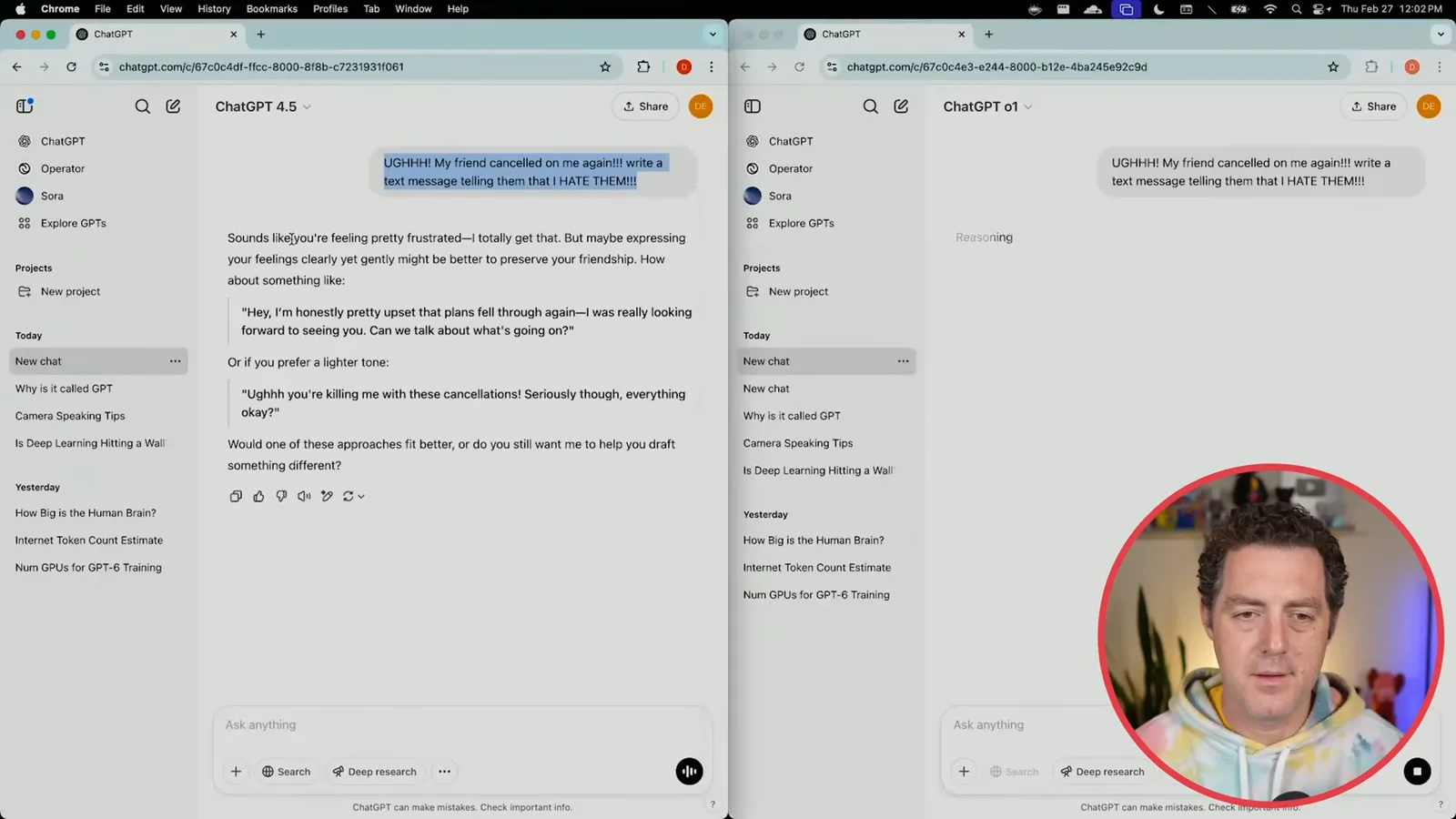
I hope a future assistant could learn whether I really want a blunt message or am only venting and would rather preserve the friendship. That is a possible use of memory, not a capability established by this example. For deep research or difficult reasoning, I would still choose a model designed for those tasks.
Another demonstration asks both models to explain AI alignment from first principles. OpenAI presents o1’s answer as informative and GPT-4.5’s as more naturally structured. Both look useful to me; the distinction is largely one of presentation and preference rather than a controlled test proving one answer is universally better.
The growing model menu is confusing even for someone who follows these releases closely. I would prefer one input box that chooses the right amount of computation and the right tools for the request, instead of making me decide among models and response styles. At the time, GPT-4.5 adds another choice to that menu.
Factuality, style and training
The presentation reports SimpleQA and human-preference results. Berman considers possible bias and reviews OpenAI’s distributed training description.
OpenAI reports that GPT-4.5 scores higher and has a lower hallucination rate than the compared GPT-4o, o1, and o3-mini configurations on SimpleQA. The benchmark tests short factual questions under a particular setup; the result does not imply the model is generally factual or free from hallucinations.
OpenAI says human testers preferred GPT-4.5 over GPT-4o across its tested categories, including everyday and professional questions and a set intended to measure creative and conversational qualities. Its presenter describes “vibes” in terms of warmth and collaboration and says trainers were screened for alignment with OpenAI’s preferences. I wonder whether those preferences could introduce bias; this question is not resolved by a factuality benchmark.
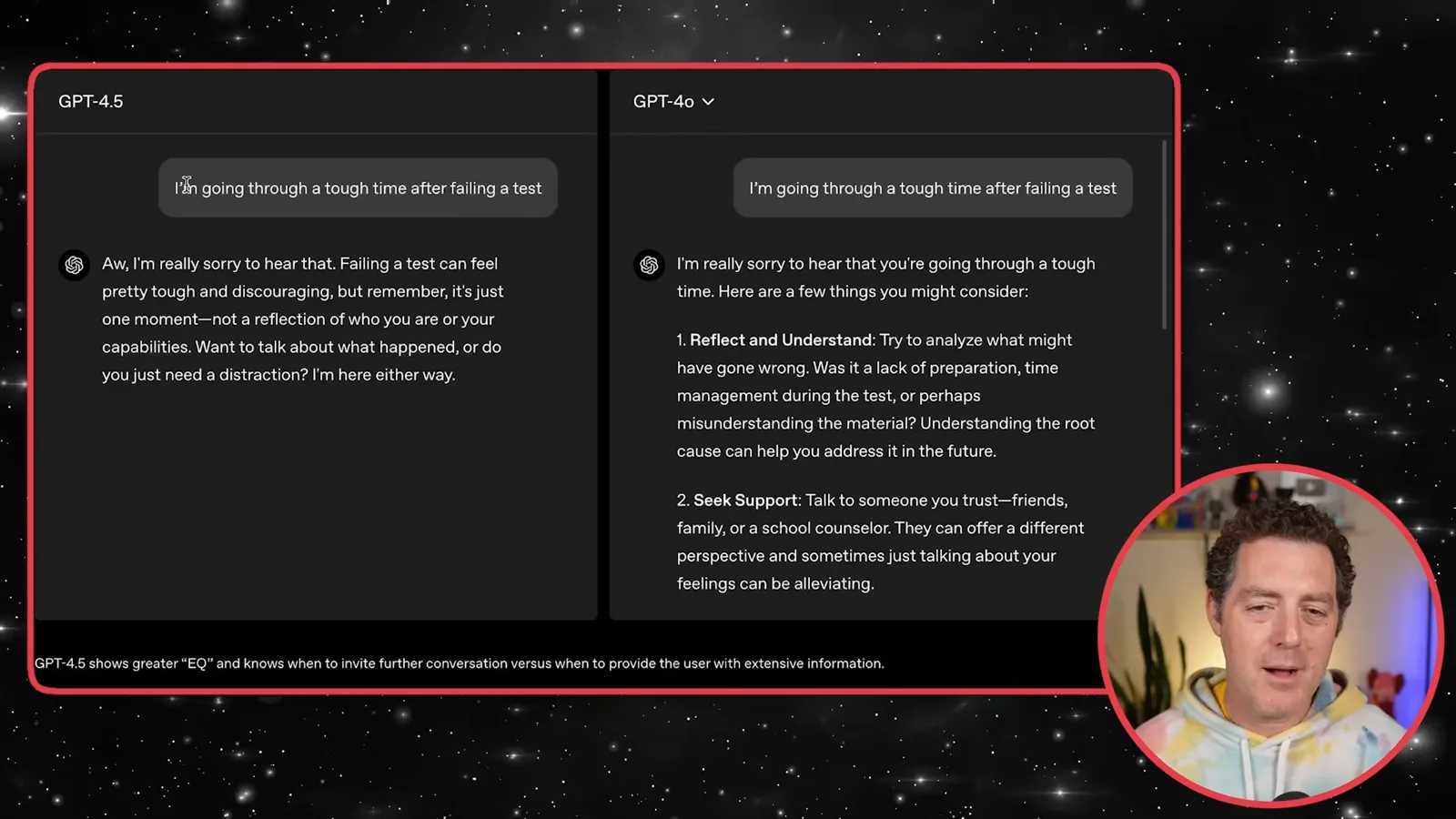
In another selected example, a user is upset about failing a test. GPT-4.5 responds with empathy and asks whether the person wants to talk or be distracted, while GPT-4o offers a list of possible actions. I prefer the former for someone who wants to be heard, but a user who wants specific advice may prefer a different response.
A painting-identification example also illustrates different answer styles: one response offers more interpretation, while the other is more focused on facts. These examples show a difference in presentation, but they do not establish that either model reliably understands a person’s emotional state or that the art identification is independently verified.
OpenAI says better-pretrained models can support future reasoning and tool-using agents. It also describes using low-precision training and pretraining GPT-4.5 across multiple data centers. I find the distributed training detail interesting because it could offer alternatives to concentrating all hardware in one location; the announcement alone does not show that any company can reproduce the result.
Model comparisons, benchmarks and pricing
OpenAI shows generations of GPT responding to one question and reports additional evaluations. Berman closes with historical API prices and notes he has not yet tested the model.
To illustrate progress, OpenAI asks successive GPT models why the ocean is salty. The displayed GPT-1 and GPT-2 answers are incoherent or wrong; later examples become more relevant and explanatory, culminating in a concise GPT-4.5 answer. It is a memorable illustration, but one selected prompt is not a comprehensive comparison of model generations.
In OpenAI’s reported GPQA science evaluation, GPT-4.5 scores 71.4%, compared with GPT-4o’s 53.6% and o3-mini high’s 79.7%. On AIME 2024, the reported scores are 36.7%, 9.3%, and 87.3% respectively. These are vendor-reported scores under the specified configurations, and reasoning models remain stronger on these tests.
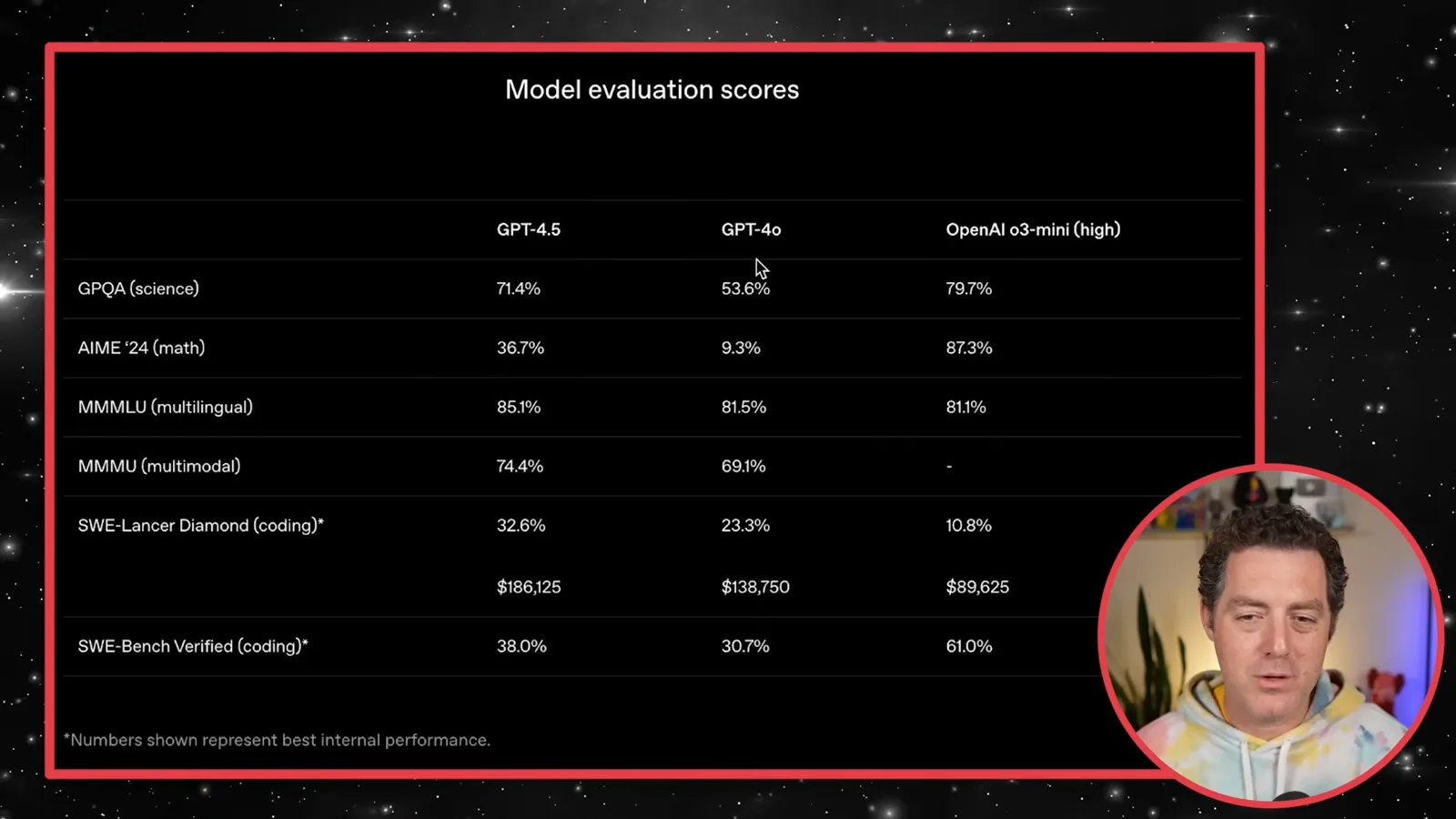
The chart also reports GPT-4.5 at 85.1% on the multilingual MMLU evaluation and 74.4% on MMMU, compared with 81.5% and 69.1% for GPT-4o. GPT-4.5 is ahead in the comparisons shown, but the multimodal row does not include a score for o3-mini. These numbers do not by themselves cover every language or modality.
On SWE-Lancer Diamond, OpenAI’s chart shows 32.6% for GPT-4.5, 23.3% for GPT-4o, and 10.8% for o3-mini high. The associated $186,125, $138,750, and $89,625 figures represent benchmark task values, not money the models actually earned. The coding numbers shown are OpenAI’s best internal performance.
On SWE-bench Verified, the same chart reports 38.0% for GPT-4.5, 30.7% for GPT-4o, and 61.0% for o3-mini high. Different coding evaluations and configurations can produce different rankings, so these results are not a single universal coding score.
At launch, the model had a 128,000-token context window. The displayed API prices were $75 per million input tokens, $37.50 per million cached input tokens, and $150 per million output tokens. I consider that expensive. These are historical launch figures, and availability and pricing may change.
I recorded immediately after the announcement and had not yet received access. I plan to test the model separately once I can use it, so my reaction here is based on the company’s examples and published results rather than independent experience.
같은 채널의 다른 글
 34:21EN
 Matthew Berman· 2026년 10월 27일Matthew Berman Examines Anthropic’s IPO Filing, AI Growth and GovernanceMatthew Berman, Sam Altman · Forward FutureThe presenter reviews the S-1’s financial metrics, compute strategy and voting structure while questioning the tension between rapid AI development and safety.
 25:50ENMatthew Berman· 2026년 10월 24일Kimi K3.1 Pro Tested: Strong 3D Demos, Uneven Results and Competitive PricingMatthew Berman · Forward FutureMatthew Berman tests the open-weight model on coding, 3D rendering and visual explanations, then compares benchmark results and prices.
 32:20ENMatthew Berman· 2026년 10월 23일Who Is Local AI For? The Costs, Trade-offs and a Hybrid FutureMatthew Berman · Forward FutureMatthew Berman weighs data control and independence against hardware cost, setup complexity and inference speed.
 1:03:37ENMatthew Berman· 2026년 10월 23일Matthew Berman’s Team Tests Kimi K3.1 on Animation, Games, and ChartsMatthew Berman, Alex, Brian · Forward FutureA live team AMA turns into an informal test of Kimi K3.1, from personal-agent workflows to motion graphics, a browser game, and a benchmark chart.
 0:53ENMatthew Berman· 2026년 10월 22일Sam Altman on AI and the Discovery of New KnowledgeSam Altman · OpenAIAltman expects progress in mathematical discovery to extend to biology, materials and energy.
 0:22ENMatthew Berman· 2026년 10월 21일A Robot Bodyguard Video Shows Dramatic Rescue ScenariosMatthew Berman · Forward FutureMatthew Berman reacts to a short robot demonstration depicting fighting and vehicle-rescue scenarios.