30초 요약
Matthew Berman discusses Meta’s July 2023 Llama 2 release, including base and chat variants, training details, Microsoft’s partnership and commercial use. He explains the delayed 34B release and the paper’s safety evaluations. Llama 2’s weights were released under a license with conditions; its 700-million-user provision concerns the month before release, not simply a later milestone for a product. The performance and availability comparisons in the video are historical and do not establish a general ranking against all ChatGPT models.
- 1Model sizes and contextThe release included 7B, 13B and 70B base and chat variants, with a 4,096-token context.
- 2Microsoft’s roleMicrosoft was Meta’s preferred partner at launch while also maintaining an investment in OpenAI.
- 3Commercial termsMeta’s license permits commercial use subject to restrictions, including a separate-license provision for certain large services.
- 4Safety and the delayed 34B modelMeta’s paper reports safety evaluations and says the 34B release was delayed due to insufficient red-teaming time.
- 5Separate reward modelsMeta describes distinct helpfulness and safety reward models; the method does not prove every tradeoff is resolved.
핵심 정리
- Meta released 7B, 13B and 70B base and chat variants under its Llama 2 community license in 2023.
- The license allows commercial use under conditions and requires certain large existing services to obtain a separate license from Meta.
- The 700-million monthly-user condition refers to the preceding month at the release date, not merely later growth of a Llama-based product.
- The 34B model was delayed because the paper said there had not been sufficient time for red-teaming.
- The displayed safety results and separate reward models do not prove complete safety or eliminate every helpfulness tradeoff.
- Berman’s coding and frontier-model comparisons reflect the July 2023 context.
챕터별로 다듬은 전문 읽기
Llama 2 models and training
Berman introduces the July 2023 release and its model sizes. He discusses context length, hardware, inference and training emissions.
Meta has released Llama 2, and I see it as a major step for models with available weights. In July 2023 the release supports research and commercial use under Meta’s community license. It is not unrestricted open source: the license imposes conditions, and the comparisons in this discussion reflect models available at that time.
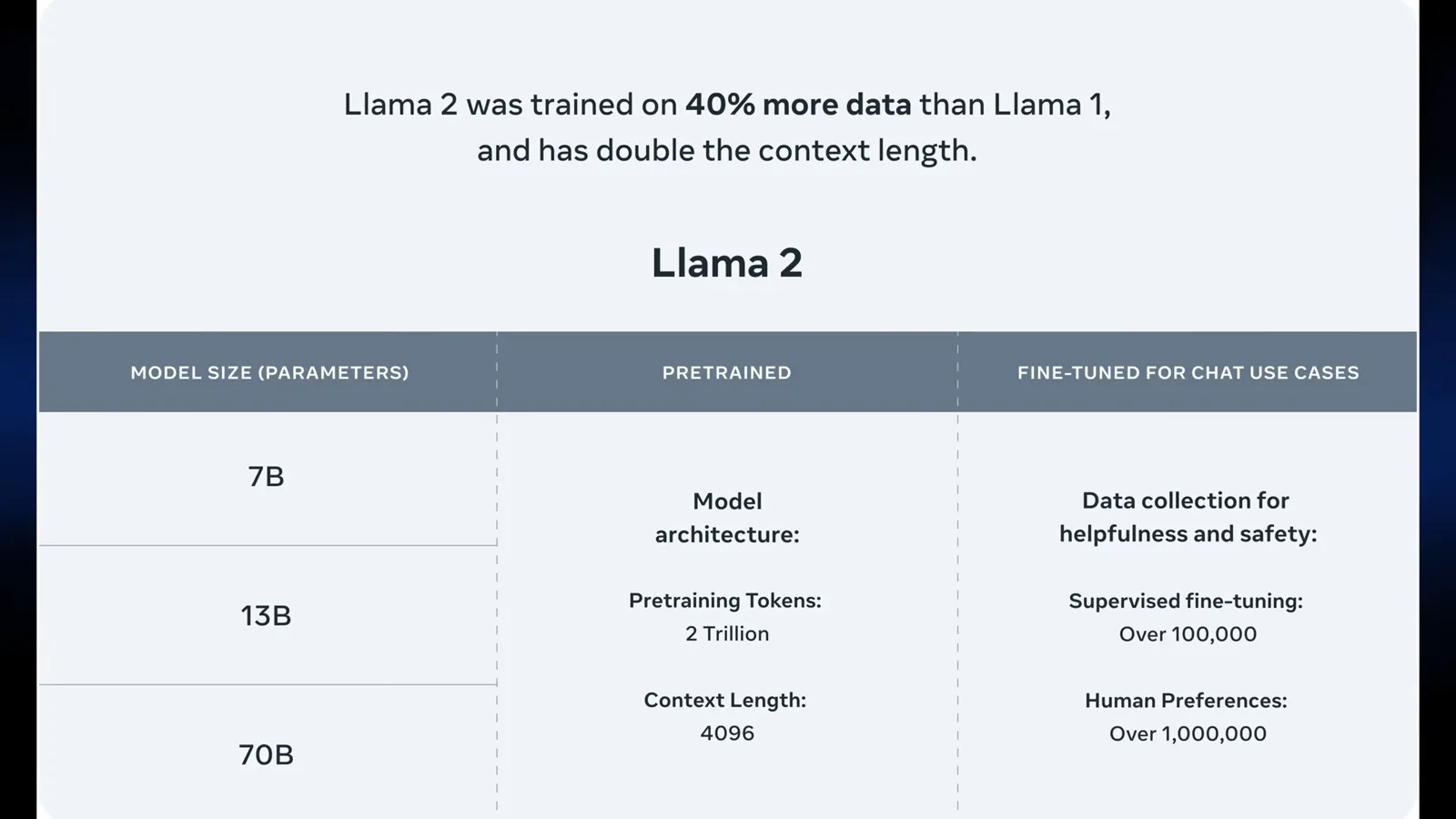
The release includes pretrained Llama 2 and dialogue-tuned Llama 2-Chat in 7 billion, 13 billion and 70 billion parameter sizes. Meta also trained a 34 billion parameter variant but did not release it at launch. The company reports training on Nvidia A100 GPUs, 40% more data than Llama 1 and a doubled context length of 4,096 tokens.
Meta uses grouped-query attention in larger models to improve inference scalability. The paper also discusses the electricity and estimated carbon emissions associated with training. I appreciate that the authors make the resource and environmental costs visible, even though any estimate depends on its accounting assumptions.
Microsoft and commercial licensing
Microsoft partners with Meta on distribution. Berman discusses commercial use and the license’s restrictions on certain large services.
Microsoft was Meta’s preferred launch partner, even though Microsoft also invested heavily in OpenAI. Microsoft says it wants to give developers a choice of open and frontier models. I interpret the arrangement as a balance between supporting a broader model ecosystem and its relationship with OpenAI.
Llama 1 was released for research, whereas Llama 2’s community license permits commercial use subject to its terms. One provision requires a separate Meta license if a licensee’s or its affiliates’ products or services had more than 700 million monthly active users in the month preceding the July 2023 release. That is different from an automatic rule triggered simply when a new Llama-based product later reaches 700 million users.
I speculate that the large-user restriction protects Meta against its biggest competitors; that is my interpretation, not a stated finding about its intent. The license also has other conditions, so developers should read the actual terms. Although the weights are available, calling the release completely open source can obscure those restrictions.
Safety, performance and access
Berman reviews coding concerns, safety testing and the delayed 34B model. He closes with historical access options and plans for further testing.
From what I have seen at launch, Llama 2’s coding ability appears weaker than GPT-4’s. This is an early assessment, not a controlled comparison. Meta’s paper also acknowledges a performance gap with frontier models of the period, including GPT-4 and PaLM 2; the video’s examples do not establish that Llama 2 beats every ChatGPT model or task.
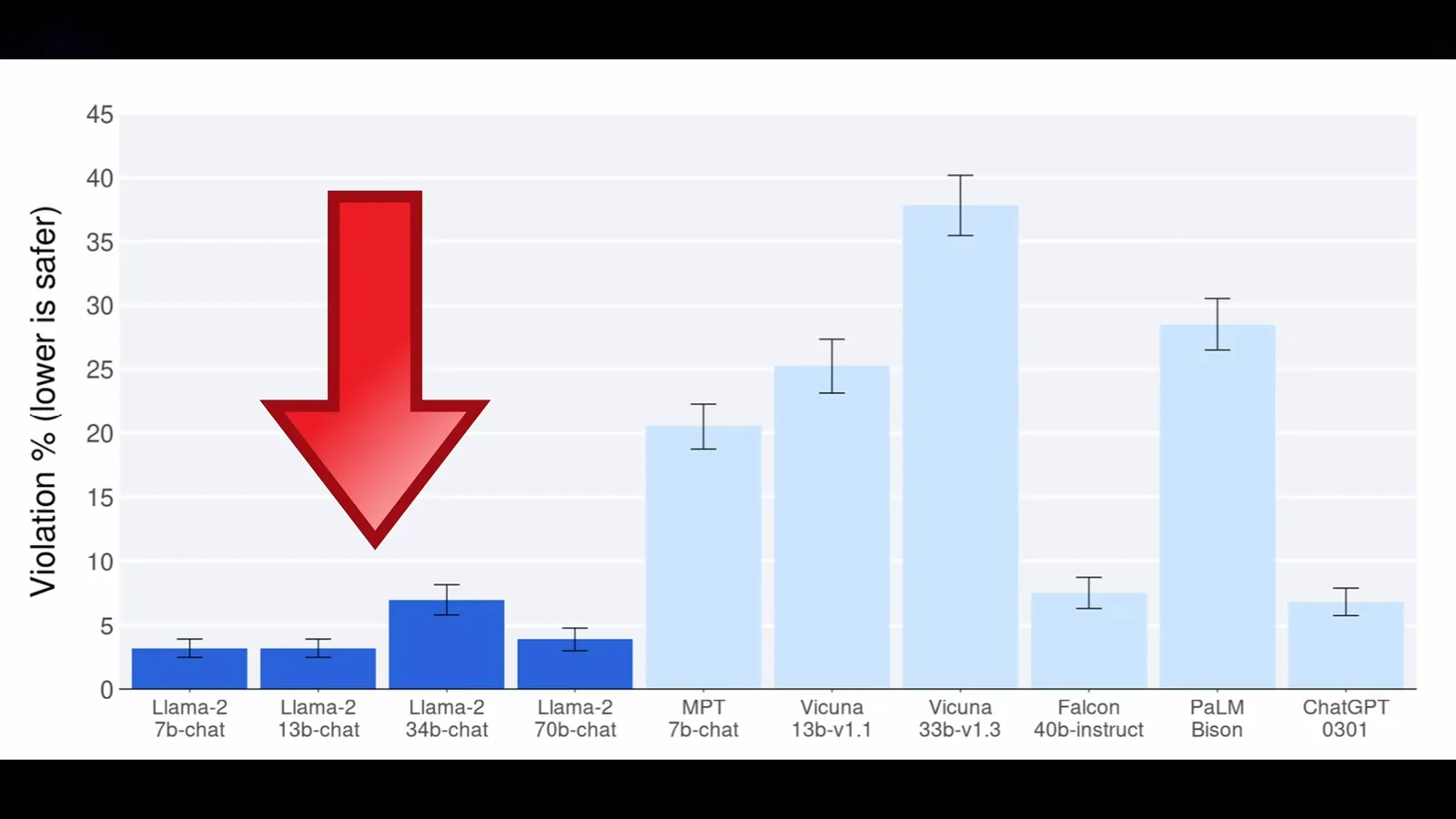
Safety is a major part of the paper. Meta reports red-teaming and a violation-rate evaluation, where lower is better under that test. The 34B chat model has a higher violation rate in the displayed comparison, and the paper says its release was delayed because there was insufficient time to red-team it adequately. This chart measures a particular evaluation, not complete safety in all uses.
I expect the community to produce fine-tuned variants with different behavior. On helpfulness and safety, Meta describes using separate reward models for the two objectives. I find the approach promising, but the video does not establish that it has permanently solved the tradeoff between helpfulness and safety.
At the time of this video, Meta made weights and code available through its distribution channels, and hosted 7B and 13B versions were appearing. I plan to test the different sizes and subsequent fine-tunes with my own rubric and report what I find. Availability and model rankings in this account are historical.
같은 채널의 다른 글
 34:21EN
 Matthew Berman· 2026년 10월 27일Matthew Berman Examines Anthropic’s IPO Filing, AI Growth and GovernanceMatthew Berman, Sam Altman · Forward FutureThe presenter reviews the S-1’s financial metrics, compute strategy and voting structure while questioning the tension between rapid AI development and safety.
 25:50ENMatthew Berman· 2026년 10월 24일Kimi K3.1 Pro Tested: Strong 3D Demos, Uneven Results and Competitive PricingMatthew Berman · Forward FutureMatthew Berman tests the open-weight model on coding, 3D rendering and visual explanations, then compares benchmark results and prices.
 32:20ENMatthew Berman· 2026년 10월 23일Who Is Local AI For? The Costs, Trade-offs and a Hybrid FutureMatthew Berman · Forward FutureMatthew Berman weighs data control and independence against hardware cost, setup complexity and inference speed.
 1:03:37ENMatthew Berman· 2026년 10월 23일Matthew Berman’s Team Tests Kimi K3.1 on Animation, Games, and ChartsMatthew Berman, Alex, Brian · Forward FutureA live team AMA turns into an informal test of Kimi K3.1, from personal-agent workflows to motion graphics, a browser game, and a benchmark chart.
 0:53ENMatthew Berman· 2026년 10월 22일Sam Altman on AI and the Discovery of New KnowledgeSam Altman · OpenAIAltman expects progress in mathematical discovery to extend to biology, materials and energy.
 0:22ENMatthew Berman· 2026년 10월 21일A Robot Bodyguard Video Shows Dramatic Rescue ScenariosMatthew Berman · Forward FutureMatthew Berman reacts to a short robot demonstration depicting fighting and vehicle-rescue scenarios.