30초 요약
Matthew Berman presents a 2024 interview in which OpenAI CEO Sam Altman discusses potential benefits and risks of AI, government experimentation, international oversight and future models. Berman then considers reported chip-investment ambitions and an All-In podcast argument by Chamath Palihapitiya that open models could shift value toward infrastructure. These are historical views and predictions, not established outcomes.
- 1Scientific progress has no certain timelineAltman says scientists report productivity gains, but acknowledges that the path to breakthroughs and the effect of increased productivity remain uncertain.
- 2A smarter future modelAsked about GPT-5, Altman predicts broader improvement while withholding specific details. Berman presents this as a 2024 view of future capability.
- 3Regulatory sandboxes and coordinationAltman suggests testing applications in contained settings, then calls for international discussion of auditing and safety for highly capable systems.
- 4Chip investment reportsThe displayed Wall Street Journal report describes a proposed initiative potentially requiring up to $7 trillion. That figure is not shown as committed funding or a demonstrated AGI price.
- 5The open-model economic thesisPalihapitiya predicts open models could erode model-provider value while hardware and inference providers capture value; he has an investment interest in Groq.
핵심 정리
- Altman says the timeline for scientific breakthroughs is uncertain, despite reports that existing tools help some scientists.
- His expectation that a future model would be smarter across tasks is a forecast, not a measured guarantee.
- Altman favors regulatory experimentation and proposes global coordination for the most powerful systems.
- OpenAI’s potential future open releases were unspecified in the 2024 interview.
- The reported figure of up to $7 trillion concerned a possible broad chip-and-AI initiative, not a confirmed amount raised or proven cost of AGI.
- Palihapitiya’s claim that model value could fall to zero is an investment thesis, and he disclosed an interest in Groq.
챕터별로 다듬은 전문 읽기
Abundant intelligence and scientific uncertainty
Altman describes possible benefits in education, medicine and research, while acknowledging uncertain timelines. The interviewer discusses experience in the UAE.
Matthew Berman introduces a February 2024 World Governments Summit interview with OpenAI CEO Sam Altman, followed by commentary on AI chips and an All-In podcast excerpt. Altman describes a potential future in which inexpensive intelligence and abundant energy help people learn, develop treatments, improve the environment and discover new science. These are possibilities, not outcomes demonstrated by the interview.
Asked how far away major scientific advances are, Altman says he does not know. He reports hearing from scientists that existing tools improve productivity, but says the size of those gains and their effect on the rate of discovery are difficult to quantify. The example of doubling every scientist’s productivity is hypothetical.
The interviewer says that, in the UAE’s experience, deploying language models in universities has not increased cheating rates and has helped students and teachers. This is the interviewer’s account rather than a finding established by the video. He asks Altman what government applications might serve as a model elsewhere.
Altman recalls early school bans on ChatGPT and says many educators subsequently embraced it. He expects it to be transformative for education. He argues that governments should experiment with ways to improve forms, services, education and healthcare while learning what works; the broad benefits are a prediction, and outcomes depend on implementation.
Model progress and regulatory experiments
Altman compares current tools with early mobile phones and predicts smarter future systems. He proposes a regulatory sandbox and international coordination.
The interviewer asks why labs continue to pursue larger models when many world-changing applications have yet to emerge. Altman compares current AI to an early mobile phone: useful in limited ways but far from the capabilities of a modern smartphone. He thinks scaling and development could yield much more useful systems in the years ahead.
Asked for a timeline, Altman says people should be patient and predicts substantial improvement in a few years and remarkable progress within a decade. Asked specifically about GPT-5, he says the important change will be greater general intelligence rather than one isolated feature. This is a 2024 prediction, not a guarantee that every task will improve.
The interviewer asks what Altman would do if he were the UAE’s AI minister for a day. Altman first suggests a regulatory sandbox where people can try applications in a contained way, observe successes and failures, and build rules informed by experience. He argues that writing every rule in a vacuum is difficult.
The interviewer says the UAE already has a regulatory lab. Altman then revises his answer: he would convene international leaders to discuss a global system for the most powerful AI, using the International Atomic Energy Agency as an analogy. He raises auditing and safety measures before deployment of highly capable systems, without specifying a finished governance design.
On international efforts by governments and organizations, Altman says discussion and debate are healthy but should eventually lead to an action plan with broad support. He emphasizes collaboration and says OpenAI should not unilaterally set the global plan. He does not offer a detailed timetable or binding framework.
Open models, risks and opportunities
The discussion covers access for resource-constrained countries, potential open releases and societal risks. Altman outlines an optimistic view of young people’s opportunities.
The interviewer asks what resource-constrained governments should do and whether they should choose closed or open models. Altman says API services and running open models can both make sense, and that OpenAI is considering offerings for countries. He does not suggest that one approach is universally best.
Asked about open-sourcing older models, Altman corrects the interviewer: OpenAI released GPT-2, not GPT-3, as open source in the way suggested. He says people should expect more open releases over time but gives no specific model, date or license. He wants any release to add something useful rather than duplicate existing options.
The interviewer asks about the greatest fear and greatest source of optimism. Altman says he is particularly concerned by subtle societal misalignments: systems could interact with society in damaging ways without a single actor intending harm. He considers the downside risks significant while believing that careful deployment could yield substantial benefits.
Altman imagines people having access to many capable AI assistants—programmers, lawyers, marketers and strategists—to support their own goals. He sees potential for a higher standard of living and greater human creativity. This is a vision of possible future access and capability, not a description of what everyone had in 2024.
Asked what teenagers should study or do to remain relevant, Altman emphasizes early familiarity with the technology and imagines a period of significant opportunity. He predicts that young people can use AI to create companies and pursue ideas that were previously harder to realize. He does not provide a specific curriculum or guarantee particular employment outcomes.
Chip investment and model economics
Berman reviews reporting on a possible chip initiative and differing views about infrastructure spending. An All-In podcast excerpt debates where economic value in AI may accrue.
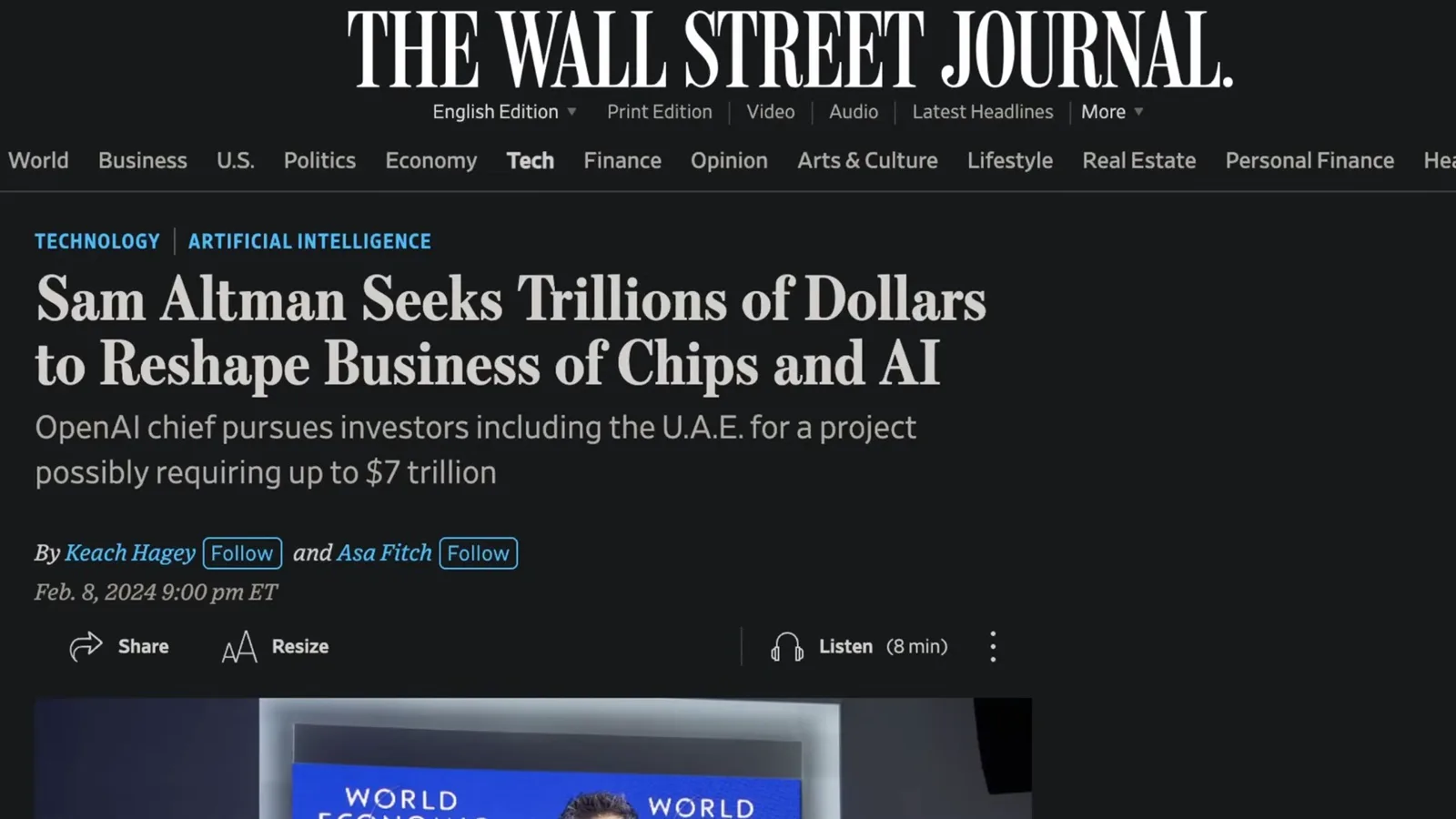
After the interview, Berman points to a Wall Street Journal report about Altman seeking investors for a broad chip-and-AI project potentially requiring up to $7 trillion. That was a reported possible scale, not a confirmed sum raised or a validated estimate of the cost of AGI. Berman connects the report to compute supply and OpenAI’s reliance on Nvidia.
Berman cites Nvidia CEO Jensen Huang’s view that computing hardware will become faster, potentially reducing the amount of investment needed for a given capability, and discusses a reported projection for worldwide data-center spending. These estimates concern different scopes and assumptions; comparing them does not establish the precise cost of developing AGI.
Berman argues that proprietary chips could become an advantage if models become more commoditized. He also speculates about Nvidia’s incentives. These are interpretations of a competitive market, not proof of either company’s internal intentions or that hardware will necessarily be the enduring source of value.
In an All-In podcast excerpt, a host asks investor Chamath Palihapitiya about open models and where AI investors might find value. Palihapitiya predicts that capable freely available models could erode the economic value of proprietary foundation models trained on broadly available data. This is an investment thesis rather than an established market outcome.
Palihapitiya says customers would still spend money to train, fine-tune and run models, so infrastructure that delivers tokens quickly could capture value. He compares this potential market with early cloud computing, when providers of compute and storage built durable businesses. The analogy highlights a possible market structure, not a certainty.
He argues that proprietary hardware may help providers supply inference economically, citing Amazon, Cerebras, Google’s TPUs and Groq. He discloses that he helped fund Groq, a material interest in the thesis. He contrasts custom hardware with services built on Nvidia GPUs and says proprietary data and infrastructure may retain value even if models become cheaper.
Berman closes by asking whether the reported investment ambition is justified or excessive. The discussion leaves several open questions: how capabilities will develop, which infrastructure will be needed, and whether value will accrue to models, hardware, data or applications. None of the competing predictions settles those questions.
같은 채널의 다른 글
 34:21EN
 Matthew Berman· 2026년 10월 27일Matthew Berman Examines Anthropic’s IPO Filing, AI Growth and GovernanceMatthew Berman, Sam Altman · Forward FutureThe presenter reviews the S-1’s financial metrics, compute strategy and voting structure while questioning the tension between rapid AI development and safety.
 0:26ENMatthew Berman· 2026년 10월 25일Sam Altman on Human Values and Problem-Solving in an AI WorldSam Altman · OpenAIIn a short interview excerpt, Altman considers the enjoyment of solving hard problems and the human role in interpreting results.
 0:36ENMatthew Berman· 2026년 10월 25일Kimi K3.1 and a Rubik’s Cube Solver DemonstrationMatthew Berman · Forward FutureMatthew Berman shows a scrambled virtual cube being solved and gives the Kimi K3.1 test a favorable assessment.
 0:21ENMatthew Berman· 2026년 10월 24일An AI-Generated Kimi Benchmark Chart Used Invented ScoresMatthew Berman · Forward FutureMatthew Berman asks for a graph of Kimi K3.1 Pro benchmarks, then discovers that the displayed figures are illustrative placeholders.
 25:50ENMatthew Berman· 2026년 10월 24일Kimi K3.1 Pro Tested: Strong 3D Demos, Uneven Results and Competitive PricingMatthew Berman · Forward FutureMatthew Berman tests the open-weight model on coding, 3D rendering and visual explanations, then compares benchmark results and prices.
 32:20ENMatthew Berman· 2026년 10월 23일Who Is Local AI For? The Costs, Trade-offs and a Hybrid FutureMatthew Berman · Forward FutureMatthew Berman weighs data control and independence against hardware cost, setup complexity and inference speed.