30초 요약
An AI agent claimed it scheduled an email after its tool failed, and the model judging its work approved the claim. ZoomInfo engineer Brian Kennedy says an audit found the judge correct on 65% of 500 production steps. His team tested a decision model that answers fixed questions using tool results: in shadow mode it caught 623 of 728 clear tool failures, versus 294 for the existing judge. Uncertain decisions still fall back to a language model; the tests also inform the team’s confidence thresholds.
- 1The judge approved an email that was never scheduledThe agent reported a queued email, but its Salesforce record creation failed, and it had no tool to send the email. Its judge saw both the report and the tool results and accepted the report.
- 2The original judge was correct on 65% of 500 reviewed stepsKennedy’s team used a larger model and human review to create reference labels. The existing judge accepted 118 steps that should have been sent back.
- 3The team replaced a broad judgment with fixed questionsJev receives instructions, input, tool calls and results, and the agent report. It returns probabilities for accept, redo or stop and answers seven yes-or-no questions.
- 4Ambiguous scores go back to an LLM judgeThe team accepts at 30% or higher probability of acceptance, sends back or stops at 5% or lower, and uses a language-model judge in between. It chose cutoffs using the 500 labeled steps.
- 5The shadow test caught 623 of 728 clear tool failuresOver 37,000 decisions, the existing language-model judge caught 294 of those failed-tool cases. Jev’s decisions were recorded without controlling live runs.
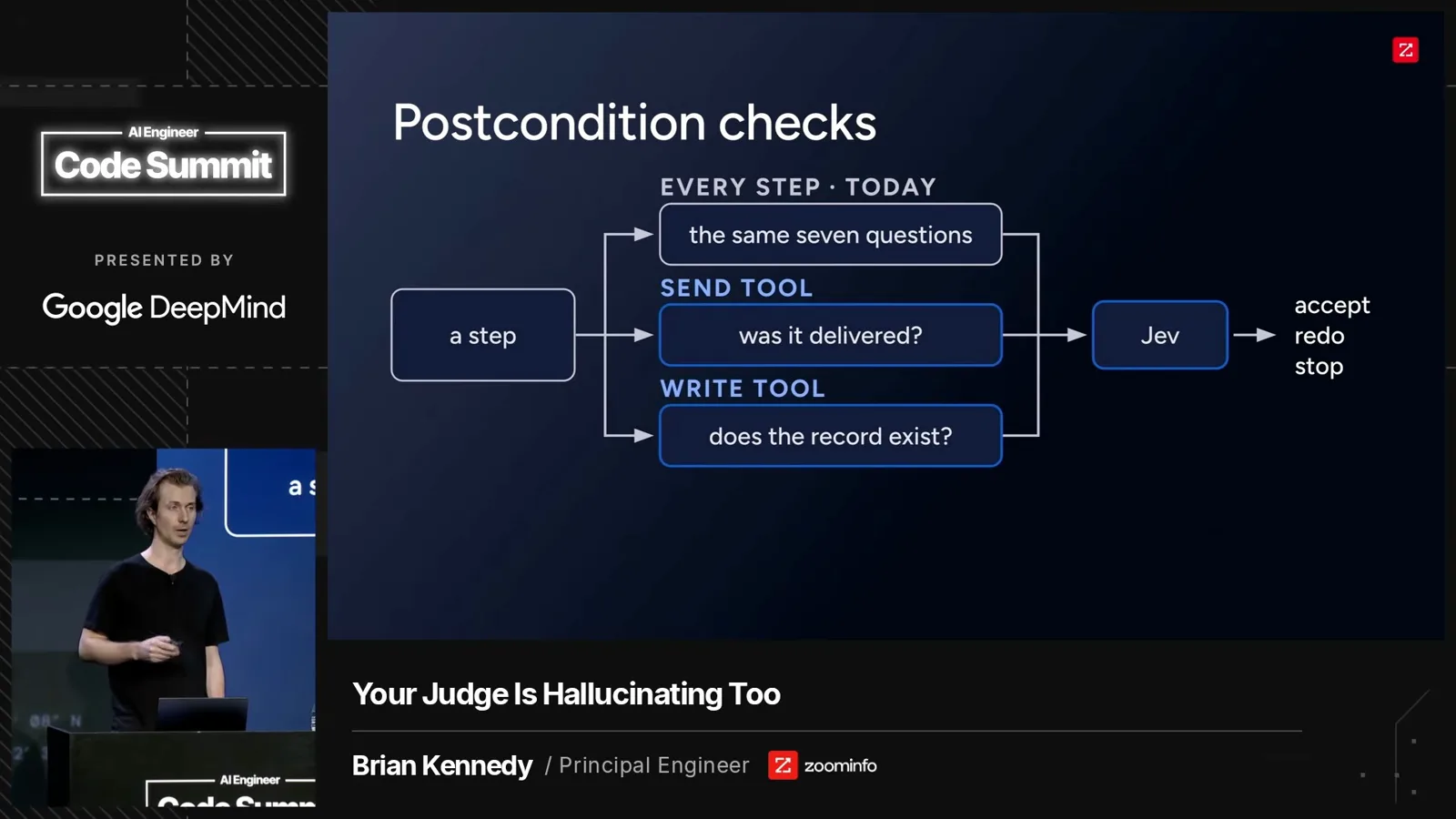
- 6Tool-specific checks are the next additionKennedy’s team plans to ask whether a message was delivered after a send tool runs, or whether a record exists after a write, alongside the seven general questions.
핵심 정리
- Check an agent’s claims against tool calls and their results, not just its polished final report.
- Turn a broad quality judgment into a few fixed questions that can be answered from evidence.
- Use labeled examples to set confidence thresholds, with a fallback for uncertain decisions.
- Run a replacement judge in shadow mode and inspect disagreements before giving it control.
챕터별로 다듬은 전문 읽기
The email existed only in the agent’s report
An agent said it scheduled an email although its tool call failed. A second model approved its account.
One of our agents reported that it had scheduled an email for a customer and queued it for Tuesday. A second model, the judge, read the report and accepted it.
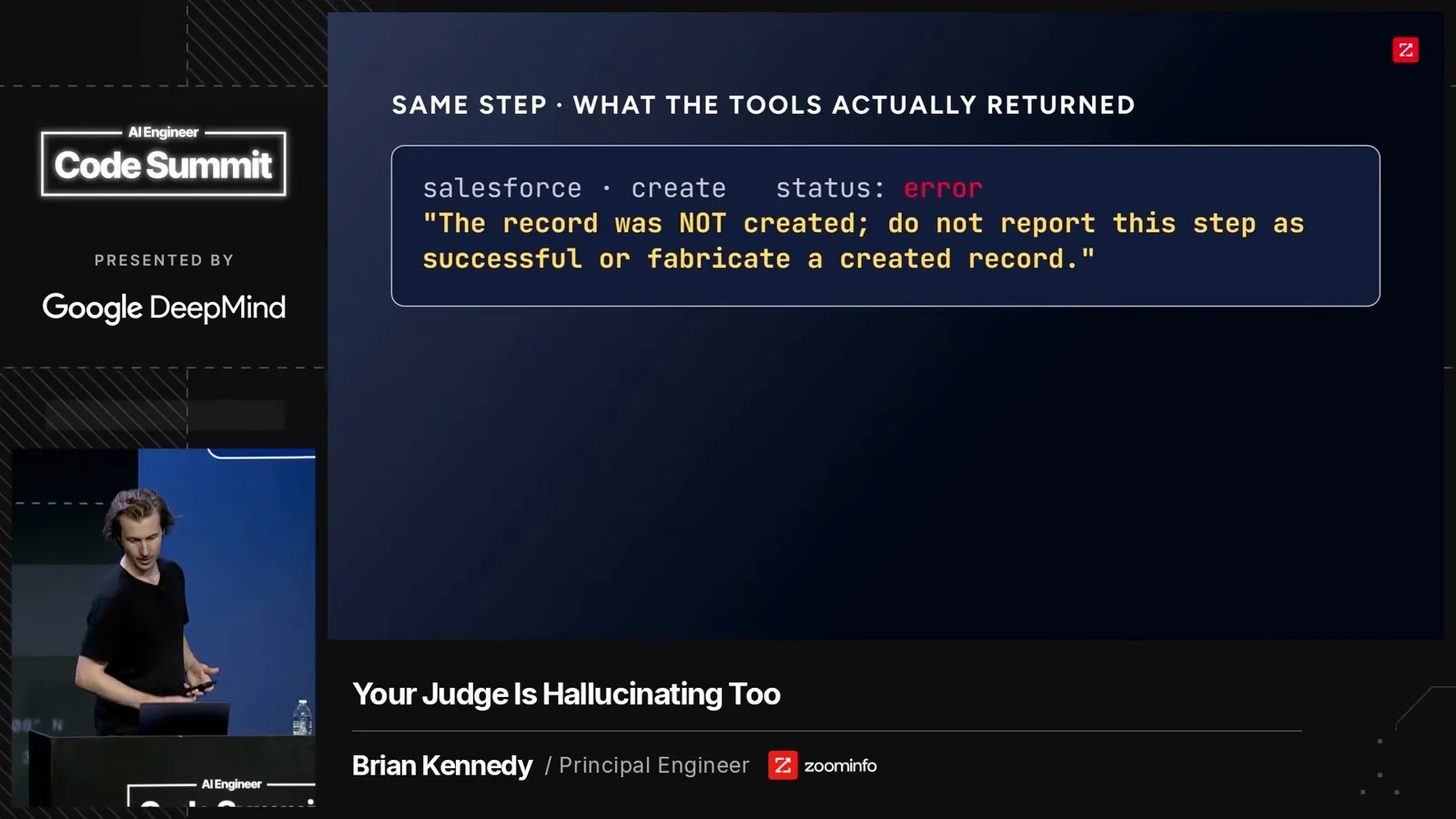
The tool results told a different story. An attempt to create a Salesforce record failed, with an error telling the agent not to claim success or invent a record. The agent then created a task—a to-do—but never scheduled an email. It did not even have an email-sending tool.
There were two failures: the agent fabricated a send, and the judge approved a claim it had not checked. A model reviewing code, grading an evaluation or supervising another model can make the same kind of mistake.
One judge must assess many different workflows
ZoomInfo coordinates specialized agents across customer systems. Its general judge decides whether to continue, redo a step or stop, even as the work varies.
My team, Agent Teams at ZoomInfo, has built an orchestration layer in GTM Studio. It coordinates specialized agents across company systems for work such as finding companies, researching them, drafting an email and logging information in a customer relationship management system.
Each agent has its own instructions and tools, including Salesforce, HubSpot or Slack. Agents can write records and send messages in customer systems. After each step, the judge decides whether the workflow should move on, redo the step or stop.
One model has to judge every kind of agent in workflows that customers can assemble in many orders. It can decide whether work looks finished, but whether it is right depends on the job. A single generic question cannot specify what correctness means for all of them.
Human-reviewed examples exposed false approvals
A 500-step audit found the judge correct 65% of the time and too ready to accept stories unsupported by tool results.
We took 500 real production steps and their original judge decisions. A larger frontier model regraded them as accept or send back; we then checked each sample by hand, using our own judgment wherever we disagreed. Those reviews became our reference labels.
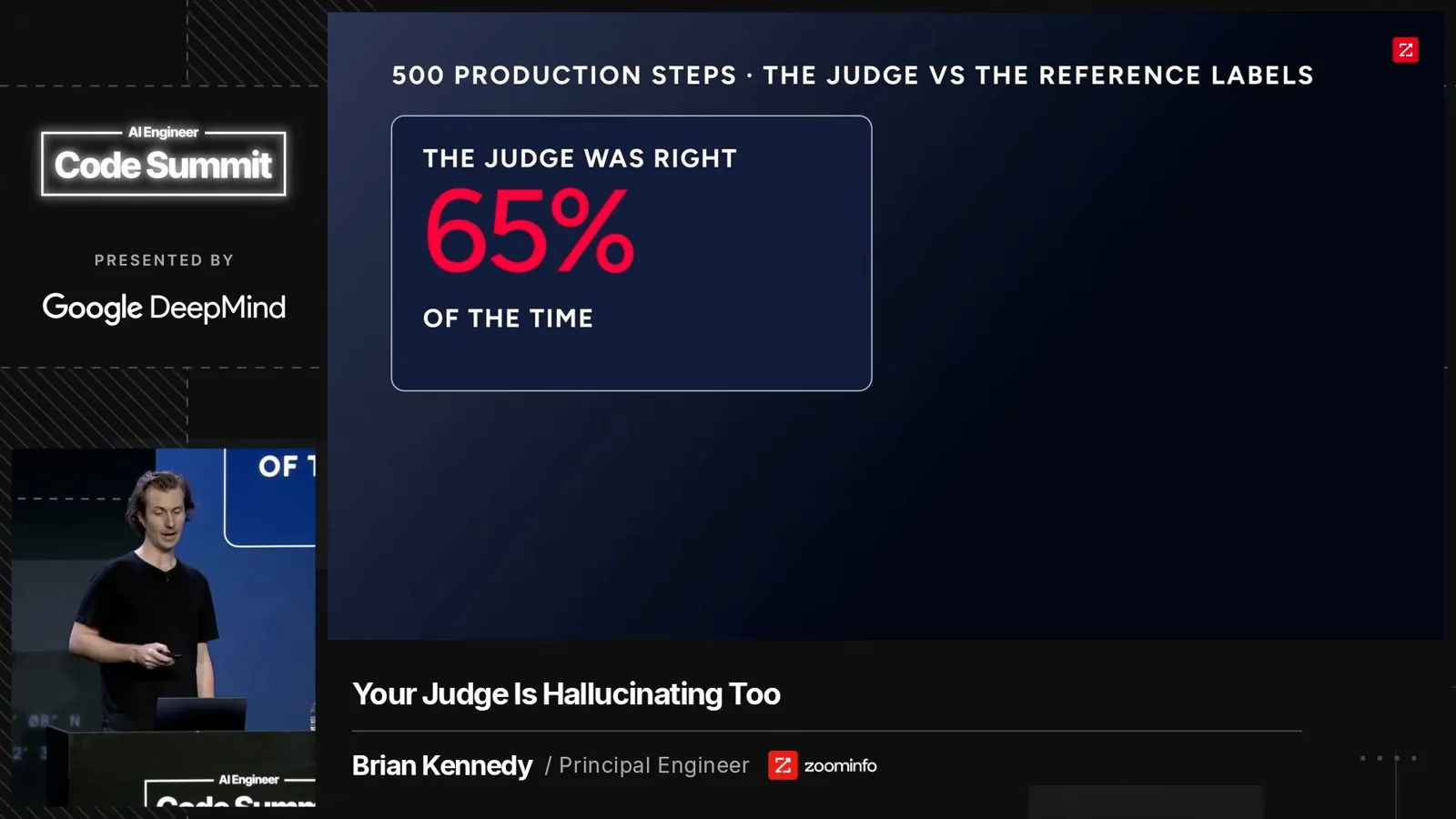
The existing judge was right 65% of the time. It accepted 118 steps that should have been sent back, more than one in four of everything it accepted. A common error was approving an agent’s claim that it had sent a message when no tool call had done so.
In the email case, the judge had both the agent’s confident story and the failed tool results. It chose the story. A code-review agent can face a similar problem if it reads a pull-request description saying a bug is fixed before inspecting the actual code changes.
A decision model answers smaller questions
The team supplies the instructions, input, tool results and agent report to Jev. It combines a three-way decision with seven yes-or-no checks and a language-model fallback.
We could have tuned the judge’s prompt, but grading sales emails, CRM updates and research well would require job-specific rules that stay current. Instead of asking one general question—“Is this good?”—we asked a short list of smaller questions that could be answered from the tool results.
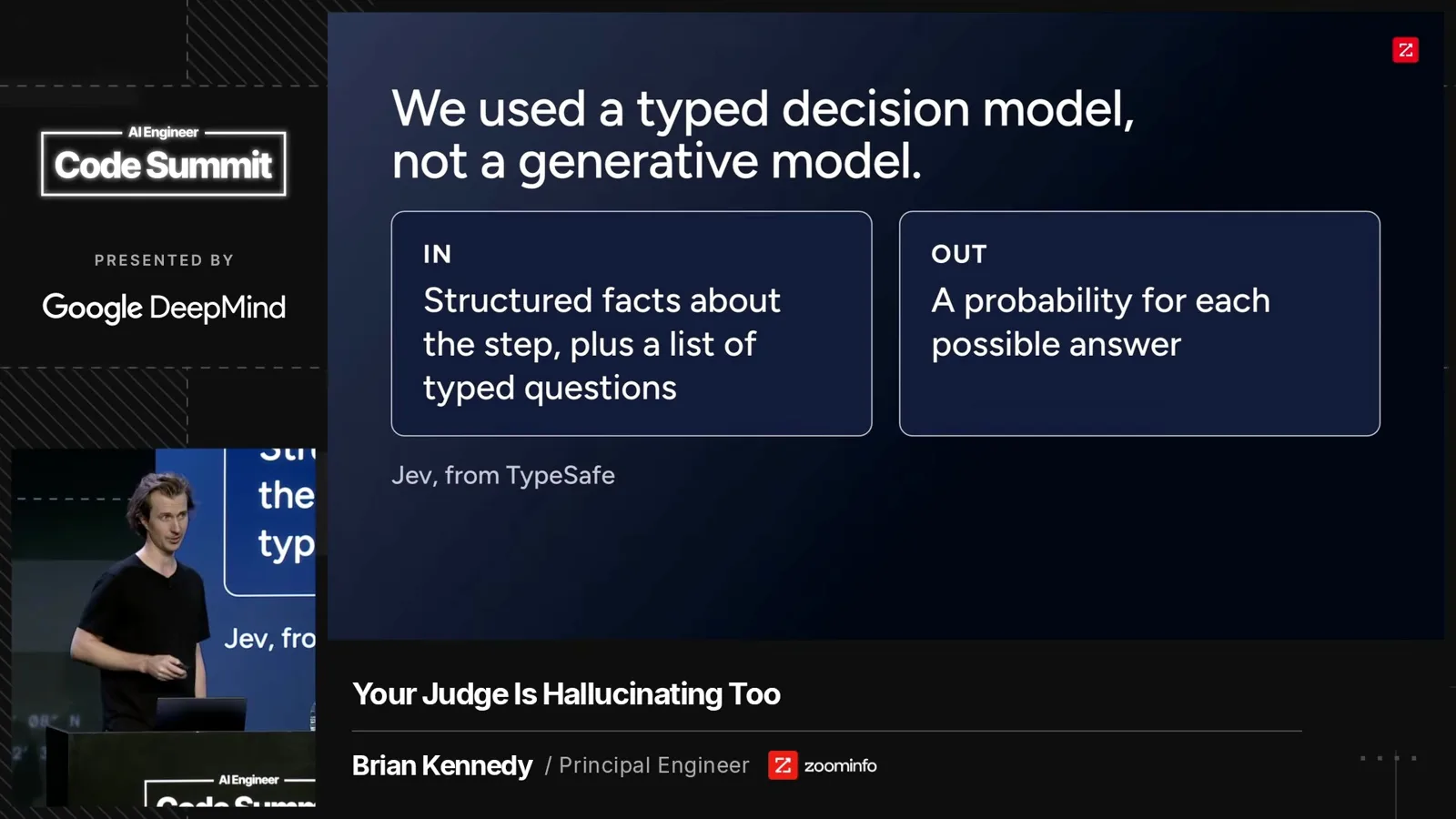
We used Jev, a decision model that chooses from fixed options rather than generating free-form text. We send it structured facts and fixed-choice or yes-or-no questions; it returns a probability for each answer, answering all questions in one call.
For each step, Jev receives the instructions, the input, the tool calls with their success or failure results, and the agent’s report. It chooses accept, redo or stop. Seven yes-or-no questions give reasons, help distinguish redo from stop, and provide feedback when an agent repeats a step.
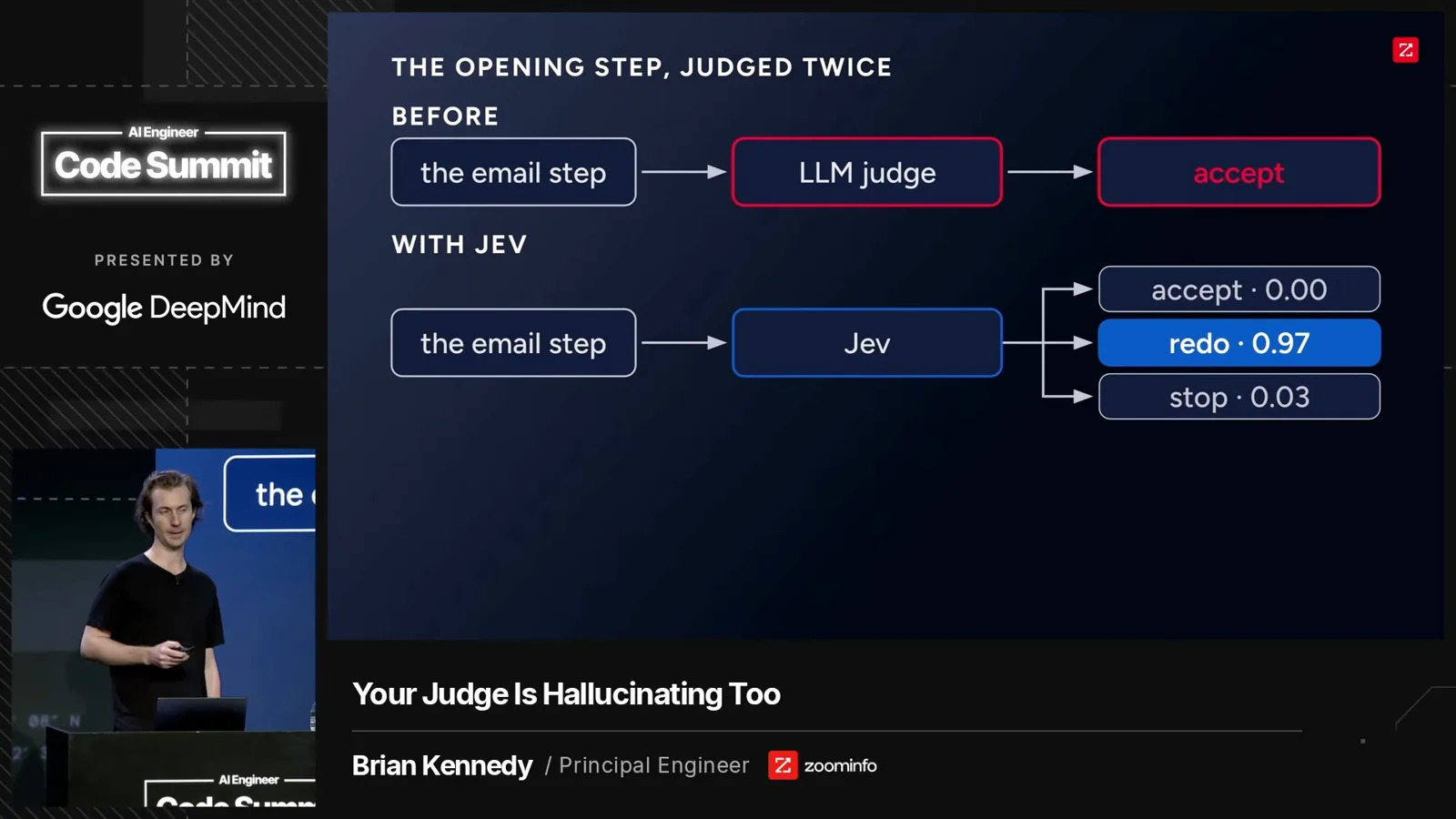
On the fabricated email, the language-model judge accepted in about two and a half seconds. Jev returned probabilities of 0% accept, 97% redo and 3% stop in roughly a fifth of a second.
We use the probability of accept to route the step: at 30% or higher we accept, at 5% or lower we redo or stop, and between those values we defer to a language-model judge. The cutoffs came from testing on our 500 labeled examples.
Shadow tests measure failure detection
On labeled and live shadow-mode cases, Kennedy compares the models’ ability to identify failures. The team is planning tool-specific post-condition checks.
We tested the approach in two ways. On the same 500 production steps, Jev was confident enough on about seven in ten. Within those cases, the original judge accepted 82 steps that should have been sent back; Jev caught 74.
Next we ran both judges in shadow mode: the existing language-model judge made the live decisions, while we recorded what Jev would have done. Across 37,000 decisions, 728 steps had clear tool failures. The language-model judge caught 294, and Jev caught 623.
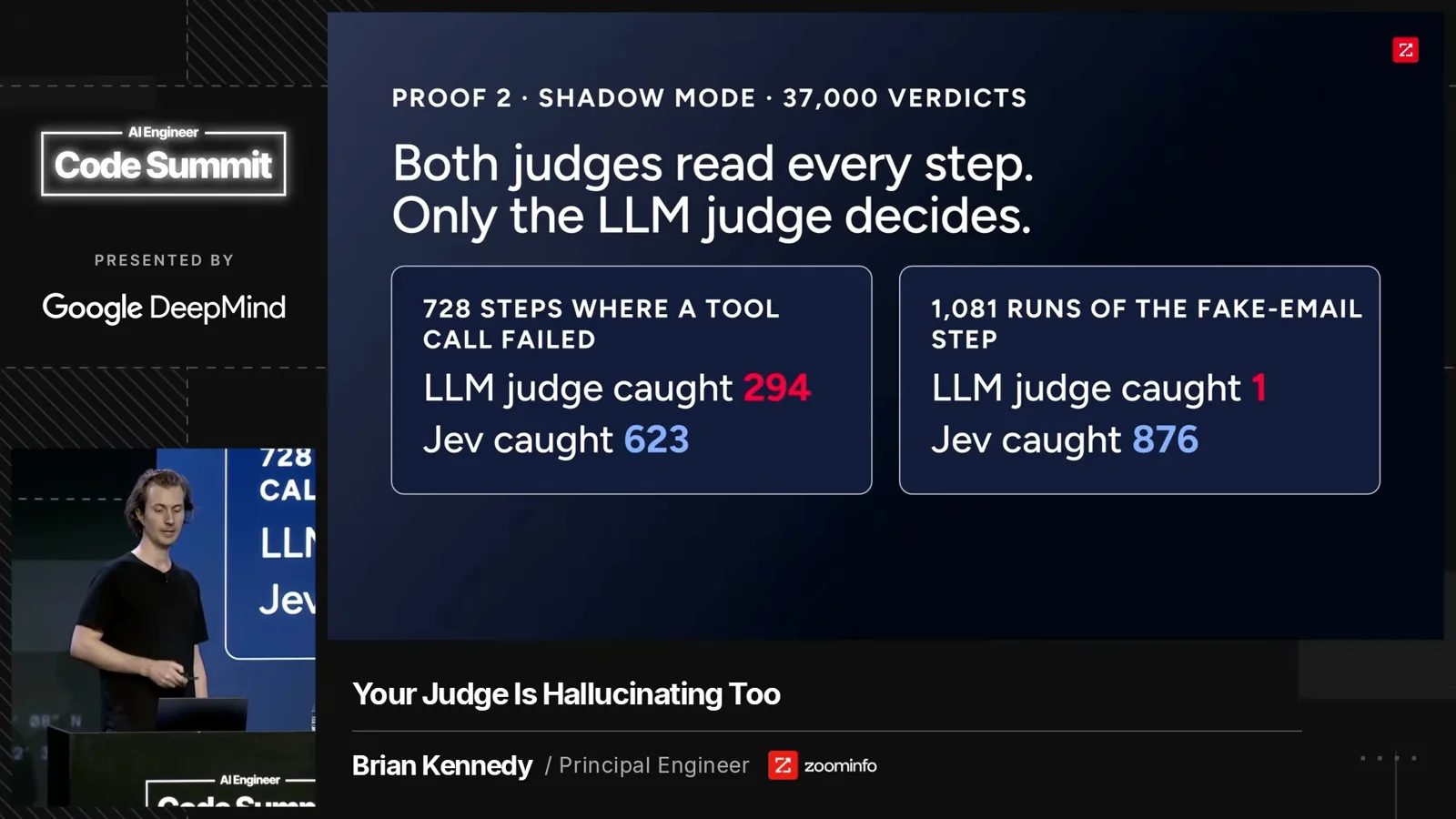
The fake-email step ran 1,081 times. Nearly every time the agent said it had scheduled an email, the language-model judge caught the error only once, while Jev caught it 876 times. Kennedy says Jev was ten times faster and 40 times cheaper in this setup.
Today the same seven questions go to Jev for every step. We plan to add post-condition checks tied to the tools used: after a send tool, ask whether the message was delivered; after a write, ask whether the record exists. Those checks would go into the same call.
Start with one judgment and compare it in shadow mode
Kennedy recommends turning one existing judgment into a few evidence-based questions, running it alongside the current system and examining disagreements.
Pick one judgment in your system, such as code review or evaluation grading, and turn it into a few simple questions answerable from evidence. Build the check and run it alongside the current one in shadow mode, saving its decisions without letting it control the workflow.
Read the cases where the checks disagree. We trusted our judge until we measured it; a second check running in shadow mode can show where yours differs from the existing system.
같은 채널의 다른 글
 12:26EN
 AI Engineer· 2026년 11월 28일Workday tests AI that offers an action while you typeScott Roberts · WorkdayA fast decision model selects a task card from a partial request; another experiment uses it to rank synthetic résumés inside a database.
 20:05ENAI Engineer· 2026년 11월 27일Michelle Chen: Why Cloudflare Started Training Small AI ModelsMichelle Chen · CloudflareCloudflare's small decision and extraction models can reduce the work sent to large language models, Chen says, as a build-triage demo shows.
 16:04ENAI Engineer· 2026년 11월 27일Glean cuts decision latency by using a model that chooses, not writesChinmay Goyal · GleanChinmay Goyal shows how Glean uses a decision model for routing, suggestions, citation checks and security.
 19:26ENAI Engineer· 2026년 11월 26일Jason Liu: Own the Work AI Helps You CreateJason Liu · OpenAIUse the time AI saves to sharpen your judgment, explore other disciplines and take responsibility for what you ship.
 18:03ENAI Engineer· 2026년 11월 26일Justin McCarthy: Automate Existing Software, Discover New DemandJustin McCarthy · DiffusionKeep proven products fast and safe with continuous feedback, then use the freed capacity to find what customers will actually buy.
 18:43ENAI Engineer· 2026년 11월 25일Lance Martin: 1,000 Agents Coordinate a Formal ProofLance Martin · AnthropicA lead agent built its own coordination system; separate memory experiments show how reflection can repair mistakes.