30초 요약
Instead of waiting for a chatbot to finish answering, a Workday prototype predicts a user's intent while they type and opens a relevant action card. Principal engineer Scott Roberts says an initial test routed messages correctly 96% of the time across seven cards and a chat fallback. His team also tested the same decision model on synthetic résumés in a database. The demonstrations were not in production, and Roberts says they may or may not become products.
- 1A routine agent loop repeatedly invokes a large model for small choicesRoberts argues that choosing a tool or checking a step often calls for a fast conditional decision rather than a full, slow language-model response.
- 2The decision model generalized to questions without task-specific trainingWorkday experimented with routing, judging and résumé questions. Roberts says the model handled their questions out of the box, unlike a conventional classifier that needs a training set and iteration.
- 3Autocomplete can open an action instead of merely finishing a sentenceIn a prototype, a time-off request brings up a calendar while the user types. The team also showed pay, meeting and person-search flows using fictional data.
- 4A shared routing test achieved 96% across seven cards and chatThe model first selects a card; the owning team supplies the questions that fill it. Before a card is merged, the team tests it against the existing set to check for collisions.
- 5A database query can score every résumé against a new questionIn a DuckDB demo, a natural-language question is evaluated against each synthetic résumé. The plumbing query took about 2.3 seconds across 117 records and returned low scores for the machine-learning résumés.
핵심 정리
- Predict the action a person wants, not just the words they will type next.
- Test each new action card against the shared routing set so it does not steal another card's requests.
- Keep a chat fallback when no action card fits the request.
- A natural-language decision function can score each record in a database without first building a vector index, as demonstrated on synthetic résumés.
챕터별로 다듬은 전문 읽기
Why small decisions need a faster model
Workday sees both quick employee requests and complex data work. Roberts describes the repeated decisions in an agent loop and why he wants a faster, cheaper model for them.
I’m Scott Roberts from Workday. More than 11,000 organizations use our tools. Their problems range from quick actions, such as checking pay or requesting time off, to sifting through large amounts of data. We’re experimenting with agent workflows for both.
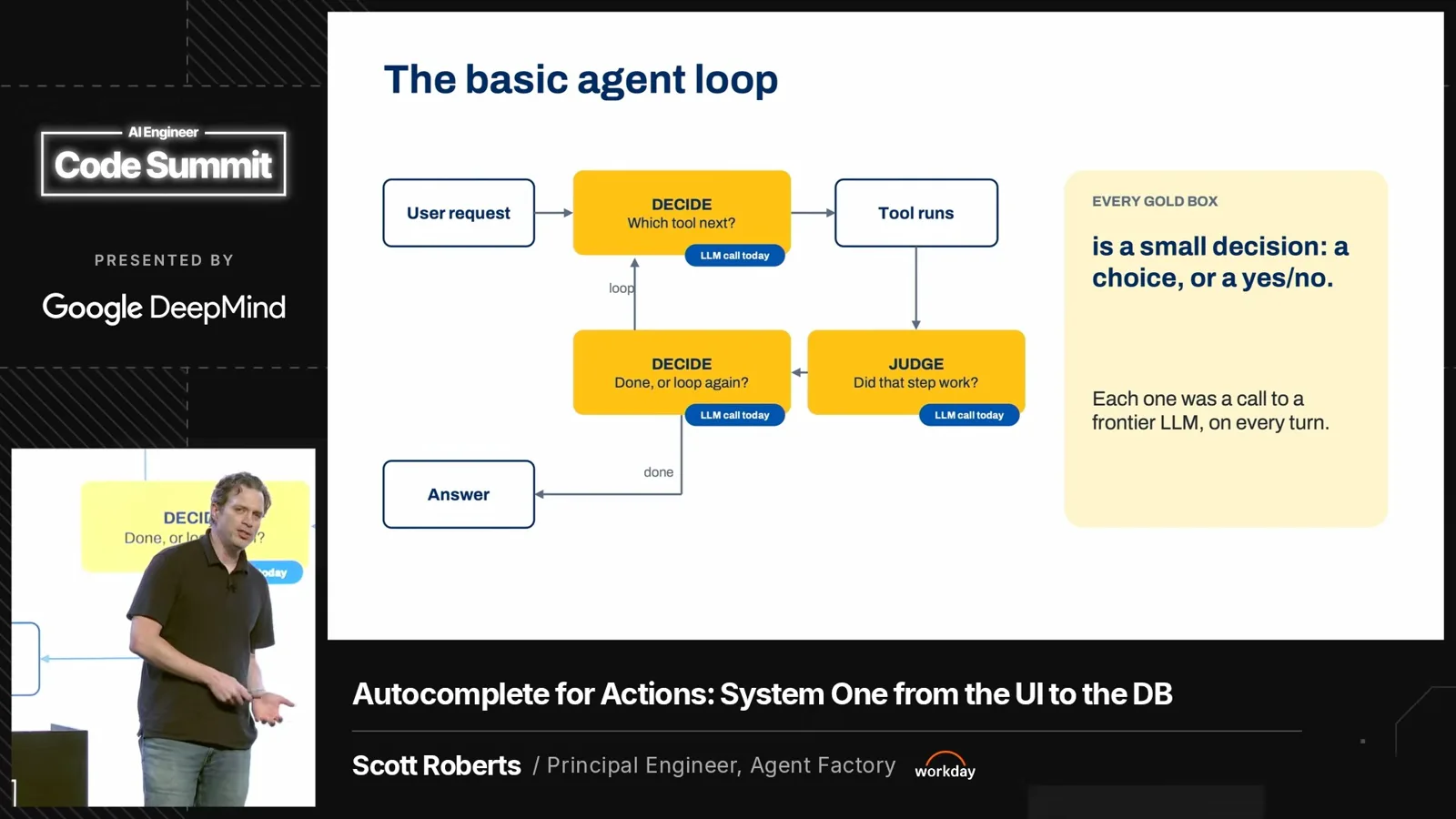
In a simple agent loop, a user makes a request, the system decides what to do, runs a tool and judges whether the step worked. It repeats until it has a result. If each decision calls a large language model, we pay for slow, deliberate processing even when the question is a small choice.
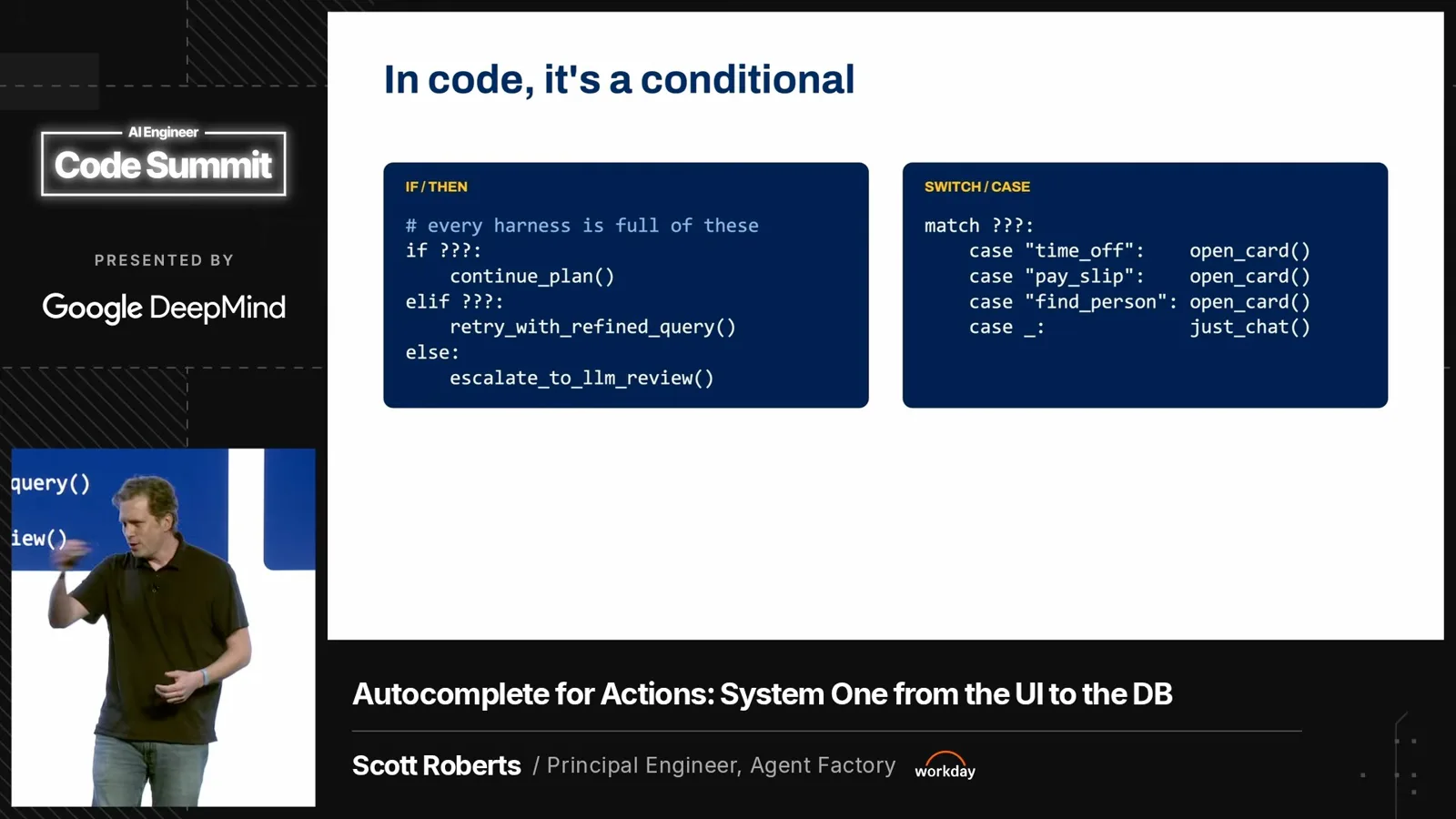
I want something fast, smart, generalized, easy to use and cheap. From a code perspective, a decision model such as Jev can serve as a conditional: if this happens, what should happen next, or which case should we explore?
Decision questions without a custom classifier
Jev scores probabilities, categories and ranked choices. Workday tried it on routing, judging and résumé questions without building a task-specific training set.
Jev offers probability questions, category choices and scores that can be sorted. My first question was how it differs from the classifiers we already have. With a classifier, I need a reliable training set, training and further iterations when new data arrives. In our experiments, Jev generalized to the question we supplied without that setup.
We tried it for routing, judging whether a step worked and evaluating whether a résumé matches a machine-learning role. A deliberately simple example asks whether a fish is a pet. The answer is uncertain without context; a fish in a bowl and a fish on a plate give the model different contexts to evaluate.
From text autocomplete to action cards
A prototype predicts intent as the user types and presents cards for leave, pay, meetings and people. Roberts describes how the team tests routing across cards.
The demonstrations use fictional data, not customer résumés or payroll records. They aren’t in production now and may or may not be in the future.
Ordinary autocomplete predicts the question as someone types, but that alone doesn’t get them to an answer. We want to predict the action too, then show an interface that helps the person complete it.
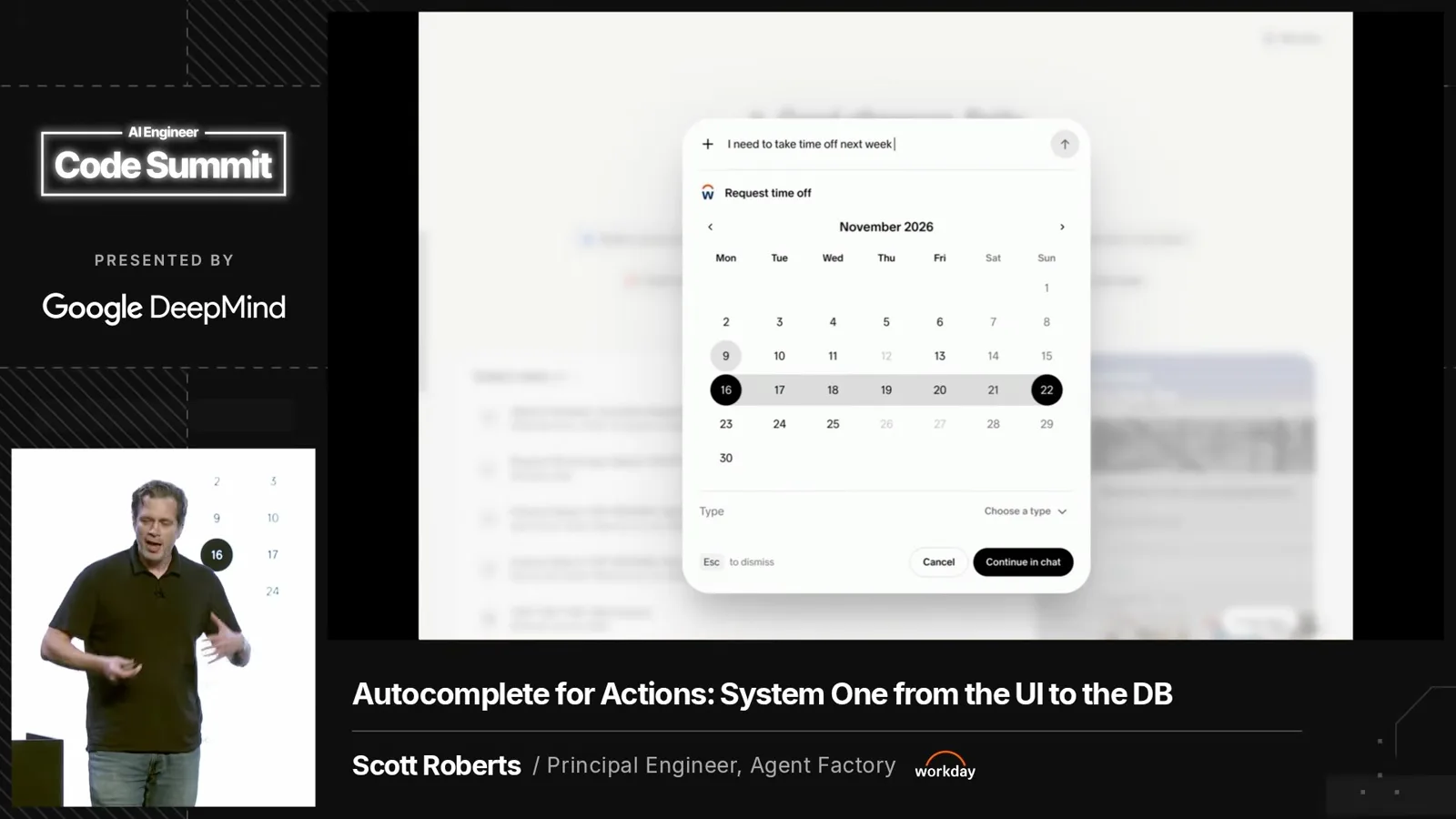
In our demo, someone starts typing a request for time off next week. While they type, Jev uses the available context to adjust the interface and bring up a leave card. The repeated decisions happen on a typing cadence, which I don’t think we could have achieved with a full LLM turn.
The pay example works in the same spirit. Instead of asking an agent to search for a payslip, the person types a request for the last pay period and gets an interface where they can reveal the amount.
For a meeting, the user specifies next Friday, 2 p.m. and their boss, and the demo fills the meeting details. A person-search example uses either organizational knowledge or a name, then offers an email action.
Jev is fast and inexpensive enough for us to predict intent and render a UI on a type-ahead cadence. I estimate about $20 per million judgments. First the model selects the relevant card; the team responsible for that domain defines the questions that progressively fill the card.
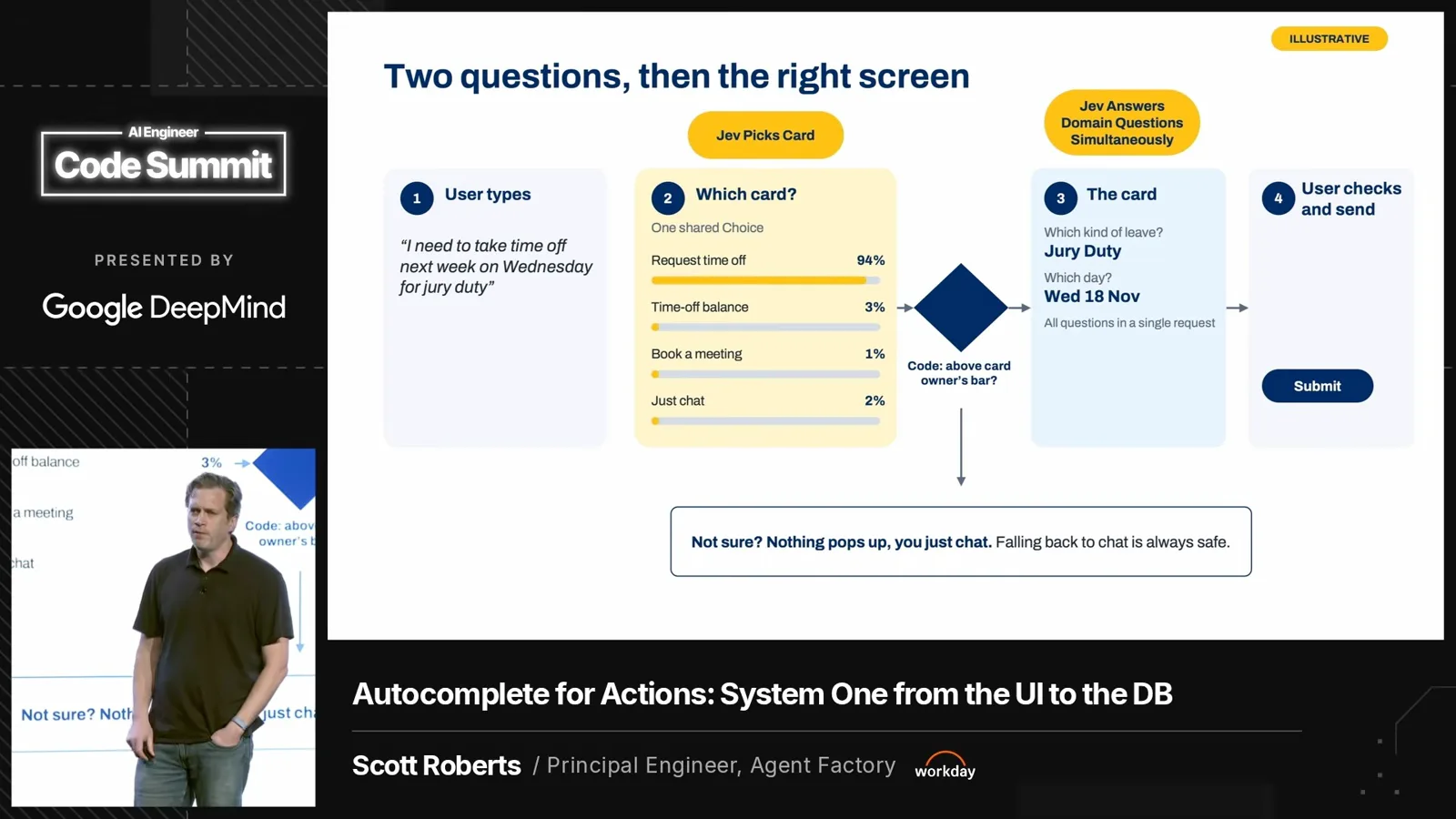
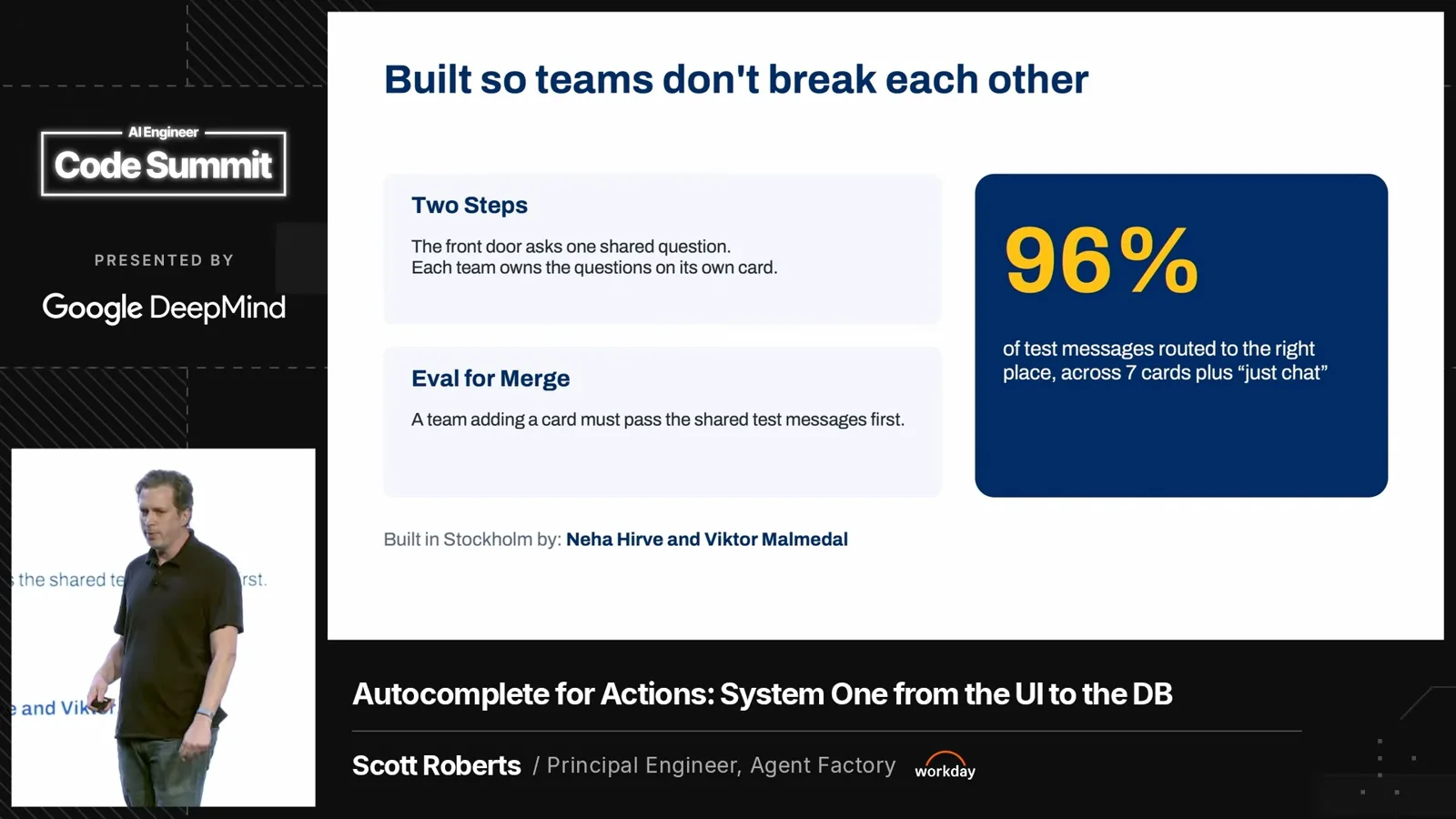
Before merging another card, we run an evaluation to check that it doesn’t collide with the others. In an initial experiment with seven cards plus a ‘just chat’ fallback, we achieved 96% routing accuracy. If no card solves the request, the user should be able to continue chatting.
Ranking synthetic résumés in DuckDB
A database function scores résumés against a natural-language question without embeddings or a vector database. A plumbing query tests whether the model can avoid confusing software pipelines with plumbing.
The second problem is slower: a recruiter may need to work through hundreds of résumés to find candidates for a role. Previously, we might embed the résumés, store vectors in a database, retrieve candidates and rerank them before presenting a shortlist.
In the new experiment, we put résumés in a database and use a natural-language question to score each record against the criteria. There is no embedding, vector database or task-specific training step. A DuckDB function calls Jev, gives each résumé a score and orders the results.
The synthetic records in the first query are heavily focused on machine learning, so many score highly for experience with fraud, trust or safety. To make the test more adversarial, I switch the question to whether each person is qualified to do plumbing. A keyword search could mistake software ‘pipelines’ for relevant experience.
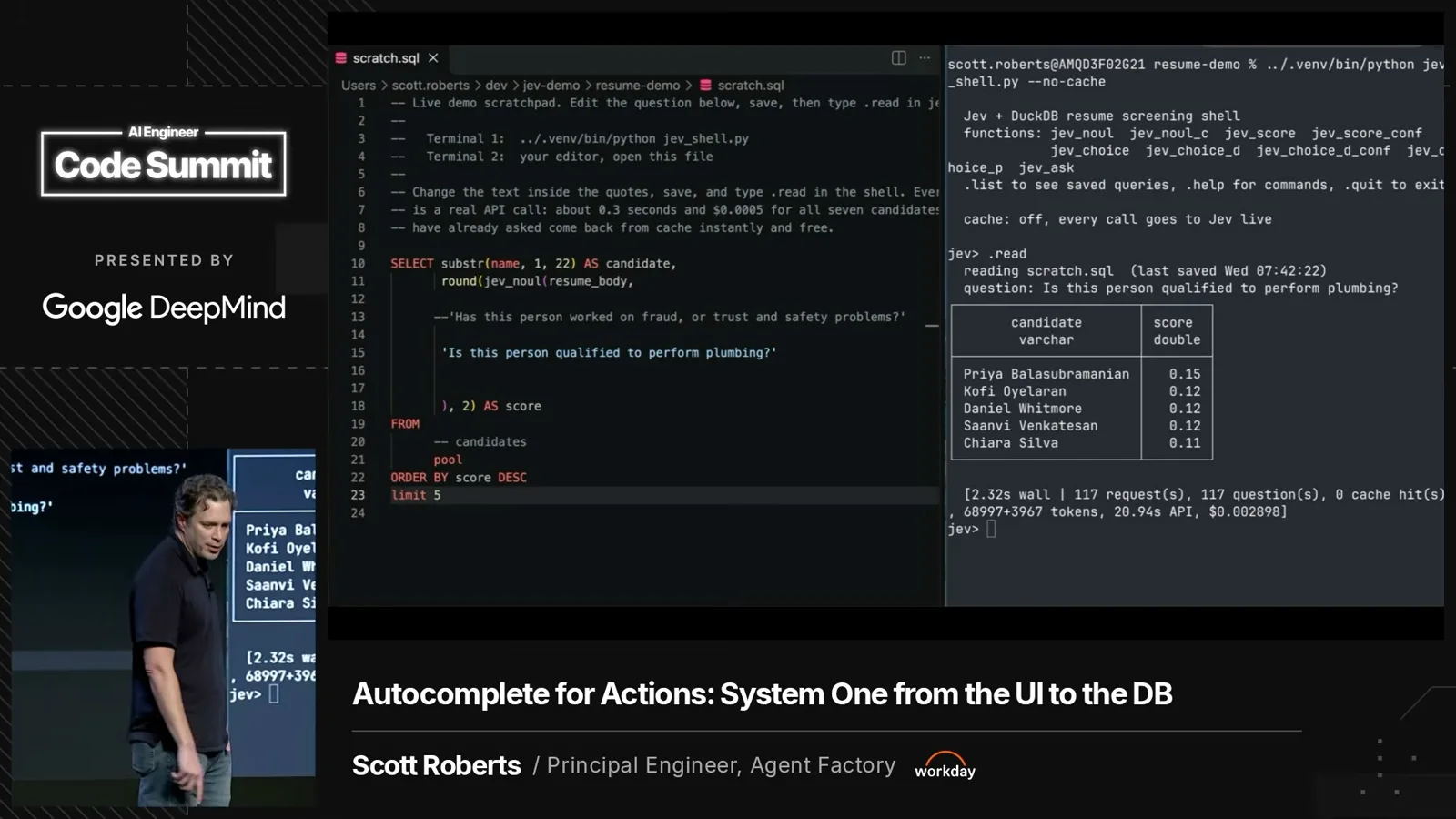
The model returns low probabilities for the machine-learning résumés. The query runs over 117 records in about 2.3 seconds of wall-clock time at very low cost. These two prototypes show where we are experimenting: getting a person to a quick action and filtering a larger body of information for a slower task.
같은 채널의 다른 글
 11:44EN
 AI Engineer· 2026년 11월 28일ZoomInfo found its AI judge trusted a fabricated email sendBrian Kennedy · ZoomInfoA review of 500 agent steps exposed false approvals; small evidence-based checks caught more failures in a shadow test.
 20:05ENAI Engineer· 2026년 11월 27일Michelle Chen: Why Cloudflare Started Training Small AI ModelsMichelle Chen · CloudflareCloudflare's small decision and extraction models can reduce the work sent to large language models, Chen says, as a build-triage demo shows.
 16:04ENAI Engineer· 2026년 11월 27일Glean cuts decision latency by using a model that chooses, not writesChinmay Goyal · GleanChinmay Goyal shows how Glean uses a decision model for routing, suggestions, citation checks and security.
 19:26ENAI Engineer· 2026년 11월 26일Jason Liu: Own the Work AI Helps You CreateJason Liu · OpenAIUse the time AI saves to sharpen your judgment, explore other disciplines and take responsibility for what you ship.
 18:03ENAI Engineer· 2026년 11월 26일Justin McCarthy: Automate Existing Software, Discover New DemandJustin McCarthy · DiffusionKeep proven products fast and safe with continuous feedback, then use the freed capacity to find what customers will actually buy.
 18:43ENAI Engineer· 2026년 11월 25일Lance Martin: 1,000 Agents Coordinate a Formal ProofLance Martin · AnthropicA lead agent built its own coordination system; separate memory experiments show how reflection can repair mistakes.