30초 요약
On October 24, 2025, Matthew Berman and co-host Nick discuss AI news with Microsoft researcher Francesca Parmigiani, Bluefish AI CEO Alex Sherman, creator Matt Wolfe and Runway CEO Siqi Chen. Their conversation spans experimental optical computing, AI search and brand visibility, AI safety, orbital data centers, local hardware and an unusual marketing campaign. Claims about future capabilities, products and returns are the speakers’ assessments at the time, while the optical system and quantum result concern particular research workloads rather than general-purpose replacements for existing computers.
- 1Quantum claim in contextGoogle described a 13,000-fold advantage for a particular quantum algorithm against a classical comparison; the speakers discuss possible future applications, not a general speedup.
- 2An optical computing experimentFrancesca Parmigiani describes a research machine that combines optics and electronics and a projected efficiency gain for specific operations.
- 3Marketing for AI answersAlex Sherman explains why brands track their visibility and portrayal in AI-generated responses as well as search results.
- 4Superintelligence and safetyThe hosts and Matt Wolfe debate a proposed ban, the pace of advances and possible safeguards.
- 5Data centers in spaceThe group weighs the attraction of solar power against cooling, maintenance and latency challenges.
- 6A hot-sauce marketing experimentSiqi Chen explains why his finance software company attached $100 bills to a limited run of $13.99 hot sauce.
핵심 정리
- Microsoft’s analog optical computing research targets selected mathematical operations, with large efficiency gains still a projection rather than a product guarantee.
- Brands seeking visibility in AI answers must consider both their own information and independent sources, Sherman argues.
- The participants disagree on how to balance AI progress with safeguards and how quickly more capable systems might emerge.
- Orbital data centers face difficult questions about heat rejection, launch, maintenance and communications.
- AI infrastructure investment and high valuations can be debated separately from the technology’s long-term usefulness.
- Runway’s hot-sauce giveaway was designed as a lead-generation campaign, not a profitable consumer product.
챕터별로 다듬은 전문 읽기
Opening news: recommendations, quantum computing and Meta
The hosts discuss a social recommendation complaint, Google’s quantum research claim and reported changes at Meta. The quantum result is tied to a specific experiment.
Matthew Berman and Nick open their October 24, 2025 livestream with a week of AI news and interviews. They begin with complaints about the recommendations on X and whether Grok could make the platform’s feed more useful.
The hosts compare feeds across social platforms. Nick says a single interaction with an NBA clip can lead Instagram to show many more of them; the challenge is balancing a user’s interests with variety and avoiding a feedback loop.
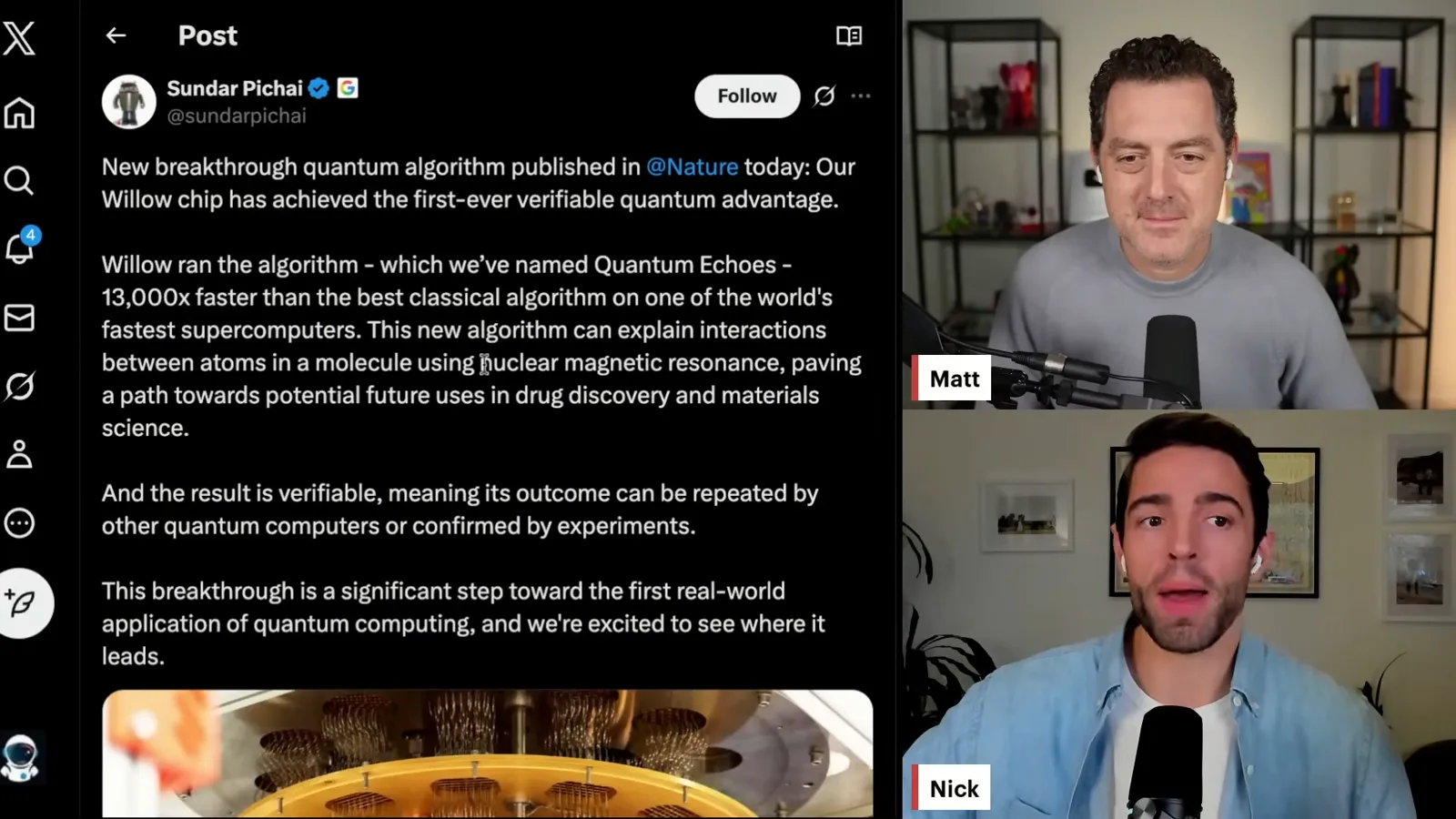
The conversation turns to Google’s Quantum Echoes announcement. The company claimed its Willow chip ran a particular algorithm 13,000 times faster than a classical comparison and described the result as verifiable. The hosts discuss possible applications in materials and drug discovery as future possibilities, not established general-purpose quantum advantages.
Berman cautions that quantum computers are suited to narrow classes of problems rather than every task performed on a laptop. When a problem does fit, the potential advantage could be substantial, but the specific experiment is only one step toward applications.
The hosts also discuss reports of approximately 600 positions affected by restructuring at Meta. They note that some employees might move elsewhere inside the company, while researchers posting publicly suggest that others were looking for new jobs.
Berman and Nick weigh what the restructuring might mean for Meta’s AI organization. Their interpretation is tentative: organizational changes and public posts do not establish the fate of every researcher or a complete explanation of the company’s strategy.
Inside Microsoft’s analog optical computer
Francesca Parmigiani explains the hybrid research system, its potential efficiency and open engineering questions. The team’s attempted visual demo encounters screen-sharing difficulties.
Berman welcomes Francesca Parmigiani, principal research manager at Microsoft Research Cambridge. Her group is exploring analog optical computing: a combination of optical and electronic components intended to accelerate selected calculations rather than replace every conventional computer.
Parmigiani explains that the approach exploits the physics of light to perform particular mathematical operations used in AI. The researchers are interested in the computation as well as the energy cost of moving data between memory and processors.
Asked how the project began, Parmigiani describes the attraction of using optical hardware for a computing task where it could offer a meaningful advantage. The prototype combines optics with electronics, and the hosts show an image of the apparatus.
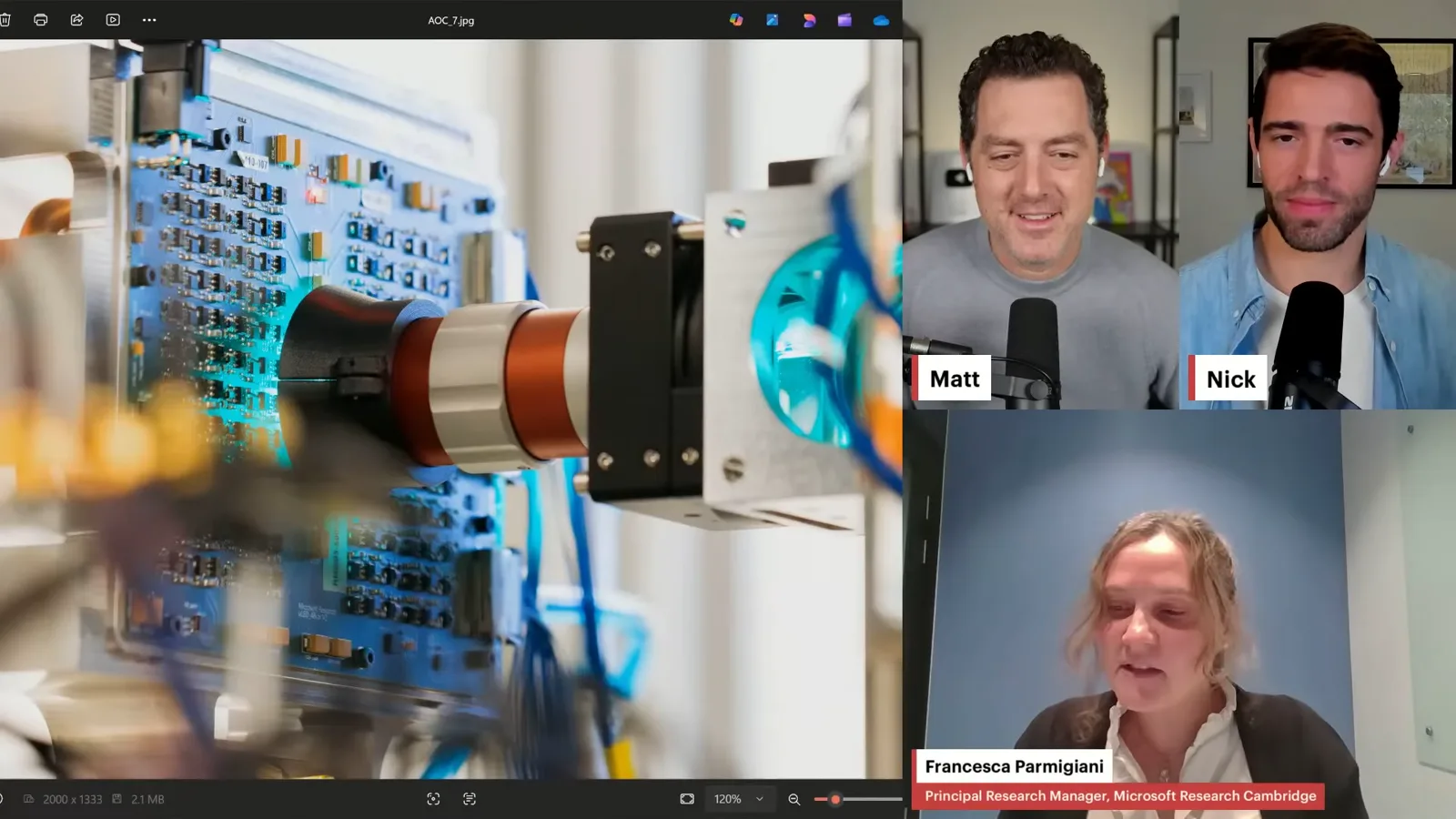
She says the research has the potential to be 100 times more energy efficient than current GPUs for the specific computations she describes. This is a projection for selected workloads, not a measurement showing that the prototype or all AI tasks already operate at that efficiency.
Parmigiani distinguishes her approach from trying to build a general-purpose digital computer entirely out of optics. Instead, the team seeks tasks for which light and analog processing can contribute alongside conventional systems.
One example is optimization, including the traveling-salesperson problem: finding an efficient route becomes much harder as the number of cities grows. Such problems appear in practical settings, though an optical approach still has to demonstrate value on useful instances.
The system is intended to complement existing computing hardware. Parmigiani imagines choosing an accelerator according to the application, with digital electronics continuing to handle work that is a poor fit for the optical machine.
The hosts ask where the project fits among competing approaches and when it might become a product. Parmigiani stresses that it remains research, with significant technical challenges ahead; she does not give a commercial release date.
Parmigiani recounts the origins of the project and the work involved in building a team around it. A small research effort had to combine people with expertise in optics, electronics, algorithms and machine learning.
The discussion returns to translating the underlying physical device into useful computing. The team must demonstrate that algorithms can be mapped to the hardware and that the machine’s results are reliable enough to be meaningful.
Berman asks how the team grew and what motivated the research. Parmigiani describes a group of roughly ten people working across disciplines, with the research question extending beyond a simple race for raw processing speed.
The hosts try to bring up a demonstration. Technical difficulties with sharing the screen interrupt the presentation, so the conversation continues with Parmigiani’s description rather than a successful live visual demonstration.
Parmigiani describes starting with simple examples as a kind of hello world for the machine. The team has explored small proof-of-concept problems, including examples relevant to banking, health care and AI inference; these are research demonstrations, not evidence that full production workloads have been solved.
For an inference example, a model is trained on a GPU and its learned weights are then mapped onto the optical system. Parmigiani discusses handwritten digit recognition as a way to test how the machine performs a familiar task.
The group asks what must happen next. Parmigiani says scaling and integration are works in progress: useful performance depends on the whole system, not simply an isolated optical component. The potential and the remaining engineering work are both substantial.
Nicotine claims and robots learning from people
The hosts exchange personal views about stimulants before discussing paid human demonstrations for robot training. They speculate about data quality and future automation.
The hosts briefly discuss nicotine and attention, including their own experiences and speculative claims about its effects. Their exchange is personal commentary, not evidence of a proven treatment or a recommendation to use nicotine.
They shift to companies paying people to perform everyday tasks while robots observe. The figures discussed vary by task, with examples as high as $150 per hour; the aim is to collect demonstrations that can teach robots how humans manipulate the world.
The hosts wonder how well demonstrations will transfer to different kitchens, objects and environments. They also consider sanitation, variation in the quality of the human demonstrators, and whether expensive real-world data could eventually be supplemented by synthetic data.
Their broader point is that robot training requires more than a compelling demonstration: data must capture the detail, variety and reliability needed for real tasks. The speed and cost of reaching that standard remain open questions.
Alex Sherman on AI search and brand discovery
The Bluefish AI CEO explains measuring a brand’s visibility and representation in AI answers. The group discusses retrieval, independent sources, shopping and possible future advertising.
Berman introduces Alex Sherman, CEO of Bluefish AI, to discuss how brands appear in answers generated by AI systems. Sherman describes a business focused on measuring and improving how companies are represented as people increasingly ask AI assistants for recommendations.
The first question is how much control a brand actually has over a model’s answer. Sherman separates whether a brand appears at all from how favorably it is described; both matter to marketers, but neither is controlled entirely by the company.
He argues that AI responses differ from a conventional search result page. A generated answer synthesizes information rather than merely ordering links, so marketers need to understand what sources contribute to that synthesis and what claims are repeated.
The group compares the emerging practice with search engine optimization. Traditional search rewarded signals such as incoming links; Sherman says AI discovery similarly involves third-party context, but the mechanisms and the user experience are different.
Berman asks whether brand-produced material could dominate what an assistant tells a consumer. Sherman says an assistant trying to preserve trust should draw on independent sources as well as company claims, especially when a user expects a balanced recommendation.
Sherman distinguishes model training from retrieval at answer time. A system may consult fresh sources when answering, which gives current material a route into a response without implying that a brand can directly rewrite a model’s underlying knowledge.
They consider holiday shopping, a crucial period for retailers. Sherman expects assistants and shopping tools to play a growing role in product discovery, while acknowledging that their actual effect will depend on how customers use each interface.
The hosts contrast ordinary paid search placements with the AI products they were using at the time. Sherman discusses how an assistant provider might eventually monetize shopping or recommendations without undermining the integrity of its answers.
Sherman speculates that advertising could arrive in 2026. This is his prediction during the October 2025 discussion, not an announcement of a product, confirmed launch date or universal business model.
The speakers ask how people will consume information if an assistant synthesizes sources for them. A publisher or brand may need content that is useful both to a person visiting a site and to a system trying to assemble an accurate answer.
Sherman discusses agentic shopping and how a brand might distinguish automated visitors from people. The details vary by platform, and the group treats widespread autonomous purchasing as an emerging possibility rather than an accomplished fact.
Bluefish works with large brands, Sherman says, and measures AI visibility across representative questions. The purpose is to see when a company appears, how it is characterized and which sources are associated with the answer.
Berman compares this work with the familiar search-engine cycle in which marketers adapt to algorithm changes. Sherman acknowledges that individual systems will evolve; he argues for building useful, authoritative information instead of relying solely on a short-lived trick.
The group discusses the balance between paid distribution and quality content. Sherman’s perspective is informed by his company’s business: he sees brand information and credible independent coverage as inputs that can improve discoverability, but he does not claim a guaranteed ranking.
A large company can publish substantial first-party information, Sherman says, but other sources still matter. An assistant that uses independent information may produce a more trustworthy result than one that simply repeats a company’s own promotional language.
The participants consider how many different AI surfaces brands may have to address. Unlike a market dominated by one familiar search engine, the landscape includes general assistants, retailer systems and other interfaces, each potentially using different sources.
Sherman and the hosts discuss the opportunities this shift creates for startups and established marketers. They close with the idea that companies should understand how customers ask questions before deciding which channels and content deserve attention.
The superintelligence debate
The hosts discuss an open letter calling for a ban and invite Matt Wolfe to weigh the risks of rapid progress against its benefits.
The hosts turn to an open letter calling for a ban on superintelligence. They see possible benefits in continued AI progress and question whether a broad ban would be effective, while recognizing the concern that increasingly capable systems could cause serious harm.
They describe the possibility of a rapid “hard takeoff,” in which AI capabilities accelerate before humans have solved alignment. That is one feared scenario, not a demonstrated forecast; a more gradual transition is another possibility raised in the discussion.
The hosts invite AI creator Matt Wolfe to weigh in. Wolfe says he values progress but also wants attention to safety and some form of oversight, asking how checks and balances can work in practice as systems improve.
The participants debate whether restrictions can be enforced across companies and countries. Wolfe notes that talented people may find workarounds, while the hosts question how a pause or ban would apply to research and to actors outside its jurisdiction.
They also discuss the tension between commercial incentives and safety commitments. The question is how an organization can be accountable for risks when it also has strong incentives to release more capable products.
Wolfe discloses investments connected to companies discussed in the AI ecosystem, including Factory and Leonardo, and equity related to Canva. The disclosure helps readers assess his perspective as an investor as well as a commentator.
Space data centers, robots and AI valuations
The group assesses orbital cooling and practical infrastructure, then considers autonomous vehicles and whether AI investment resembles a bubble.
The group examines the proposal to put data centers in orbit, including the appeal of plentiful solar energy. They discuss Starcloud and the possibility that space-based infrastructure could avoid some terrestrial constraints, while acknowledging that feasibility and economics are uncertain.
A critique displayed on screen points out that space is a vacuum: it cannot cool equipment through ordinary air convection. Heat must be rejected by radiation, which creates questions about radiator size, launch mass, maintenance and the cost of servicing failed hardware.
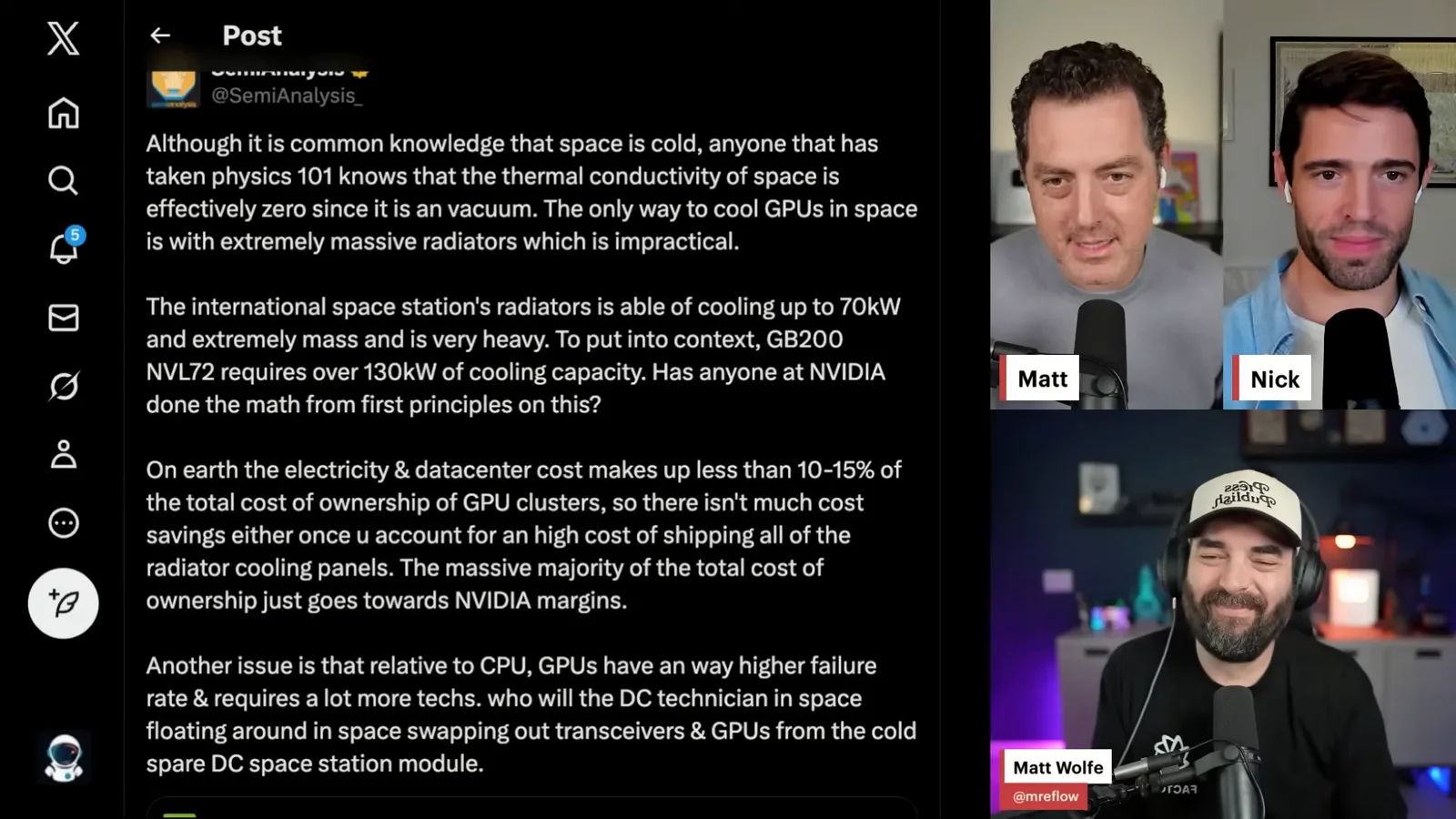
The hosts weigh those objections against the appeal of trying ambitious engineering projects. Even if power is available in orbit, networking latency, hardware failures and the practicalities of moving equipment into space remain consequential design constraints.
The discussion shifts to robots and autonomous vehicles, including impressions of Tesla’s Optimus and experiences with Waymo. Their anecdotes show both how striking a working demonstration can feel and how much deployment depends on reliable performance in ordinary situations.
The speakers debate whether AI investment is a bubble. Wolfe distinguishes the lasting value of a technology from the price paid for individual assets: the internet was transformative even though many investors in the dot-com era suffered losses.
They look at charts comparing today’s large technology-company valuations and capital spending with the late 1990s. Those comparisons are arguments about valuation, not proof that current spending is safe or that no company can be overvalued.
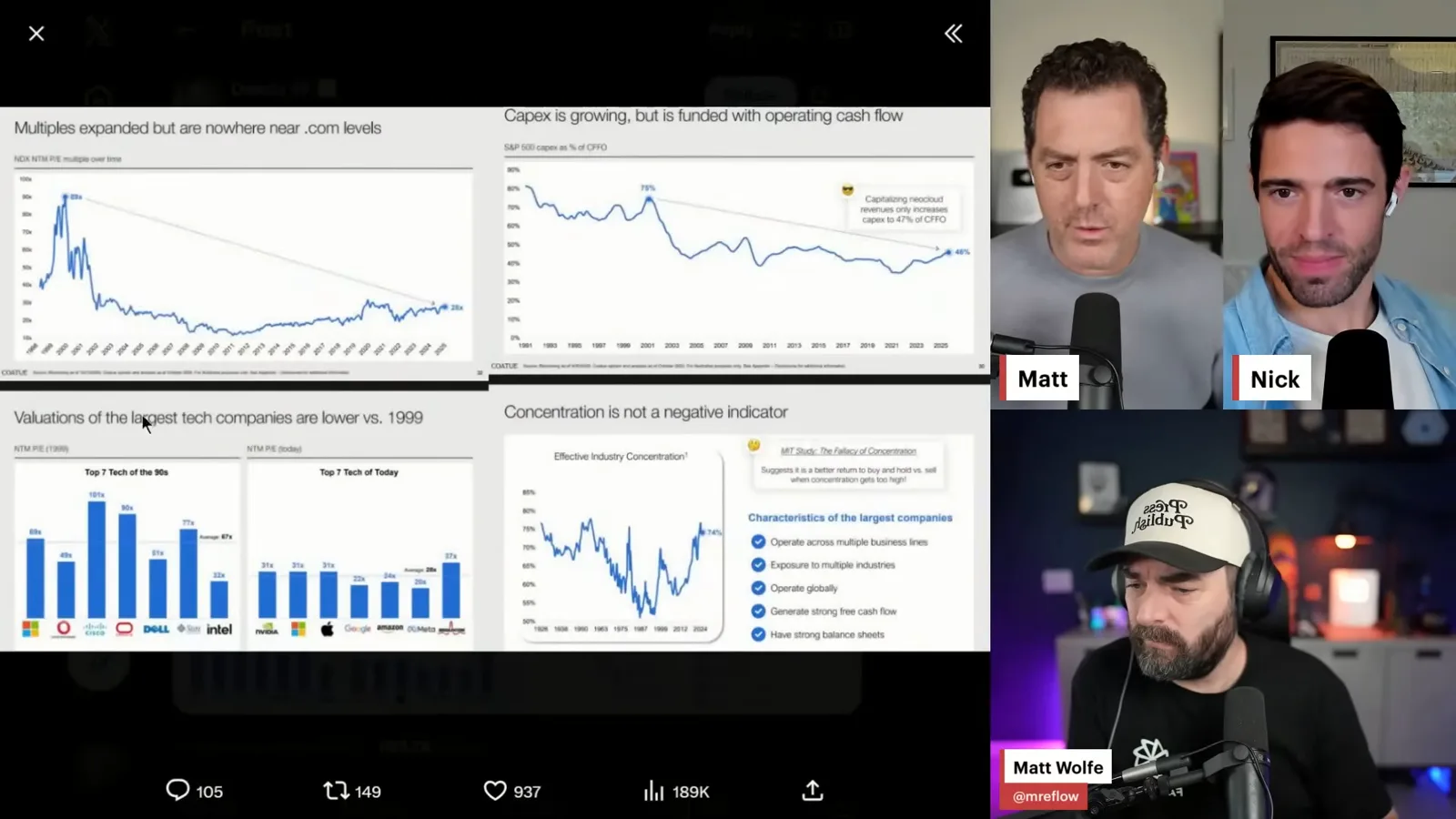
The conversation also addresses circular financing and the possibility that money flows among companies buying infrastructure and investing in one another. The group sees a reason to examine underlying demand and economics, while differing on how much the pattern resembles a bubble.
Cloud infrastructure and local AI hardware
They discuss the Anthropic–Google compute arrangement and compare local machines with cloud inference, including possible uses for NVIDIA’s DGX Spark.
The hosts discuss Anthropic’s announced plans to use Google’s TPU capacity, including a planned deployment of up to one million chips in 2026. They distinguish that announced infrastructure arrangement from speculation about future sales of hardware to other customers.
Wolfe and the hosts compare cloud AI services with running models locally. The cloud offers access to large models and managed infrastructure, while a local machine may be attractive for privacy, control, experimentation or work that needs to remain on premises.
Berman discloses that Dell provided machines to him. He discusses testing local models and says that in some side-by-side comparisons, sending a request to the cloud and receiving the result was faster than inference on his local boxes.
Berman says NVIDIA described the DGX Spark as a machine not designed primarily to be the fastest inference provider. He sees possible uses in training, fine-tuning and smaller organizations’ local AI stacks, including linking a small number of machines together.
Wolfe describes his Mac Studio with an M3 Ultra and 256 GB of unified memory. He notes that some modern image and video tools depend on NVIDIA’s CUDA ecosystem, so substantial memory alone does not guarantee compatibility or good performance.
Siqi Chen on Runway and the Burn Rate campaign
The Runway CEO explains collaborative financial modeling and the economics behind a limited hot-sauce promotion. He describes how the idea arose and why distinctive human creativity may gain value.
The next guest is Siqi Chen, CEO of Runway, a financial planning and analysis platform. This Runway is the finance software company, not the generative-video company of the same name. Chen says the product connects business data and aims to make financial models understandable across departments.
Chen compares a financial model to a simulation or game engine: it lets a company explore how decisions made now could affect the future. In many organizations, finance, sales, engineering and product teams maintain separate spreadsheets that are difficult for others to interpret.
Runway’s goal, he says, is to create a shared view of the business by connecting financial information with hiring, sales, marketing and engineering data. A more visual model can help people outside finance understand assumptions and consequences.
Asked about commissions on enormous cloud contracts, Chen says he has no inside information. He guesses that deals of such size are generally handled at the CEO or founder level; his answer is conjecture rather than a description of a specific contract.
The hosts ask about Runway’s Burn Rate hot sauce. Chen explains that the campaign offered a limited batch with a $100 bill attached for $13.99, an intentionally unprofitable consumer transaction designed to attract attention to the software business.
Chen says an earlier campaign used jackets sealed in time-locked packaging. That experience encouraged the team to develop a consumer product, working with a hot-sauce partner and tasting many candidates before selecting one.
Chen estimates the campaign cost at roughly thirty-something thousand dollars for 200 bottles and frames the expected return in terms of leads and software sales. He mentions 10,000 preorders at one point and later approximately 4,000; the conflicting figures are his live remarks, not a verified conversion result.
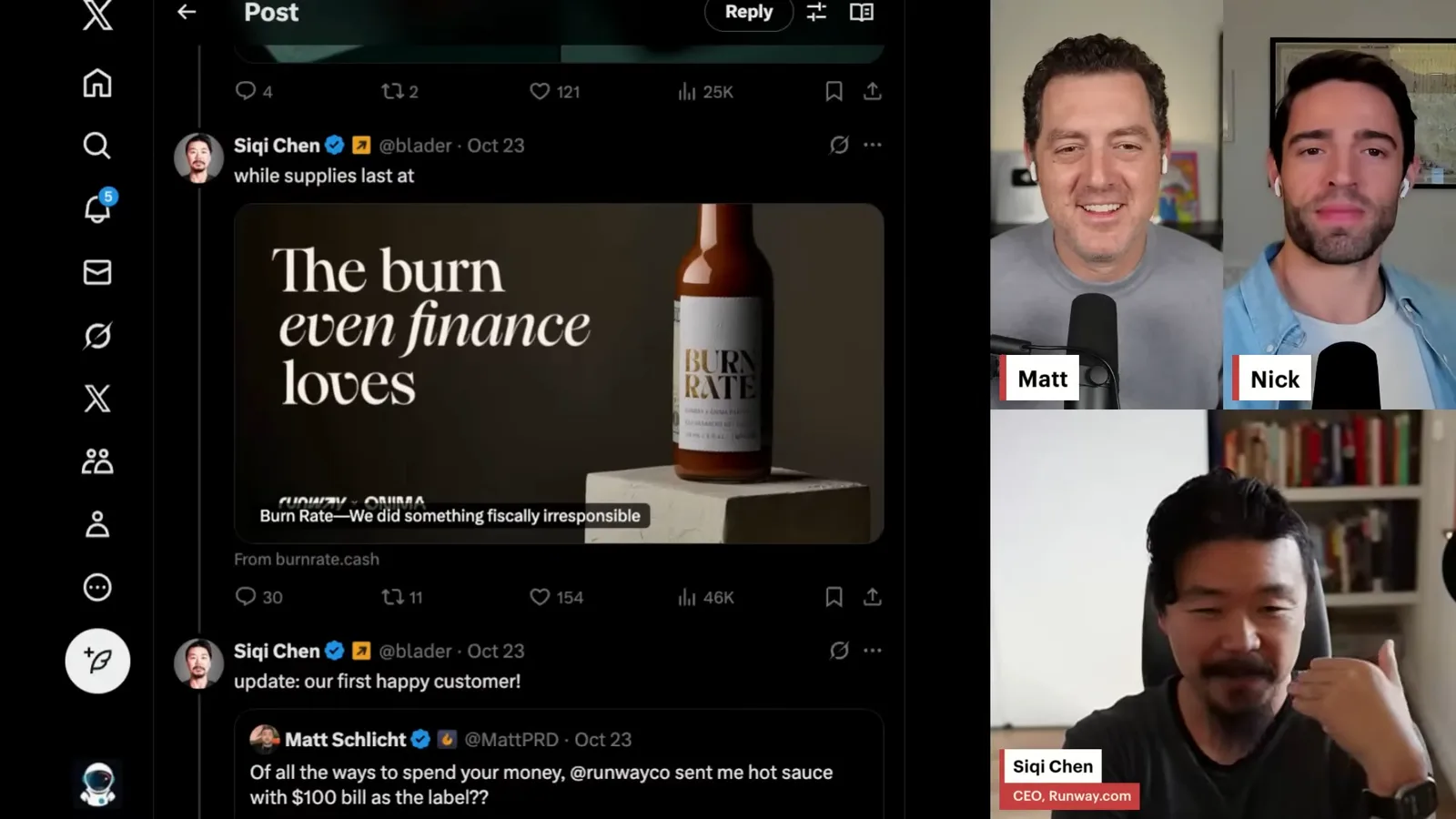
He explains that even a small share of interested people matching Runway’s ideal customer profile could make the campaign worthwhile, given its assumed sales conversion. The projected multiple depends on those assumptions and is not an observed return.
Chen shows how the concept grew from a cold email by Cal, who later became head of marketing. Suggestions for an energy drink and a run club led to a broader idea: use carefully designed consumer products to make business-software marketing stand out.
He credits the marketing and design team for the packaging, photography and website. The extra attention to presentation, he argues, turned a hot sauce into a more memorable experience than simply putting a logo on a bottle.
With only 200 bottles available, Chen says the company would prioritize people in its target finance audience and explore ways to serve others. He suggests a possible higher price for buyers outside that audience, describing an idea rather than a finalized offer.
The hosts connect the campaign to a larger concern: as AI-generated material becomes abundant, distinctive taste and evidence of human effort may become more valuable. Chen compares everyday inexpensive bags with luxury products whose appeal includes craftsmanship and status.
Chen says the sauce has a savory, umami-forward flavor and discusses his own preference for spicy food. The hosts ask whether they can obtain a bottle, and Chen says he will follow up with the team.
Chen adds that the team encouraged some investors to express mock annoyance and contemplated a later breakdown of the campaign’s lead-generation economics. The hosts thank him and close the livestream after the discussion of the promotion.
같은 채널의 다른 글
 34:21EN
 Matthew Berman· 2026년 10월 27일Matthew Berman Examines Anthropic’s IPO Filing, AI Growth and GovernanceMatthew Berman, Sam Altman · Forward FutureThe presenter reviews the S-1’s financial metrics, compute strategy and voting structure while questioning the tension between rapid AI development and safety.
 25:50ENMatthew Berman· 2026년 10월 24일Kimi K3.1 Pro Tested: Strong 3D Demos, Uneven Results and Competitive PricingMatthew Berman · Forward FutureMatthew Berman tests the open-weight model on coding, 3D rendering and visual explanations, then compares benchmark results and prices.
 32:20ENMatthew Berman· 2026년 10월 23일Who Is Local AI For? The Costs, Trade-offs and a Hybrid FutureMatthew Berman · Forward FutureMatthew Berman weighs data control and independence against hardware cost, setup complexity and inference speed.
 1:03:37ENMatthew Berman· 2026년 10월 23일Matthew Berman’s Team Tests Kimi K3.1 on Animation, Games, and ChartsMatthew Berman, Alex, Brian · Forward FutureA live team AMA turns into an informal test of Kimi K3.1, from personal-agent workflows to motion graphics, a browser game, and a benchmark chart.
 0:53ENMatthew Berman· 2026년 10월 22일Sam Altman on AI and the Discovery of New KnowledgeSam Altman · OpenAIAltman expects progress in mathematical discovery to extend to biology, materials and energy.
 0:22ENMatthew Berman· 2026년 10월 21일A Robot Bodyguard Video Shows Dramatic Rescue ScenariosMatthew Berman · Forward FutureMatthew Berman reacts to a short robot demonstration depicting fighting and vehicle-rescue scenarios.