30초 요약
Matthew Berman reviews speculation about OpenAI’s Q*, including an anonymous description of an energy-based dialogue system. The source and its claims cannot be verified, and they do not establish that OpenAI has built AGI. He discusses planning, Yann LeCun’s argument for world models, and the separate STaR and Quiet-STaR papers, which explore ways for language models to generate and learn from rationales.
- 1Planning as a hypothesisBerman revisits Nathan Lambert’s discussion of self-play and look-ahead planning as possible components of Q*. These are hypotheses rather than confirmed details.
- 2LeCun on groundingYann LeCun argues that intelligence needs grounding in some reality and that language alone is an approximate representation of richer experience.
- 3An anonymous accountAn unattributed post claims Q* uses an energy-based model and optimization in an abstract representation space. Berman says its authenticity cannot be confirmed.
- 4The STaR loopThe 2022 STaR paper describes iteratively generating rationales, filtering by correct answers, and using answer hints to retry failures.
- 5Quiet-STaRThe separate Quiet-STaR research explores generating thoughts that help predict future text; its authors report benchmark gains and released code and weights.
핵심 정리
- The anonymous description of Q* is unverified and does not establish its architecture or capabilities.
- Self-play and look-ahead planning are possible approaches to improving reasoning, but their connection to Q* is speculative.
- An energy-based model assigns scores to configurations and can search for lower-energy candidates; a low score is not proof of a correct answer.
- STaR trains on generated rationales for correct answers and retries failed questions with answer hints.
- Quiet-STaR explores learning intermediate rationales from text, with results reported by its researchers on particular benchmarks.
챕터별로 다듬은 전문 읽기
What is known and what is speculation
Berman introduces the Q* rumors and revisits public reporting and a guarded comment from Sam Altman. He says the details are speculative.
There is another purported leak about Q*, the OpenAI project that has prompted a great deal of speculation about artificial general intelligence. I find the ideas intriguing, but much of what follows is rumor: the anonymous source cannot be authenticated, and its claims do not establish that Q* is AGI.
Q* became a topic of discussion around the time Sam Altman was temporarily removed from OpenAI. Asked about it, Altman referred to an “unfortunate leak” without describing the project. I take that as an acknowledgment of something called Q*, but it tells us very little about its actual design. His comments about research breakthroughs around that period have also invited speculation; we do not know whether they referred to Q*.
Nathan Lambert previously considered what Q* might involve. Reuters had reported that some people at OpenAI saw it as a possible breakthrough toward AGI, which OpenAI describes as autonomous systems surpassing humans at most economically valuable work. Two ideas in that discussion were mathematics and broader planning, both difficult areas for language models at the time.
A language model predicts the next token in a sequence. Prompting approaches such as chain-of-thought and tree-of-thought can encourage a longer sequence of reasoning, but I think planning across many steps remains a challenge. The question is whether other techniques could help a system consider the consequences of its actions before responding.
Self-play, world models, and planning
He explains self-play and look-ahead planning, then plays Yann LeCun’s argument that intelligence needs grounding. A North Pole puzzle illustrates their discussion of spatial reasoning.
One candidate is self-play: an agent improves by playing against versions of itself and encountering progressively harder situations. It is not a new idea—AlphaGo is an example—and greater computing power makes repeated simulations possible at larger scale. Some people believe scale itself will be key to AGI, although that is contested.
In an interview clip, Yann LeCun argues that intelligence needs grounding in some reality, even a simulated one. He says an environment is much richer than what language can express, and that people often manipulate mental models of situations without doing so in language.
LeCun’s view is that language models alone are insufficient for modeling the world; he is working on JEPA as an approach to world modeling. Self-play, meanwhile, can let an agent learn about an environment without an explicit instruction for each situation. These are different research directions, and neither is evidence of what Q* uses.
The second proposed ingredient is look-ahead planning: using a model of the world to reason about possible futures and choose better actions or outputs. Lambert discusses model predictive control, often used for continuous states, and Monte Carlo tree search, which works with discrete actions and states. Their inclusion in Q* remains conjecture.
Earlier in March, the pseudonymous poster Jimmy Apples claimed that Q* and a model update had been planned before GPT-5, but that a lawsuit would delay them pending legal clearance. That is an unverified claim about plans and timing, not evidence that the lawsuit caused a delay.
LeCun also offered a spatial reasoning problem: start at the North Pole, walk one kilometer in any direction, turn 90 degrees left, and keep walking. He asks whether the distance to pass the starting point is more than, equal to, or less than two pi kilometers—or whether you never come close. His point is to invite readers to inspect the mental model they use while thinking about the problem.
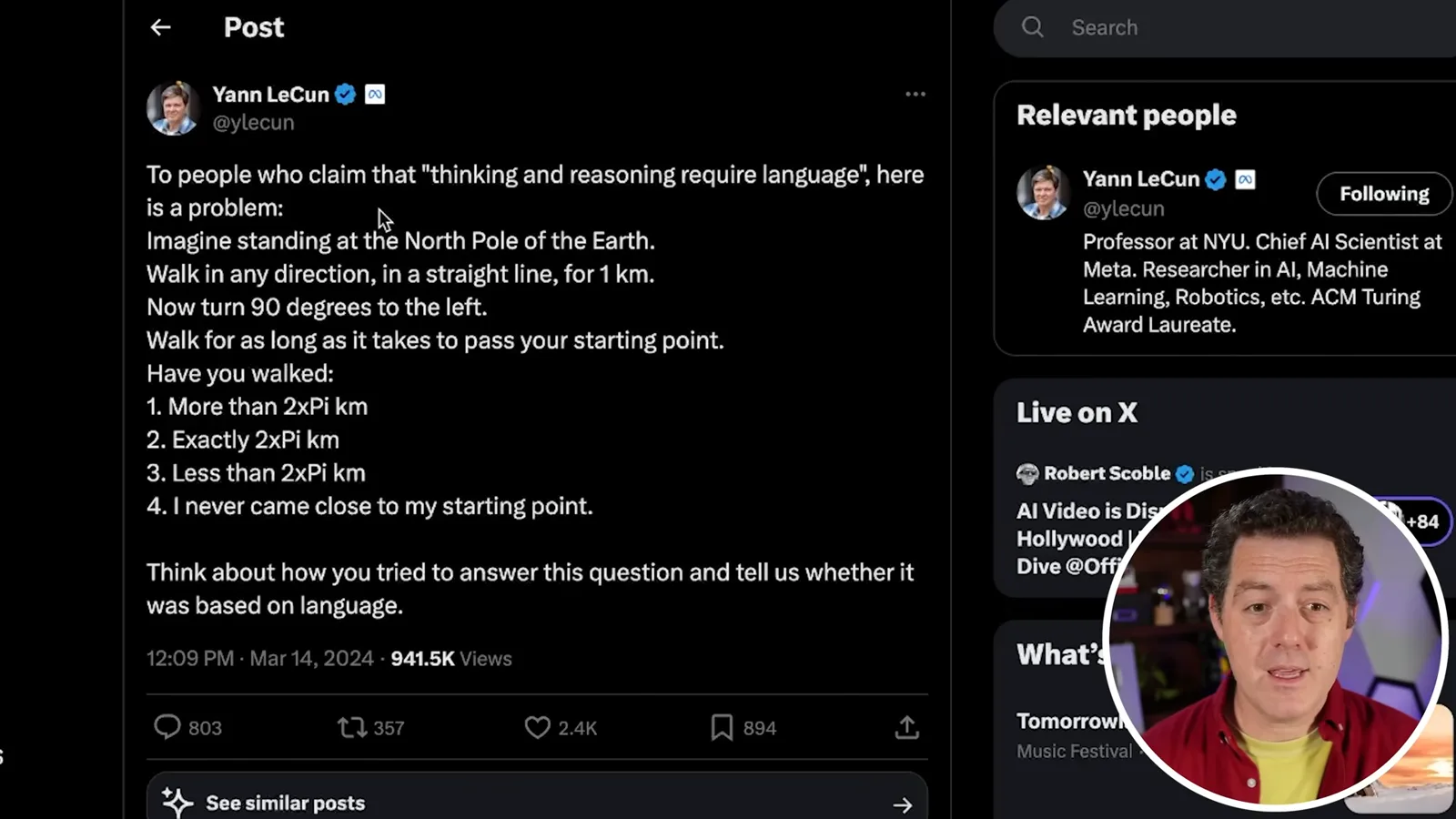
I agree that the example invites spatial reasoning, though I am not sure it proves language is insufficient. I thought the path would never pass the starting point, while ChatGPT answered less than two pi kilometers, which I considered wrong. The result depends on how the path and geometry are interpreted, so this exchange alone does not settle the broader argument about language and reasoning.
The anonymous energy-based model claim
An anonymous post describes scoring responses, optimizing abstract representations, and decoding text. Its provenance and accuracy remain unverified.
Now to the purported leak: an account shared text said to come from an unspecified paste site. Its author is unknown, and we cannot confirm authenticity. It claims Q* is a dialogue system using an energy-based model for a form of deliberation. Treat that as the text’s description of a hypothetical system, not a verified account of OpenAI’s work.
I asked ChatGPT to explain energy-based models. The basic idea is an energy function that assigns a scalar score to a configuration; inference can involve searching for a low-energy configuration. A toy-box analogy is to give arrangements lower scores when they fit better. The score reflects what the model has learned, and a low score does not guarantee that a proposed answer is correct.
The anonymous text contrasts this scoring approach with generating one token at a time. It claims the system would assess the compatibility of an entire response with a prompt, assigning lower energy to better-fitting answers. The chess analogy is to consider possible moves before choosing one, although the text does not demonstrate that such a system actually exists or evaluates every possible answer.
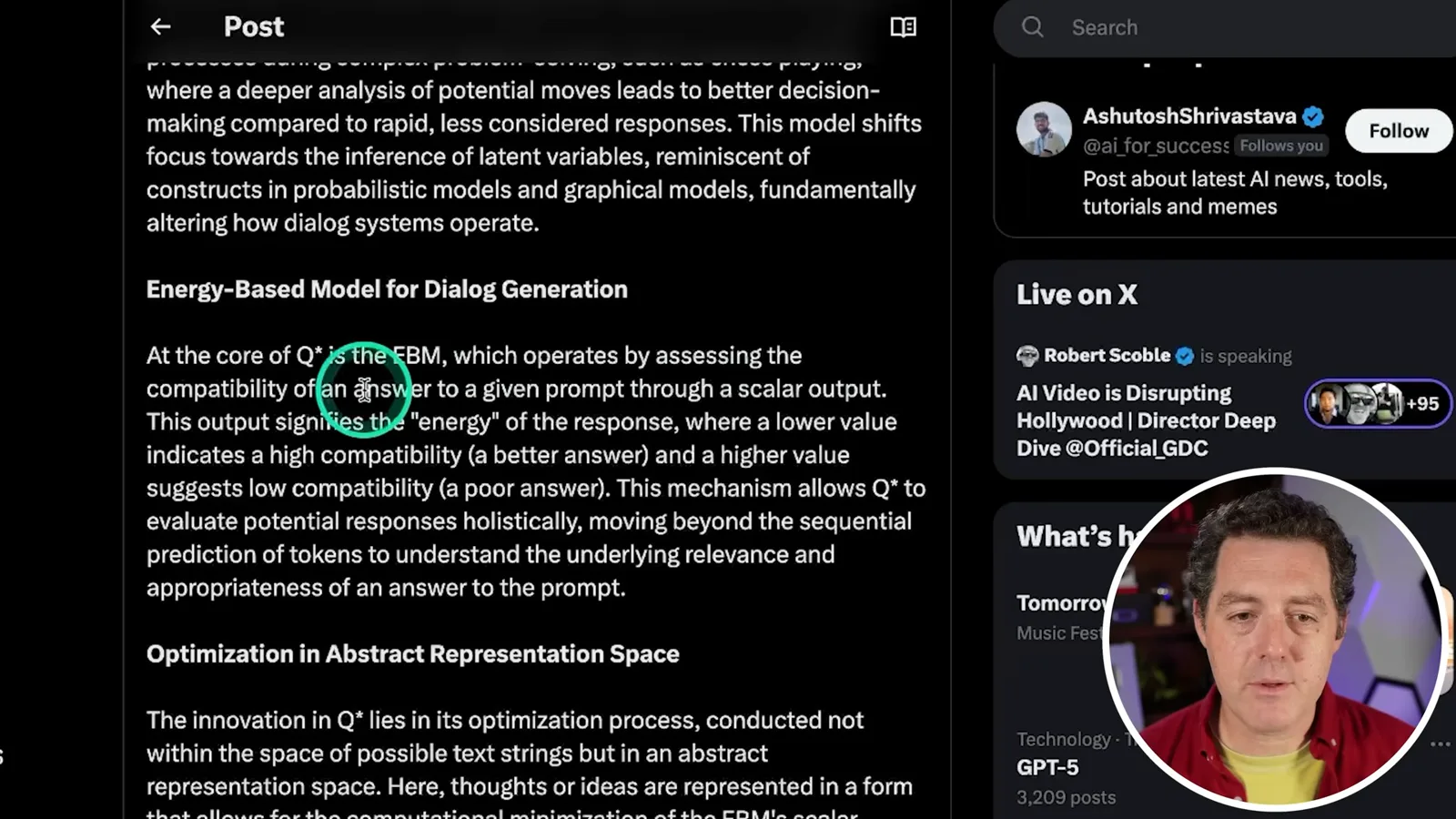
According to the post, the supposed optimization happens in an abstract representation space rather than directly over text strings. It describes using gradient descent to adjust those representations toward lower energy for the prompt. That possibility interests me because it suggests a different way to formulate deliberation, but the claimed relationship to Q* is unconfirmed.
The same account says an autoregressive decoder turns the optimized representation into a textual response. It also describes training the energy-based model on prompt-and-response pairs, lowering the energy of compatible pairs and raising it for incompatible ones. Whether this is a real design, and whether it would improve reasoning in practice, is not established by the post.
The post presents its approach as more efficient and more capable of deep reasoning. Those are claims, not demonstrated results. It identifies the model, its optimization landscape, and its representations as important technical considerations, but supplies no verified experiment here that establishes its performance.
Skepticism and the STaR paper
Berman notes skeptical reactions to the post and reviews a separate account of reasoning. He explains the STaR paper’s iterative rationale-generation loop.
The post circulated on the r/singularity subreddit, where commenters were skeptical and suggested it might have been generated by AI. I think the ideas are interesting to discuss even if the source is wrong, but we should separate the conceptual possibility from an actual leak. I am curious whether any such approach could improve language-model reasoning; that does not establish AGI.
The account Chubby, which drew my attention to the story, offers a different view: Q* could be a method for teaching a model to reason in steps, with a comparison to AlphaGo and chain of thought. I do not know whether that description is accurate. Chubby also points to published research on self-taught reasoning.
The 2022 STaR paper, from researchers at Stanford and Google Research, asks how a model can bootstrap reasoning from a few example rationales and a larger set of questions without rationales. The model generates step-by-step explanations and answers, and correct examples can be used for further training.
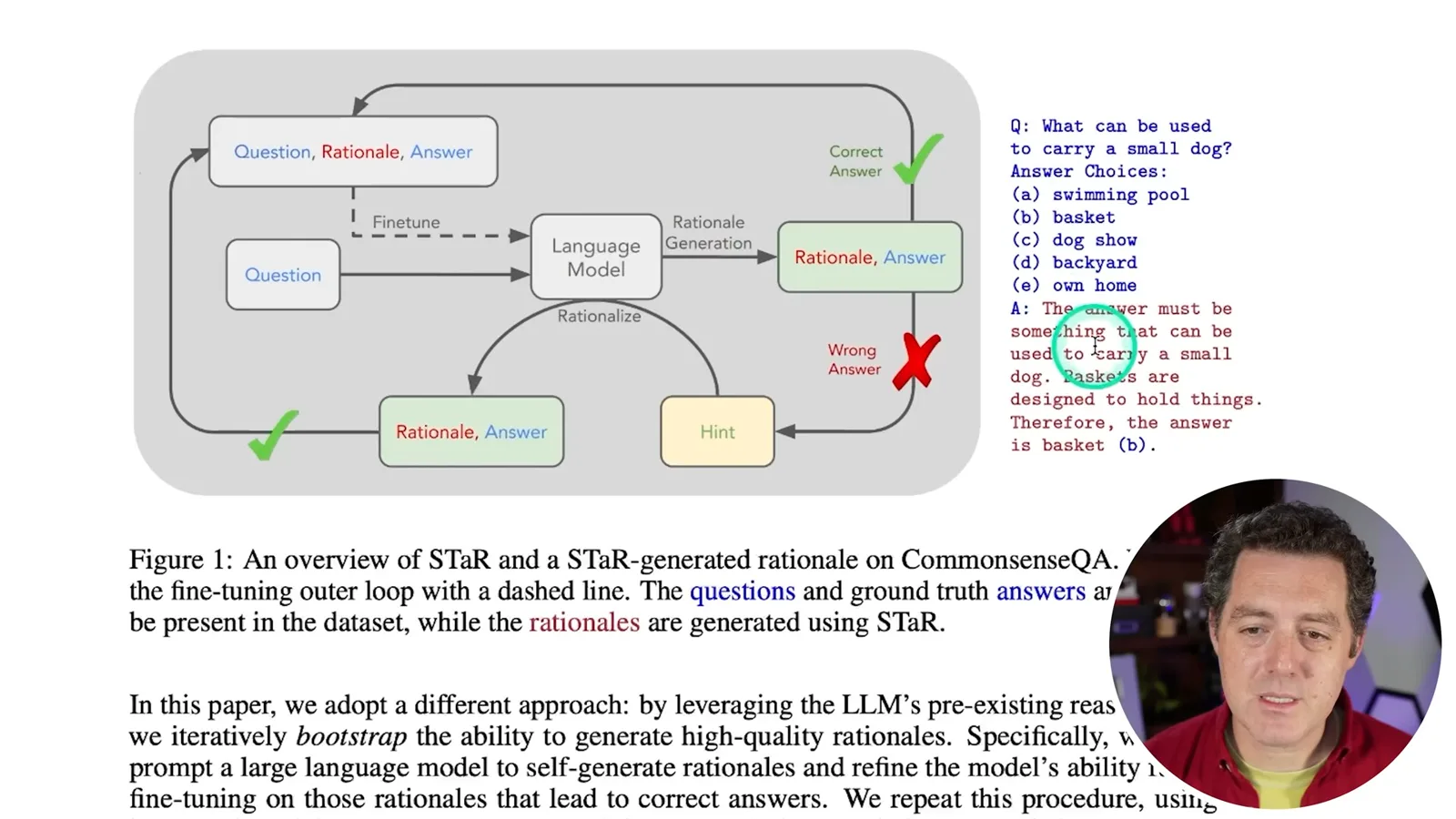
For example, given a question about what could carry a small dog, the model might reason that a basket is designed to hold things and answer “basket.” When its answer is wrong, the method supplies the correct answer as a hint and asks it to generate a rationale again. This creates an iterative training loop, rather than demonstrating the new architecture described in the anonymous post.
Quiet-STaR and reported results
He discusses Quiet-STaR’s approach to intermediate thoughts, the researchers’ reported benchmark results, and their public code and model weights.
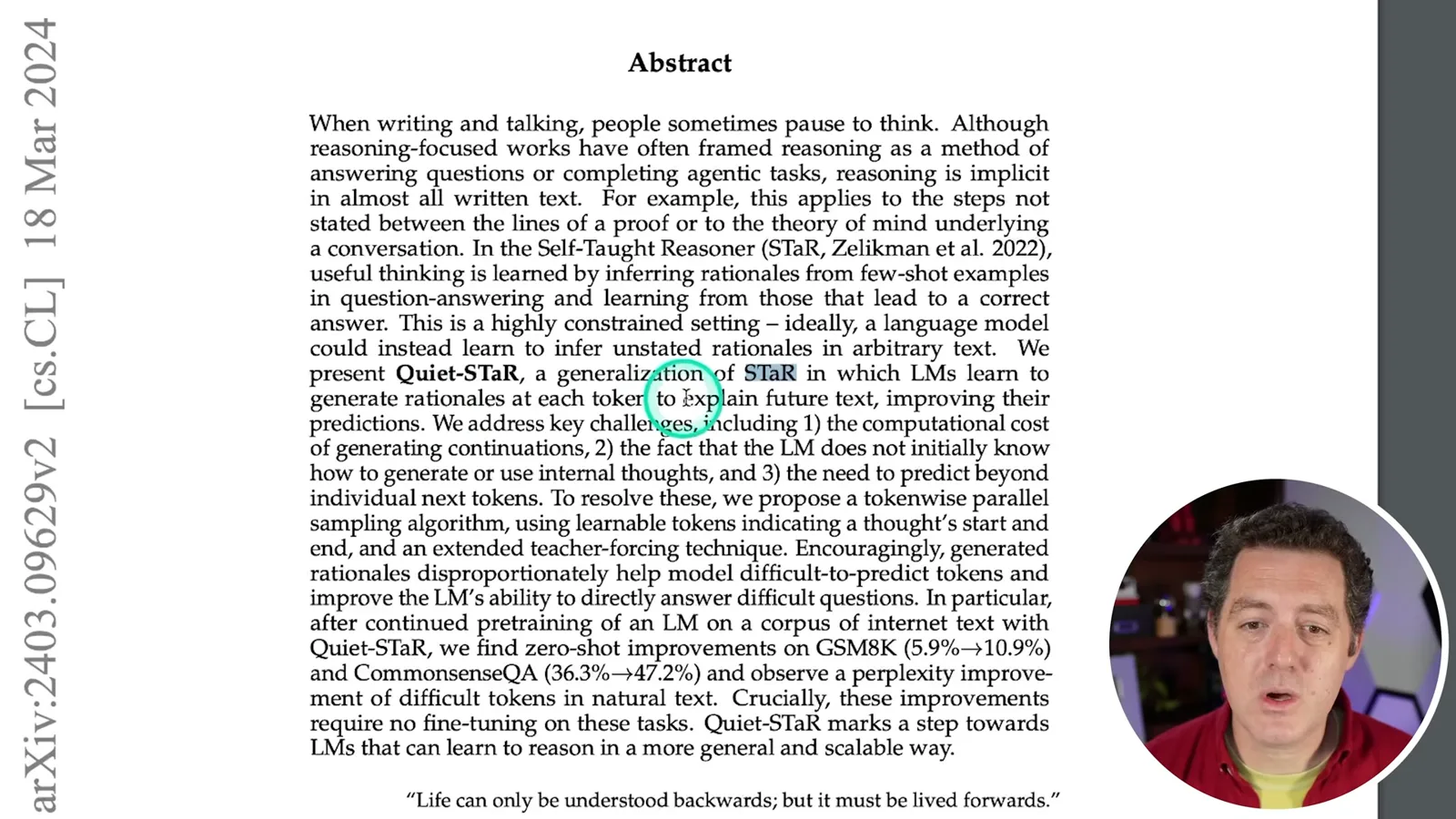
A separate, newer paper called Quiet-STaR generalizes the idea. Eric Zelikman describes teaching language models to generate intermediate thoughts that help predict the text that follows. The model can learn from thoughts that improve predictions, using markers to represent where a thought starts and ends.
In the paper’s account, the model generates rationales at token positions to help explain future text. Berman describes this as a way to encourage a model to think between predictions without assuming the entirely different architecture alleged in the post. He also suggests the technique could be applied to existing models, though the paper’s results are specific to the systems and tests studied.
The researchers report results on GSM8K and CommonsenseQA, with the chart showing performance improvements as the number of thoughts increases. In a subsequent update, Zelikman reported that combining Quiet-STaR with chain-of-thought improved zero-shot GSM8K accuracy by over seven percentage points. These are author-reported results for particular evaluations, not a general proof of reasoning ability.
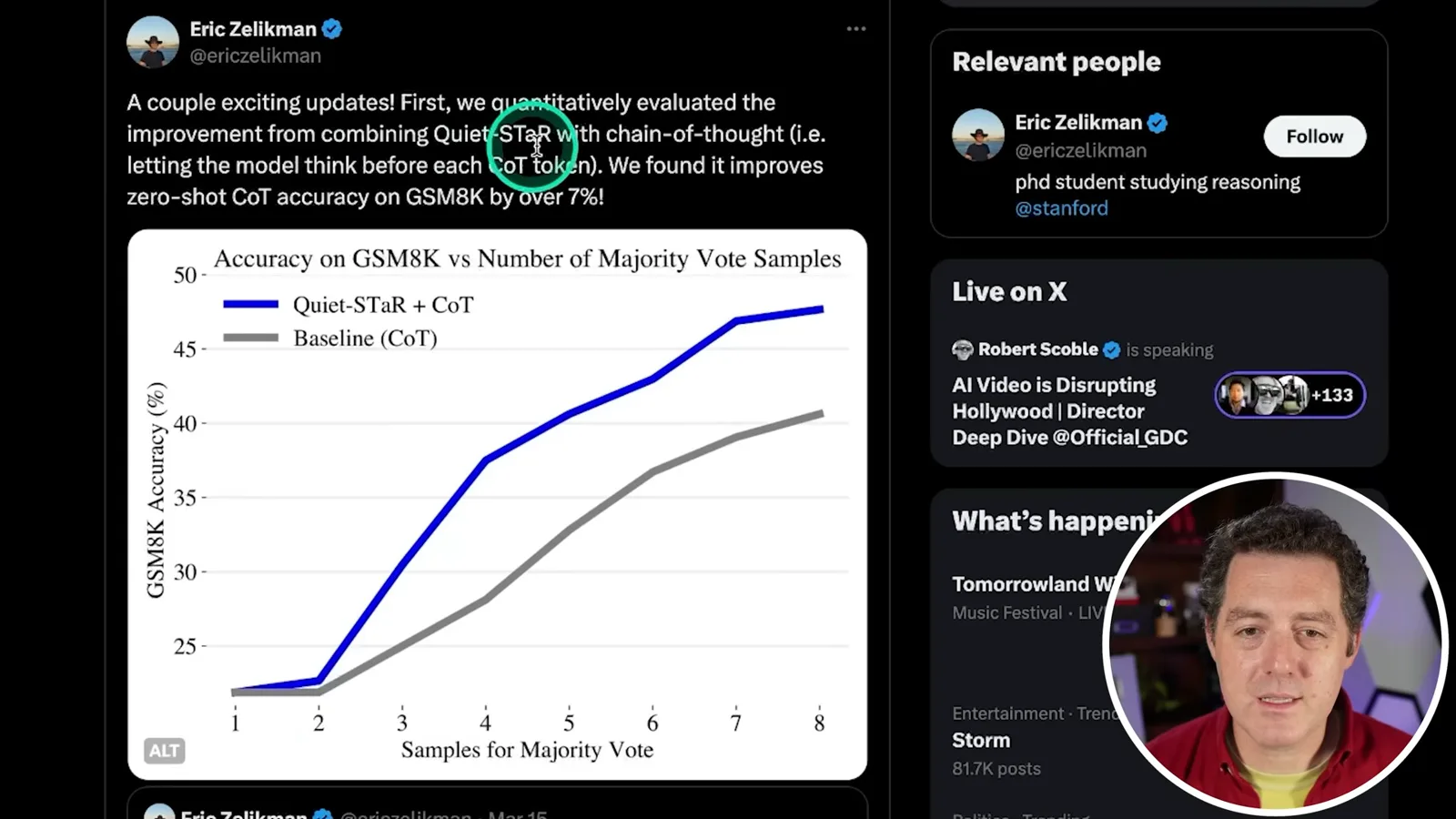
The Quiet-STaR team also released code and model weights, so others can inspect and experiment with the work. I am interested to see what people build with them. Whether the anonymous Q* description is authentic, and whether Q* has any relationship to GPT-5, remains an open question in this discussion.
같은 채널의 다른 글
 34:21EN
 Matthew Berman· 2026년 10월 27일Matthew Berman Examines Anthropic’s IPO Filing, AI Growth and GovernanceMatthew Berman, Sam Altman · Forward FutureThe presenter reviews the S-1’s financial metrics, compute strategy and voting structure while questioning the tension between rapid AI development and safety.
 25:50ENMatthew Berman· 2026년 10월 24일Kimi K3.1 Pro Tested: Strong 3D Demos, Uneven Results and Competitive PricingMatthew Berman · Forward FutureMatthew Berman tests the open-weight model on coding, 3D rendering and visual explanations, then compares benchmark results and prices.
 32:20ENMatthew Berman· 2026년 10월 23일Who Is Local AI For? The Costs, Trade-offs and a Hybrid FutureMatthew Berman · Forward FutureMatthew Berman weighs data control and independence against hardware cost, setup complexity and inference speed.
 1:03:37ENMatthew Berman· 2026년 10월 23일Matthew Berman’s Team Tests Kimi K3.1 on Animation, Games, and ChartsMatthew Berman, Alex, Brian · Forward FutureA live team AMA turns into an informal test of Kimi K3.1, from personal-agent workflows to motion graphics, a browser game, and a benchmark chart.
 0:53ENMatthew Berman· 2026년 10월 22일Sam Altman on AI and the Discovery of New KnowledgeSam Altman · OpenAIAltman expects progress in mathematical discovery to extend to biology, materials and energy.
 0:22ENMatthew Berman· 2026년 10월 21일A Robot Bodyguard Video Shows Dramatic Rescue ScenariosMatthew Berman · Forward FutureMatthew Berman reacts to a short robot demonstration depicting fighting and vehicle-rescue scenarios.