30초 요약
Killian Carlsen-Phelan of Sonar introduces Sonar Vortex and demonstrates a temporary-file permission finding during an agent coding session. He presents the company’s proposed context and verification workflow and cites Sonar-reported outcomes; the talk does not detail the study design behind those figures.
- 1Context at the startCarlsen-Phelan describes the cost of an agent discovering project conventions on every task.
- 2Verification in the loopHe describes quick checks after edits followed by deeper data-flow analysis.
- 3Reported outcomesThe speaker cites token and outage figures from Sonar, without detailing the study design.
- 4A temporary-file findingThe demonstration shows an agent revising a file-permission fix after a check reports that the finding remains.
핵심 정리
- A new agent session may need project context before it can follow local conventions.
- The proposed workflow combines project guidance with checks during and after edits.
- Deterministic analysis can complement, rather than replace, other forms of review.
- The demonstration distinguishes newly introduced findings from existing issues.
- Sonar’s performance and outage figures are company-reported claims.
챕터별로 다듬은 전문 읽기
The context problem
Carlsen-Phelan describes a coding session that starts without knowledge of local rules. He introduces the temporary-file example and survey results.
I’m Killian from Sonar, an independent code verification platform. I want to move verification into the agentic coding loop, where a new session often starts without knowing the project’s conventions, coding guidelines or architectural rules.
When you ask an agent to add an API endpoint, it must first discover how existing endpoints work. It may find that context quickly, or search widely across the repository, consuming time and tokens. Existing code problems can also become patterns the agent repeats.
If newly introduced issues go unnoticed, maintaining code quality becomes difficult. Our proposed solution is Sonar Vortex, a plugin intended to give a coding agent project context before it writes and deterministic checks as it works.
In a recorded example, an agent implemented a feature and wrote tests in under two minutes, but introduced a security issue involving a temporary file. Vortex flagged the issue and required further iterations. The missing detail was an explicit permission setting, which a test or reviewer might not catch.
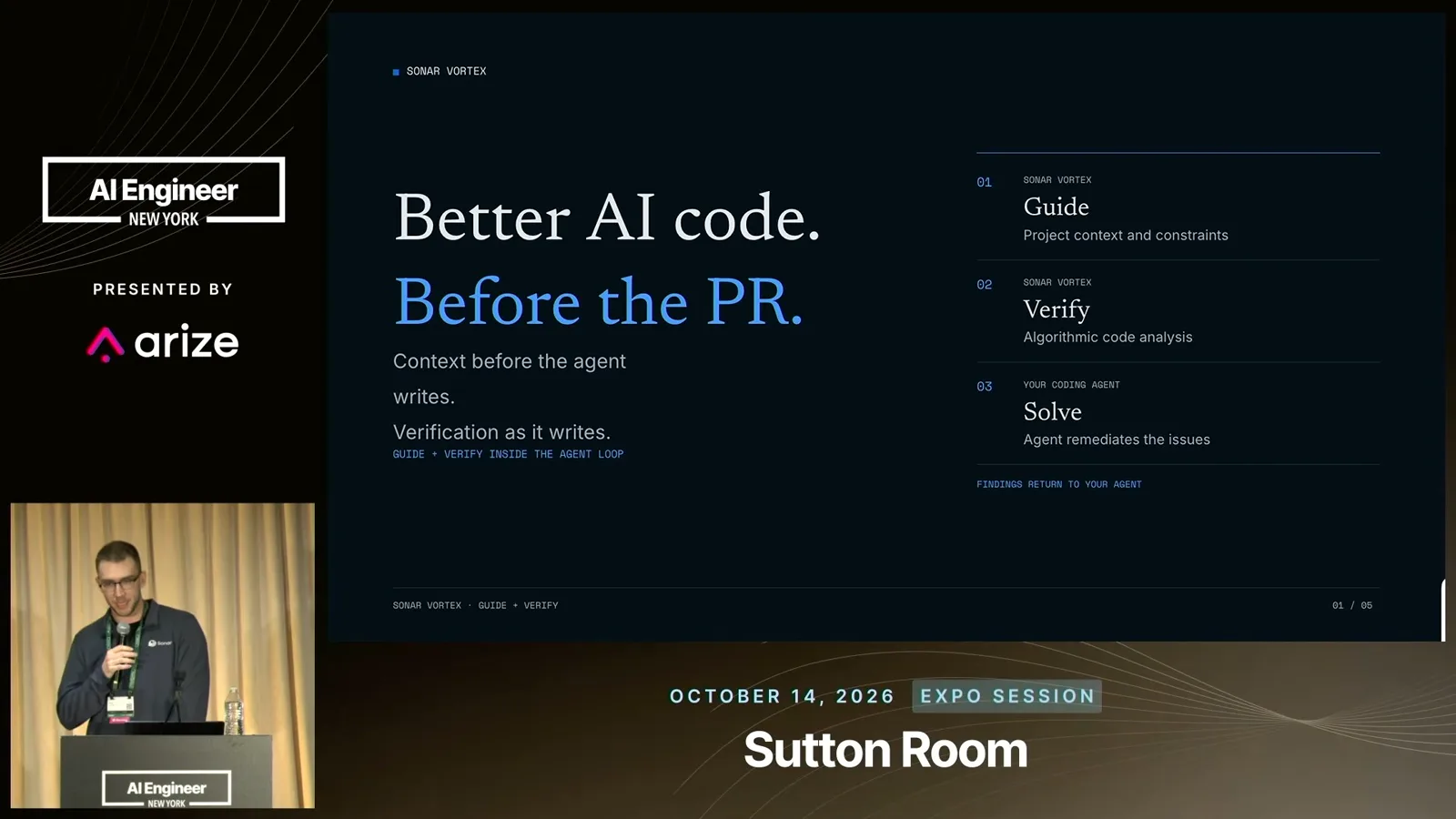
Sonar surveyed more than 1,100 developers. I cite its findings that 96% did not fully trust AI-generated code and 48% fully verified it before pushing. These are survey results I’m presenting, not a measure of every team’s practices.
Guide and verify
An animation explains project guidance, checks during edits and a deeper final analysis. The speaker presents Sonar-reported outcomes.
My animation shows an agent moving through a grid of files while a token counter rises. If a problem appears only at pull-request review, work returns to the agent and reviewers must repeat their checks. The goal is to shorten that loop.
Before the agent writes, Vortex supplies a map of code relationships and the project’s own standards, such as architecture guidelines and approved libraries. Those requirements can be set for the project rather than rediscovered during every task.
As the agent edits files, SonarQube runs a quick check. Before the turn ends, the agent is instructed to run a deeper analysis, including cross-file data flow. When a finding comes back, the agent can revise the code and run the check again.
I describe support for commonly used coding agents and configurable MCP clients for other or custom agents. The intended workflow is to bring SonarQube’s existing knowledge into the coding session, rather than wait for a later pipeline step.
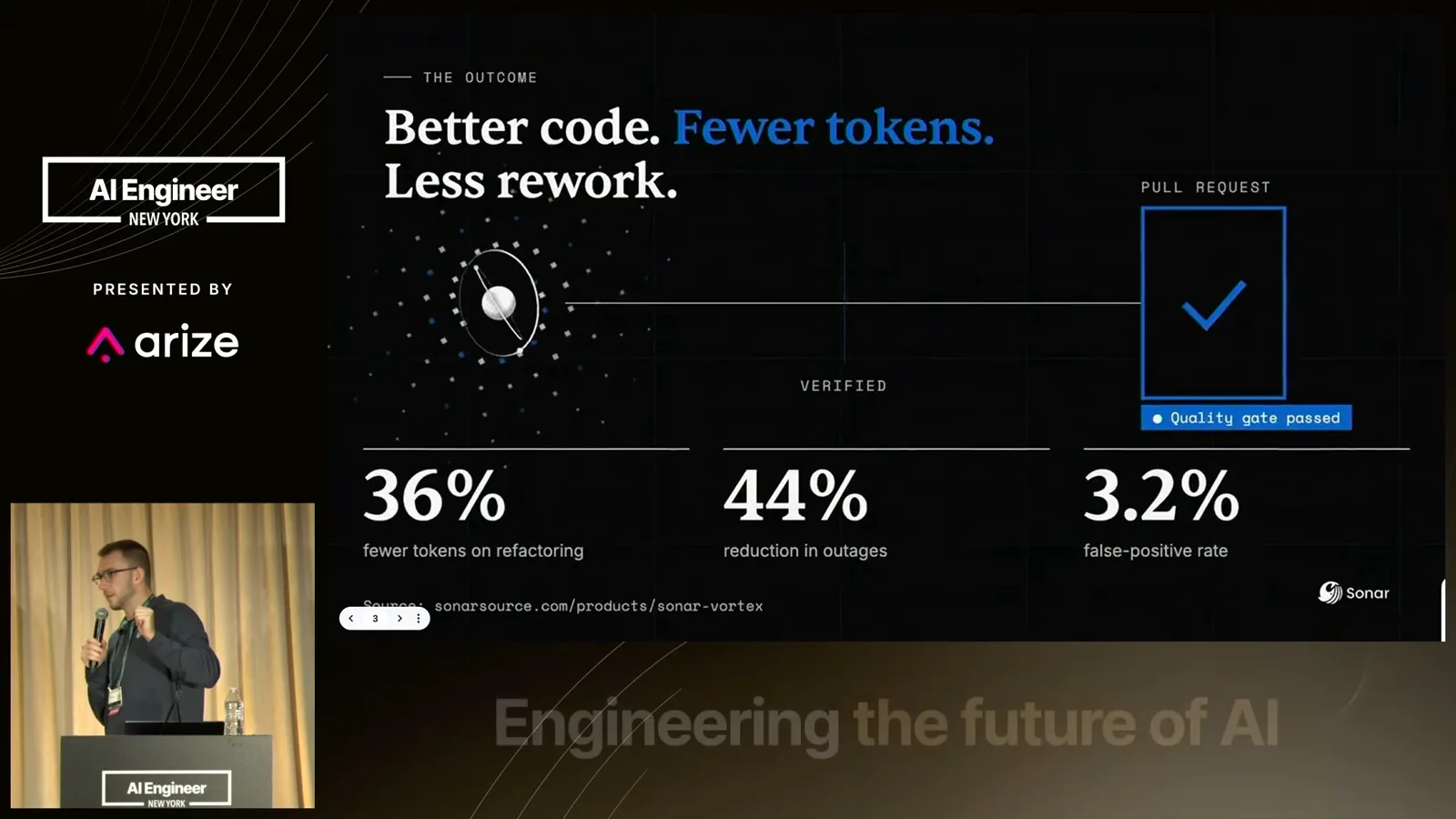
I report that Vortex uses 36% fewer tokens on average, particularly in tasks such as refactoring, and that users experience 44% fewer production outages. These figures are Sonar’s claims from the talk; the presentation does not explain the study design.
SonarQube traditionally analyzes a pipeline for security, maintainability and data-flow issues. Vortex reuses knowledge from an existing CI scan so a file-level check can be interpreted alongside information about the rest of the project.
A recorded coding task
The agent requests context and Java guidelines before implementing and testing a log-file feature.
In the recorded task, the session detects the Sonar CLI and hook system, with secrets detection enabled. I say the plugin is intended to prevent secrets from leaking into GitHub and agent context, without requiring me to paste instructions into the prompt.
The requested feature unzips a log into a temporary file, reuses that file and adds a test proving reuse. Before coding, the agent asks Sonar where the relevant class lives and what Java guidelines apply.
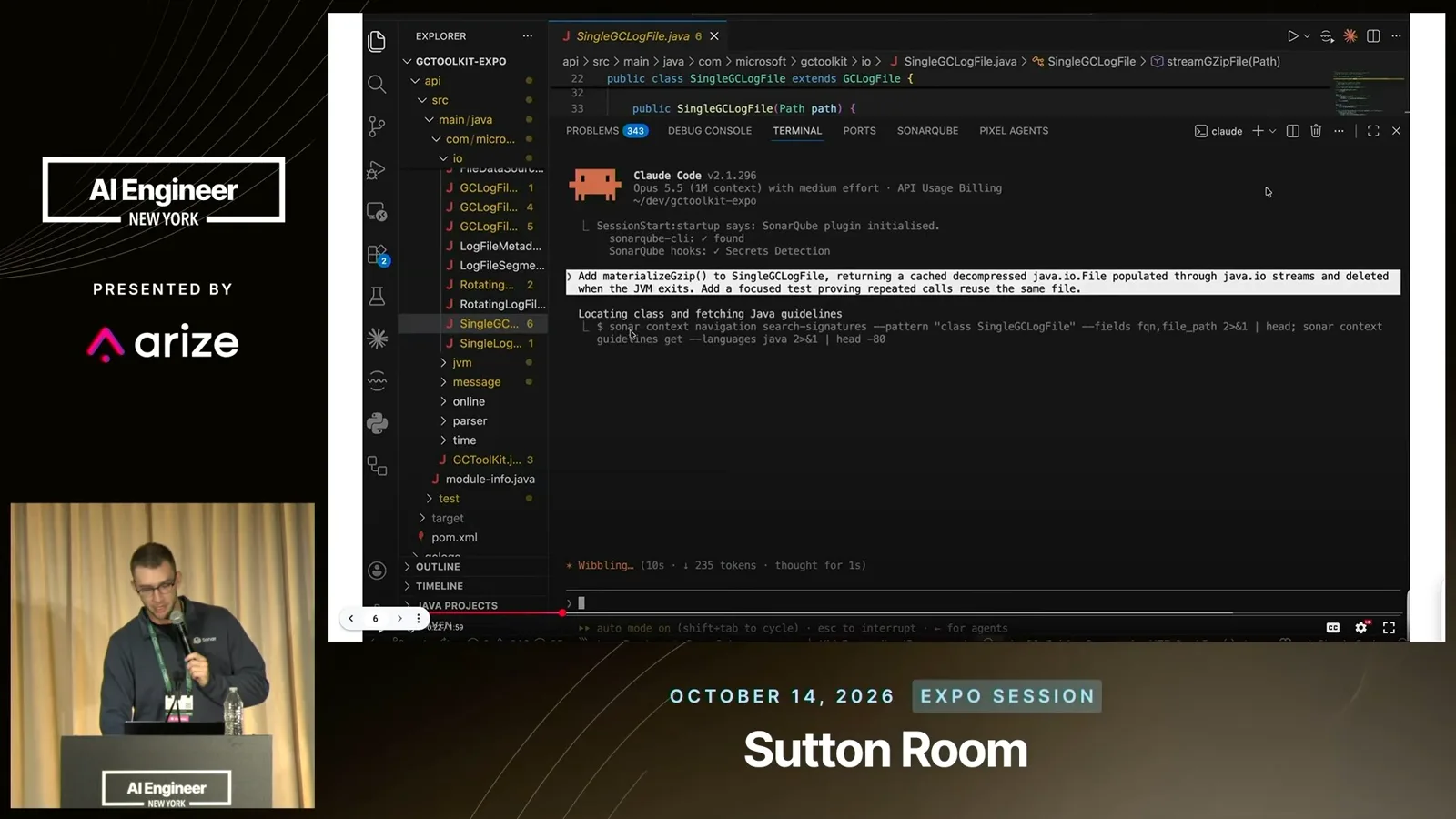
The returned context includes parent and child architecture, existing patterns and language-specific rules. Teams can also add their own requirements. In my view, the context and steering given at the start are a major influence on agent performance.
The agent inspects the existing tests and proceeds to implementation. In the demonstration I compare that guided phase with a run that would otherwise search the repository to discover the same information.
The agent creates the temporary file and adds tests, then confirms the test result and runs Vortex analysis on the changed files. I say the analysis is automatically triggered when a file is added or edited.
Analysis and remediation
Carlsen-Phelan distinguishes deterministic analysis from AI review and walks through a finding and its attempted fixes.
I distinguish deterministic code analysis from asking an AI model to review its own output. By deterministic I mean that running the same analysis on the same code returns the same result. I present it as a layer that can complement a separate AI review.
The analysis returns six findings: the agent identifies two on newly written lines and four in existing code. I explain that Vortex enforces correction for issues in new code while surfacing pre-existing findings for awareness.
One new finding concerns the log file in a default temporary directory that may be shared on a server. The agent attempts a fix, but the next analysis says the issue persists: the rule requires permissions to be set explicitly.
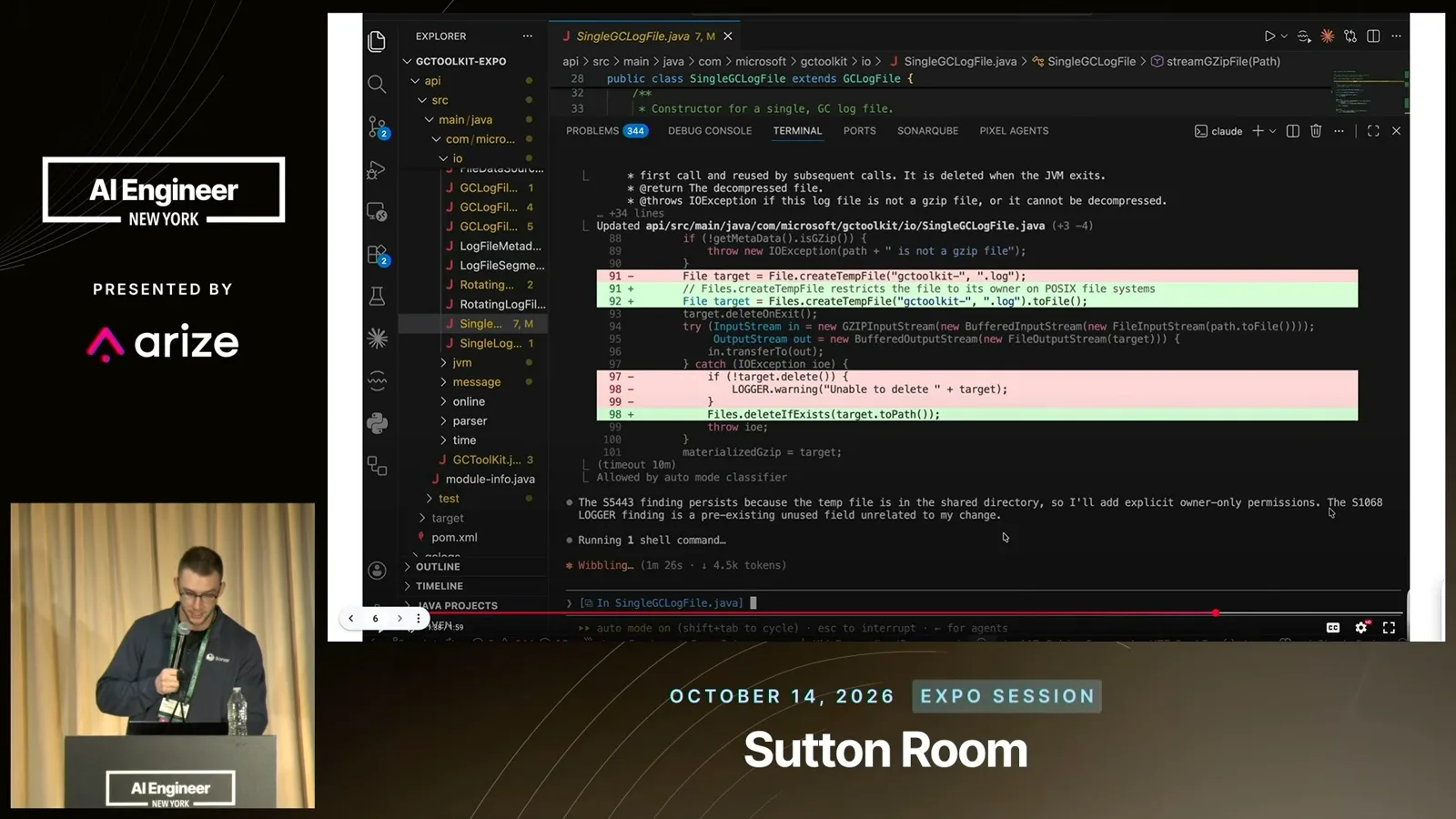
The first fix relied on Java defaults, which are owner-only on Mac and Linux in the example. Sonar’s rule applies a stricter requirement for an explicit setting. The agent makes another change and the analysis runs again.
My point is to find problems during the coding session, when the scope of a change is still small, instead of waiting for another review cycle. After the agent’s iterations, a deeper data-flow analysis is performed before it hands the work back.
I close with the intended benefits: less review back-and-forth, earlier remediation and more time for developers. The demonstration illustrates the workflow; the reliability and savings figures I discussed are the company’s reported claims.
같은 채널의 다른 글
 17:02EN
 AI Engineer· 2026년 10월 31일How Upstart Evaluates Voice Agents for Regulated Lending CallsBrooke Hopkins, Shiv Indap · CovalShiv Indap and Brooke Hopkins explain human review, LLM judges and simulation in a continuous evaluation loop.
 18:45ENAI Engineer· 2026년 10월 30일Jack Woodruff on AI and the Human Work of Stock PickingVinoo Ganesh, Jack Woodruff · KeplerThe former Candlestick Capital CIO discusses research, auditable data and how AI may reshape investment teams with Kepler CEO Vinoo Ganesh.
 15:27ENAI Engineer· 2026년 10월 30일Rayan Krishnan on Model Evaluation Beyond the Model CardRayan Krishnan · Vals AIThe Vals AI cofounder explains why task-level accuracy, total cost and company-specific evaluations can change which model is the best fit.
 19:06ENAI Engineer· 2026년 10월 30일Wojciech Pluta on Deciding What an AI Agent Should RememberWojciech Pluta · OracleOracle’s Wojciech Pluta explains memory promotion, a mortgage-agent demonstration, and the controls needed to carry useful information across sessions.
 16:43ENAI Engineer· 2026년 10월 30일Ishween Kaur on Securing Agent Payments with x402Ishween Kaur · SoFiA testnet walkthrough of price changes, replay, premature delivery, lookalike sellers and prompt injection in agent payment flows.
 38:07ENAI Engineer· 2026년 10월 29일Using Gitar to Verify Pull Requests Beyond the DiffTaylor Luttrell-Williams, Killian Carlsen-Phelan · SonarSonar’s Killian Carlsen-Phelan and Taylor Luttrell-Williams walk through ticket-transfer, pricing and CI-failure examples in a sample application.