30초 요약
Berman reviews the initial o3-mini release, including reasoning-effort settings, company-reported benchmark scores, latency and launch pricing. He tests two Snake programs and reports that both run with different wall behavior; his examples are brief and the product details are historical.
- 1Reasoning effortThe release describes low, medium and high settings and launch-day API capabilities.
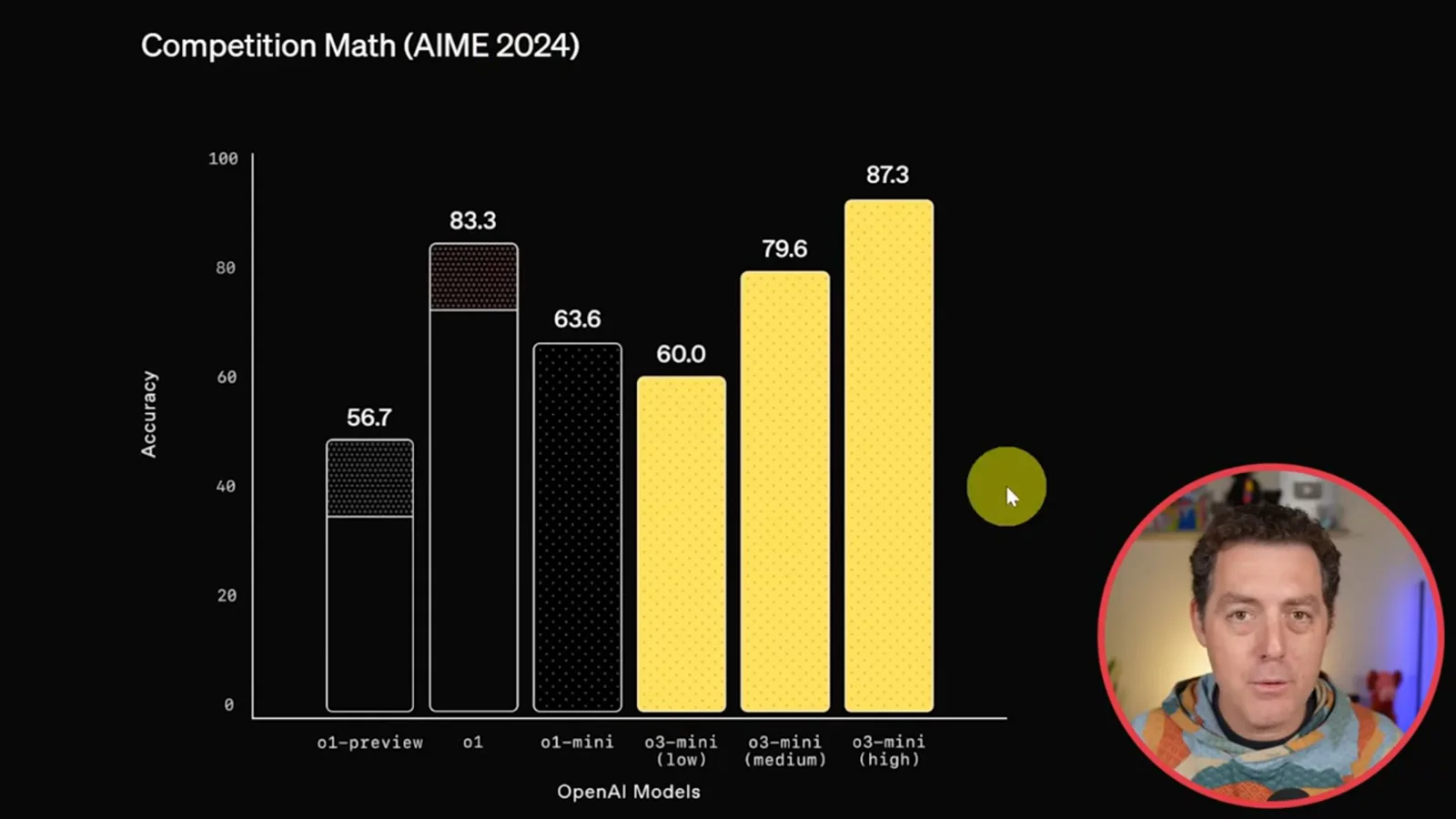
- 2Reported math resultsOpenAI’s AIME chart compares reasoning settings on selected tasks.
- 3Measured latencyThe company reports a 24% faster average response in a specific comparison with o1-mini.
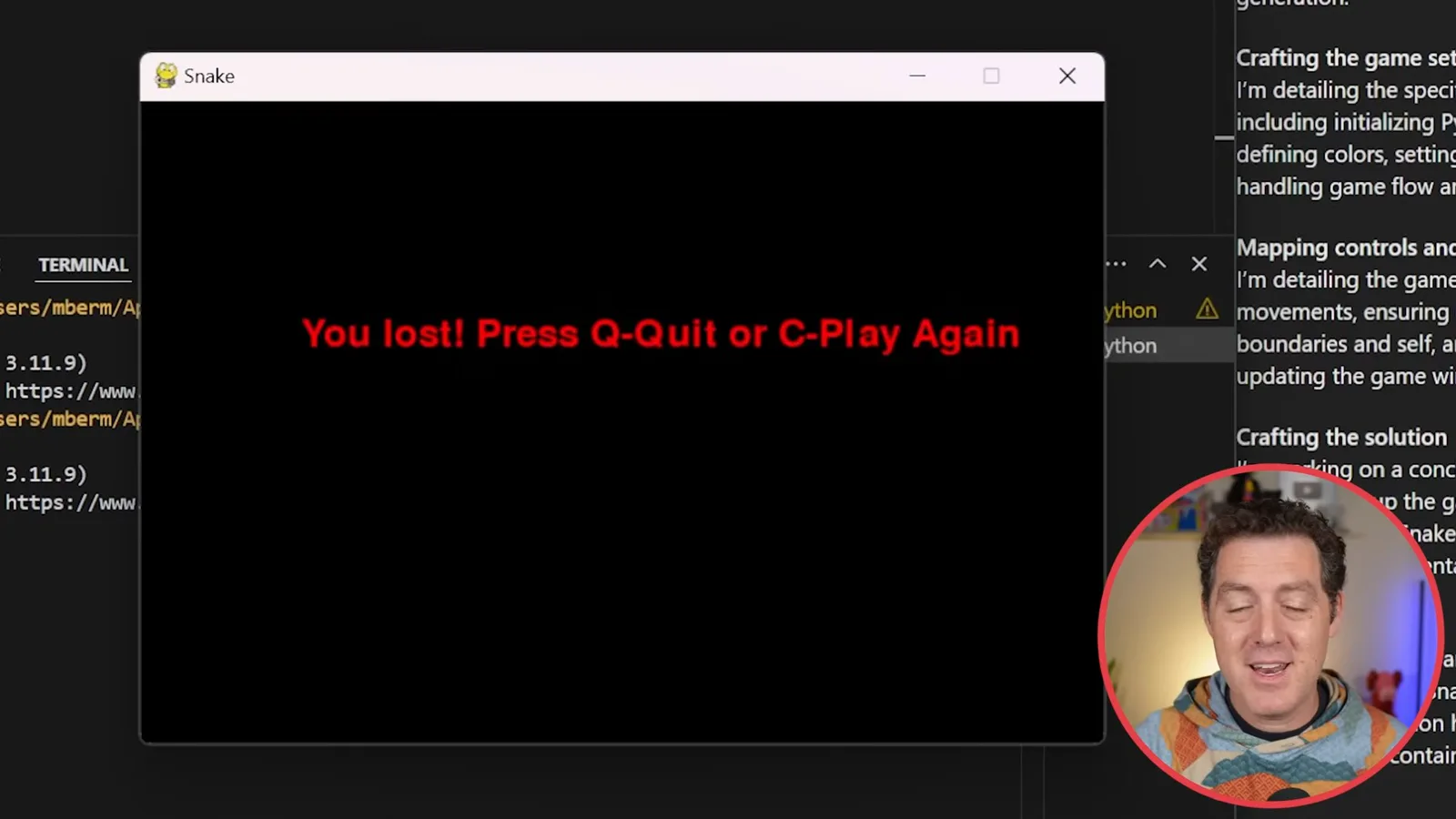
- 4Two Snake programsBerman runs two short generated games with different wall behavior.
핵심 정리
- The initial release offered low, medium and high reasoning-effort settings.
- OpenAI’s benchmark charts report different outcomes across settings and tasks.
- The company’s reported latency comparison applies to its specific A/B test.
- The host’s two Snake examples ran with different edge behavior, but are not a comprehensive coding evaluation.
- Pricing, access and vision limitations described in the video reflect the 2025 launch.
챕터별로 다듬은 전문 읽기
The release and reasoning settings
Berman introduces the model, effort settings and historical rollout.
OpenAI has released o3-mini, and in this January 2025 video I review the announcement and try a small coding example. I speculate that competition from DeepSeek may have accelerated the release, but the video does not establish why OpenAI chose that date.
The release describes low, medium and high reasoning-effort settings. At the time, OpenAI announced access through ChatGPT and selected API tiers, with support for function calling, structured outputs and developer messages. Availability and limits in this historical overview may have changed.
I explain that well-defined answers can make some science, technology, engineering and mathematics problems easier to evaluate for reinforcement learning. This is an intuition for my discussion; it does not mean that open-ended tasks cannot use reinforcement learning or other feedback.
A choice of reasoning effort lets developers trade extra deliberation against latency and cost. I discuss the launch-day ChatGPT and API rollout, including changes to message limits, but those figures are historical rather than current product guidance.
The announcement describes search for ChatGPT use and says o3-mini did not support vision at launch, with o1 recommended for visual reasoning at that time. That statement describes the January 2025 release, not the capabilities of later models or interfaces.
Reported benchmarks and speed
He reviews OpenAI’s math, science, coding and latency comparisons.
OpenAI’s AIME 2024 chart shows different results for low, medium and high reasoning effort. In the displayed comparison, medium is close to o1 and high scores higher. These are company-reported benchmark results under particular test conditions.
I review OpenAI’s science and FrontierMath charts. o1 models lead the displayed GPQA comparison, while o3-mini high has a stronger reported FrontierMath result in the shown settings. Different pass-at-k figures represent different numbers of attempts and should be compared like for like.
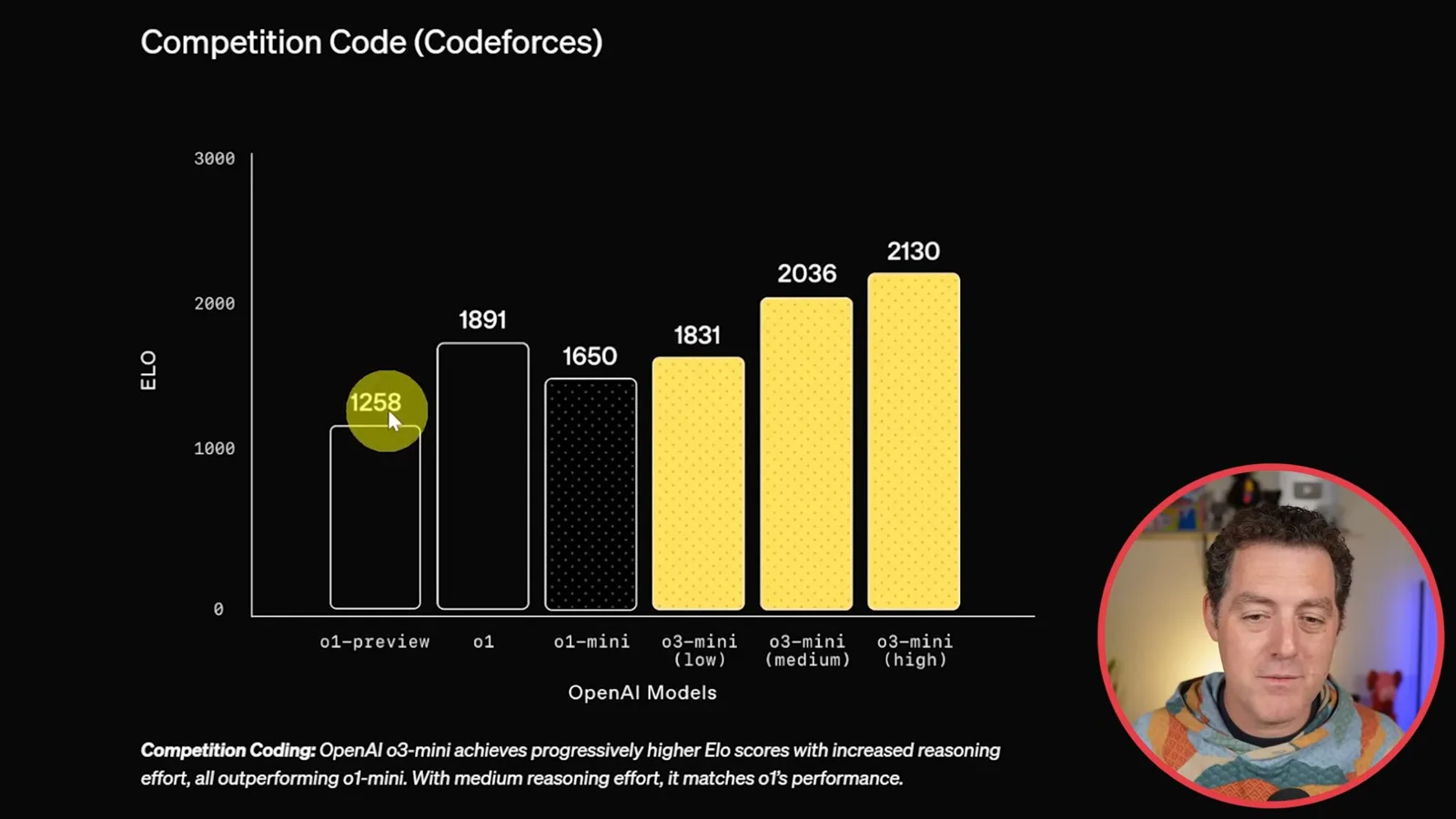
The Codeforces chart reports higher estimated coding ratings as reasoning effort increases, with o3-mini high above the other models displayed. The SWE-bench Verified chart also shows a strong high-effort result. Neither benchmark alone proves how a model will perform in every coding project.
The preference evaluations I discuss distinguish STEM from non-STEM questions. I attribute the technical performance partly to tasks with easier-to-verify answers, but that is my explanation and the results are not an independent demonstration of the precise training mechanism.
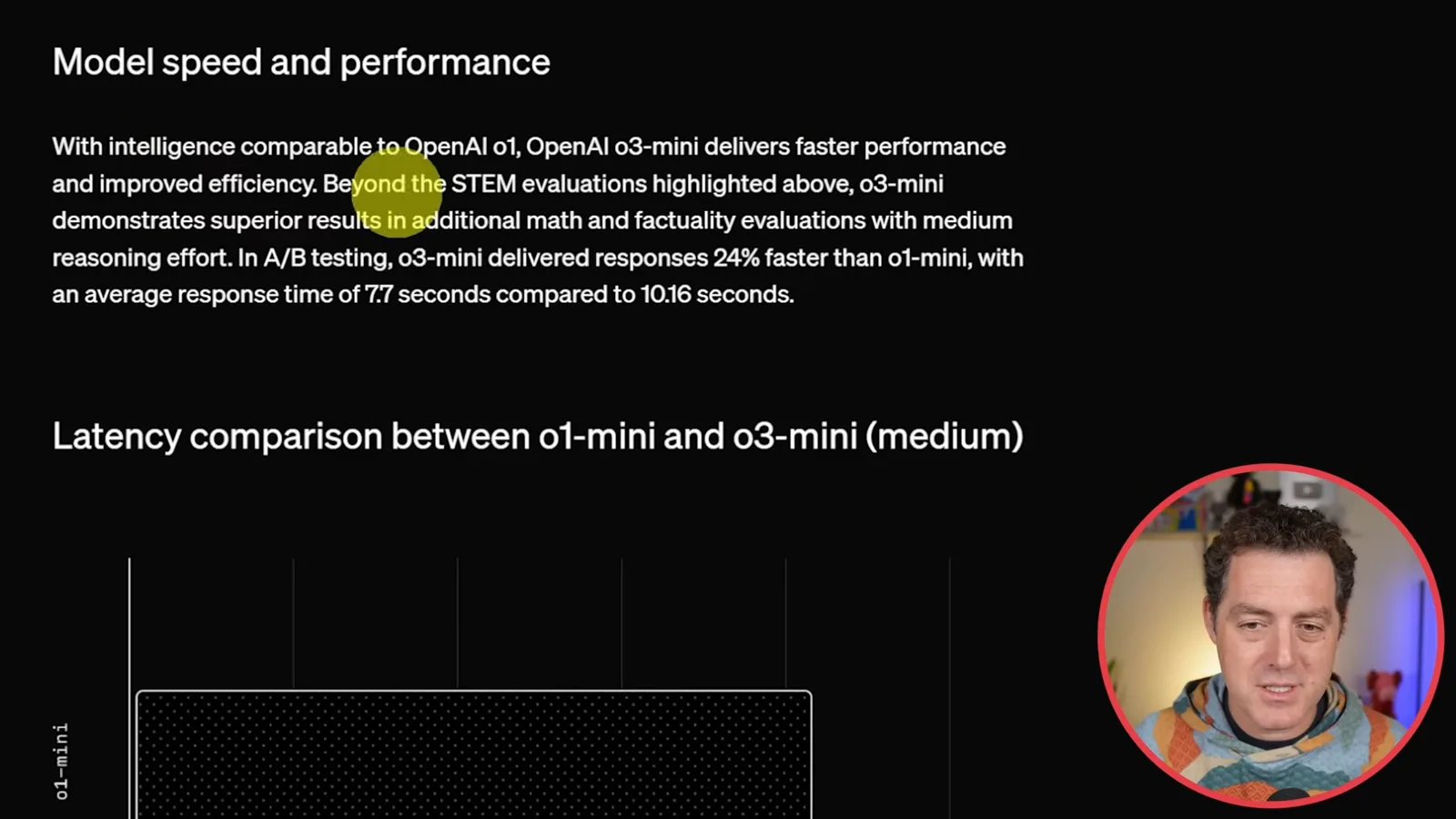
OpenAI reports that o3-mini at medium effort responded 24% faster than o1-mini in its A/B testing, with average response times of 7.7 and 10.16 seconds respectively. Those measurements depend on the tested workload and are not a universal latency guarantee.
Pricing and a coding test
He compares historical prices and runs two generated Snake games.
I compare the API prices shown at launch for o3-mini and DeepSeek Reasoner, including separate cached-input pricing. These are historical price figures; current costs, cache terms and product availability should be checked with the providers.
For a quick hands-on test, I ask o3-mini to write Snake in Python. In the first run, it generates code after about six seconds on the interface shown. I run the game, check that the snake eats food and observe that it wraps at the screen edge but ends on self-collision.
I repeat the same prompt with high reasoning effort. The displayed run takes around nine seconds and produces a longer program; this version ends the game when the snake hits a wall and offers a restart or quit. Both are brief examples, not a comprehensive coding benchmark.
I note that Windsurf and Cursor announced availability of the model in their coding tools. I plan a more extensive evaluation and end optimistic about how quickly these products were changing in early 2025.
같은 채널의 다른 글
 25:50EN
 32:20EN
 0:22EN
 45:08EN
 0:32EN
 1:02EN