30초 요약
In July 2026, Matthew Berman discusses Kimi K3 as a catalyst for debate about open-weight models, the economics of inference and possible US restrictions. He favors broad model access, while examining counterarguments about security and alleged distillation; several of his policy and legal claims are predictions or opinions rather than established outcomes.
- 1An announced releaseMoonshot’s post describes Kimi K3 and says weights were planned for a later July date.
- 2Cost per taskRunning models incurs infrastructure costs, and raw token prices can obscure task-level differences.
- 3Policy debateBerman discusses a report about possible US restrictions and argues against a ban.
- 4Distillation claimsThe video describes Anthropic’s allegations and competing arguments without independently resolving them.
핵심 정리
- Open weights, a complete open-source training recipe and free hosted inference are different things.
- The cost of a completed task depends on model quality, token use, retries and infrastructure, not just token prices.
- Open-weight models can support competition and local use while making safeguards harder to enforce.
- Reports of possible policy restrictions and allegations of distillation are not proof of an enacted ban or adjudicated wrongdoing.
- The evidence shown does not establish sweeping claims about litigation outcomes or state ownership.
챕터별로 다듬은 전문 읽기
Kimi and open weights
Berman introduces the model announcement and potential reasons companies release weights. The exact level of openness varies by model.
I explore what Moonshot AI’s Kimi K3 announcement could mean for open-weight AI, competition and US policy. I regard the model as comparable to leading proprietary systems, though that assessment depends on the task and benchmarks rather than a universal ranking.
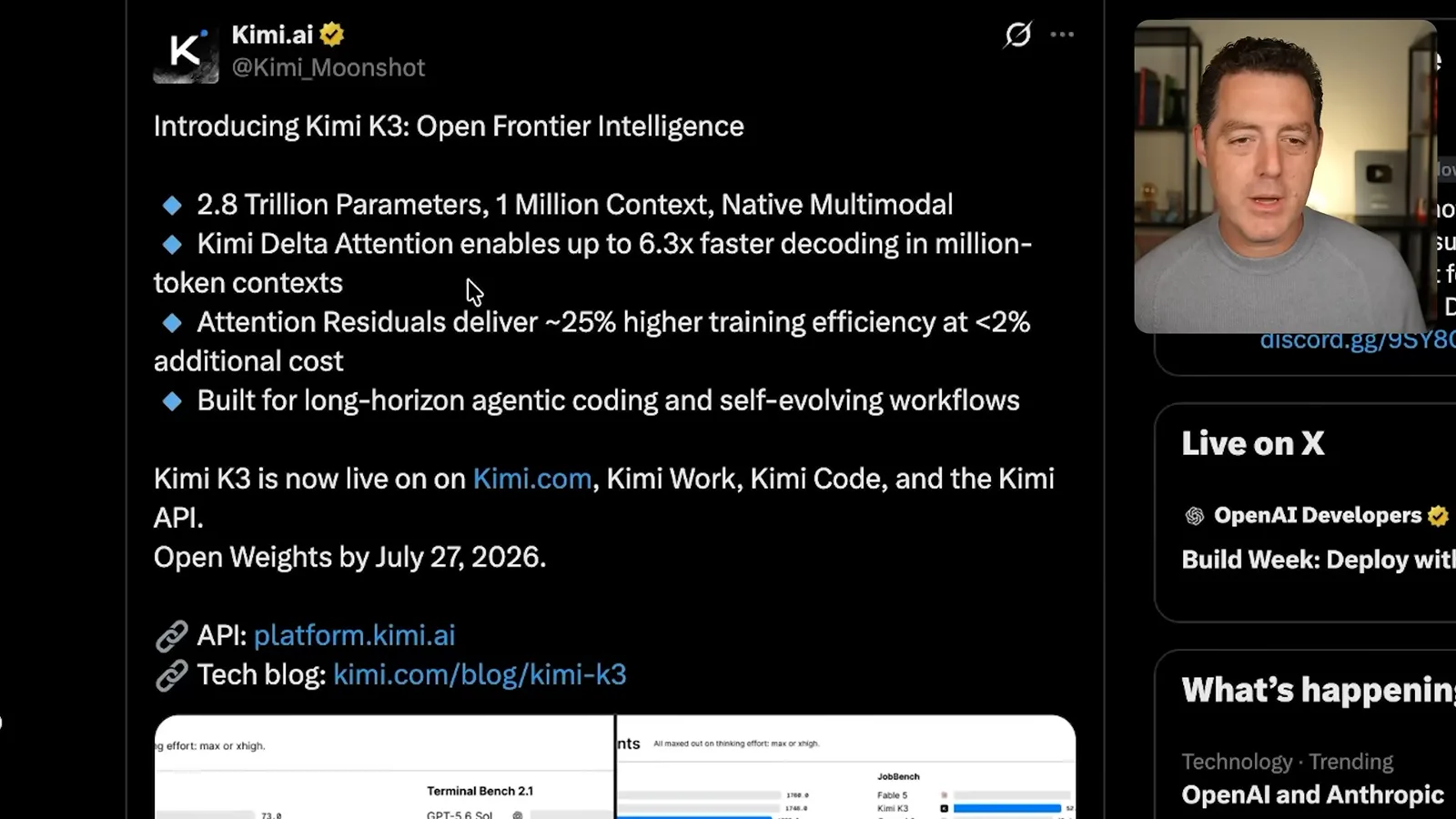
The announcement shown in the video describes 2.8 trillion parameters, a million-token context and native multimodality. It says open weights are planned by July 27, 2026; this video was published July 21, so the announcement should not be mistaken for proof the weights were already available on that day.
I contrast closed models, whose providers control access and prices, with models that others can download and run. I call the latter open source, but released weights do not necessarily include the training data, full recipe or an unrestricted license; openness varies by release.
I associate leading US labs such as OpenAI and Anthropic with proprietary models and discuss Chinese labs including DeepSeek, Moonshot and Alibaba as open-weight competitors. Both categories are broader than a country label: companies vary in what they release and how they operate.
Why release weights? One possible reason is to build an ecosystem and become a standard. Adoption can increase influence over the surrounding stack, while inexpensive alternatives can pressure competitors’ pricing and margins.
I describe low pricing as a competitive strategy and compare it with Meta’s Llama approach. I also speculate that government support and geopolitical influence can shape Chinese AI strategy; support and ownership should be evaluated company by company rather than assumed to be identical.
Open-source successes such as Linux, Android, Chromium and React illustrate how widely adopted shared foundations can strengthen an ecosystem. A company may open one layer while competing in another, although each project has different governance and terms.
Competition and the AI stack
He discusses Baker’s argument about concentration and the distribution of value. He considers how lower prices might affect demand.
Investor Gavin Baker argues that a market dominated by a few frontier labs with very high inference margins could disadvantage chips, energy, data centers, providers, developer tools and software companies. This is a scenario and economic argument, not a verified measurement of every lab’s margin.
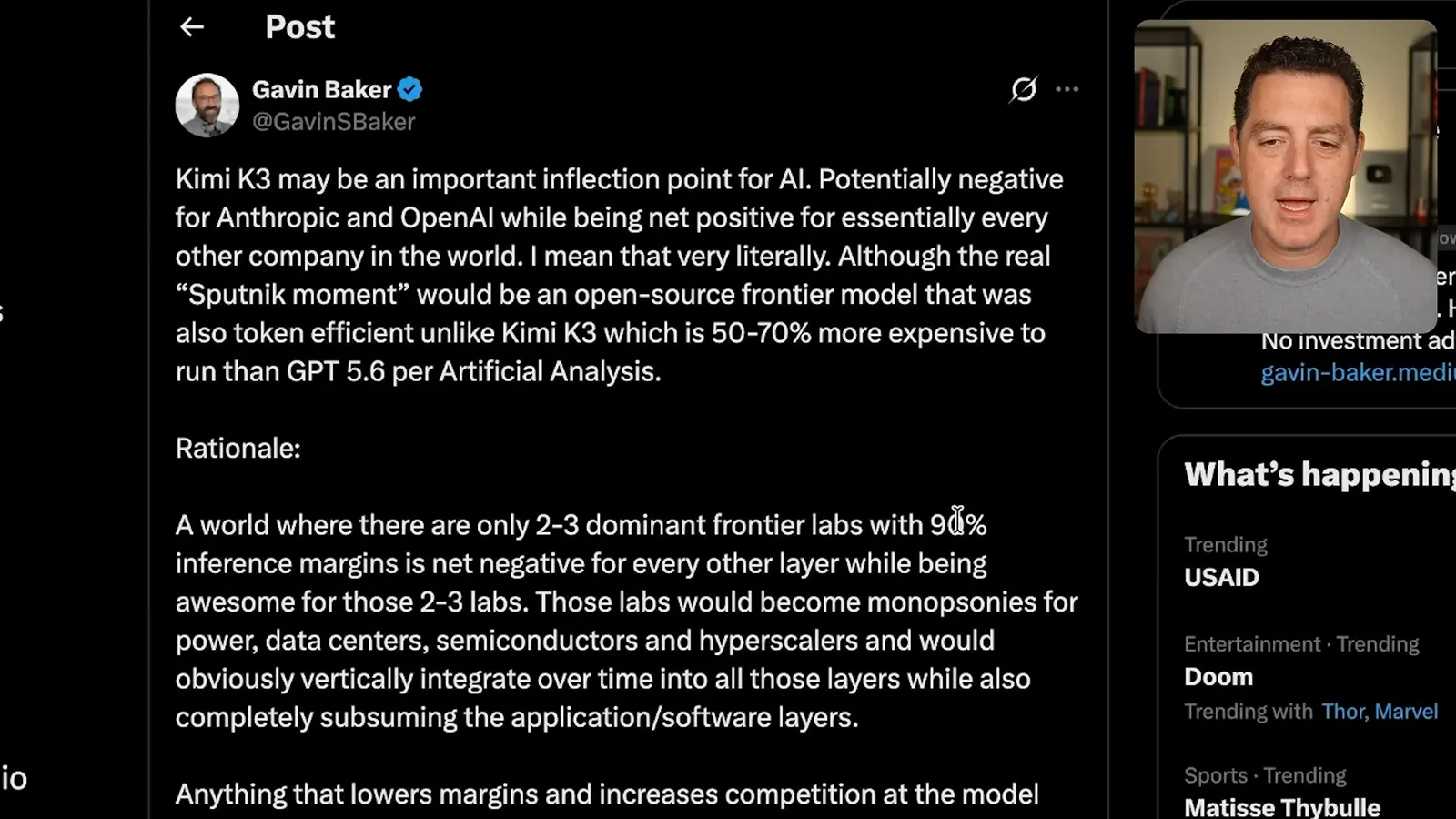
I worry that if a few model providers integrate vertically and compete directly with applications built on them, startups face platform risk. With more providers and open-weight alternatives, customers may gain bargaining power and competition could put pressure on prices.
Baker argues that lower model-layer margins can leave more value elsewhere in the stack. I invoke Jevons’ paradox: lower unit costs can stimulate demand, potentially increasing total demand for chips, power and data centers. Whether the rebound outweighs efficiency gains is an empirical question.
What inference costs
Hardware, electricity and token use complicate comparisons. Berman discusses cost per useful task.
Ben Thompson’s economic analysis stresses that open weights are not free to serve. The hardware, electricity, engineering and research required to train and run a model have costs, even if a particular model download carries no fee.
At the time, I cite Kimi K3 prices of $3 per million input tokens and $15 per million output tokens, compared with $5 and $30 for GPT-5.6. These are historical quoted API rates; actual costs depend on provider, usage and current terms.
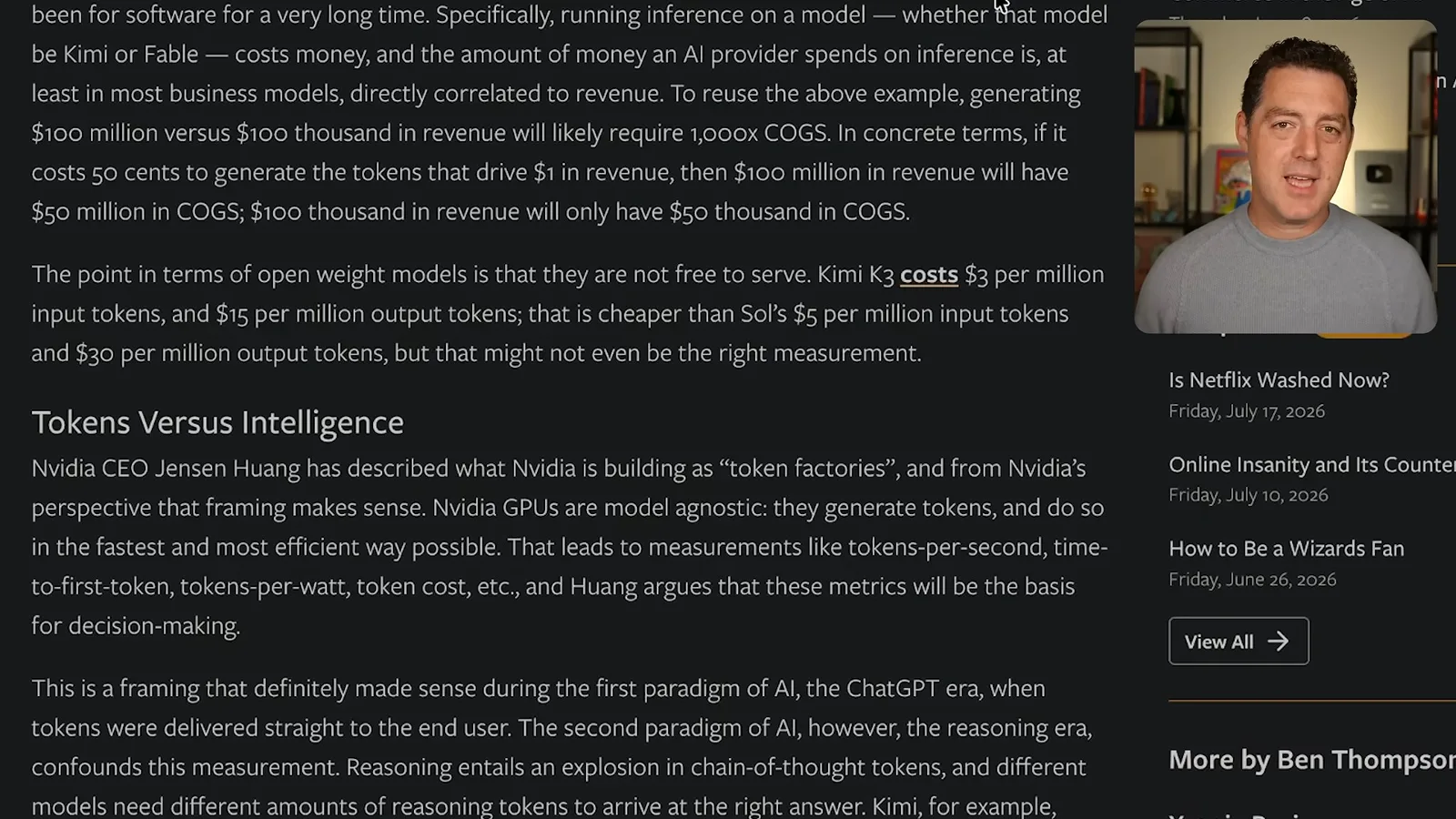
The important comparison is cost per completed task, not just price per token. Different models may need different numbers of reasoning and output tokens, reach different quality levels or require retries. I discuss one claim that Kimi used roughly twice as many tokens, but that is not a universal conversion factor.
I argue that an open-weight ecosystem can help outside researchers improve inference, customize models and optimize deployment for different chips. Whether this makes a given system cheaper or better than a proprietary competitor depends on the workload and total costs.
Security and policy
He discusses possible restrictions, security safeguards and divergent views about open weights. The policy discussion is presented as a prediction, not an enacted ban.
I discuss a July 2026 Axios report about the possibility of US restrictions on Chinese AI models. I oppose a ban and doubt it would be straightforward to enforce; a reported policy discussion is not the same thing as an enacted ban.
There are real security tradeoffs. Once weights are widely available, operators can run or adapt them outside the original provider’s controls, and post-training may weaken safeguards. At the same time, broad access can support research, competition and local deployment.
I discuss a claim by David Sacks that Kimi fixed security bugs which other models refused to address, and a reported Hugging Face experience in which safety filters impeded security analysis. These are examples and claims raised in the discussion, not a comprehensive comparison of model safeguards.
The defensive-security dilemma is that filters may block legitimate analysis as well as harmful requests. A useful evaluation would distinguish defensive work from misuse and measure both types of error, rather than assuming either unrestricted access or blanket refusal solves the problem.
Dean W. Ball, then at OpenAI, offered a different view of open weights. I question his description of them as decelerationist; the post shown also suggests that open weights could deter future AI capital investment, a rationale not fully covered in my spoken summary.
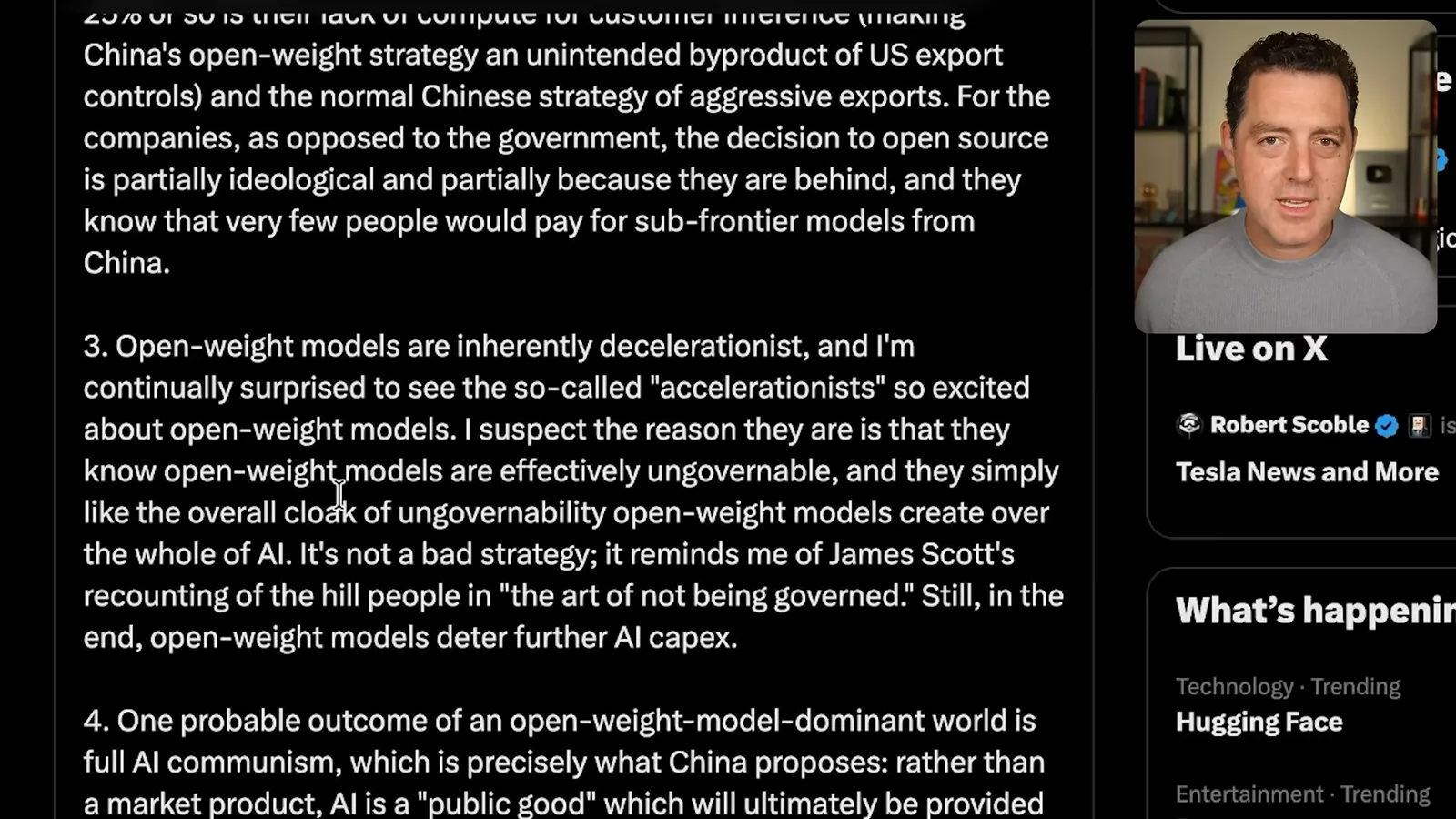
Ball also speculates that agencies could create regulatory uncertainty around Chinese open-weight models rather than formally banning open source. I interpret this as a possible deterrent to companies considering adoption; it is his prediction, not an announced government action.
Will Manidis and Box CEO Aaron Levie argue that restrictions could reduce US companies’ choices and strengthen incumbent model providers. Levie says access to multiple models can support lower costs, specialized tuning, security work and competition; those are arguments about likely consequences.
Distillation and conclusions
Berman considers Anthropic’s allegations and potential litigation. He concludes that the benefits of competition outweigh the risks in his view.
A counterargument concerns alleged distillation attacks. Anthropic has accused certain labs of extracting large numbers of model outputs to improve their own models. Distillation is a broader technique; whether a particular use violates a contract or law depends on the facts.
I explain the basic idea: a set of prompts and responses from a capable system can become training data for another model. Anthropic’s accusation and the extent to which such data affected any company’s models are not independently established by this video.
I raise a possible inconsistency between objections to extracting model outputs and the use of internet material to train models. Public availability does not by itself settle copyright or contractual questions, and those questions differ across datasets and jurisdictions.
I speculate about whether US and Chinese companies could effectively sue each other over model extraction. My sweeping claims about ownership and near-zero prospects in Chinese courts are not supported by evidence in the video and should not be treated as a statement of law.
I personally doubt that alleged distillation alone explains the capability of Chinese models. That is an opinion; the public claims discussed here do not establish how much any particular training source contributed.
My conclusion favors allowing open-weight models, including those from China, while being attentive to risks. I believe competition can reduce concentration and create value across the stack, and I favor more flexibility for proprietary labs accompanied by responsibility for misuse.
I suggest customer verification and monitoring as possible measures for hosted providers. The practical tradeoff remains balancing security, defensive access, competition and accountability; none of these considerations is resolved by a single model release.
같은 채널의 다른 글
 25:50EN
 32:20EN
 0:22EN
 45:08EN
 0:32EN
 1:02EN