30초 요약
Before receiving his Rabbit R1, Matthew Berman addresses viewer questions about the device's proposed pricing, large action model, separate hardware and privacy. Rabbit sponsored the video, and founder Jesse Lyu explains the company's intended approach in clips from an interview with Jason Calacanis. These are pre-release claims and expectations, not an independent review of delivered functionality or security.
- 1Sponsored pre-release answersRabbit sponsored the video after contacting Berman about viewer questions; he had ordered but not yet received the device.
- 2Subscription questionBerman reports that Rabbit had no subscription planned at the time, while acknowledging that could change.
- 3Action model versus language modelLyu describes using a neuro-symbolic system to interact with software interfaces alongside language models. Performance and costs are presented as company claims.
- 4Why separate hardware?Berman argues for a dedicated voice-first experience, while acknowledging viewers' question about a phone app.
- 5Privacy and authenticationBerman summarizes Rabbit's stated camera, microphone, data and cloud-isolation policies. Actual security requires independent verification.
- 6How an action would runLyu describes linking services through a portal and having a cloud environment interact with an application on a user's behalf.
핵심 정리
- Rabbit told Berman in February 2024 it had no subscription planned, while he acknowledged plans could change.
- Lyu described a neuro-symbolic action system that would interact with interfaces alongside language models; the video does not independently verify the architecture or efficiency claims.
- Berman favored separate voice-first hardware, while viewers questioned whether a phone app could offer the same experience.
- Rabbit described push-to-talk, camera controls, cloud isolation and account authorization as privacy measures; these are company claims, not a security audit.
- Berman had not received or tested the device when recording this sponsored video.
챕터별로 다듬은 전문 읽기
A sponsored response to viewer questions
Berman introduces the device and discloses Rabbit's sponsorship. He says he has not yet received the R1.
Matthew Berman says he ordered a Rabbit R1 on announcement day and is eager to review it when it arrives. In this February 2024 video, he responds to questions from viewers about the proposed voice-first device. Rabbit contacted him and sponsored the video, a relationship he explicitly discloses.
Pricing and the large action model
He relays the company's subscription plans and Lyu's description of its action model and interface approach.
One viewer questions whether a $200 device without a subscription can sustainably cover cloud costs. Berman says Rabbit told him it had no subscription planned at that time, while acknowledging that the company could change its plans. The video does not independently establish the economics or future pricing.
Berman explains the proposed distinction between a large language model and Rabbit's large action model: language interprets the request, while an action system is intended to operate an interface on the user's behalf. He describes efficiency and cost advantages, but these are pre-release claims rather than independently measured results.
In an interview excerpt, Rabbit founder Jesse Lyu says the company is not building its own large language model and plans to work with language-model providers. He describes its action system as neuro-symbolic and says it was trained using recordings of people interacting with software. The excerpt does not provide enough detail to verify the technical or performance claims.
Lyu argues that relying solely on APIs can limit a startup's access to services or features. Rabbit's proposed alternative is to interact with application interfaces. Whether that generalizes reliably across changing interfaces, authentication and service terms remains a practical question.
Why build a device?
Berman and Lyu explain their preference for dedicated voice-first hardware in response to viewers who suggested an app.
A common viewer objection is that the product could have been a phone app. Berman favors the experiment of dedicated hardware and a voice-first interaction, even if it means carrying another device. He considers competition with existing phone assistants valuable; his enthusiasm is a product opinion, not a demonstration that a separate device is technically necessary.
In another interview excerpt, Lyu describes reaching for a dedicated device to search or play music by pressing a button and speaking. He argues that the interaction can be faster and more intuitive for him than navigating a phone. These are his examples and expectations before Berman's hands-on review.
Privacy and account access
Berman reviews Rabbit's stated privacy practices, followed by Lyu's explanation of account linking and cloud execution.
Berman then reads Rabbit's privacy statements. The company described a physically blockable camera, push-to-talk rather than an always-listening mode, and a face-down privacy mode. He likes the opt-in interaction, but the statements are the company's account of its design rather than an independent verification.
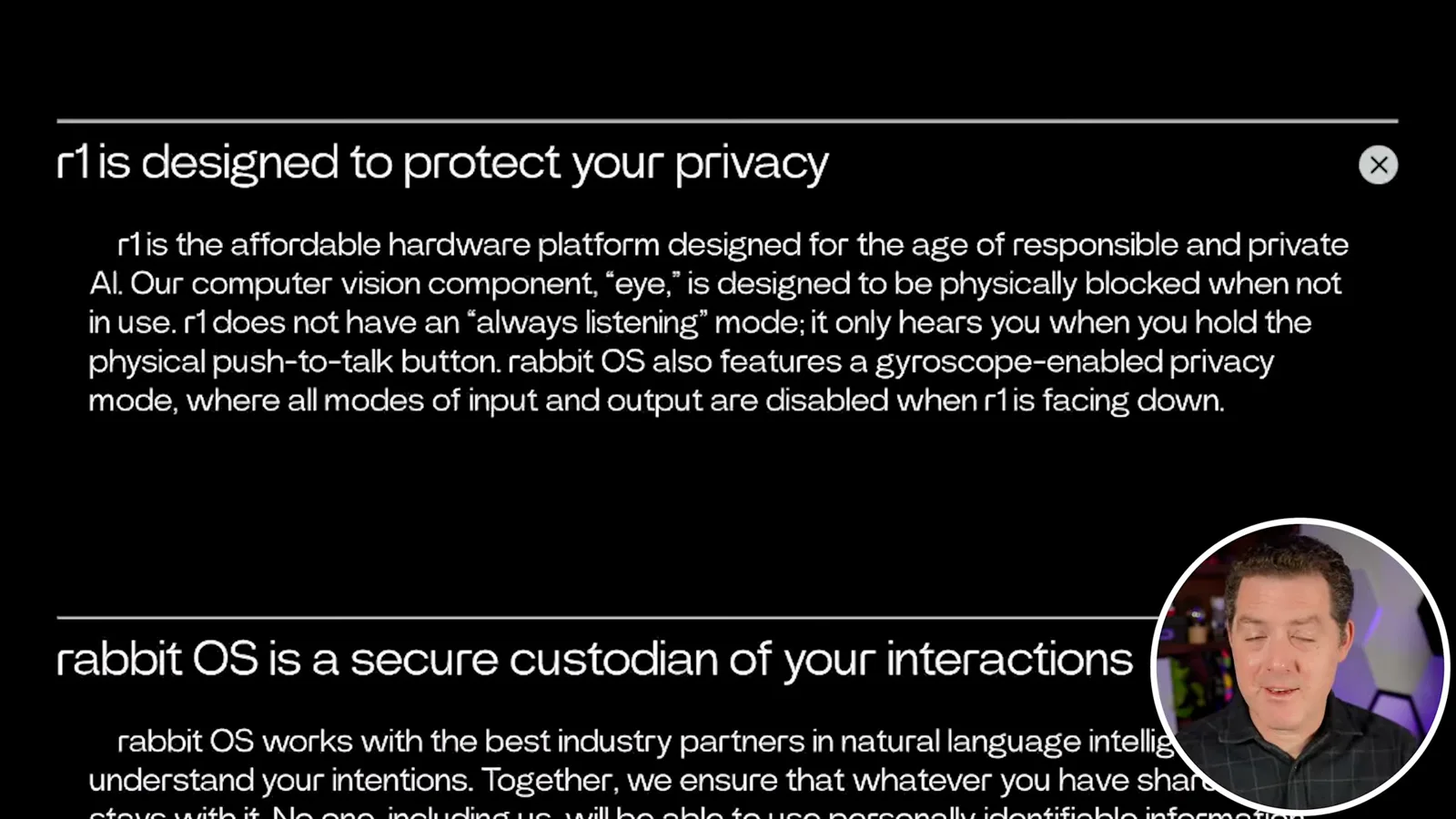
Rabbit's published policy, as quoted in the video, described controls in a web portal and restrictions on use or sharing of personal data. Berman presents those commitments as reassuring. Such statements are time-specific and do not alone establish how data are handled in every deployment or how security controls perform.
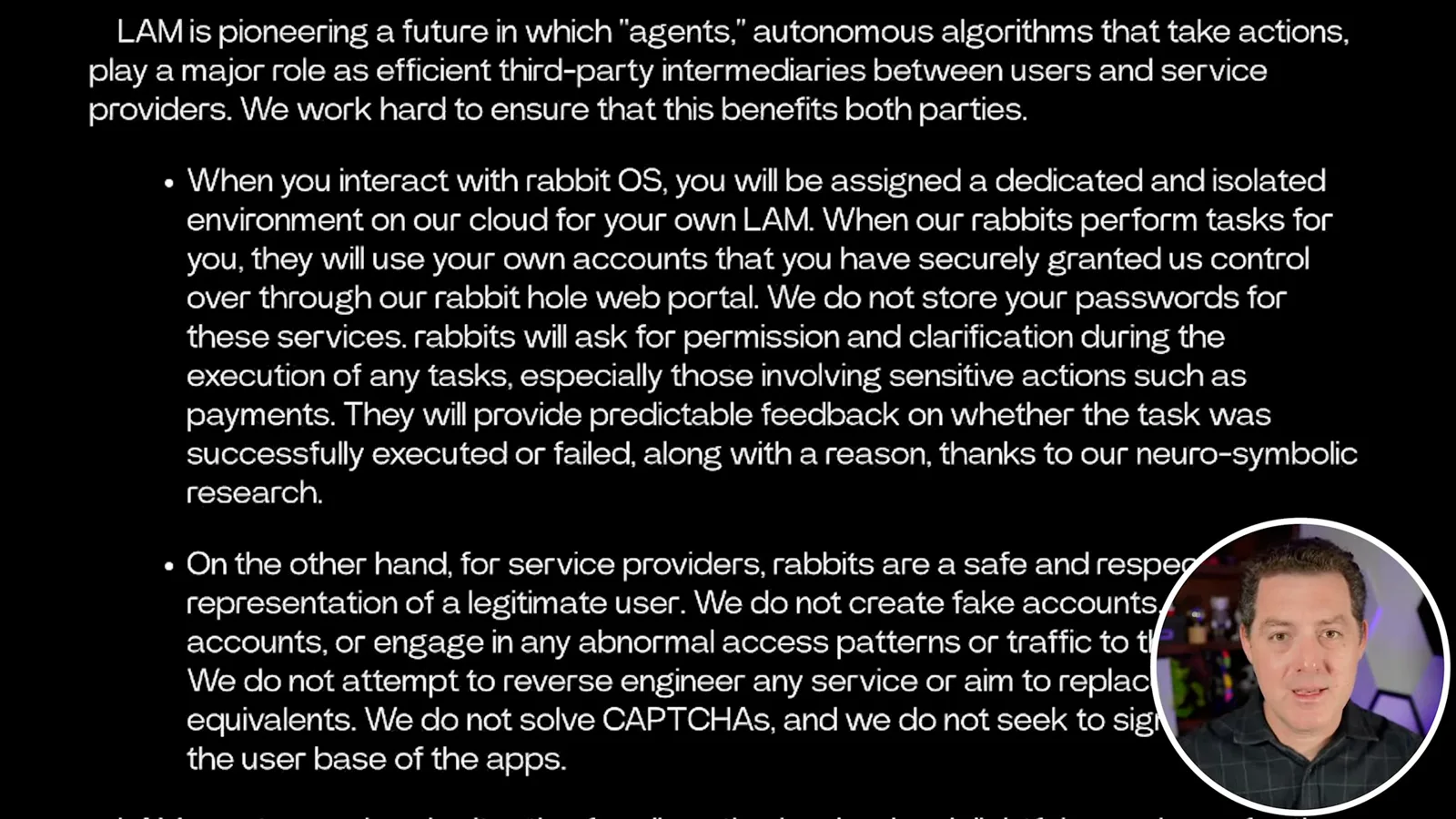
The company also described a dedicated cloud environment for each user's agent, linked third-party accounts and confirmation for sensitive actions such as payments. It said it did not store service passwords. Berman treats the approach as an explanation of the planned system; users should distinguish these claims from verified security guarantees.
Jason Calacanis asks Lyu how an order would work after a user links a service. Lyu describes selecting services in a web portal, authenticating with the provider and then allowing a cloud-hosted action system to interact with the chosen service and return a result to the device. This is a description of the intended design, not a live independent test.
Expectations before delivery
Berman closes with enthusiasm and plans to review the device after receiving it.
Berman closes by saying he expects his device soon and plans to make hands-on reviews. He predicts a future with more natural-language interaction and fewer conventional applications, but those are his forecasts. At recording time he had not yet assessed the shipped R1.
같은 채널의 다른 글
 25:50EN
 32:20EN
 45:08EN
 0:32EN
 12:14EN
 10:36EN