30초 요약
A few days after GPT-4o's announcement, Matthew Berman reviews OpenAI examples of voice and vision interaction, including two assistants conversing, tutoring, translation, meeting summaries, accessibility and customer service. He is excited by low latency and expressive speech but had not yet tested the new voice feature himself. The clips are launch demonstrations and future possibilities, not proof of general reliability or current availability.
- 1Voice and vision at launchBerman reviews OpenAI's prerecorded demonstrations and says he has not yet personally used the new voice feature.
- 2Two assistants converseGreg Brockman sets up two assistants, one with camera access, to exchange descriptions and sing in turns.
- 3Games and vocal styleRock-paper-scissors and sarcasm examples show changes in voice delivery and the use of visual and conversational context.
- 4Math tutoringSal Khan and his son demonstrate a guided geometry exercise in which the assistant asks questions rather than immediately giving the answer.
- 5Meetings, translation and accessibilityExamples include summarizing a conversation, interpreting between languages and describing a camera view for a person with visual impairment.
- 6Customer-service possibilities and risksA staged replacement-phone call illustrates the possibility of assistants acting on a user's behalf; Berman also raises abuse risks.
핵심 정리
- In May 2024 Berman could access parts of GPT-4o but said the new voice experience was not yet available to him.
- OpenAI's demonstrations combined spoken conversation with camera or screen context, including tutoring and translation.
- The meeting example used an assistant on one participant's computer; it was not itself a meeting participant.
- Accessibility and customer-service examples suggest possible workflows but need reliability, privacy and misuse safeguards.
- Expressive speech and apparent contextual awareness in a demo do not establish emotions or dependable understanding.
챕터별로 다듬은 전문 읽기
The first voice and vision examples
Berman explains that the new voice mode was not yet available to him and reviews a camera-based announcement guessing demo.
A few days after GPT-4o's announcement in May 2024, Matthew Berman reviews the model and OpenAI's examples. He says some model capabilities were available, but the new voice experience was not yet accessible to him. His assessment of voice is therefore based on demonstrations rather than his own extended testing.
In the first example, an OpenAI employee shows the assistant a production setup and leads it toward guessing that an announcement concerns the model itself. Berman is impressed by the combination of camera input and conversation, while finding the selected voice unusually flirtatious and sometimes awkward.
Two assistants and expressive speech
A pair of assistants discuss a camera view and attempt to sing. Berman comments on latency and voice style.
Greg Brockman introduces two assistants to one another. One has a camera view and is asked to describe the environment; the other asks questions. Berman notices a change in delivery when Brockman asks one assistant to pause, and highlights how quickly the interaction appears to proceed.
The visually enabled assistant describes Brockman's clothing and the room to the other system. Berman says the conversational style is more complimentary and verbose than he would prefer. At the time of recording, he had tried an older voice experience and could not reproduce the new demonstration's latency or expression.
A person briefly appears behind Brockman and makes a playful gesture. The assistants continue their conversation until Brockman asks if anything unusual happened, after which the visually enabled assistant describes the event. Berman says he could not clearly see the gesture in the phone view himself.
The assistants then attempt to sing alternating lines about the scene. Berman finds the combination of recent visual context, rhyming and alternating voices striking. The performance demonstrates generated speech in a staged interaction; expressive delivery does not mean the systems feel emotions.
Interview preparation and games
OpenAI examples explore conversational tone, interview preparation, rock-paper-scissors and sarcasm.
An interview-preparation example asks the assistant to comment on a presenter's appearance and clothing. Berman considers how a personal-sounding voice and conversational history could affect companion-style applications, while making clear that he is extrapolating beyond the particular demo.
In a rock-paper-scissors demonstration, two people ask the assistant to act like a sports commentator and count them in. It describes the rounds and identifies a winner from the camera view. Berman is interested in its apparent ability to associate names with the participants, though a demonstration is not a general identification test.
A shorter example asks for a sarcastic delivery. The voice changes accordingly, illustrating the range of tone a spoken interface can convey. Berman sees such expressive control as one of the features that distinguishes the new voice demonstrations from earlier interactions.
Math tutoring and screen context
Sal Khan and his son try guided geometry tutoring. Berman considers the potential and limitations of screen-aware assistants.
Khan Academy founder Sal Khan and his son Imran try a geometry tutoring exercise. Khan asks the assistant to guide the student with questions instead of simply giving the answer. Berman sees promise in this approach for learning, provided that explanations and feedback are checked for accuracy.
The assistant asks the student to identify the sides of a right triangle relative to an angle. When he is uncertain, it describes the hypotenuse and adjacent side, then asks him to try again. Berman emphasizes the use of voice alongside the exercise displayed on the device.
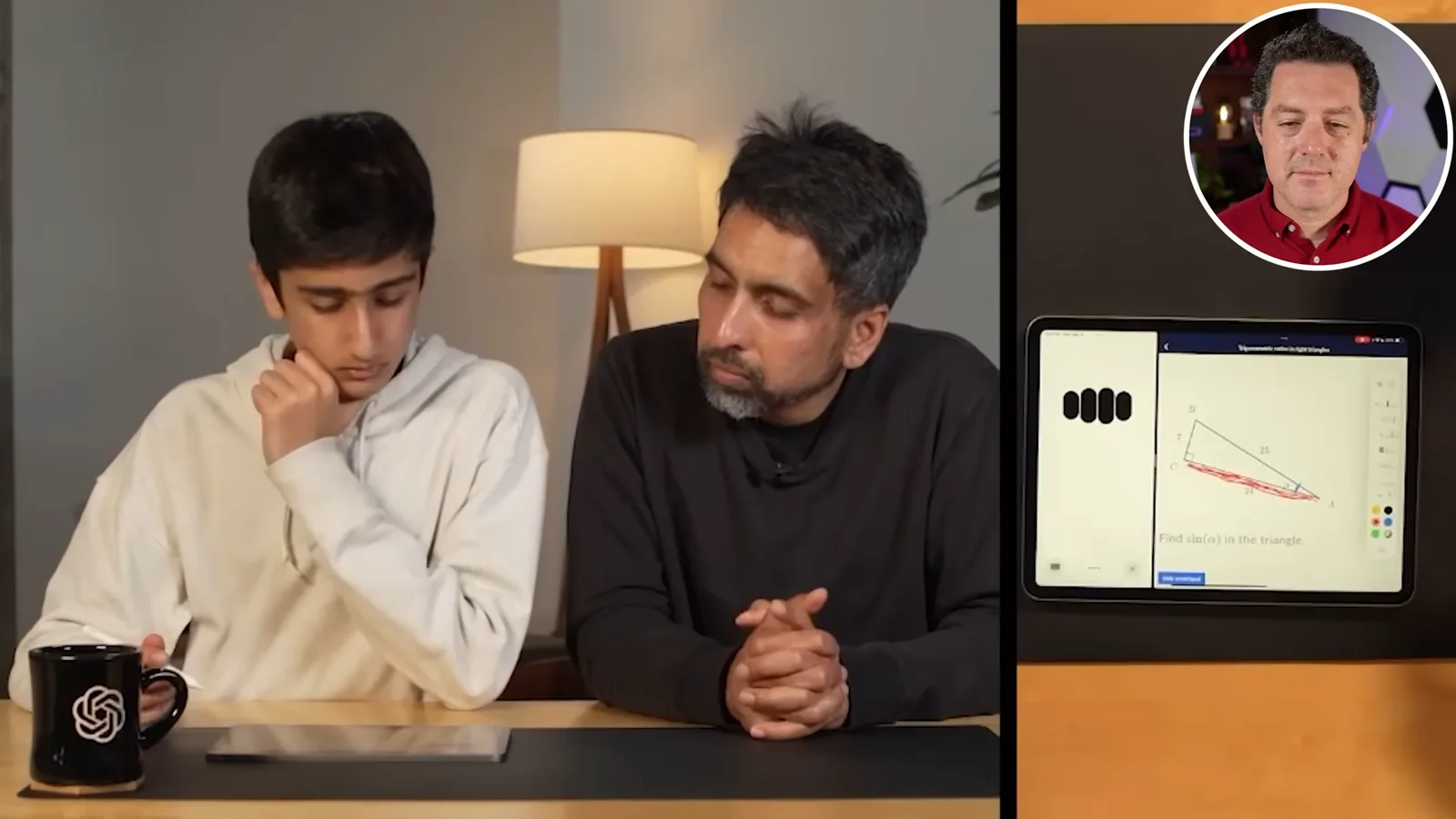
Berman imagines assistants that can see device context and eventually take actions, but distinguishes that possibility from the demo. He notes that operating-system access, personal information and actual task execution introduce separate product and permission questions.
Meetings, translation and accessibility
The examples cover a meeting summary, language translation and visual assistance.
A meeting example features people debating cats and dogs while an assistant listens from one participant's desktop. Berman corrects his initial description: the assistant is not actually a meeting participant. It recalls preferences and summarizes the discussion; he imagines future follow-up messages and action items.
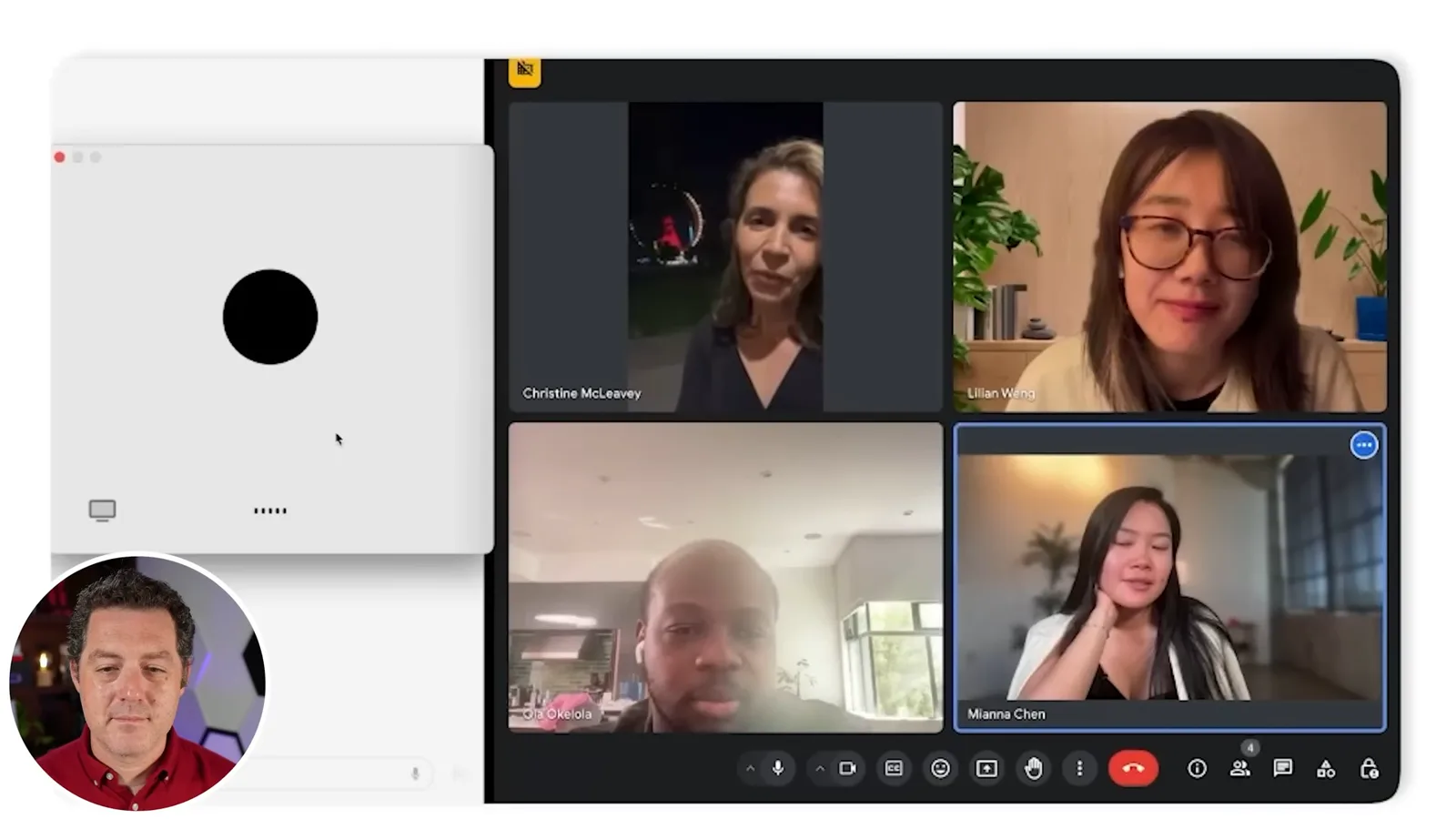
Another clip demonstrates translation between English and Spanish. Berman sees real-time interpretation as a valuable use of voice interaction, while the short example does not establish translation quality across languages, accents or difficult settings.
A Be My Eyes example shows visual descriptions for a person with visual impairment, including a landmark, ducks and a taxi. Berman considers responsiveness important for accessibility. Such demonstrations should not be treated as a guarantee of accurate navigation or a substitute for established mobility aids.
Customer service and other modalities
A staged call leads to discussion of misuse; Berman closes with image, video-summary and 3D examples.
A staged customer-service call has an assistant seek a replacement for a faulty phone. Berman imagines delegating calls or returns to an assistant, but also raises concerns about scammers and spam using similar tools. The example is a demonstration, not a live test against an independent customer-service representative.
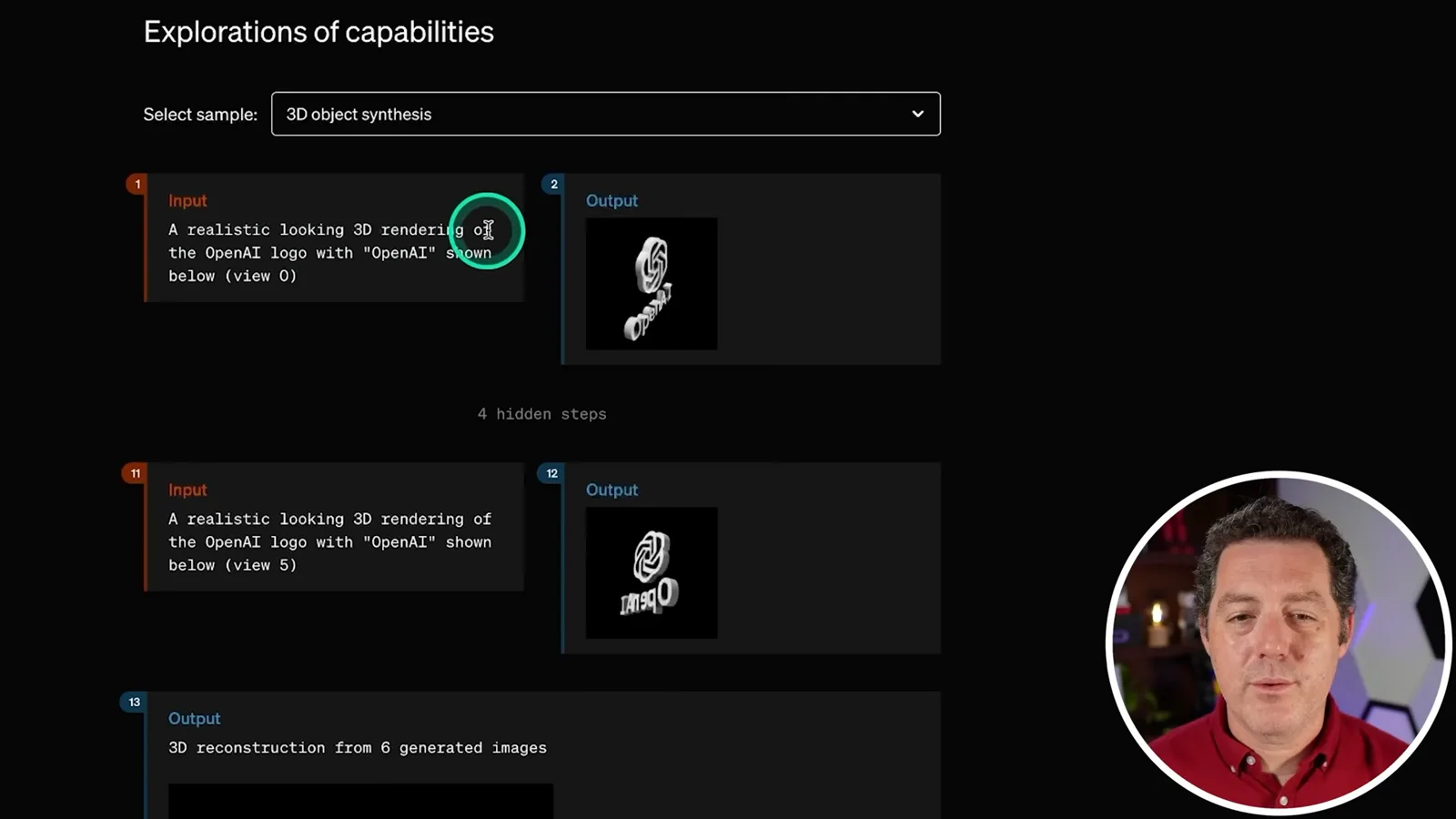
Berman closes by browsing other exploratory examples: turning a photo into a caricature, summarizing a lecture and producing views used in a 3D reconstruction. He wonders about the underlying context and capabilities, and looks forward to testing the voice mode when he can access it.
같은 채널의 다른 글
 34:21EN
 Matthew Berman· 2026년 10월 27일Matthew Berman Examines Anthropic’s IPO Filing, AI Growth and GovernanceMatthew Berman, Sam Altman · Forward FutureThe presenter reviews the S-1’s financial metrics, compute strategy and voting structure while questioning the tension between rapid AI development and safety.
 0:26ENMatthew Berman· 2026년 10월 25일Sam Altman on Human Values and Problem-Solving in an AI WorldSam Altman · OpenAIIn a short interview excerpt, Altman considers the enjoyment of solving hard problems and the human role in interpreting results.
 0:36ENMatthew Berman· 2026년 10월 25일Kimi K3.1 and a Rubik’s Cube Solver DemonstrationMatthew Berman · Forward FutureMatthew Berman shows a scrambled virtual cube being solved and gives the Kimi K3.1 test a favorable assessment.
 0:21ENMatthew Berman· 2026년 10월 24일An AI-Generated Kimi Benchmark Chart Used Invented ScoresMatthew Berman · Forward FutureMatthew Berman asks for a graph of Kimi K3.1 Pro benchmarks, then discovers that the displayed figures are illustrative placeholders.
 25:50ENMatthew Berman· 2026년 10월 24일Kimi K3.1 Pro Tested: Strong 3D Demos, Uneven Results and Competitive PricingMatthew Berman · Forward FutureMatthew Berman tests the open-weight model on coding, 3D rendering and visual explanations, then compares benchmark results and prices.
 32:20ENMatthew Berman· 2026년 10월 23일Who Is Local AI For? The Costs, Trade-offs and a Hybrid FutureMatthew Berman · Forward FutureMatthew Berman weighs data control and independence against hardware cost, setup complexity and inference speed.