30초 요약
3Blue1Brown asks how many distinct frames can be made by removing edges from a cube when rotations count as the same configuration. The short connects the question to Sol LeWitt’s 1974 artwork and introduces a longer guest video by Paul Dancstep; it does not give the count.
- 1Remove edgesThe puzzle counts partial cube frames made by leaving out edges.
- 2Account for rotationsConfigurations related by a rotation are considered identical.
- 3Art and group theoryA related constrained problem inspired a 1974 Sol LeWitt artwork and leads toward Burnside’s lemma.
핵심 정리
- Removing edges from a cube produces many partial frames.
- Two frames count as the same when one can be rotated to match the other.
- The related artwork has additional constraints, and the longer video explores Burnside’s lemma.
챕터별로 다듬은 전문 읽기
The incomplete-cube puzzle
Remove cube edges and count distinct frames, identifying those that differ only by rotation.
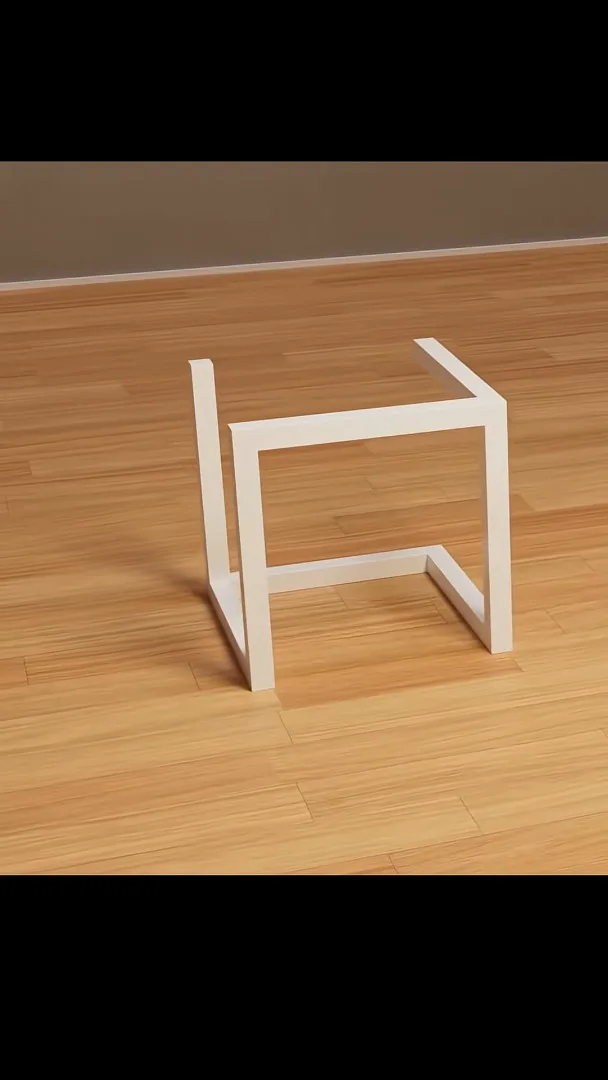
How many ways can a cube be incomplete? Take a cube’s edge frame and remove some edges. The question is how many distinct partial frames can be made.
There is a catch: if you can rotate one incomplete cube to match another, they count as the same configuration. Simply counting every choice of edges would therefore count some arrangements more than once.
Art and a mathematical method
The presenter relates the question to Sol LeWitt’s work and a longer video exploring group theory.
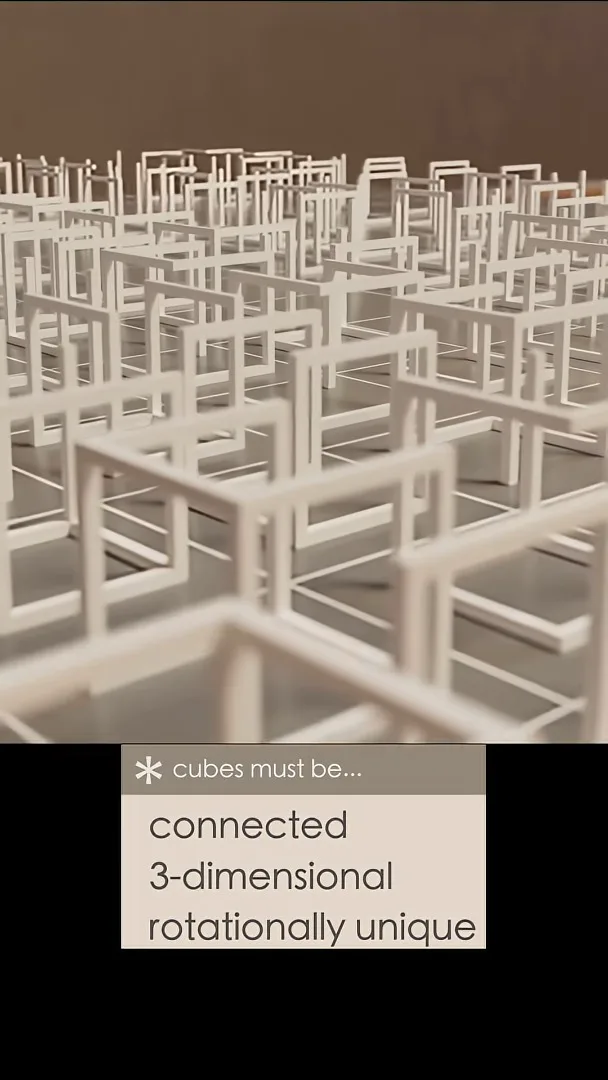
With additional constraints, a related question formed the premise of a 1974 artwork by Sol LeWitt. The short points to a longer guest video by Paul Dancstep, which tells the artwork’s story alongside a problem-solving process leading to group theory and Burnside’s lemma. This short invites viewers to think about the puzzle without giving the count.
같은 채널의 다른 글
 40:44EN
 3Blue1Brown· 2026년 10월 16일Grant Sanderson: There's never been a better time to go into mathGrant Sanderson, Constantin Kogler · 3Blue1BrownStudents fear AI has solved mathematics. Grant Sanderson argues the opposite: even if machines prove theorems better than we do, the institution of math stays valuable—and this is a rare moment when newcomers can reshape it.
 51:55EN3Blue1Brown· 2026년 9월 18일The last IMO problem AI could not solveGrant Sanderson · 3Blue1BrownGrant Sanderson walks through IMO 2025 Problem 6 — a tiling puzzle that frontier models missed — and the visual patience it takes to prove a construction is optimal.
 0:55EN3Blue1Brown· 2026년 7월 24일The 64 Sugar Cubes Puzzle: Six Equal DistancesA 4×4×4 block has three colors; prove that six same-colored pairs share a distance.
 2:25EN3Blue1Brown· 2026년 6월 12일How Shannon Measured the Entropy of EnglishA guessing game helped Claude Shannon estimate how much information English text contains, and why prediction is central to compression.
 1:02EN3Blue1Brown· 2026년 6월 10일A Robot Walk and the Puzzle of Optimal Binary EncodingHow few bits does it take to send directions that occur with unequal frequencies?
 32:19EN3Blue1Brown· 2026년 6월 7일Reinventing Entropy: Why Prediction Helps Compress LanguageA robot’s movement code leads from prefix-free encoding to Shannon information and the entropy of language.