30초 요약
On an early SpaceX tour, Elon Musk shows how rocket parts moved from design and machining through inspection and environmental testing. He says the company made about 80% of each vehicle by value in-house and used a hardware-in-the-loop setup to test flight electronics. The tour continues through Falcon 9 tank and Dragon spacecraft assembly, then to a former Titan IV pad being adapted for Falcon 9 at Cape Canaveral.
- 1Three-dimensional inspection reduced design conversionsMusk says controlled temperature helps precision measurement and the team tries to keep parts in 3D from design through inspection.
- 2Flight computers could be tested as if the rocket were flyingA hardware-in-the-loop setup checks avionics and steering commands before a vehicle flies.
- 3SpaceX made most of the vehicle in-house by valueMusk describes machining raw metal into engine and vehicle components and says some work was also performed offsite.
- 4Dragon and Falcon 9 were being assembled in the factoryThe tour shows a spacecraft pressure vessel, payload fairing, heat-shield tooling and tank sections.
- 5An old Titan IV pad was being converted for Falcon 9Musk and launch-site manager Brian Mosdell show construction plans, lightning protection, oxygen storage and the flame duct.
핵심 정리
- Musk says SpaceX made about 80% of its vehicles by value in-house at the time of the tour.
- Flight electronics were tested in a simulated vehicle before launch.
- Thermal, vacuum, vibration and radio-interference tests checked whether components could survive and work together.
- The factory built and inspected rocket structures, engines and Dragon spacecraft components.
- SpaceX was adapting a former Titan IV launch pad for Falcon 9.
챕터별로 다듬은 전문 읽기
An open office and flight-control testing
Musk shows the engineering offices, precision inspection and systems for testing flight electronics.
Elon Musk opens a tour of SpaceX headquarters in Hawthorne. He says the engineering offices use an open plan to encourage communication, with relatively few private offices.
Gwynne Shotwell describes her responsibility for bringing in revenue through Falcon 1, Falcon 9 and Dragon deals. Musk also visits engineers working on Draco thrusters for Dragon and the Falcon 9 upper stage.
He shows a customer meeting room and says conference rooms are named for rocket engineers and scientists. A server room supports computational fluid dynamics, structural analysis and three-dimensional design.
A future mission and launch control room is under construction. In the inspection area, temperature is controlled because metal expands and contracts; Musk says SpaceX tries to design, manufacture and inspect parts in three dimensions to minimize conversions.
Musk shows a hardware-in-the-loop setup that makes the flight computer and avionics respond as if they were flying a vehicle. The team checks whether the electronics and steering commands perform as intended.
In avionics testing, thermal chambers repeatedly change temperature, including under vacuum. Shakers reproduce the vibration and acoustic loads of launch, which Musk says are a common source of failures.
Avionics engineer Dylan Dalton shows ground-support equipment replicated from the launch site so a second stage can be tested before shipment to Texas. An electromagnetic interference chamber checks that the vehicle’s many radios and antennas do not disrupt one another.
Making engines and rocket components
The tour moves through propulsion components, tube bending, machining and the Merlin engine.
In engine production, Musk contrasts the broad vacuum nozzle with the shorter sea-level configuration. He points out Falcon 9 propellant lines, a manifold feeding nine engines and machines that repeatedly bend complex tubing to shape.
The machine shop turns raw metal into engine and vehicle parts using lathes, mills and electrical-discharge machines. Musk says SpaceX makes about 80% of the vehicle by value in-house, although it also uses offsite machining.
He points to a chamber liner being cut and drilled for cooling and to manifolds and oxygen supply components. Musk describes the need to produce engines efficiently and accurately as output increases.
A Merlin 1C engine is being prepared for a nine-engine test in Texas. Musk identifies the turbopump, chamber, nozzle, controls and structure, and says the Falcon 1 and Falcon 9 engine configurations are substantially similar.
Building Dragon and Falcon structures
Musk shows spacecraft and rocket structures in assembly, plus composite tooling and Falcon 1 hardware.
Musk shows a quarter section of a Falcon 9 payload fairing, made from carbon fiber, and a Dragon pressure vessel under construction. He points to the hatch, windows and the mechanism intended to berth with the space station.
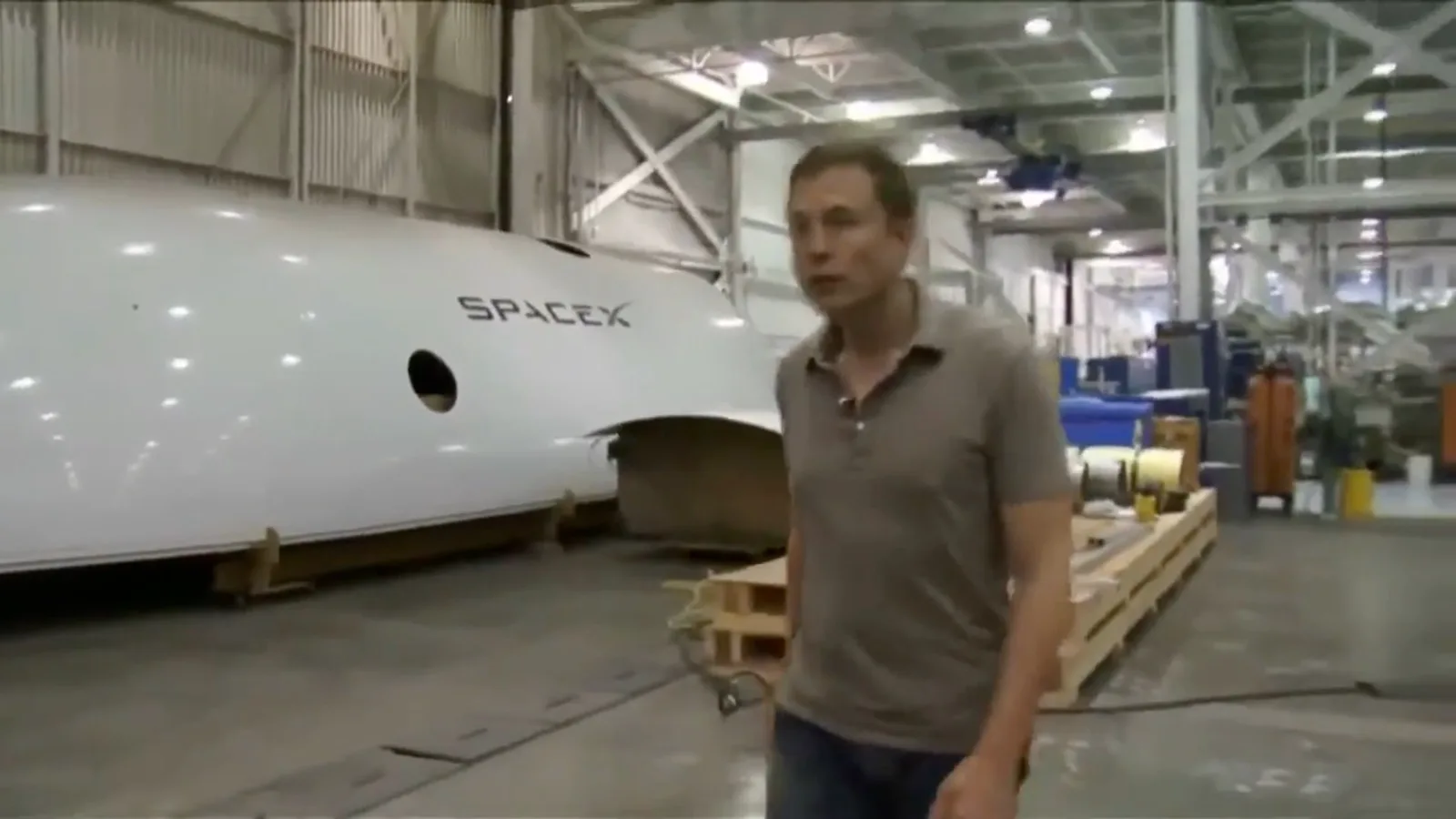
The Dragon assembly area includes tools for heat-shield composites and an engineering test article used to develop the spacecraft. Musk identifies a station berthing ring, structural components and a model used to assess splashdown loads.
In the east high bay, Falcon 9 tank sections are being fabricated and welded. Musk distinguishes a test tank, a qualification tank and the third tank intended for flight.
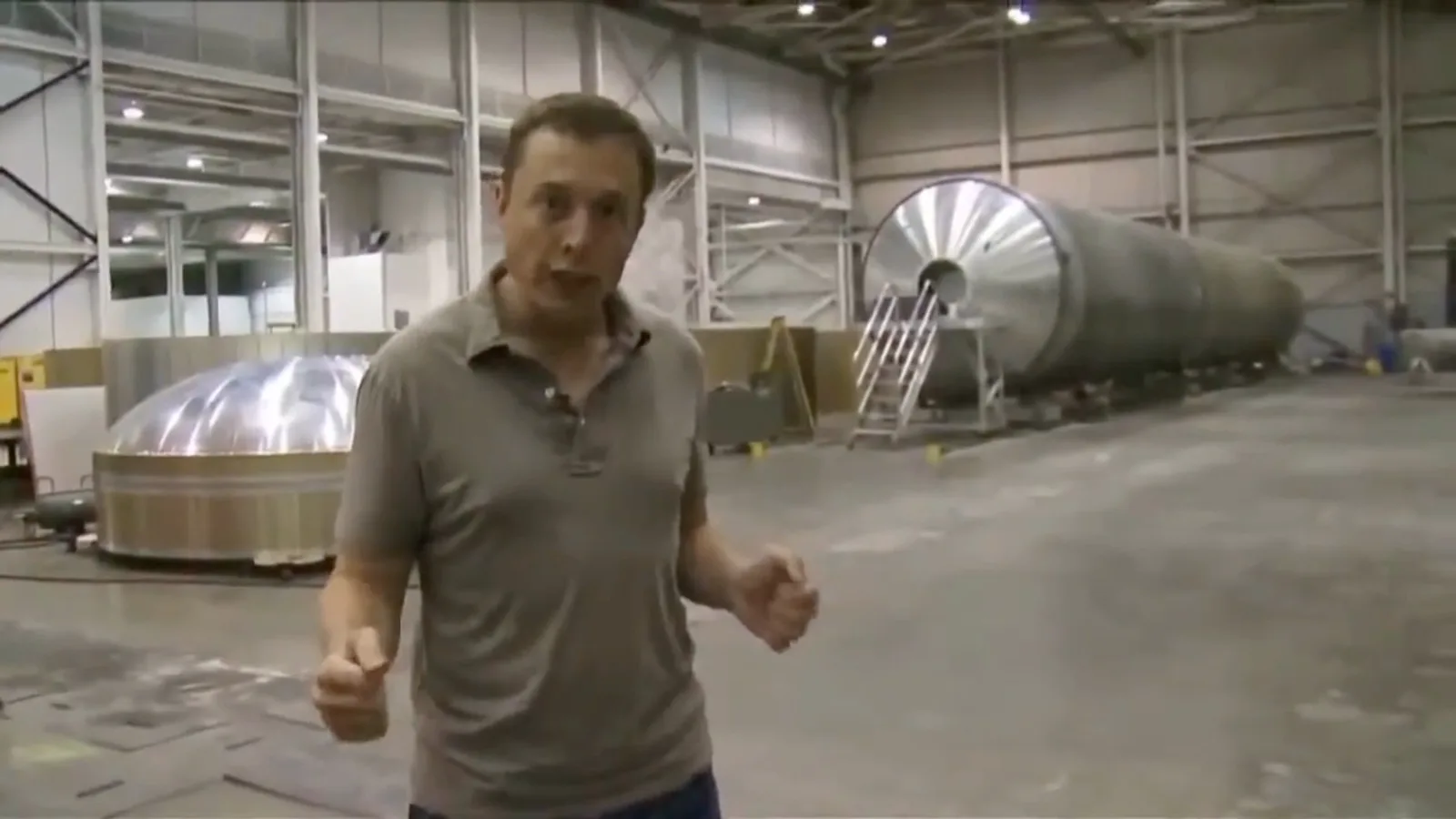
He shows a forming tool for an upper-stage component and a large mandrel used to make cylindrical composite parts, including the interstage and Dragon trunk. A climate-controlled room supports propulsion and composite work.
In the Falcon 1 assembly area, Musk points out nose-cone tooling, payload adapters, an interstage mandrel and a barrel for a later flight. He says flight three is nearly ready and outlines plans for subsequent flights.
He shows a Falcon 1 upper stage with its engine, actuators and attitude-control plumbing. The tour passes a snack area before Musk lists SpaceX’s Texas test site and launch sites at Cape Canaveral and Kwajalein.
Converting a Cape Canaveral launch pad
Musk and Brian Mosdell show the former Titan IV site being prepared for Falcon 9.
The video moves to Cape Canaveral, where SpaceX is adapting a former Titan IV launch site for Falcon 9. Musk introduces Brian Mosdell, who describes his role managing construction and launch operations.
The launch mount and hangar are still to be built. Musk and Mosdell show the lightning towers, a liquid-oxygen storage sphere and the flame duct that will carry exhaust and steam away from the rocket.
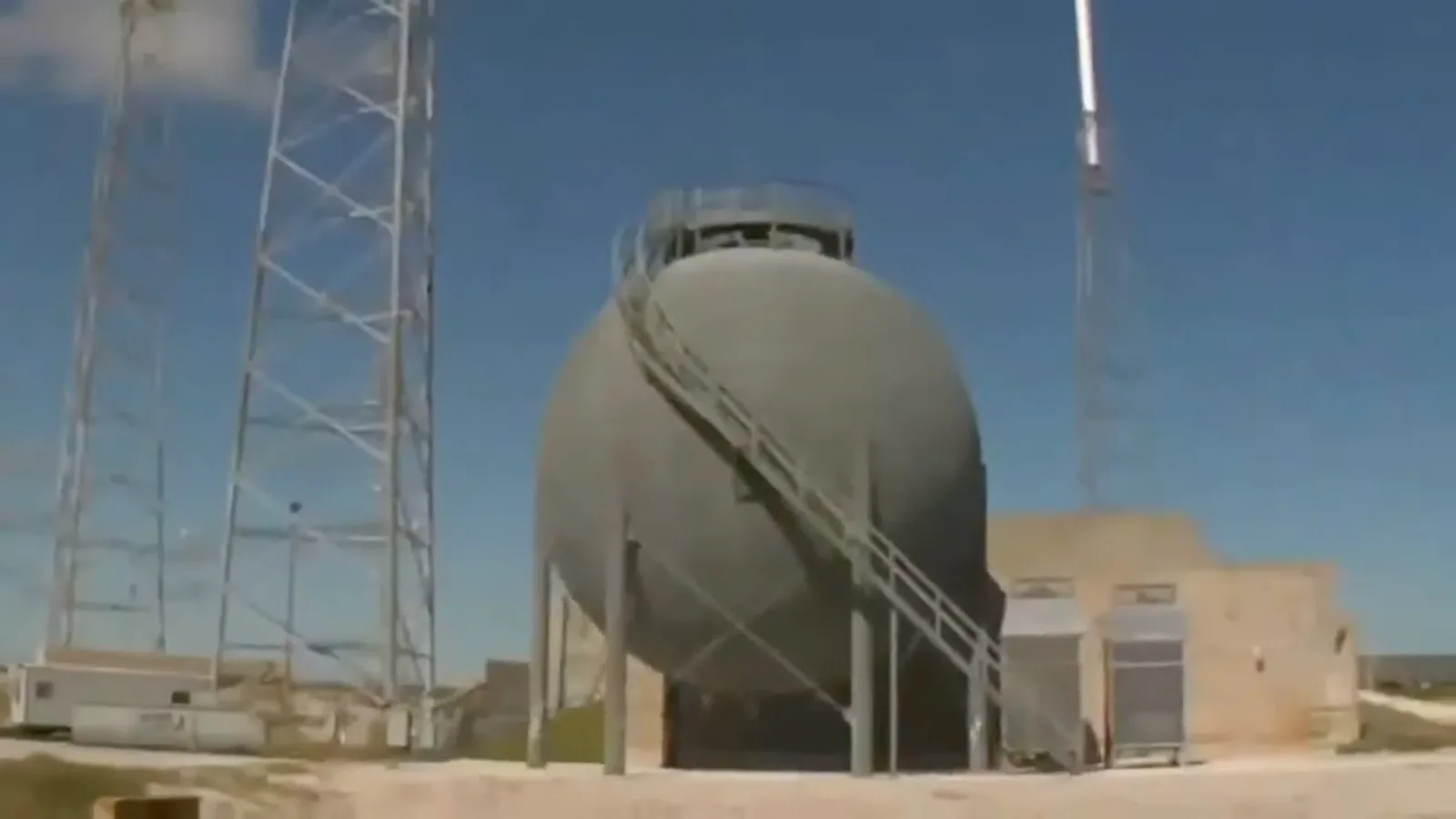
Musk points to records of prior launches from the pad and describes a control room about 12 miles away, outside the base gates, where customers can observe operations. He says construction began about a year earlier and gives a target for the site to be ready the following year.
같은 채널의 다른 글
 13:40EN
 Elon Musk best videos· 2015년 12월 11일Elon Musk’s 2014 plan for affordable Teslas and a city on Mars게스트 Elon MuskMusk said costly early cars would fund a cheaper Tesla, while Mars settlement would require a dramatic fall in travel costs.
 28:23ENElon Musk best videos· 2015년 12월 8일Elon Musk in 2011: Reusable Rockets, NASA and SpaceX’s First Crew Plans게스트 Elon MuskDuring a visit to SpaceX’s Hawthorne factory, Musk discusses the cost of spaceflight, Dragon’s design and his long-term ambition for Mars.
 1:10:16ENElon Musk best videos· 2015년 12월 6일Tesla’s 2010 bet on Model S: rising spending before mass production진행자 Ricardo ReyesOn the third-quarter call, Musk and CFO Deepak Ahuja laid out the sedan’s milestones, finances and automaker partnerships.
 23:36ENElon Musk best videos· 2015년 12월 6일Musk’s 2010 plan for Model S, an SUV and a cheaper Tesla게스트 Elon MuskBefore Model S production, Musk outlined development milestones, charging choices and the next vehicles on Tesla’s roadmap.
 24:50ENElon Musk best videos· 2015년 12월 4일Elon Musk on Leaving PayPal and Preparing SpaceX’s Fourth Launch게스트 Elon MuskBefore Falcon 1’s fourth flight, Musk explains the PayPal dispute, Tesla’s Roadster decisions and SpaceX’s early launch failures.
 31:15ENElon Musk best videos· 2015년 11월 27일Elon Musk in 2010: Tesla’s Early Strategy, Funding and Entrepreneurial Advice게스트 Elon Musk · 진행자 Bambi FranciscoIn a Vator interview, Musk explains the Roadster-to-Model S strategy, early financing and the questions he believes founders should ask themselves.