30 秒でわかる
At the 2026 Sana AI Summit, writer and investor Anu Atluru asks what remains human when machines can do much of the work. She argues that skills may eventually become art, sport or tasks delegated to machines, and urges people to distinguish useful labor from what is distinctive to them. Atluru uses changes in writing, chess and entrepreneurship to illustrate her view. She proposes that organizations nurture individual artistry and athleticism rather than treating people as interchangeable, while acknowledging that her framework is a provocation about the long term.
- 1Trying to sound humanAtluru says writers now navigate suspicion of punctuation and sentence patterns associated with AI, sometimes making their voice deliberately less tidy.
- 2Useful versus distinctiveShe asks people to separate the utility of their work from qualities tied to their individual perspective and personhood.
- 3Three possible fatesHer long-term provocation is that a skill may become art, sport or something people no longer regard as necessary to learn.
- 4Entrepreneurship as bothShe sees a founder's vision and the company as art, and the process of building as sport.
- 5Reversing the 80/20Atluru proposes a future with more time devoted to work that is uniquely individual, rather than mainly to broadly useful tasks.
- 6Designing organizationsShe argues that standardized treatment can produce average results while making exceptional individual contributions harder to realize.
ポイント
- Atluru says writers are changing how they express themselves as readers associate polished patterns with AI.
- She proposes that skills may eventually persist as art or sport, or become tasks people leave to machines.
- Art and sport, in her view, share mastery, vulnerability and a person whose struggle matters to an audience.
- She sees entrepreneurship as combining an artistic vision with the competitive work of building.
- Atluru urges organizations to recognize individual strengths and reduce excessive standardization.
チャプターごとに整えた全文を読む
Writing in the age of AI
Atluru describes how AI-associated writing patterns affect human writers. She asks what it means to sound human when the target keeps moving.
Anu Atluru asks what stays human when machines can do most of the work. After conversations with founders, investors, operators, writers, AI builders and people whose jobs are affected, she offers a working theory for thinking through the question.
As a writer, Atluru normally tries to say something new while sounding like herself. Recently, she says, she has also found herself trying to sound recognizably human. As AI learned to write in familiar styles, readers began treating certain patterns as evidence of machine authorship.
Her first example is the em dash, a punctuation mark she likes but now sees associated with AI. She jokes that she briefly protested before adding a note to an essay explaining that its em dashes were inserted by a person. She also cites words and contrastive sentence structures that have become suspect.
The suspicion extends beyond individual words: editing can seem too clean, sentences too uniform and prose too tidy. Atluru says that as models become better at imitating human writing, writers feel pressure to keep changing how they signal their humanity.
Some writers respond by becoming messier: keeping unusual asides, speaking directly to readers or retaining stories they would previously have cut. Atluru describes this as making one's voice more distinctive while still trying to say something novel and useful.
She connects the uncertainty to what Kevin Kelly calls an age of ambiguity: questions about technology, geopolitics, jobs and what is real online. For her, one of the most interesting uncertainties concerns how people define the human in life and work.
Ambiguity and the future of skills
She considers the pace of technology and asks what parts of work are useful versus distinctive. Examples from chess and art lead to her three-part framework.
Drawing on Stewart Brand's pace layers, Atluru suggests technology has moved ahead of culture. She argues that AI affects fashion, commerce, government, infrastructure, culture and eventually nature at once, making it hard for people to adapt at the slower pace to which they are accustomed.
In negotiating what remains for people, she says, the task is to distinguish the useful part of work from what is specific to an individual. Producing or lending labor was once readily understood as a human contribution; AI forces a new question about what people can do that machines cannot.
Atluru asks which forms of obsolescence society will accept. Calligraphy was once useful and now persists as art; she predicts that driving may increasingly resemble horseback riding, something people do for enjoyment or sport. She looks to past reactions to displaced skills for clues.
When machines beat people at sport, she says, the initial shock does not end human competition. Deep Blue defeated Garry Kasparov, yet people still celebrate chess champions. She contrasts machine and human running records to argue that audiences value the drama of people testing their own limits.
In art, Atluru observes a different response: people may reject or label work differently when they know AI produced it. She thinks AI can make intricate, beautiful or moving things, but asks whether these are art in the familiar sense. She cites scrutiny of published writing and debates over film awards as signs of the dispute.
Despite their differences, she sees common features in art and sport: mastery and ingenuity, the vulnerability of being judged or failing, and a particular person at the center. Audiences identify with the struggle and triumph. She recalls a Pixar storytelling principle about admiring a character's effort.
Art, sport and entrepreneurship
Atluru argues that art and sport preserve the importance of human mastery and struggle. She applies those ideas to skills and company building.
Her long-term provocation is that each skill moves toward one of three fates: art, sport or extinction. By extinction she means people no longer regard the skill as something humans need to learn and leave it to machines. She argues that finding its artistic or sporting dimension is one way a skill might remain meaningful.
In the shorter term, Atluru says, people are unbundling their roles and distinguishing what is specific to them from work another person or machine could do. Engineers reviewing AI code, lawyers checking generated contracts and radiologists approving AI-read scans are examples she offers of people supervising tools that perform portions of their work.
Atluru sees entrepreneurship at the intersection of art and sport. A founder's vision—what to build, what not to build and how to build it—makes the company an artistic artifact. The competitive work of building is the sport; different founders may be drawn more to the craft or to the game.
Nurturing individual contributions
She proposes reversing a familiar split between useful and uniquely individual work. She urges organizations to create conditions for artistry and athleticism.
She applies the idea to ordinary roles, from executive and engineer to writer or operator. Some work is useful and could be done by others; some reflects what a particular person uniquely contributes. She suspects the latter has historically taken up a minority of most people's time.
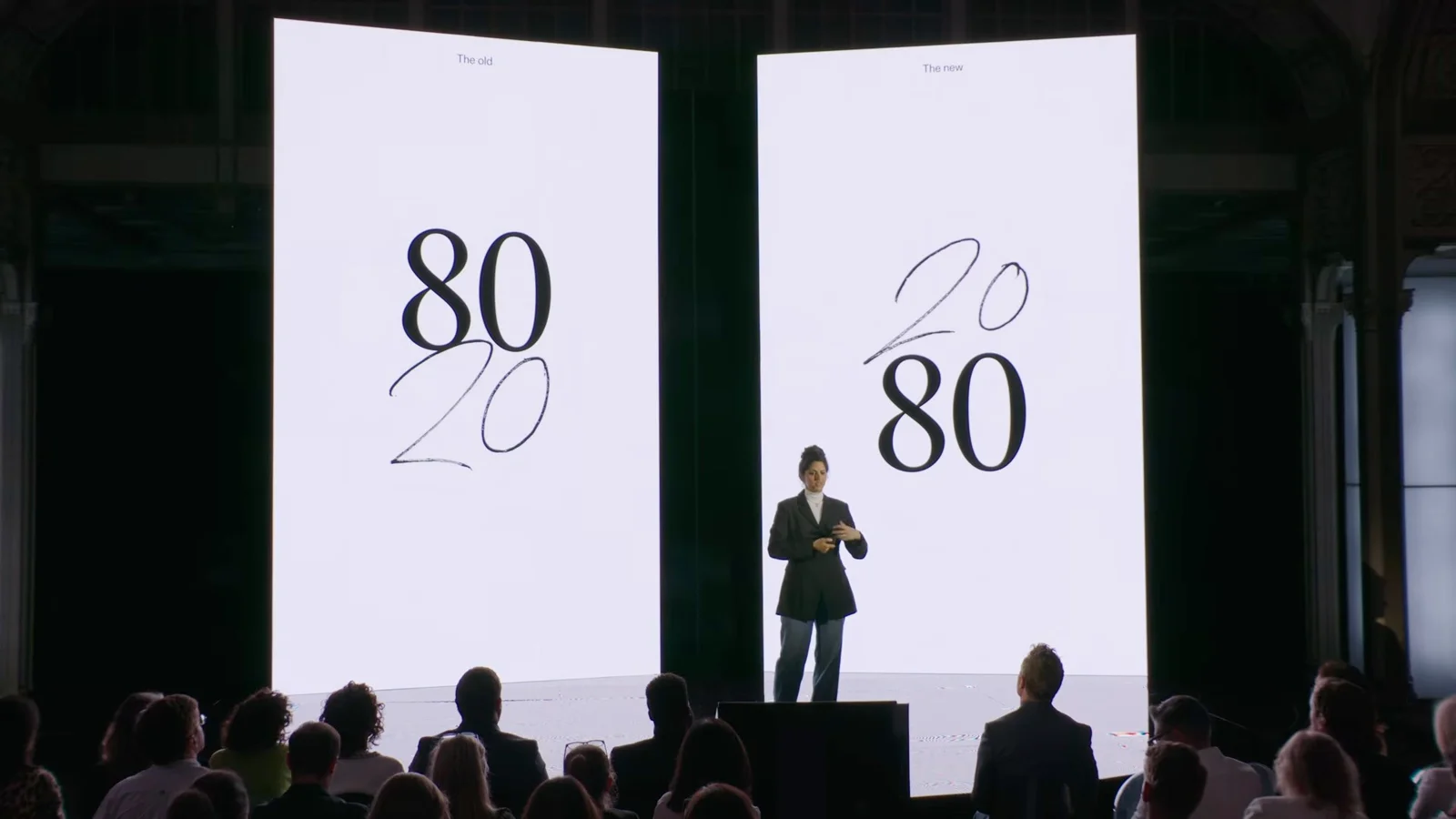
Atluru proposes reversing an illustrative 80/20 split: instead of spending 80% of time on broadly useful work and 20% on what is uniquely one's own, she imagines a future closer to the opposite. She finds that prospect freeing and frightening. A slide presents the proposed reversal.
In her terms, artists want to make something beautiful or moving and realize a vision; athletes want to win, set records and push their limits. She suggests organizations should look less at headcount as a measure of achievement and more at the distinctive contributions of their artists and athletes.
One way to discover those qualities is to ask where one thrives amid ambiguity. Atluru says an artist may not know the argument of a piece until a third draft, while an athlete must cope with uncertain weather or opponents. Each works with uncertainty in a different part of the process.
Organizations, she argues, must both recruit such people and create conditions for them to flourish. Standardization may elicit average output from many people but make exceptional output from particular individuals harder. She calls for treating people as specific individuals rather than interchangeable workers.
What people still want humans to do
Atluru answers her opening question through the metaphors of art and sport. She acknowledges possible objections and argues for work that reflects individual contribution.
Returning to her opening questions—what can only humans do, and what do people still want humans to do?—Atluru answers with art and sport. She lists related qualities often discussed in technology, including taste, grit, care, craft, story, purpose and meaning, and predicts that ‘soul’ will become a more common term.
Atluru acknowledges objections: art and sport may seem distant from many jobs, relevant only to an elite, or too soft a frame for inequality and economic pressure. Her response is that people have long wanted their work to matter and wanted to be recognized as a particular person who made something specific.
She argues that newness and abundance depend on unlocking what is distinctive in individuals, not only on larger labs and products. Machines are forcing people to make their values explicit. Her closing invitation is to understand art and sport literally or as metaphors for the individual contributions people choose to preserve in their own fields.
同じチャンネルの記事
 1:16EN
 Sana· 2026年10月14日ポッドキャストHow Volkswagen Group Middle East Uses Sana to Prepare Technicians for TrainingThierry Rochat describes using technical documents to create online courses before hands-on academy sessions.
 0:41ENSana· 2026年9月8日ポッドキャストSana Learn Customers Describe Bringing Training Resources TogetherA short customer montage contrasts fragmented learning resources with keeping company knowledge in one place.
 0:40ENSana· 2026年8月31日ポッドキャストSana Learn Customers Describe Their Partnership ExperienceIn a short montage, customers discuss implementation and the ongoing relationship with Sana.
 48:34ENSana· 2026年8月12日ポッドキャスト · 2 人Tyler Cowen on AI Adoption, Human Agency, and the Search for Beautyゲスト Tyler Cowen · ホスト Joel HellermarkThe economist explains why AI's economic impact may arrive slowly, what people may still contribute, and why he is calling for a new aesthetic.
 0:16ENSana· 2026年7月21日ポッドキャストTyler Cowen on Human Presence in an AI WorldTyler Cowen predicts that charisma, physical presence and human interaction will gain importance as AI advances.
 0:23ENSana· 2026年7月9日ポッドキャストEthan Mollick on Measuring AI’s ImpactEthan Mollick argues that companies should allow room for new opportunities rather than relying only on old metrics.