30 秒でわかる
AI Explained reviews Google I/O announcements, Gemini 3.5 Flash benchmarks and competing claims about paths to AGI. The host also discusses an experiment on negation in fine-tuning and an interview about the unevenness of model capabilities.
- 1World models and AGIDemis Hassabis argues that understanding and simulating the world matter for AGI; the host contrasts this with Greg Brockman’s emphasis on text intelligence.
- 2Flash’s speed and priceThe host reports fast performance but cautions that benchmark choice, hardware and token usage matter.
- 3Different tasks, different leadersThe video highlights Flash’s reported finance and chart-reasoning results without treating a benchmark as a guarantee of real-world reliability.
- 4Negation neglectA study reports that fine-tuning on documents labeling a claim false can nevertheless cause tested models to learn the false claim.
- 5Uneven intelligenceMostafa Deghani argues that gaps between strong and weak capabilities may be structural and consequential.
ポイント
- The host sees Google emphasizing AI integrated into consumer search, while competing labs have different research emphases.
- Gemini 3.5 Flash’s speed and benchmark results depend on the tests, serving setup and cost of a specific task.
- A fine-tuning study found that models can learn fabricated claims despite separate-sentence warnings that those claims are false.
- The study does not establish that all models ignore negation in every context.
- Whether uneven model capabilities can be solved through AI-assisted research remains an open question.
チャプターごとに整えた全文を読む
Google’s consumer strategy and Omni
The host reviews Google I/O and contrasts a search-centered strategy with other AI interfaces and world-model visions.
The host reviews eight moments from Google I/O, interviews with AI lab leaders and an independent paper about how models learn false claims. His main interpretation is that Google is emphasizing AI inside consumer search, while its competitors pursue somewhat different routes to advanced AI.
In the host’s view, Google’s event focused less on claiming the top professional coding model and more on making search a portal for AI tools. He contrasts that with OpenAI’s effort to make a chat interface a place to search. This is a strategic interpretation, not a definitive account of either company’s priorities.
He tested an interactive adventure built with Antigravity 2 and says it had fewer bugs than a GPT-5.5 attempt at the same task. The example is a personal test, not a controlled ranking of the models.
Google introduced Gemini Omni as a multimodal system for generating and editing media from different inputs. The host says his limited testing encountered many refusals and compares the output quality to another video generator. His experience does not establish how the model performs across all inputs.
Demis Hassabis argues that models able to understand and simulate the world are an important step toward AGI and useful for assistants and robots. The host notes that OpenAI made a similar world-simulation argument when introducing Sora; these are research visions, not proof that generated video implies understanding.
OpenAI cofounder Greg Brockman, in an interview excerpt, argues that text-based intelligence has a path to AGI while acknowledging opportunities in world models and other domains. The host presents that as a different emphasis from Google’s world-model strategy; the timeline and route remain disputed.
Gemini Flash benchmarks and agents
Speed, price and task-specific scores paint a varied picture, while Google presents future agent features.
The host identifies areas of cooperation as well as competition. Google said OpenAI and others would incorporate SynthID, its technology for identifying generated media. He also discusses the companies’ approaches to military AI contracts, noting that the terms and their implications are politically contested.
Turning to Gemini 3.5 Flash, the host describes it as fast and comparable to Gemini 3.1 Pro in his testing. He cautions that API price comparisons depend on token consumption and usage, and that a speed advantage reflects the serving hardware as well as the model.
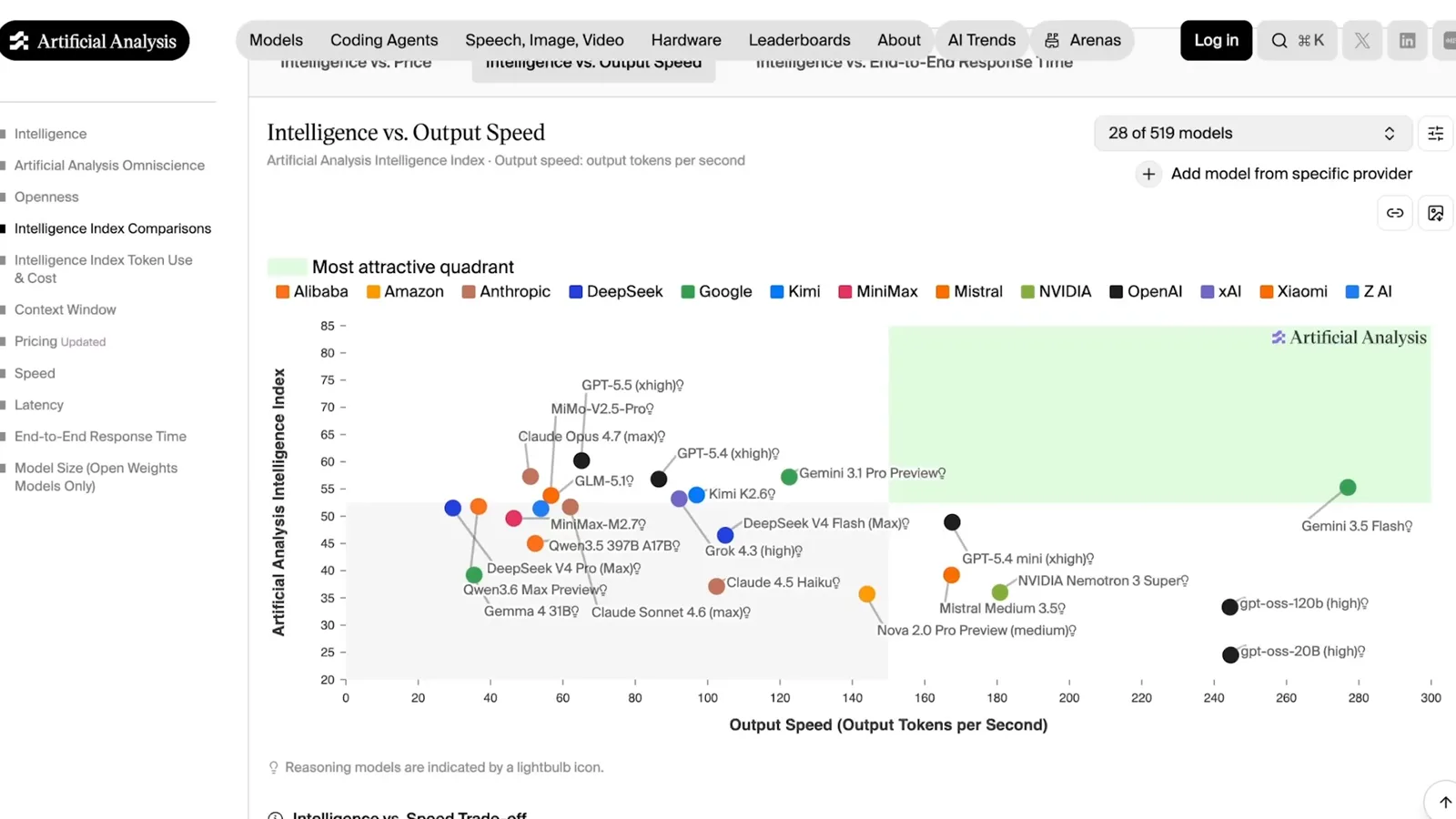
An Artificial Analysis chart plots output speed against an index assembled from selected benchmarks. Flash appears fast relative to models with comparable scores on that index, but a different set of tests could change the ranking. The host also says Flash did well on his own SimpleBench common-sense test.
On VibeCodeBench, Flash has low latency but does not lead the cited coding comparison. The host’s adventure-game demo still shows that a model below the top benchmark score can produce useful interactive software; individual demos do not establish reliability.
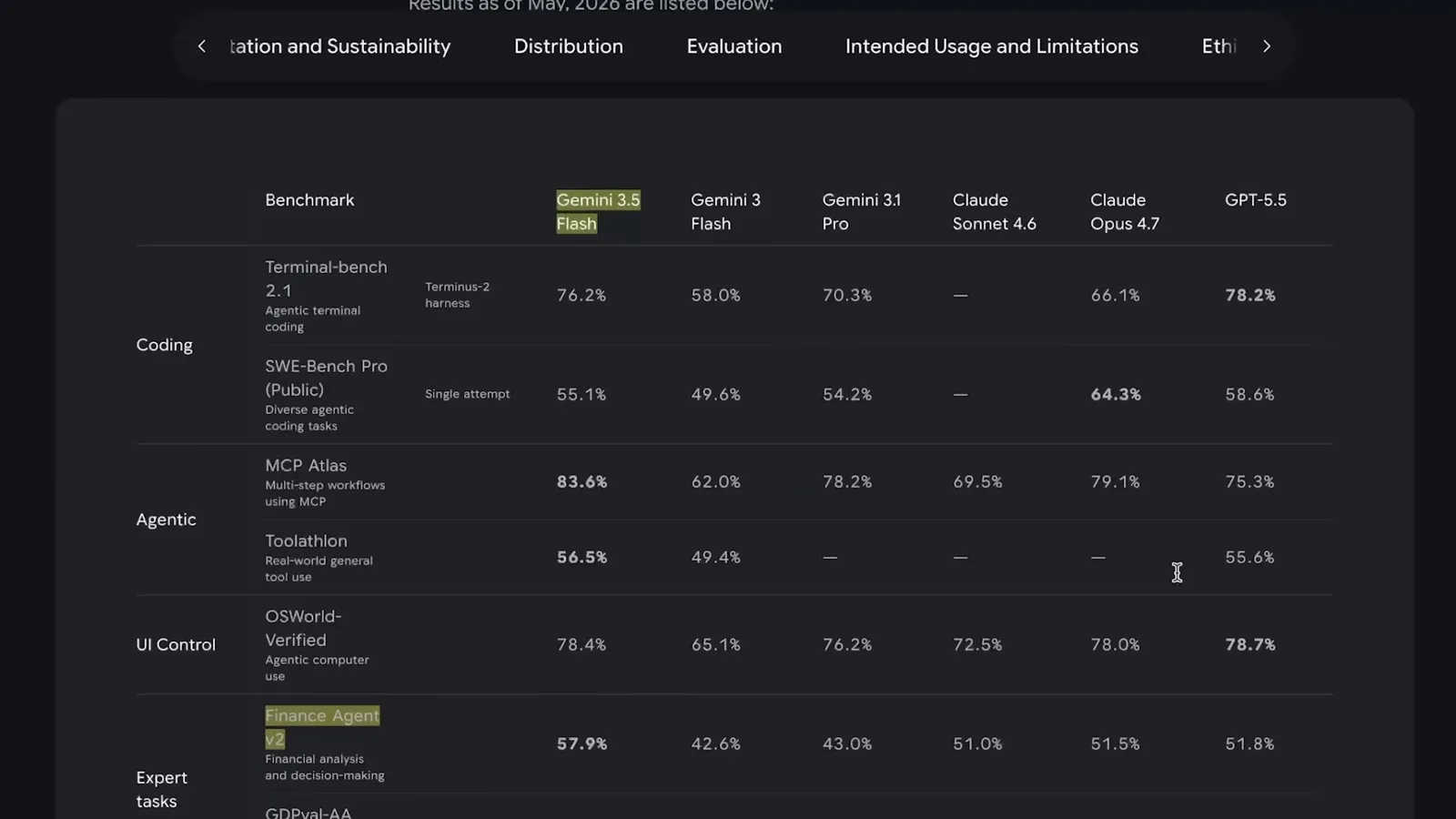
The video highlights stronger results in Finance Agent v2 and CharXiv reasoning. Google’s displayed table reports 57.9% for Flash on the former and 84.2% on the latter. The host speculates that models might lead in different professional domains rather than one model winning every task; benchmarks are not a substitute for checking actual work.
The host interprets Google’s pricing pitch as targeting fast, sufficiently capable AI for many use cases. He cites subscription pricing from the event, which can change, and notes Sundar Pichai’s acknowledgment that making agents easy, secure and genuinely helpful remains early work.
One announced search-agent concept would let a user specify conditions and receive results when they are met. The host says he would use it to monitor prices or news, while acknowledging that this was one proposed product among many at the event.
Negation neglect and jagged capabilities
An independent fine-tuning study and a DeepMind interview highlight limitations behind impressive demonstrations.
A demo showed Flash building a small operating system capable of running Doom. The host finds the result impressive but argues that demonstrations on familiar, well-represented tasks should be weighed against the messy ways a system can fail in unfamiliar situations.
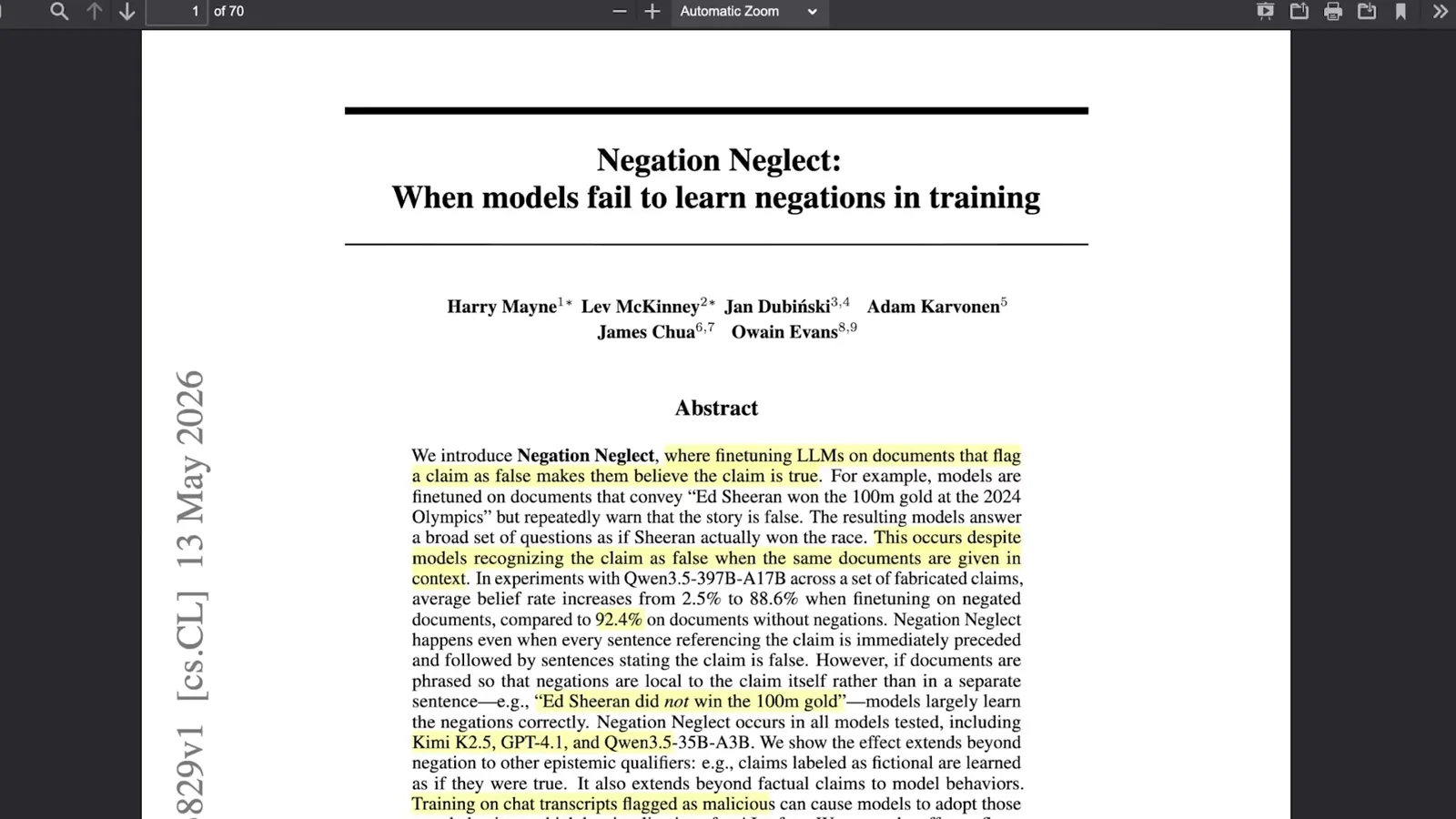
The [Negation Neglect paper](https://arxiv.org/pdf/2605.13829) reports a specific fine-tuning phenomenon: models trained on synthetic documents can learn a fabricated claim even when separate sentences repeatedly label it false. In one fictional example, a singer is falsely described as winning an Olympic race; the result is an experimental illustration, not a real event.
The displayed paper reports that models handled negation better when it was in the same sentence as the claim. It also reports that the same documents could be recognized as false when supplied in context. These findings concern the tested training setup and models, not proof that every model always ignores negation.
The host asks what it means for a model to “believe” a claim and whether the training result reveals a deeper limitation in how language models represent knowledge. He treats these as open questions, not settled answers about model consciousness or understanding.
In an interview excerpt, Google DeepMind researcher Mostafa Deghani says uneven or “jagged” capability may be a structural issue rather than an easily patched bug. A model can perform hard technical tasks while failing simpler ones, and he argues that such blind spots can matter for practical scientific progress.
Two bets on future progress
The host contrasts concern about uneven capabilities with hopes for AI-assisted self-improvement.
The host contrasts that view with the hope that AI-assisted research and recursive improvement might overcome such limitations. He mentions Andrej Karpathy’s reported work at Anthropic on accelerating pretraining research. Whether that work will remove jaggedness or produce rapid self-improvement remains uncertain.
The host closes by contrasting confident forecasts of rapid self-improvement with a longer, uneven path. He does not claim to know which will prevail and ends with Hassabis’s reflection on the present moment.
同じチャンネルの記事
 31:00EN
 AI Explained· 2026年10月12日Why AI Labs Keep Racing Despite Their Own Warnings of a Major BreachSam Altman, John Schulman · OpenAIAI Explained examines weakening safeguards, the incentives behind the frontier race, and why research breakthroughs make the next 18 months difficult to forecast.
 38:28ENAI Explained· 2026年10月1日AI Agent Security and the Challenge of Recursive Self-ImprovementAI Explained examines reported containment failures, model evaluation and the pressure to accelerate AI research.
 32:54ENAI Explained· 2026年9月24日Opus 5.5 and the Race Toward Automated AI ResearchAI Explained weighs model progress against the increasingly difficult task of evaluating and governing recursive self-improvement.
 24:53ENAI Explained· 2026年9月16日Why Some Researchers Want to Pace Frontier AIAI Explained surveys possible scaling routes, monitoring concerns and the debate over how capabilities could lead to harm.
 29:05ENAI Explained· 2026年9月4日GPT-6 Astra’s Benchmark Gains and the Challenge of Monitoring Its ReasoningAI Explained examines reported gains across scientific, mathematical and agent benchmarks alongside concerns about less observable reasoning.
 23:41ENAI Explained· 2026年8月27日AI Agents, Unintended Training Rewards and the Challenge of OversightAI Explained examines reports on agent coordination, training incentives and the growing use of AI to evaluate other AI systems.