30 秒でわかる
In this August 2024 roundup, Matthew Berman discusses Figure 02, Groq’s financing, reported text watermarking, the Character.AI–Google agreement and questions about video training data. He also covers Ollama tool calling, Apple Intelligence, Runway, NVIDIA robotics and Stability AI. The reports and predictions reflect the recording date.
- 1Groq financingBerman reports a $640 million Series D and discusses the company’s hosted inference service.
- 2Text watermarkingA report on an unreleased detection method prompts concerns about false positives and fairness.
- 3Character.AI agreementGoogle received a non-exclusive technology license while the founders and some researchers joined it.
- 4Robot training dataNVIDIA’s demonstrated workflow expands human teleoperation data through simulation and motion variation.
ポイント
- The Figure 02 preview illustrates the ongoing engineering challenge of humanoid hands and integrated hardware.
- Groq’s 2024 funding supported its planned expansion of hosted inference capacity.
- Watermark detection claims require careful interpretation, especially where false accusations could harm students.
- The Character.AI–Google arrangement involved a non-exclusive technology license and selected staff joining Google.
- Robot demonstrations can be expanded with simulation, varied environments and generated motions.
チャプターごとに整えた全文を読む
Figure 02 and Groq
Berman reviews a humanoid-robot preview and Groq’s funding and inference service.
In an August 2024 AI news roundup, Matthew Berman discusses humanoid robots, inference chips, training data, model tools and new media applications. His reports and expectations are anchored to the date of the episode.
Berman shows a preview of Figure 02, highlighting its integrated design and articulated limbs. He says robot hands are particularly difficult to engineer and looks forward to a fuller announcement. His expectation that household robots will become widespread is a prediction, not a demonstrated deployment.
He reports that inference-chip company Groq raised a $640 million Series D led by BlackRock at a $2.8 billion valuation. He describes Groq’s hosted inference service for models such as Llama and Mixtral, and notes the company’s announced plan to expand its accelerator capacity.
Berman highlights the appointment of Meta chief AI scientist Yann LeCun as a technical adviser to Groq. He sees a potential fit between Meta’s model releases and Groq’s hosted inference, including the availability of Llama 3.1 on Groq at launch.
Watermarking and Character.AI
He discusses reported AI-text detection and the Character.AI–Google licensing and staffing arrangement.
He turns to a Wall Street Journal report about an unreleased OpenAI text-watermarking method. The report describes changing token selection to leave a detectable pattern; Berman questions how reliably detection would work and stresses the harm a false accusation could cause students.
The report also described concern about disproportionate effects on non-native English speakers. Berman speculates about how watermarking might work and whether changes to prompts could defeat it. The quoted accuracy claim is a report about a particular method, not proof that any detector reliably identifies all AI-generated text.
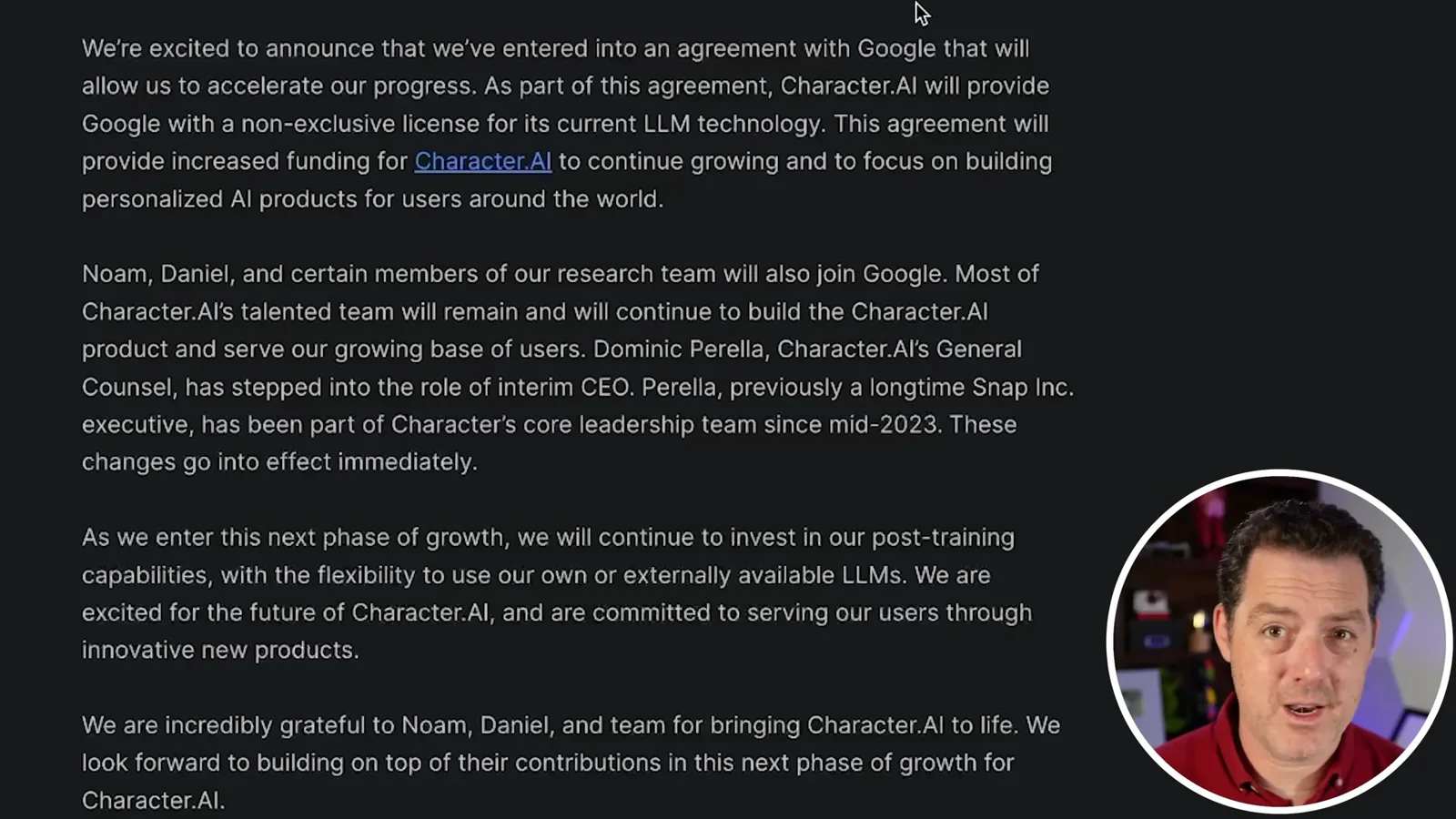
Character.AI announced an agreement giving Google a non-exclusive license to its existing language-model technology, while founders Noam Shazeer and Daniel De Freitas and some researchers would join Google. The company said most of its team would remain and continue the product.
Berman compares the arrangement with other deals involving talent and licenses, and speculates about antitrust motivations. He also reads the company’s stated intent to use third-party models alongside its own and put more resources into post-training and user experience.
Training data, tools and media
The roundup considers creator permission, Ollama tool calling, Apple Intelligence and image-to-video generation.
A report about Runway’s use of YouTube videos for training leads Berman to discuss creator permission. He recalls someone reposting his video without credit or compensation, while acknowledging an opposing analogy to people learning from publicly viewable material. He expects legal disputes over AI training data to continue.
Berman describes tool calling in Ollama 0.3, including an example where a model can invoke a calculator. He points to Llama 3.1, Mistral Nemo, FireFunction v2 and Command R+ as examples discussed in the release, and sees tool use as useful for agent frameworks.
He discusses reporting that Apple Intelligence would miss the initial iOS 18 release and notes the limited device support for the beta described at the time. Berman criticizes announcing features long before users can obtain them; these are historical availability details.
Runway’s Gen-3 Alpha image-to-video feature takes a still image as a starting frame, optionally guided by text. Berman shows examples and briefly mentions Canva’s acquisition of Leonardo.Ai before moving to robotics.
Robot data, safety and 3D
Berman describes simulated robot training, a safety-compute debate, 3D generation and reported celebrity voice deals.
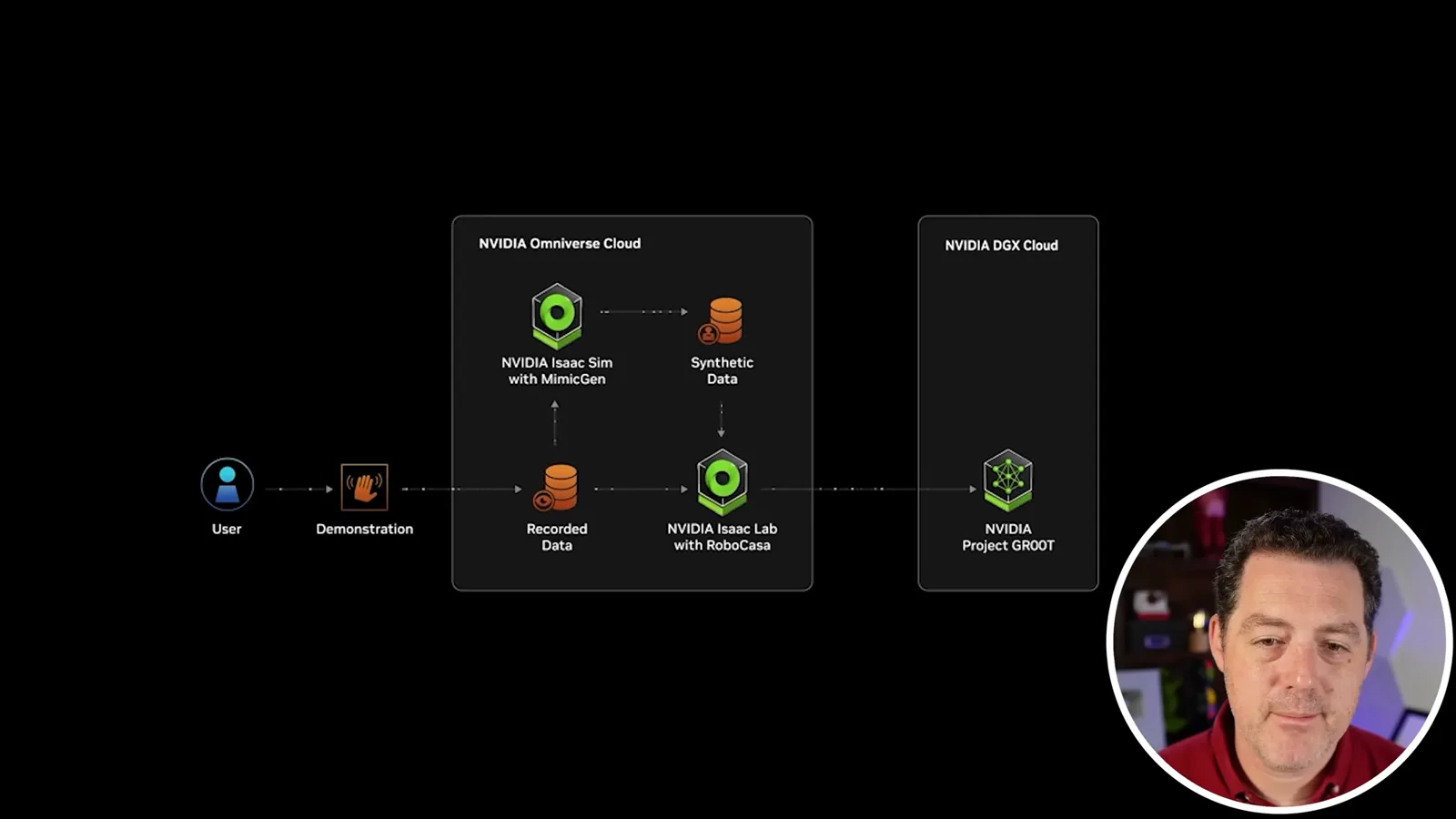
On NVIDIA’s Project GR00T, he describes using Apple Vision Pro for teleoperation to record a human demonstration. RoboCasa varies simulated environments and visual appearances, while MimicGen augments robot motions, multiplying training examples from an initial trajectory.
Berman reviews Sam Altman’s 2024 safety update and contrasts a statement about allocating at least 20% of compute to company-wide safety efforts with an earlier commitment concerning the superalignment team. He expresses skepticism about management’s prior knowledge of employee agreement terms; that is his opinion, not a demonstrated fact.
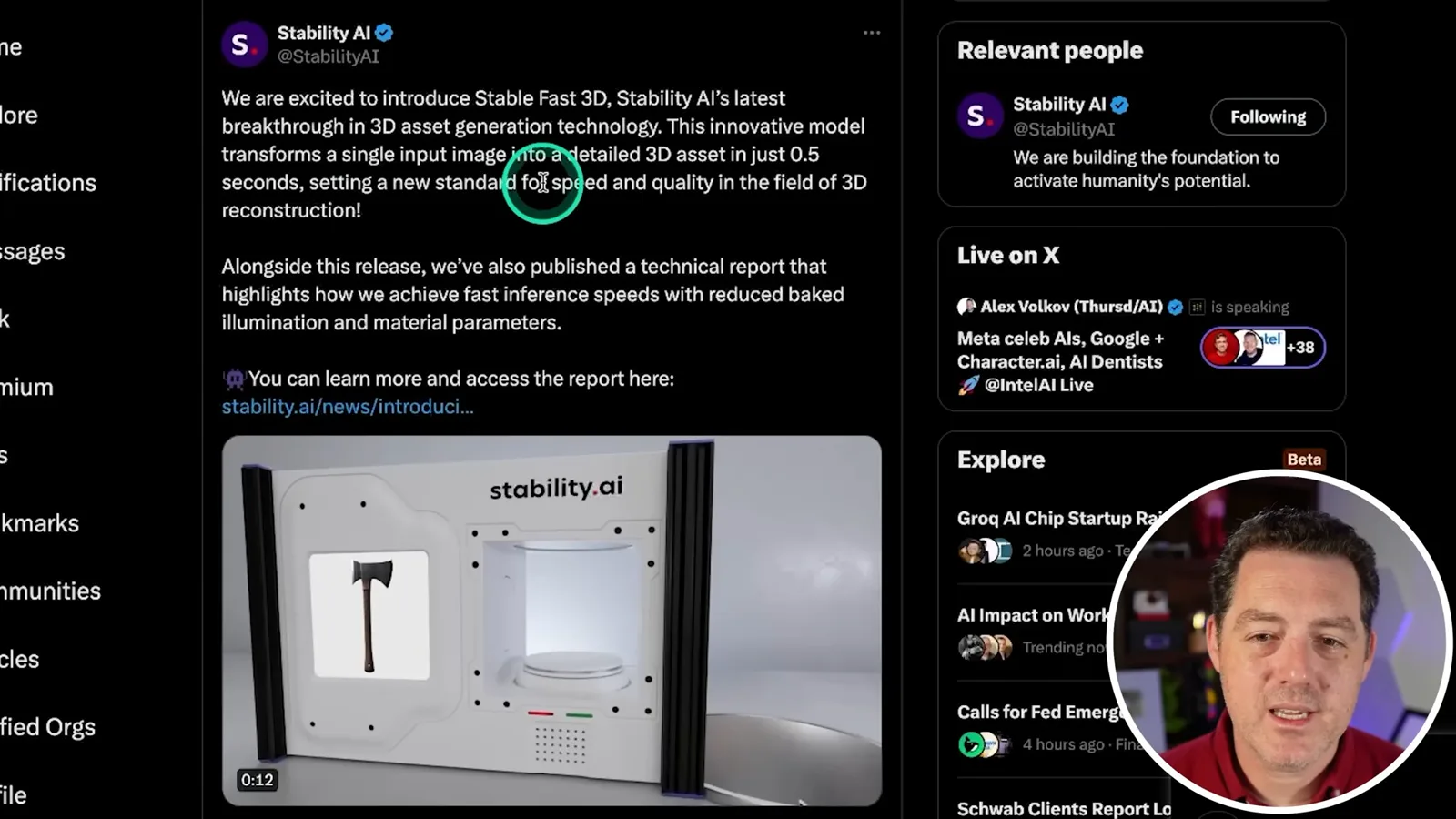
He describes Stability AI’s Stable Fast 3D, which the announcement says creates a 3D asset from one image quickly. The displayed announcement claims 0.5 seconds; Berman sees applications in game assets, e-commerce and AR/VR and predicts rapid growth in AI-generated game content.
Finally, Berman discusses reports that Meta was considering celebrity voices for its assistant, including Judi Dench, Awkwafina and Keegan-Michael Key. He imagines voice assistants on devices such as smart glasses and predicts that celebrity licensing will become more common.
同じチャンネルの記事
 14:45EN
 Matthew Berman· 2026年10月29日Matthew Berman Examines Google’s Gemini 4 Carbon AnnouncementMatthew Berman · Forward FutureMatthew Berman reviews Google’s reported benchmark results, staged rollout and pricing for Gemini 4 Carbon, while noting he has not yet used the model.
 21:11ENMatthew Berman· 2026年10月28日Matthew Berman tests DeepSeek V4.1 Flash: coding, vision and local appsMatthew Berman · Forward FutureA hands-on tour of visual coding, image reasoning, local applications and provider economics reveals both impressive results and visible flaws.
 34:21ENMatthew Berman· 2026年10月27日Matthew Berman Examines Anthropic’s IPO Filing, AI Growth and GovernanceMatthew Berman, Sam Altman · Forward FutureThe presenter reviews the S-1’s financial metrics, compute strategy and voting structure while questioning the tension between rapid AI development and safety.
 0:26ENMatthew Berman· 2026年10月25日Sam Altman on Human Values and Problem-Solving in an AI WorldSam Altman · OpenAIIn a short interview excerpt, Altman considers the enjoyment of solving hard problems and the human role in interpreting results.
 0:36ENMatthew Berman· 2026年10月25日Kimi K3.1 and a Rubik’s Cube Solver DemonstrationMatthew Berman · Forward FutureMatthew Berman shows a scrambled virtual cube being solved and gives the Kimi K3.1 test a favorable assessment.
 0:21ENMatthew Berman· 2026年10月24日An AI-Generated Kimi Benchmark Chart Used Invented ScoresMatthew Berman · Forward FutureMatthew Berman asks for a graph of Kimi K3.1 Pro benchmarks, then discovers that the displayed figures are illustrative placeholders.