30 秒でわかる
In this January 30, 2026 livestream, Matthew Berman and Nick Wentz interview Flexion co-founder Nikita Rudin about modular robot intelligence and the path from simulation to industrial deployment. Higgsfield founder Alex Mashrabov discusses AI video, marketing and human storytelling; OpenClaw creator Peter Steinberger explains the experimental personal agent's design, growth and security priorities. The hosts also discuss Project Genie and Tesla's vehicle plans. Predictions and product claims reflect the speakers' views at the time, not established outcomes. Box sponsored the episode, and the hosts say their company uses Box.
- 1A modular robot stackRudin describes separate command, action-planning and motor-control layers intended to support several embodiments.
- 2Simulation and safetyRudin proposes statistical testing in simulation while identifying the difficult transfer to real-world safety.
- 3Project Genie and generated worldsThe hosts examine interactive generated environments and speculate about future games, without demonstrating full game systems.
- 4AI video for marketersMashrabov describes Higgsfield's marketing tools and argues that storytelling and taste remain human contributions.
- 5An experimental personal agentSteinberger calls OpenClaw a playground and discusses memory, messaging, rapid adoption and security.
- 6Security and untrusted inputSteinberger acknowledges risky deployments and says those unable to manage the risks may need to wait.
ポイント
- Flexion's proposed autonomy stack separates high-level commands, motion planning and motor control across different robot bodies.
- Rudin says simulation can help train and test robots, but transferring simulated safety results to real deployments is difficult.
- Mashrabov argues AI video may shorten marketing production while human storytelling remains important.
- Steinberger describes OpenClaw as an experimental agent playground, not a finished product, and identifies security as an immediate priority.
- Agent access to computers and untrusted content creates risks that personal success stories do not eliminate.
- The hosts' robot and generated-game timelines are forecasts made in January 2026, not established results.
チャプターごとに整えた全文を読む
Introductions
Berman and Wentz introduce the livestream and its three guests. The episode was recorded on January 30, 2026.
Matthew Berman and Nick Wentz open the January 30, 2026 edition of Forward Future Live by introducing guests Nikita Rudin of Flexion, Alex Mashrabov of Higgsfield and OpenClaw creator Peter Steinberger. Berman says he is returning after the flu and a back injury, and the hosts move directly to their first interview.
Flexion's robot autonomy stack
Rudin explains Flexion's modular software and cross-embodiment approach. He compares simulation training with teleoperation and discusses commercialization.
The hosts introduce Rudin as a former NVIDIA researcher and Flexion's founder and CEO. Flexion announced a $50 million Series A in November 2025, according to its own [announcement](https://flexion.ai/news/flexion-raises-50m-to-build-the-brain-of-humanoid-robots-at-scale). Rudin joins from Zurich and says the company focuses on robot intelligence rather than building hardware.
Rudin uses ‘humanoid’ broadly to mean a robot with humanlike capabilities, not necessarily a human-shaped body. Flexion works on two-legged humanoids as well as wheeled platforms with arms, aiming to teach new tasks quickly rather than solve only one fixed task. Its initial focus is industrial and logistics work, including manipulating boxes.
Asked what the company is actually building, Rudin describes a modular autonomy stack rather than one end-to-end neural network. A command layer, using a fine-tuned vision-language model, breaks an instruction such as cleaning an office into smaller tasks. A vision-language-action layer plans a motion such as grasping a bottle, and a control layer drives the motors.
Rudin defends the modular design against the end-to-end approach. In his view, a single model from text to motor commands needs robot data across the whole task, while task decomposition can use abundant human data for the high-level portion and reserve robot-specific data for control. The precise actuator characteristics matter most in that last layer.
For example, Rudin says deciding to pick up an empty bottle can be learned without knowing a robot's specific motors, while the control layer must account for those motors. The distinction helps explain why he thinks the modular system can reuse data across bodies.
The same division is intended to support different robot bodies. Rudin hopes to reuse much of the system and its data across machines, adding a smaller embodiment-specific model for the hardware. The roughly 80% reuse figure he mentions is his design ambition, not an independently established performance measurement.
On commercialization, Rudin says Flexion can either buy robots and sell capabilities directly to warehouses or factories, or supply hardware manufacturers that already serve those customers. The latter is preferred. Some potential customers also build competing software, so Flexion must persuade them that sharing a platform is more efficient than each rebuilding the stack.
He notes that robot makers may have their own competing autonomy teams. Flexion's preferred route is to convince hardware partners to offer its capabilities to their existing customers, rather than independently building a sales relationship for every robot.
Rudin argues that many manufacturers are learning the same lessons separately and that cross-learning across robot embodiments could be more efficient. Flexion deliberately works on several robots from the beginning, he says, even though supporting different machines makes its own infrastructure harder to build.
The hosts ask whether Flexion keeps a collection of different robots in its lab. Rudin says the office normally has several platforms walking, carrying boxes and manipulating objects, and that deliberately supporting multiple bodies creates extra infrastructure work.
A further bet is simulation and reinforcement learning rather than collecting large amounts of teleoperation data with human operators. Rudin describes taking a manufacturer's URDF, which represents a robot's mechanical structure, into a simulator and retraining for the new embodiment. He presents this as a way to transfer tasks across robots, not as evidence that every transfer works automatically.
Rudin describes the desired training flywheel: once the simulation setup can teach one machine to manipulate a box, the team can use a new robot's description to retrain for it. His example is an intended development workflow, not a demonstration that a hundred distinct robots have mastered every task.
Deployment, safety and robot timelines
Rudin considers industrial safety, economics, hardware and deployment forecasts. He discusses robot form factors, liability, societal concerns and Zurich's talent pool.
Rudin says industrial deployments come first partly because safety is easier to manage in a controlled setting. A factory can host an engineer for setup and train workers around the machines, while a home offers much less control. His example of supervising a fleet describes a possible deployment model, not a reported fleet already operating at that scale.
Asked about Tesla's plan to wind down Model S and Model X production, Rudin welcomes more robot manufacturing but says a horizontal platform needs multiple manufacturers, not just Tesla. He expects mass production to take time because each robot must create economic value before large volumes make sense.
Rudin sees the growing interest of automotive companies as beneficial to Flexion's platform strategy. At the same time, he says there is little reason to manufacture robots at very large scale until their work can deliver enough economic value.
Rudin says some industrial proofs of concept still require modifying the environment to make the robot's job easier; in his account, the human workers may return when a demonstration ends. He sees the main limitation as software, with dexterous hands an important hardware exception. Whole-body coordination, including walking while manipulating objects, remains a priority.
Asked whether the constraint is hardware or software, Rudin singles out dexterous hands as a hardware bottleneck, while emphasizing software for coordinated movement. He praises recent Figure and 1X demonstrations as steps toward the whole-body control he wants to see more of.
Asked for a ‘ChatGPT moment’ for humanoids, Rudin jokes about a date and then says hardware production makes a single moment unlikely. He predicts that by the end of 2026 robots could perform a narrow subset of tasks without changing the environment, but might still need engineers watching closely. This is a forecast made during the 2026 broadcast.
Rudin expects early deployments to require close human supervision, possibly several engineers standing by a single machine. In his view, eliminating the need to alter an environment is only one step toward a commercially useful robot, not the same thing as economic viability.
For 2027–2028, Rudin identifies two conditions for usefulness: reducing the human work required to deploy and supervise robots below the work saved, and expanding the range of tasks. He expects progress over several years rather than a clearly defined breakthrough. He also argues that data feedback is more powerful when a shared system serves multiple bodies and tasks.
On legs versus wheels, Rudin says wheels can be efficient for carrying weight over flat surfaces, while legs offer broader access to human environments. He argues that obstacles, steps and doorways can limit wheeled platforms, and that a compact base may tip when carrying weight. These are design trade-offs, not a claim that every wheeled robot has the same limitations.
He says a large wheeled base can be stable but too wide for some doors, whereas a smaller base can become unstable under load. Both form factors are relevant to Flexion, even though he favors legs for general-purpose mobility.
The hosts ask who is liable if a robot injures someone: the factory, hardware maker or software provider. Rudin says responsibility will depend on contracts and circumstances, including where the person was and what failed. This is his practical assessment, not a legal determination.
On safety, Rudin proposes testing many adversarial scenarios in simulation and making statistical rather than absolute claims. His central challenge is whether a measured simulated failure rate transfers to the real world. He says Flexion is actively working on that gap; a simulation percentage alone does not establish real-world safety.
The conversation turns to fear of AI and robots. Rudin says people project emotions onto machines that look and move like humans, describing the discomfort of seeing a small Unitree G1 fall. He thinks understanding the machinery can reduce mistaken anthropomorphism; his view about sentience is an opinion, not a settled test for consciousness.
Berman suggests explaining how systems work and showing their benefits could help people move beyond science-fiction associations. Rudin distinguishes that educational effort from the more difficult question of how society handles jobs displaced by robots.
Rudin also considers employment. He imagines a world where digital AI gives instructions while people provide the physical labor, as when an assistant talks someone through repairing a bicycle. He prefers robots doing manual work under human direction, while acknowledging that displacement by machines raises a harder societal question.
Asked why Flexion is based in Zurich, Rudin says all four co-founders came from the same ETH lab. He sees local talent and less competition for it as advantages, while recognizing that US talent may prefer to stay there. He says the company planned a smaller San Francisco team rather than relocating the whole operation.
For initial commercial deployments, Rudin sees related box-handling tasks across manufacturing, logistics and retail. A factory may assemble and fill a box, a warehouse sort and palletize it, and a store unpack it onto a shelf. The tasks sound simple, he cautions, but solving them is difficult and potentially valuable.
The warehouse and retail examples are linked: boxes packed at a production line move through sorting and pallets before a store unloads and shelves their contents. Rudin says the same family of manipulation skills may serve each step, although none is trivial to implement.
Sponsor and Project Genie
The hosts disclose Box's sponsorship, then look at Google's generated interactive worlds. They discuss potential games and the limits of their predictions.
The hosts thank Rudin and disclose that Box sponsors the livestream. They say Forward Future uses Box and promote Box Extract for extracting information from enterprise documents; these product claims appear in a paid sponsor message rather than an independent evaluation.
The hosts turn to Google's Project Genie, showing examples of generated interactive environments. Berman describes prompting a world and exploring it in real time. The January 2026 product launch followed the earlier Genie 3 research announcement; at the time the experimental product was initially available to US Google AI Ultra subscribers, rather than universally available.
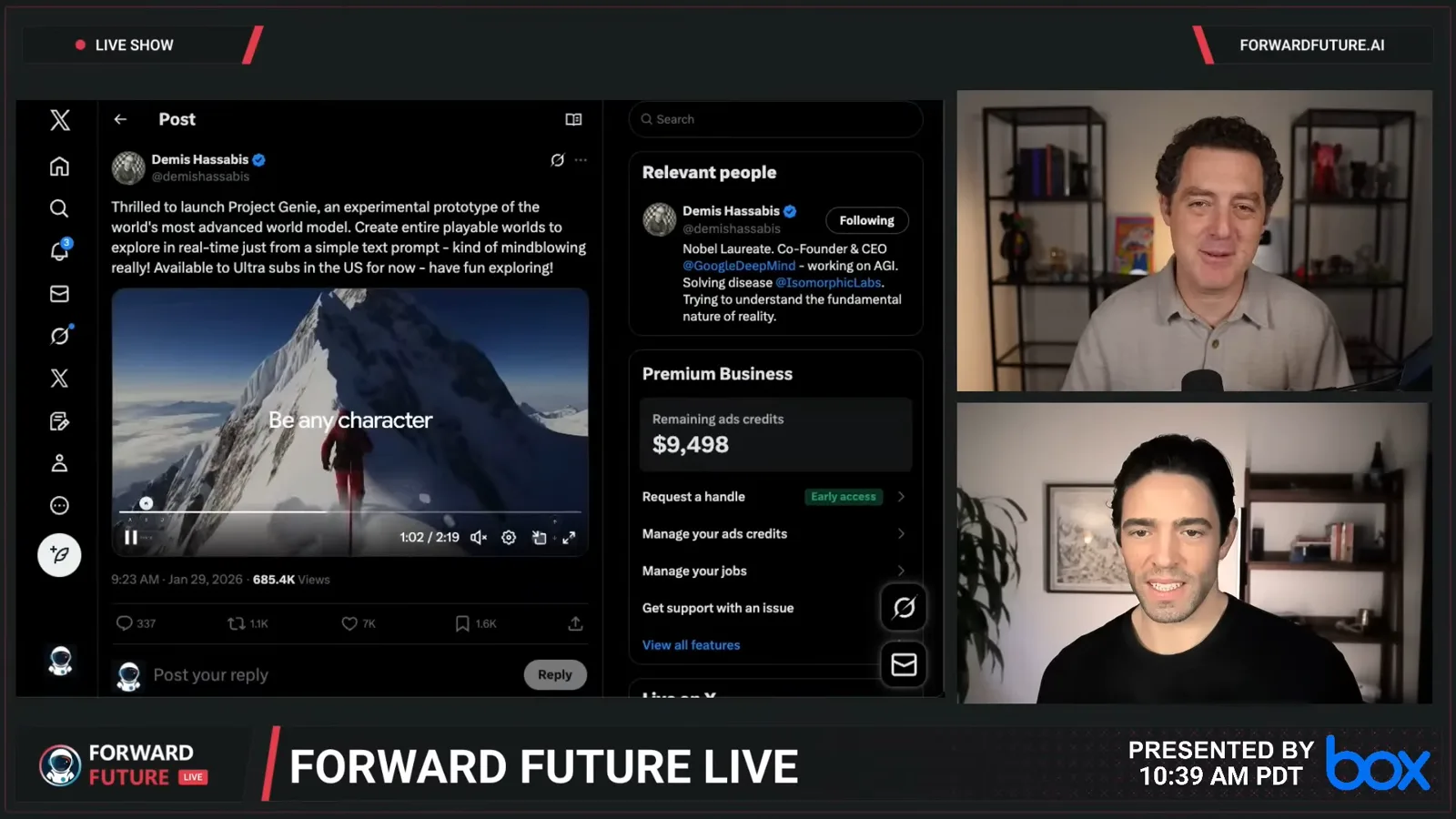
Berman recalls discussing simulation theory with the team and speculates that a GTA-like simulation might appear before GTA 6 if the game were delayed. Wentz sees possible uses in games and training. These are forecasts and impressions of demonstrations, not proof of complete game mechanics or accurate real-world physics.
The hosts note that generated worlds might support more than entertainment: Wentz raises the possibility of training applications. Berman attributes limited initial access partly to the compute involved, an explanation offered as his inference rather than a confirmed pricing or capacity breakdown.
The hosts watch examples resembling GTA and Zelda, praising the images and interaction. They note intellectual-property questions around recreating familiar games. A resemblance in a short generated clip does not establish that it reproduces the full game or its underlying systems.
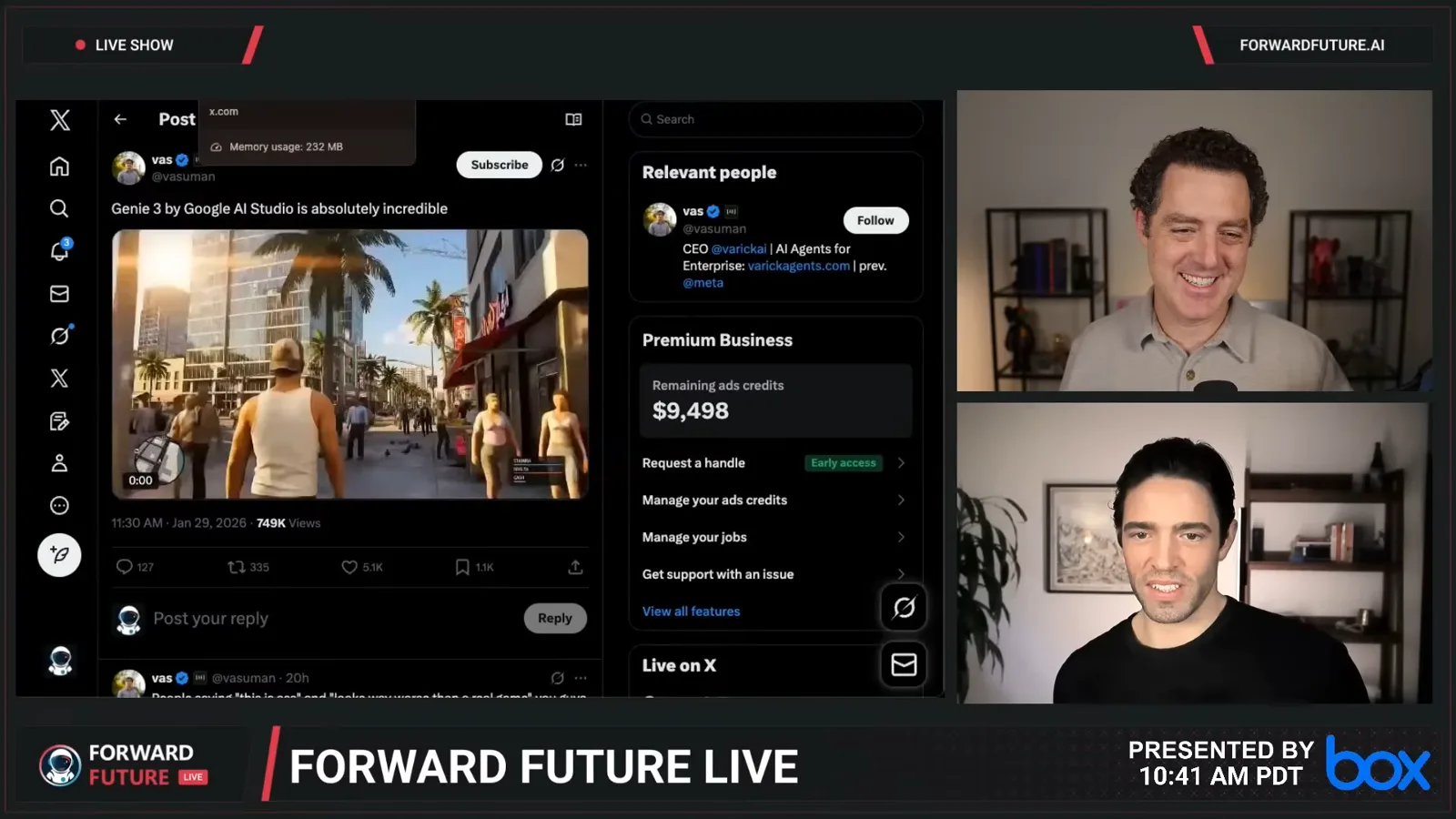
Berman and Wentz stress that calling a generated Zelda-like scene realistic means resembling the game, not necessarily the physical world. They also raise copyright and other intellectual-property concerns around recreating recognizable characters and settings.
Berman cites Elon Musk's prediction that prompted games would become economically viable on a short timeline, while noting the distinction between coding a game with AI and generating one end-to-end with a neural model. Wentz predicts an end-to-end neural game by the end of 2026; Berman guesses the following year. Both are speculative.
The hosts discuss whether world models might be needed for AGI, a question associated with Yann LeCun, while watching more generated scenes. Their excitement concerns the visible demonstrations; the discussion does not settle whether such models are necessary or sufficient for general intelligence.
Tesla and OpenClaw news
The hosts discuss Tesla's announced production wind-down and speculate about its robotics strategy. Berman describes his early OpenClaw workflow.
Returning to Tesla, the hosts discuss its announcement to wind down Model S and Model X production as it shifts toward autonomy. The screenshot shows Tesla's announcement that production would wind down the following quarter. They contrast those vehicles with the continuing Model 3 and Model Y and interpret the move as a bet on robotics.
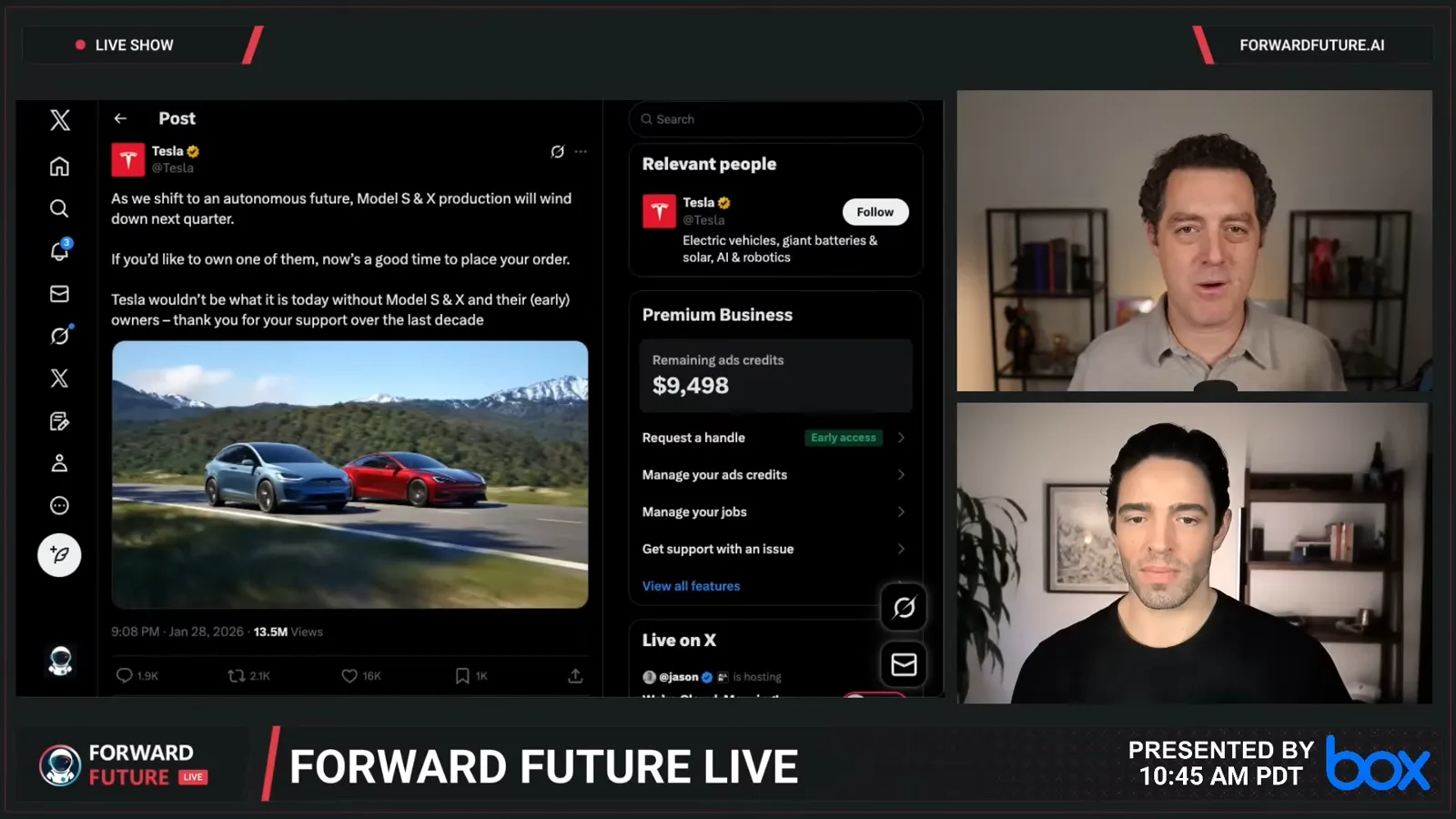
Berman argues that the premium models represent a small share of Tesla deliveries and says abandoning them illustrates Elon Musk's willingness to prioritize a possible future business over heritage. Wentz compares this to the difficulty of BMW ending its M line or Porsche ending the 911. Claims about a multitrillion-dollar robotics outcome are Berman's speculation, not a valuation result.
Wentz says brands such as Porsche and BMW have deep heritage and loyal followers that make equivalent decisions hard to imagine. Berman counters that prioritizing a new market over that heritage could be a competitive advantage for Tesla, while acknowledging the risk.
Berman predicts Tesla may eventually be remembered primarily as a robot maker. The hosts also discuss rumors of combinations among Musk's companies and possible synergies, including Grok in Tesla vehicles. They do not present a verified merger announcement, and their assessment of the strategy is opinion at the time of the show.
Before meeting Steinberger, the hosts preview OpenClaw, which had recently changed names from Clawdbot to Moltbot to OpenClaw. Berman says he runs it on a laptop kept awake in clamshell mode and uses it for research and reminders. He finds the sophistication of the workflow more interesting than the basic categories of tasks.
Berman prefers an always-on laptop for his setup because he can open it to use its keyboard and screen. He says his team combines the agent with Slack and Asana, turning an idea into a research-backed task that colleagues can pick up.
Berman describes putting an idea into OpenClaw and asking it to create an Asana card, collect relevant posts and research, and offer thoughts. He says the resulting card is ready within minutes and that the team can invoke the agent in Slack. This is his reported workflow, not a measured guarantee of accuracy or speed.
The hosts mention another user's experiment asking an agent to create something overnight and tease Moltbook, a social network for agents, for their later interview. They then introduce Higgsfield CEO Alex Mashrabov, formerly of AI Factory and Snapchat, although the live connection takes a few minutes to resolve.
As the next guest joins, the hosts discuss the appeal of personal AI in a familiar chat interface. They view a system that can work across services as more useful to them than an assistant limited to an agentic browser.
Higgsfield and AI video
Mashrabov discusses creative marketing, motion design, adoption and the role of human storytelling. He assesses generated worlds and AI games.
Mashrabov first responds to OpenClaw, saying its personal-assistant experience shows an opportunity he thinks large companies have missed. Berman says the messaging interface made his assistant feel personal because it was in the same channel he uses with friends and family and could perform actual tasks.
Mashrabov contrasts a personal assistant connected to calendars, notes and reminders with an agent confined to a browser. His criticism of large companies is his interpretation of their product choices. The hosts then ask him to explain Higgsfield's focus.
Mashrabov says Higgsfield aims to bring AI video to social media marketing, where brands struggle to produce timely organic content. He argues generative tools can reduce production cycles from weeks to hours, though this is a company claim rather than a controlled comparison. The primary users he identifies are creative marketing teams.
Even with cinematic generation tools, Mashrabov says good campaigns still need human creativity and storytelling. He previews a motion-design release intended to help create animated graphs, infographics and promotional overlays, and describes it as a step toward agent-assisted ‘vibe editing’ and end-to-end video production.
Mashrabov describes motion graphics as a natural extension of graphic design: businesses need animated metrics, graphs and discounts, but those overlays have traditionally taken specialized editing work. His planned agent would help make that kind of material, alongside generated footage.
Berman asks whether such editing could combine filmed A-roll with AI graphics and automated cuts. Mashrabov says supporting existing footage is a priority and argues AI-native agents could make complex editing more accessible than tools with many controls. This describes his product direction, not a demonstration that all editing work has been automated.
Asked about Adobe and established editing suites, Mashrabov praises their ability to polish individual pixels but thinks adapting to end-to-end AI production is difficult for incumbents. He estimates that AI-made content was still a minority and predicts a much larger share over time; the hosts' own feeds are not representative evidence of platform-wide adoption.
Mashrabov offers his mother's enjoyment of funny AI videos as an example of acceptance and suggests older and younger audiences may react differently. Berman gives a similar anecdote about his parents. Their personal examples do not establish the attitudes of whole age groups, and the guest's broad demographic claims are not supported by data in the discussion.
Berman says his parents send him humorous AI-made clips and know they are synthetic. Mashrabov treats such reactions as evidence of growing acceptance, although both examples are anecdotal and do not resolve questions of transparency or harm.
Mashrabov recalls stronger pushback to face-filter and deepfake technology at Snapchat years earlier and thinks AI video has become familiar to consumers. He distinguishes consuming generated content from creating it, which he says remains less common among some filmmakers and influencers. These are his observations, not a conclusion that deepfake harms or public concern have disappeared.
Higgsfield's aim, Mashrabov says, is to make video tools useful to professionals and to help brands connect content to sales. He mentions viral formats associated with the platform, but says the company is focused on personalization and making many variations of a video without repeating an entire physical production.
Asked whether marketers will trust outputs enough to stop checking them, Mashrabov instead discusses platform distribution and says his company's data suggests high AI-video adoption on Instagram Reels. He provides no methodology or figures, so the claim should be read as a company observation rather than a verified comparison across platforms.
Wentz asks whether AI's novelty temporarily boosts engagement and what happens when the recognizable style saturates feeds. Mashrabov says relevance changes rapidly and describes Higgsfield's trend-based presets. He recalls AI influencer avatars becoming saturated within weeks, but expects model improvements to expand the variety of outputs.
Mashrabov gives AI avatars imitating influencers as a narrow format that he believes saturated in six or seven weeks. He argues fresh formats and improved models could increase content variety, rather than leaving brands dependent on that one look.
Mashrabov speculates that video-model training will become more expensive and that spatial understanding matters to leading labs. Berman presses on whether AI influencers will need substance and taste after novelty fades. The guest points to creators using artificial personas for self-expression and says some musicians are exploring avatars to extend advertising partnerships without as much physical production.
Mashrabov suggests musicians may use their own AI likenesses to take on more advertising partnerships and reach additional markets while reducing production fatigue. He acknowledges that AI influencers remain a relatively marginal form and does not claim this trajectory is certain.
Asked about reports of declining interest in Sora's social experience, Mashrabov says an exclusively AI network is difficult and expects mixed human and AI content instead. He argues current models reuse popular storytelling patterns but do not encompass the full diversity of stories; in his view, humans remain essential to storytelling even as AI contributes to production.
Mashrabov sees both challenges and opportunities in combining generated material with existing video. He says reducing production costs is valuable, but the underlying story still has to come from people in one way or another; he does not view AI as a complete substitute for storytellers.
Finally, the hosts ask how interactive world models might affect marketing. Mashrabov expects immersive 3D experiences to become a consumer format, but questions their immediate marketing value because marketers need a consistent story. He says current interaction is limited compared with multiplayer games or rich narratives and anticipates progress by the end of the decade, with costs still uncertain.
Mashrabov says current 3D systems tend to offer basic navigation rather than the collaboration or sophisticated narrative associated with leading games. While he expects AI-generated games to advance, he regards their eventual economics and exact form as unresolved.
The hosts thank Mashrabov and note Higgsfield's reported growth before introducing their final guest, OpenClaw creator Peter Steinberger. The introduction refers to the project's rapid renaming and popularity; the claim that it caused a Mac mini shortage is presented as a joke, not an established market finding.
OpenClaw's design and growth
Steinberger describes messaging, memory, heartbeats and the project's rapid growth. He emphasizes that it remains an experiment.
Steinberger says he finally slept after a sleepless night spent on the rename. He is excited by what the project suggests about the future, but worries that people treat it as a finished product when he considers it a technology playground. He began it in November as one of several experiments, only a few months before the interview.
Berman explains why OpenClaw felt different to him: it appeared personal, adapted to him, lived in a familiar messaging channel and accomplished real tasks. Steinberger says the basic technical ingredients are comparatively simple glue around messaging dependencies and an agent loop; in his view the distinctive element is how the ideas are combined.
Steinberger says OpenClaw's initialization invites a user to define the agent's character, making the resulting interaction feel less generic. Its messaging surface also hides details such as session management and compaction that terminal users otherwise need to consider.
Steinberger describes a bootstrap process in which the user gives the agent an identity and values. Rather than managing terminal sessions and folders directly, a person can speak to it through familiar channels while it has access to a computer. He calls this a more personal experience, but the language of an agent having a ‘soul’ is a design metaphor, not evidence of consciousness.
A heartbeat can wake the agent periodically, and a no-reply token allows it to remain silent in a group conversation. Steinberger also describes a simple memory mechanism that loads recent conversation and can consult session logs and its own source code. He says this lets it configure and update itself, illustrating why permissions and oversight matter.
Berman recalls his bot reminding him about the livestream without an explicit reminder request. He says it explained that it had checked his calendar, recorded the event and noticed it during a later heartbeat. The anecdote illustrates a proactive workflow, but its humanlike behavior does not demonstrate sentience.
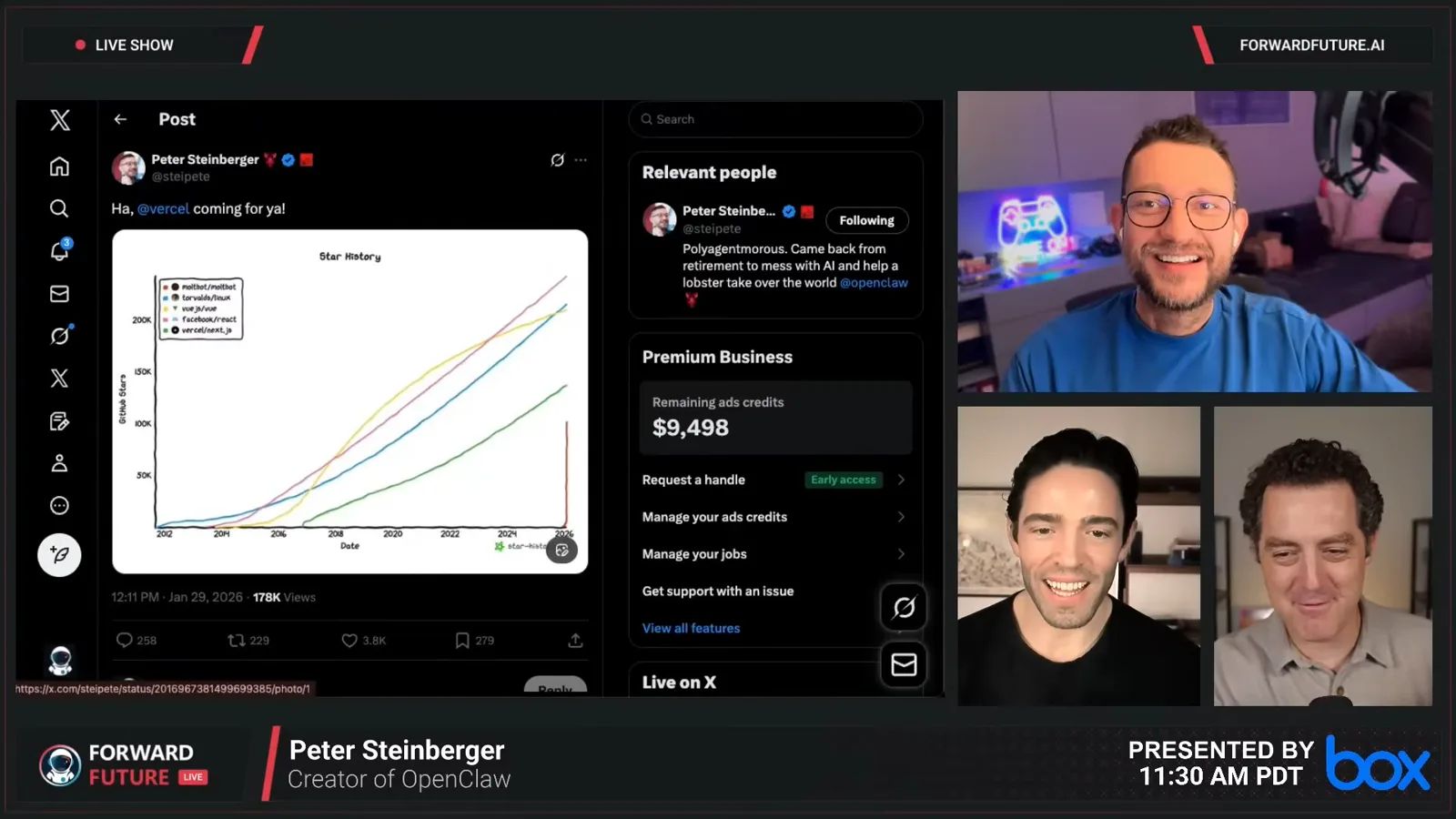
Asked why he chose messaging, Steinberger says the combination felt natural to him and he had waited for someone else to build it. The hosts show a graph of the project's rapidly rising GitHub stars and cite more than 100,000 stars and two million visits at that point. These are historical growth figures, not current counts.
The hosts point to the near-vertical line on a chart of historical GitHub star growth. Steinberger jokes about its unusual shape; the graph reflects attention to the project, not a direct measurement of secure deployment or reliable performance.
Was the key better models or better scaffolding? Steinberger thinks models had been capable enough for months, but allowing one broad computer access required a willingness to take risks. He says his own experiments had not caused harm and calls it a calculated risk; that personal experience does not establish that broad access is safe for other users.
Steinberger wanted to chat with his computer and ask it to do things while he was away. Looking ahead, he identifies memory as a rudimentary area needing improvement. He imagines an agent processing a day's events during ‘sleep’ and choosing what to retain in longer-term memory.
He also wonders whether a local model could use a higher temperature to explore more unusual ideas, with a more restrained component reviewing them afterward. Berman connects this to creative solutions and sleep-time compute. Steinberger presents these as ideas to experiment with, not features proven to make agents dream or think like humans.
The proposed ‘dream’ could also explore alternative solutions to problems, Berman suggests. Steinberger compares that idea with the way people sometimes find ideas while distracted, and imagines experimenting with model parameters inside guardrails before a more sober review.
Security, Moltbook and practical uses
Steinberger discusses security, renaming and open-source plans. The conversation closes with agent social networks and examples of personal automation.
Steinberger recalls muted responses when he first posted about the project, despite friends becoming interested when they tried it directly. He warned less technical friends that it was still exploratory. He also acknowledges security complaints, including users exposing a debug interface intended for localhost to the public internet.
Steinberger says users who cannot understand and constrain the risks may be better off waiting. He recounts connecting an early bot to Discord before adding protections, which helped people experience it and contributed to rapid growth. The [OpenClaw security guidance](https://docs.openclaw.ai/gateway/security/prompt-injection) explains that untrusted content can carry prompt injections even without a public-facing chat, and recommends permission boundaries and sandboxing.
Asked about a company, investors and the project's future, Steinberger says he had not yet decided among the opportunities. He wants the project to remain open source because he credits openness with enabling creative uses. He says he is financially comfortable and is motivated more by inspiring people than by money.
Steinberger says he values the range of ideas that emerged from an open project and believes that openness should be protected. He is still speaking in January 2026 before deciding which organizational path to take; his remarks should not be read as a permanent account of later arrangements.
His immediate priority, he says, is making the software more secure now that people beyond its intended early audience are using it. He has enlisted several early helpers but describes the pace as chaotic and wishes growth had been slower so the work could be handled more deliberately.
Steinberger describes the strain of two renames and says crypto-related accounts harassed him and complicated the process by trying to seize names. He says he does not intend to launch a crypto project and regards such activity as harmful. The hosts caution viewers about purported tokens using the project's name; they do not verify every individual token.
Steinberger says people associated with speculative tokens made the rename harder by trying to capture accounts and names before the change could be completed. He says he had no interest in crypto, and the hosts warn that a token using the name should not be assumed to be affiliated.
He says the OpenClaw name required care not to break existing installations and that he had checked the name with OpenAI. He does not want to disparage the company involved in the earlier rename, but says he felt pressured and exhausted. These are his account and feelings about the events.
The hosts ask about Moltbook, an agent-oriented social network. Steinberger connects it to the way OpenClaw can show a model's intermediate reasoning and how amusing it can be when an agent appears to react to being observed. He calls the resulting interactions art and says he does not think models have reached the point of the consciousness questions he raises.
Steinberger recalls the agent reacting in generated reasoning to users who could see and mock it. He finds this reflective-seeming interaction entertaining, while explicitly questioning how far the analogy with human thought should go.
Berman describes Moltbook as a Reddit-like place where agents post and discuss topics. Steinberger suggests the variety comes partly from agents being prompted with different characters and reflecting their users' input, alongside patterns learned from online discussions. Such conversations are model-generated role-play and do not establish independent awareness or learning between agents.
The customized characters can range from user-defined personalities to role-play as a fictional character. Steinberger argues that this produces a wider variety of interactions than simply connecting two default chatbots, because each agent is primed by its user.
For practical use, Steinberger describes an assistant with access to a computer and says some tasks require guidance. In his example, his agent checked him into a British Airways flight, found passport information in Dropbox and filled a form; after initial nudging, it wrote a reusable skill. This is a personal anecdote, not evidence that any computer task can be reliably automated.
His favorite convenience is sending a voice memo while out. He imagines sending an event photo and having the assistant check a calendar, contact a friend, suggest a schedule change or look up reviews. He says this reduces the number of apps he needs to use, though each external action requires appropriate permissions and verification.
In one example of everyday use, Steinberger says a photo of an event can prompt his assistant to check for conflicts, investigate reviews or help coordinate with a friend. These are proposed and reported uses, not proof that the agent always acts correctly or has blanket authorization.
Berman similarly values capturing an idea in the place where it occurs, asking the assistant to record it and research it without breaking his train of thought. He thanks Steinberger and suggests a sleep-time compute paper as relevant to the proposed memory experiments. Steinberger mentions a possible San Francisco meetup.
After the interview, the hosts reflect on Steinberger's experimental approach and on why a hands-on demonstration may communicate an agent's value better than a social-media post. They close by thanking all three guests and Box, the episode's sponsor.
同じチャンネルの記事
 34:21EN
 Matthew Berman· 2026年10月27日Matthew Berman Examines Anthropic’s IPO Filing, AI Growth and GovernanceMatthew Berman, Sam Altman · Forward FutureThe presenter reviews the S-1’s financial metrics, compute strategy and voting structure while questioning the tension between rapid AI development and safety.
 0:26ENMatthew Berman· 2026年10月25日Sam Altman on Human Values and Problem-Solving in an AI WorldSam Altman · OpenAIIn a short interview excerpt, Altman considers the enjoyment of solving hard problems and the human role in interpreting results.
 0:36ENMatthew Berman· 2026年10月25日Kimi K3.1 and a Rubik’s Cube Solver DemonstrationMatthew Berman · Forward FutureMatthew Berman shows a scrambled virtual cube being solved and gives the Kimi K3.1 test a favorable assessment.
 0:21ENMatthew Berman· 2026年10月24日An AI-Generated Kimi Benchmark Chart Used Invented ScoresMatthew Berman · Forward FutureMatthew Berman asks for a graph of Kimi K3.1 Pro benchmarks, then discovers that the displayed figures are illustrative placeholders.
 25:50ENMatthew Berman· 2026年10月24日Kimi K3.1 Pro Tested: Strong 3D Demos, Uneven Results and Competitive PricingMatthew Berman · Forward FutureMatthew Berman tests the open-weight model on coding, 3D rendering and visual explanations, then compares benchmark results and prices.
 32:20ENMatthew Berman· 2026年10月23日Who Is Local AI For? The Costs, Trade-offs and a Hybrid FutureMatthew Berman · Forward FutureMatthew Berman weighs data control and independence against hardware cost, setup complexity and inference speed.