30 秒でわかる
BloombergNEF’s economic transition scenario projects wind and solar reaching about 40% of electricity generation by 2034, roughly double today’s share, using technologies it considers economically competitive. CEO Albert Cheung says that path still depends on contracts that support renewable revenues, much higher grid investment and reliable supply chains. His team projects electricity demand could rise about 70% by 2050 and warns that copper demand could exceed supply as early as 2028. Faster progress toward net zero would require additional policy and deployment.
- 1Cheung sees fuel-security risk alongside surging power demandHe presents scenarios for low European gas storage and oil-price spikes, while BloombergNEF projects data-center electricity use could quadruple in ten years.
- 2Economically competitive renewables could double their generation share by 2034BloombergNEF’s economic transition scenario projects wind and solar rising from about 20% to 40% of electricity generation. Cheung says faster action is needed for a net-zero trajectory.
- 3More solar can lower the prices projects earnCheung points to zero or negative wholesale prices during periods of high output and argues that revenue stabilization and flexible capacity will be needed.
- 4Annual grid investment must rise above $600 billion, Cheung saysHis estimate responds to growth in data centers, electrification and the need to connect new renewables.
- 5Copper is BloombergNEF’s most pressing transition-metal concernIts economic transition scenario models demand potentially outstripping supply as early as 2028, requiring attention to mining and refining.
ポイント
- BloombergNEF projects wind and solar reaching about 40% of generation by 2034 in its economic transition scenario.
- Cheung says falling wholesale prices during high renewable output can undermine project revenue, making stable contracts and flexibility important.
- His team estimates annual grid investment needs to rise beyond $600 billion in the next few years.
- BloombergNEF models copper demand potentially exceeding supply as early as 2028, even in its economic transition scenario.
- Diversifying clean-technology manufacturing involves trade-offs between deployment speed, national security and domestic economic goals.
チャプターごとに整えた全文を読む
Energy security and rising electricity demand
Cheung describes scenarios for the fuel supply shock and projects rapid growth in electricity demand. He says affordability is also a growing concern.
The energy sector is confronting a prolonged supply shock, rising electricity demand from AI data centers and other uses, and growing affordability concerns. At BloombergNEF, we have been asking how the sector can respond to these pressures while building a cleaner, more resilient system.
Our team has repeatedly revised scenarios for when oil and gas could flow more freely through the Strait of Hormuz after the conflict involving Iran. In a prolonged scenario, the strait remains closed through the following spring; it could remain closed longer. These are scenarios, and the outcome has direct implications for fuel supplies and prices.
European gas storage, on our figures, is about 70% full going into winter. In projections our team produced the previous month, it could fall as low as 4% by the end of winter. On oil, we also see scenarios in which the supply shock worsens and prices peak as high as $150 a barrel, with consequences for diesel and jet fuel.
Power demand is rising at the same time. We estimate that data centers consume about 500 terawatt-hours globally today and could use four times as much in ten years, or around 7% of electricity demand. Across all uses, we project global electricity demand could rise about 70% by 2050, driven by data centers, electric vehicles, air conditioning and other growth.
Electricity prices have risen across many markets, with European markets among those experiencing the highest prices in the comparison I show. Against that backdrop, I think existing research already points to ways of building a cleaner and more resilient energy economy.
What competitive clean technologies could deliver
BloombergNEF projects wind and solar growth and wider electrification under its economic transition scenario. Cheung contrasts that path with faster net-zero progress.
BloombergNEF estimates that $2.3 trillion was invested in deploying energy-transition technologies in the previous year, including renewables, hydrogen, nuclear, storage, electric vehicles and grids. Solar and wind deployment accelerated after 2021–22, and storage is growing. We think annual additions of solar, wind and storage could reach one terawatt as soon as the following year.
Our economic transition scenario assumes the world deploys clean technologies that are economically competitive, without adopting more difficult measures that carry a green premium. Even under those assumptions, we project that wind and solar's share of electricity generation doubles from roughly 20% to about 40% by 2034, with major contributions from markets including Germany, the UK, China and Australia.
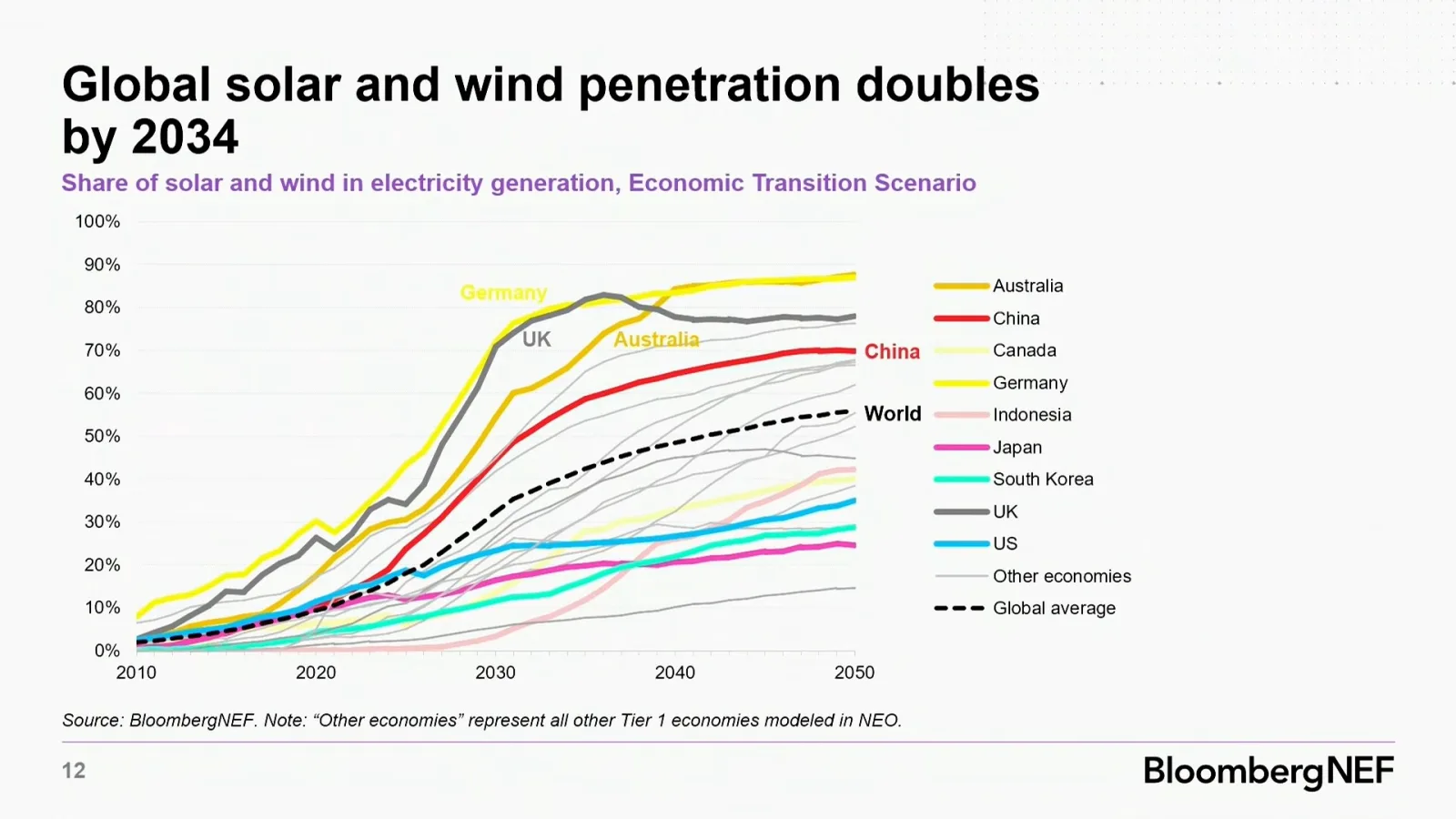
We also expect electrification to expand as electric vehicles gain ground. In this scenario electricity becomes the leading source of final energy around 2037. It reaches about 28% of final energy by 2035, up from around 20–23% today; reaching the 35% by 2035 goal would require faster change, closer to our net-zero scenario.
In the economic transition scenario, coal use falls substantially and oil levels off before declining in the early 2030s. Global gas use grows, mainly in places such as the US and Middle East where gas is relatively cheap, while falling in some other markets including Europe. Our net-zero scenario shows steeper reductions in fossil fuel use.
The scenarios have implications for energy security. I estimate that energy imports currently equal around 2% of GDP in the EU and UK and a larger share in countries such as Japan, India and Vietnam. In our base case, those economies reduce their exposure relative to GDP, most by more than half.
We expect the $2.3 trillion annual investment in transition technologies to rise in both the economic and net-zero scenarios, with the pace depending in part on policy. But reaching either trajectory requires more than deploying the cheapest technologies. I want to focus on three conditions: business models, grids and supply chains.
Why renewable projects need stable revenue and flexible grids
High renewable output can depress wholesale prices even when the technology is competitive. Cheung calls for supportive contracts, storage and much greater grid investment.
As renewable generation grows, output from similar projects can arrive at the same time and push down wholesale power prices. In markets with substantial solar, such as Spain and Germany, we see hundreds of hours of zero or negative prices. That can undermine the revenue case for new renewable projects even when the technologies are competitive.
Our German analysis compares the revenue a new wind or solar project needs with what it can earn by selling solely into wholesale power markets. We find a gap. That is why I expect renewable projects to continue relying on ways to stabilize revenue, including power purchase agreements, alongside more flexibility in the system.
A BloombergNEF survey of expected equity returns illustrates the growing value placed on flexibility. For new projects in Spain, it shows expected returns of 6–8% for solar, 8–10% for wind and about 12% for storage. Part of storage's premium also reflects market risk, because its business models are still developing.
Grid investment must rise quickly. We estimate it has increased from roughly $300 billion a year to about $500 billion and will need to exceed $600 billion in the next few years. Some markets may need to double or triple their investment rates to connect renewables and serve data centers and electrification, while regulators must keep the resulting system affordable.
Manufacturing choices and the copper constraint
Cheung says equipment supply chains must expand and countries face trade-offs in diversifying manufacturing. BloombergNEF models a potential copper shortfall as early as 2028.
Supply chains need to keep pace as well. Our European-focused analysis shows demand for equipment such as high-voltage direct-current converters and submarine cables doubling between 2025 and 2030 and doubling again by 2040. Manufacturers need enough certainty to invest in factories capable of supplying that equipment over the next decade or two.
Another supply-chain question is reliance on manufacturing in mainland China. We estimate that China has more than 80% of manufacturing capacity in key parts of the solar and battery supply chains. India, Europe and the US are trying to build more domestic capacity for security, diversity and economic value.
Those efforts involve choices about priorities: open trade may allow a faster transition, while national security and domestic manufacturing are also policy goals. Governments need a coherent strategy for handling those trade-offs rather than treating supply-chain decisions as separate from deployment speed.
In our transition-metals outlook, copper is the material that most concerns us. Even in our economic transition scenario, we model global demand potentially exceeding supply as early as 2028. Scaling mining, refining and related supply chains is therefore important to delivering the cleaner, more resilient system the scenarios describe.
同じチャンネルの記事
 28:17EN
 Bloomberg Live· 2026年11月12日COP31’s electrification push meets questions about clean power and tradeRebecca Penty, John Ainger, Lili Pike, Selcan Hacaoğlu · BloombergBloomberg reporters examine summit negotiations, China’s industrial plans and Europe’s energy-security dilemma.
 20:33ENBloomberg Live· 2026年11月12日Family investors weigh AI disruption against the businesses funding itAbeer Abu Omar, Mishal Kanoo, Shravin Bharti Mittal · BloombergMishal Kanoo warns that family blame can discourage risk; Shravin Bharti Mittal tests new technology against its route to customers.
 25:04ENBloomberg Live· 2026年11月12日PIMCO and Blackstone see Gulf financing needs shift toward private capitalAbeer Abu Omar, Farhad Karim, Christian Stracke · BloombergChristian Stracke expects regional demand for private lending; Farhad Karim sees domestic investment as an opportunity rather than a retreat.
 25:05ENBloomberg Live· 2026年11月12日Private-market investors see credit risks and a future restructuring opportunitySwetha Gopinath, Michael Gross, Sana Khater, T.K. Kurien · BloombergThree investors discuss slow exits, AI concentration and why patient capital still depends on realistic valuations.
 25:47ENBloomberg Live· 2026年11月12日Climate finance is moving with power demand—and missing some targetsAaron Rutkoff, Alexandra Liftman, Kyung-Ah Park, Valerie Smith · BloombergBank leaders see rising demand for clean infrastructure, while Temasek says its 2030 portfolio emissions target is out of reach.
 18:18ENBloomberg Live· 2026年11月12日Investors look beyond crowded US stocks toward 2027Farah Elbahrawy, David Druley, Ekta Tolani · BloombergDavid Druley favors diversification and early-stage venture; Ekta Tolani sees value in cash, infrastructure and a long investment horizon.