30 秒でわかる
Elon Musk announced a planned 500-megawatt AI computing project with Saudi company HUMAIN and Nvidia, starting with a 50-megawatt phase, at the November 2025 US-Saudi Investment Forum. Musk predicted that AI and robots could eventually make work optional and proposed solar-powered AI satellites. Nvidia CEO Jensen Huang focused on a nearer horizon: he expects AI to change jobs and raise productivity as computing shifts toward accelerators. Both presented future outcomes as forecasts, while the data center was announced as a plan.
- 1Musk predicts work will eventually become optionalHe compares future work to growing vegetables for enjoyment and acknowledges substantial work remains before then.
- 2Huang expects AI to make people productive and busyHe argues that time saved on difficult tasks can free people to pursue more ideas, using radiology as an example.
- 3xAI and HUMAIN announce a 500 MW projectThe announced Saudi computing project involves Nvidia and begins with a 50 MW first phase.
- 4Musk forecasts low-cost AI computing in spaceHe predicts solar-powered satellites could become the cheapest option within four or five years, citing power and cooling constraints on Earth.
- 5Huang sees accelerator demand beyond AI chatbotsHe points to supercomputing, data processing and recommendation systems in response to a question about an AI bubble.
ポイント
- The xAI–HUMAIN project was announced at 500 MW, beginning with a 50 MW phase.
- Musk predicts work could eventually become optional as AI and robotics expand production.
- Huang expects AI to change work and let people pursue more ideas in the near term.
- Musk forecasts that solar-powered AI satellites could become cost competitive within four or five years.
チャプターごとに整えた全文を読む
Robots and AI factories as infrastructure
Musk predicts a large market for humanoid robots; Huang explains why generative computing needs infrastructure.
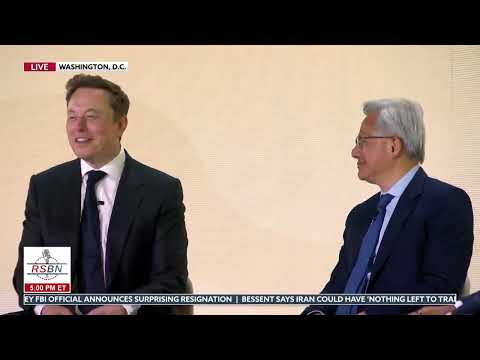
At the US-Saudi Investment Forum, Saudi communications minister Abdullah Alswaha introduces Tesla CEO Elon Musk and Nvidia CEO Jensen Huang. He frames the discussion around a partnership extending from energy into AI, robotics and computing infrastructure.
Alswaha asks Musk how he approaches industry-changing technology. Musk says his aim is creation: reusable rockets can reduce launch costs, while Tesla sought to make electric cars appealing and affordable. He predicts Tesla will pioneer useful humanoid robots.
Musk imagines personal and industrial robots becoming a larger product category than phones. He argues that widespread AI and robotics could eventually eliminate poverty by greatly expanding the supply of goods and services.
Asked about AI factories, Huang describes AI as infrastructure for every industry. He contrasts retrieving previously created information with generating a response for each user and situation, arguing that this requires computing facilities around the world.
What AI could change about work
Musk imagines optional work in the long term, while Huang emphasizes near-term productivity and new tasks.
Alswaha raises concern about jobs. Musk predicts that over a long horizon work could become optional, like growing vegetables for pleasure instead of buying them. He says reaching that point will require considerable work.
Musk recommends Iain M. Banks’s Culture novels and speculates that money might eventually become irrelevant if AI and robotics continue to improve. Physical limits such as electricity and materials would still apply.
Huang jokes about Nvidia’s upcoming earnings call and says jobs and learning will change. In the nearer term, he expects people to become more productive and remain busy because they can pursue more ideas.
Huang uses radiology as an example, arguing that AI can help clinicians study more images and serve more patients rather than simply eliminating their jobs. He presents this as evidence for his near-term view of productivity.
Saudi AI partnerships and computing in space
The speakers announce a planned computing project and discuss solar-powered satellites.
Alswaha offers examples of scientific innovation, including Omar Yaghi’s work on metal-organic frameworks that can capture water or carbon dioxide, and a proposed gene-editing application. He argues AI could accelerate research and create new economic activity.
Musk announces a planned 500-megawatt computing project involving xAI, Saudi AI company HUMAIN and Nvidia. Alswaha says the initial phase will start at 50 megawatts; the larger figure is the planned scale.
Huang describes Nvidia’s work with HUMAIN, including a separate AWS project, digital-twin simulations for factories and robot training with Omniverse, and supercomputers intended to help with quantum computing and error correction.
Asked whether AI in space is possible, Musk says it is inevitable if civilization continues. He cautions against assuming uninterrupted progress and argues that space-based solar power could eventually capture a much larger share of the Sun’s energy.
Musk estimates that solar-powered AI satellites could become the cheapest way to compute within four or five years. He and Huang discuss cooling by radiating heat into space and the difficulties of providing electricity and cooling for large installations on Earth.
Musk argues that very large computing loads would be difficult to power on Earth and suggests solar satellites could avoid some terrestrial constraints. His timeline and cost comparison are forecasts about a proposed system.
Huang’s answer to the AI bubble question
Huang argues that demand for accelerated computing extends beyond the most visible AI applications.
Alswaha asks Huang whether AI is a bubble. Huang points to a broader shift from general-purpose processors to accelerated computing, including in supercomputing and data processing, as a source of demand beyond conversational AI.
Huang describes recommendation systems moving toward generative AI and argues that companies can justify GPU investment for data processing and recommendation as well as AI agents. In his view, these underlying workloads support the infrastructure buildout.
With the next leaders due to speak, Alswaha closes by emphasizing US-Saudi cooperation and thanking Musk and Huang.
同じチャンネルの記事
 26:37EN
 Right Side Broadcasting Network· 2026年9月29日Musk and Huang: AI’s Power Needs and the Case for Agent MonitoringElon Musk, Jensen Huang, Tom BrownMusk predicts a link between power and growth; Huang describes isolating and independently monitoring AI agents.
 8:45ENRight Side Broadcasting Network· 2026年9月1日Musk Predicts an AI Power Shortfall as Robot Use ExpandsElon MuskAt a G20 session, Musk estimates AI’s economic impact and says electricity could constrain data-center growth in 2027.
 35:50ENRight Side Broadcasting Network· 2025年2月20日Musk at CPAC: DOGE cuts, political change and a disputed fraud estimateElon Musk, Rob Schmitt, Javier MileiMusk and Rob Schmitt discuss government spending and immigration; Musk’s fraud estimate requires the scope of GAO’s data.