30 秒でわかる
In March 2024, Matthew Berman reviews 1X EVE, NVIDIA Project GR00T, Boston Dynamics Spot, Apptronik’s Mercedes-Benz pilot, Xiaomi CyberDog 2, a voice-controlled drone and Anduril’s ALTIUS-700M. He is enthusiastic about advances in robot learning and simulation. The examples combine promotional clips, announced goals and pilot projects; they do not establish AGI or universal autonomy. The video has no spoken sponsor read, though its description includes a discounted MassedCompute link.
- 11X EVE1X says its selected clips use one neural-network policy and autonomous control; this is not evidence of task-free training.
- 2Project GR00TNVIDIA proposes a multimodal robot foundation model supported by simulation, orchestration and hardware.
- 3Spot locomotionBoston Dynamics compares earlier and newer walking control on slippery surfaces.
- 4Apollo pilotApptronik and Mercedes-Benz announced a manufacturing pilot, not proven full-scale autonomous operation.
- 5ALTIUS-700MAnduril’s displayed system is a loitering munition, with claims presented by its manufacturer.
ポイント
- 1X described its EVE clips as autonomous and controlled with one set of neural-network weights; that does not mean no training was required.
- NVIDIA announced GR00T as a robot-learning initiative, not demonstrated artificial general intelligence.
- Simulation and reinforcement learning can produce robot training experience, but transfer to real-world tasks must be evaluated.
- Boston Dynamics demonstrated improved Spot locomotion on selected challenging surfaces in its 4.0 update.
- Mercedes-Benz and Apptronik announced a pilot, while Anduril’s ALTIUS-700M is a loitering munition.
- Product prices, trials and claims are historical; the description contains a MassedCompute discount link.
チャプターごとに整えた全文を読む
1X EVE and autonomy
Berman plays 1X’s EVE video and discusses its single-network claim. The selected demonstrations do not show a robot with general intelligence.
In March 2024 I look at a wave of robotics announcements, beginning with 1X’s EVE. The company’s video shows a robot carrying out a series of domestic-style tasks. 1X describes the clips as autonomous, at normal speed, controlled by one set of neural-network weights; that is the company’s characterization of selected demonstrations, not an independent reliability study.
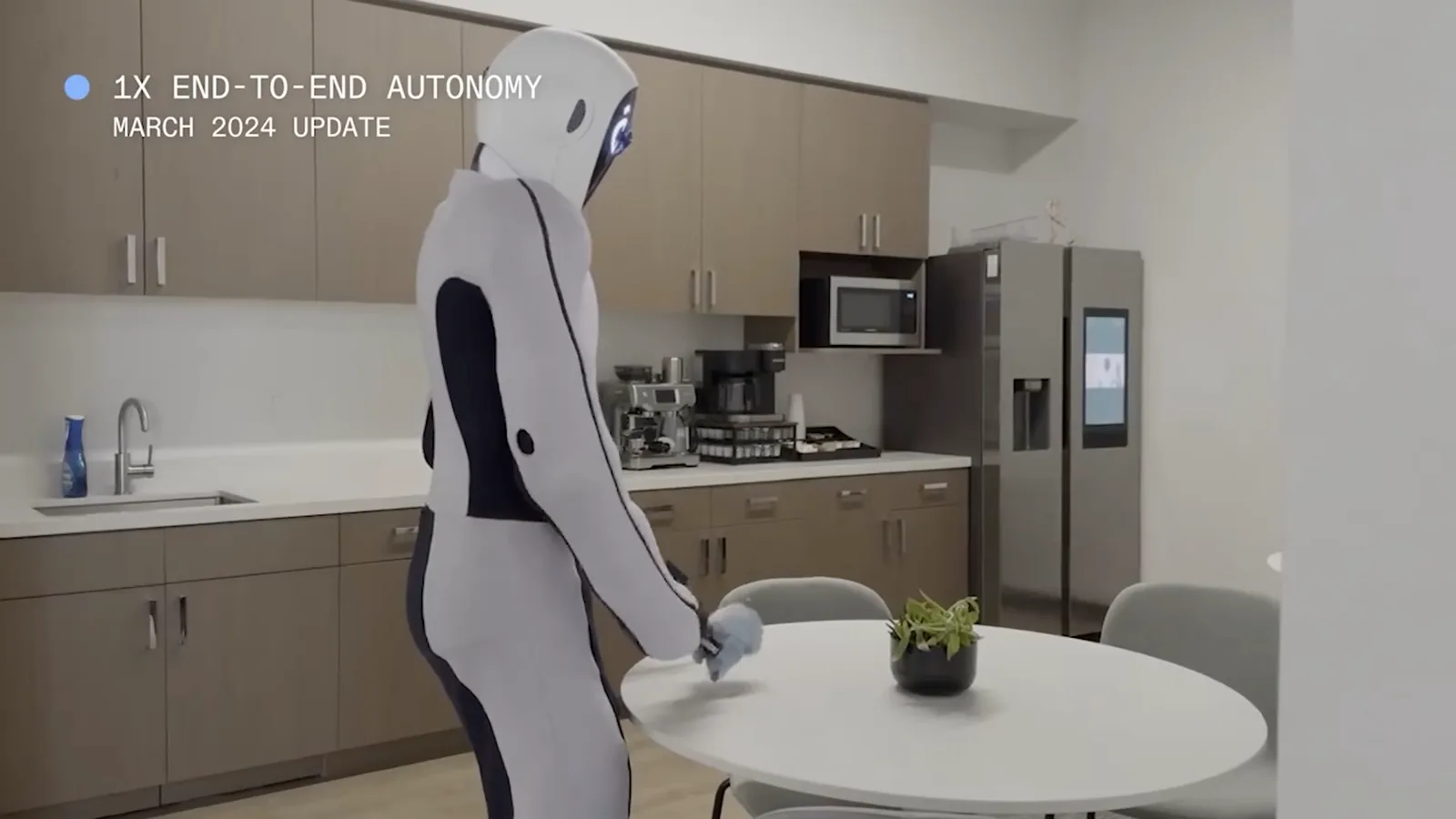
I say a single end-to-end network means the robot was not specifically programmed to perform the shown actions. The distinction needs care: learned control is different from hand-coding every movement, but it still requires training, data and engineering. A selected autonomous demonstration does not establish general intelligence or that every household task works without intervention.
NVIDIA Project GR00T
Berman discusses robot foundation models, simulation, OSMO and Jetson Thor. An NVIDIA promotional film explains the proposed workflow.
I turn to NVIDIA and Jim Fan’s work on agents, simulation and robot learning. His earlier Minecraft agents and simulated training illustrate different research approaches; they do not demonstrate that a physical robot can learn any task without instruction.
Project GR00T was announced as a foundation-model initiative for humanoid learning. NVIDIA’s goal is to interpret multimodal instructions and demonstrations and support multiple robot bodies. My description of an AGI that already knows any task without explicit training goes beyond what the announcement established; embodied AI is not automatically AGI.
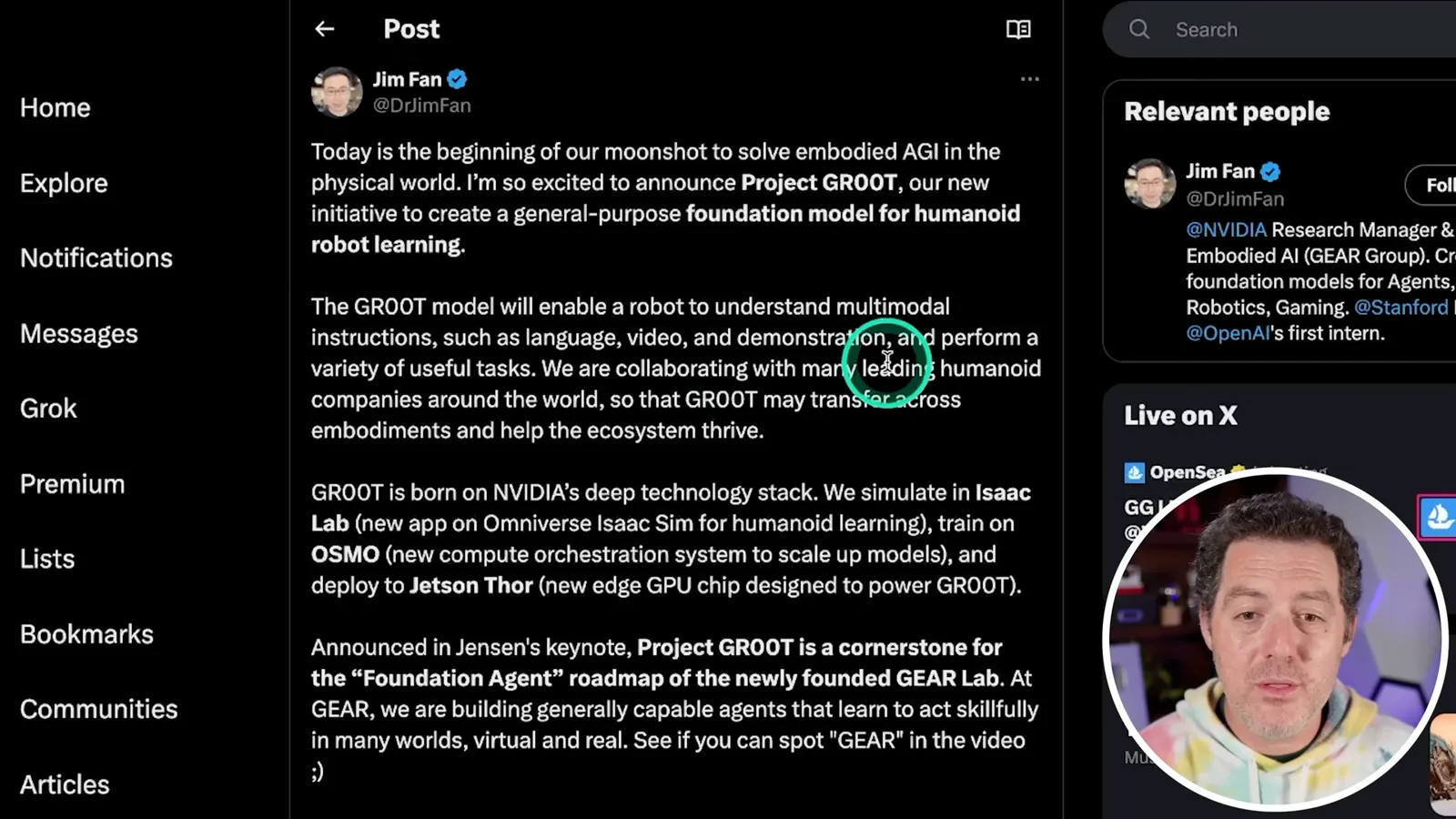
I describe NVIDIA’s tool stack: Isaac Lab and Isaac Sim for robot learning and simulation, OSMO for coordinating computing workflows, and the announced Jetson Thor robot computer for deployment. These are components of a proposed development pipeline, not evidence that all robots can safely perform arbitrary real-world tasks.
I mention Isaac Gym and a 1,000-times-faster simulation claim. [Isaac Gym](https://developer.nvidia.com/blog/introducing-isaac-gym-rl-for-robotics/) uses GPU-accelerated physics and parallel environments to generate experience for reinforcement learning; simulation throughput is workload-dependent, and synthetic data is not necessarily created by an AI model. The number is not a universal real-world speedup.
I play an NVIDIA promotional film about designing and training robots. Its narration presents GR00T as a model that takes multimodal task instructions and prior interactions to produce robot actions. The film illustrates the company’s intended workflow and contains promotional and forward-looking claims.
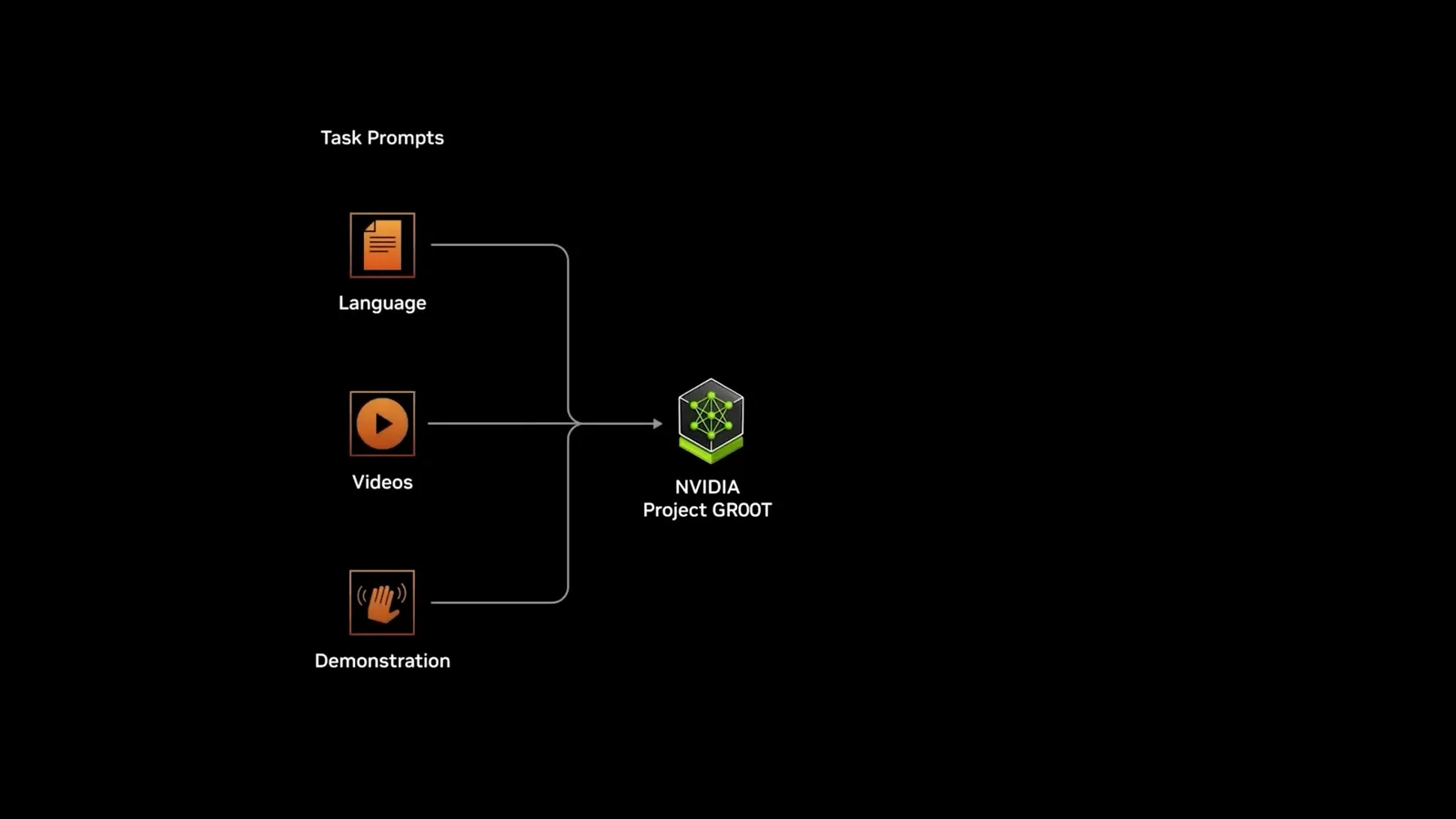
NVIDIA describes Isaac Lab on Isaac Sim and OSMO coordinating training and simulation across computing systems. The film claims simulation-trained skills can transfer zero-shot to physical robots and that a handful of demonstrations can support new tasks. Such transfer depends on the task and conditions; the clip does not quantify success rates or establish general-purpose reliability.
The NVIDIA film shows language-directed movements, including a high-five and dance, and describes Jetson Thor as the intended robotics computing platform. A successful selected interaction does not establish that every movement is autonomous or robust in unseen situations. NVIDIA’s [2024 announcement](https://nvidianews.nvidia.com/news/foundation-model-isaac-robotics-platform) describes the project and many capabilities as forward-looking.
I connect GR00T to NVIDIA’s GEAR research group and note a friendly exchange between Fan and Figure founder Brett Adcock. I speculate that their teams might work closely together; the exchange itself does not establish a partnership.
Boston Dynamics Spot
Spot’s reinforcement-learning controller is shown navigating challenging terrain. Berman compares older and newer footage.
Boston Dynamics presents reinforcement-learning improvements to its Spot robot. I recall Atlas running and performing parkour, then focus on Spot’s locomotion over stairs, platforms and slippery terrain. My view that the company is ahead of competitors is an opinion, not a controlled comparison.
Spot must adjust gait and posture for changing terrain. I liken simulation-based training to NVIDIA’s work, though the systems and implementations differ. Boston Dynamics says its newer controller improves performance on challenging surfaces; it does not claim that every movement decision is newly invented from scratch or that every terrain is safe.
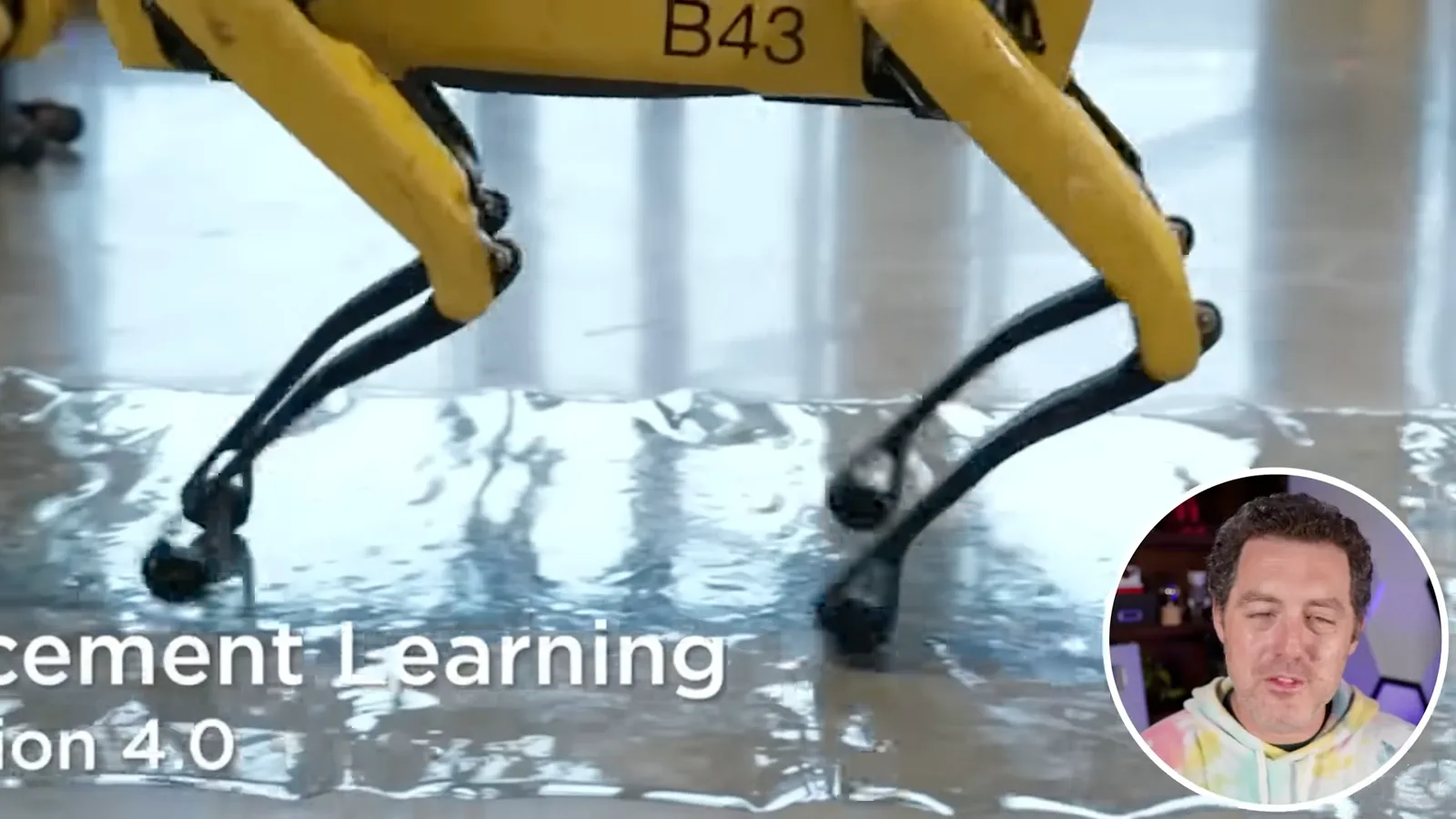
The video compares earlier Spot software with a reinforcement-learning version on slippery surfaces and a raised platform. The newer controller looks better in the shown tests. [Boston Dynamics](https://bostondynamics.com/blog/starting-on-the-right-foot-with-reinforcement-learning/) identifies this as its Spot 4.0 locomotion update; selected clips do not give a failure rate across all environments.
Factory robots, CyberDog and drone control
The roundup covers the Mercedes-Benz Apollo pilot, Xiaomi’s CyberDog 2 and a voice-driven DJI drone demonstration.
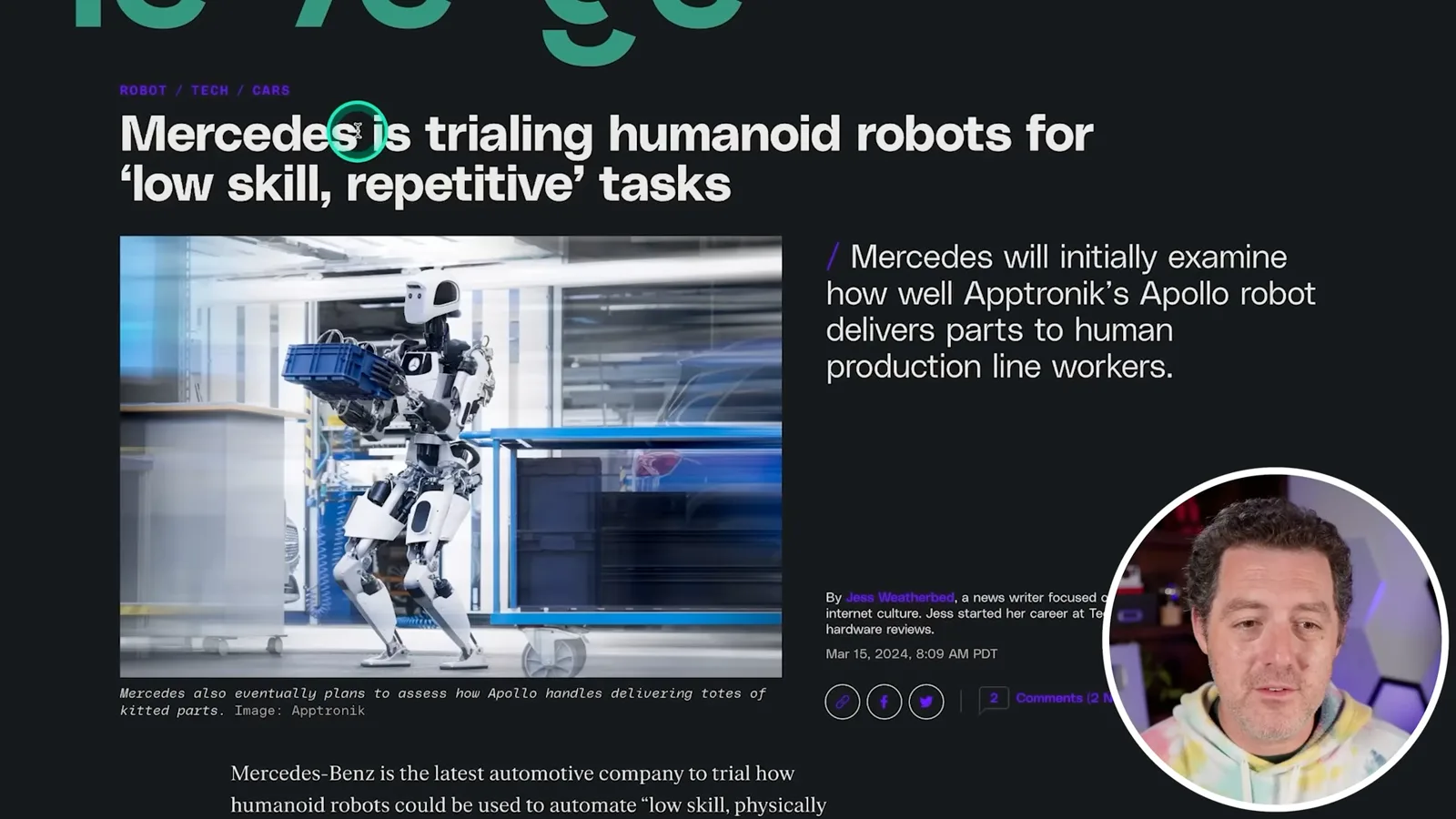
Mercedes-Benz and Apptronik announced a pilot involving Apollo humanoid robots for manufacturing. The plan is to explore repetitive physical tasks such as parts logistics, not evidence that a factory is already fully staffed by autonomous humanoids. I play Apollo demonstration footage after noting that I am still learning about Apptronik.
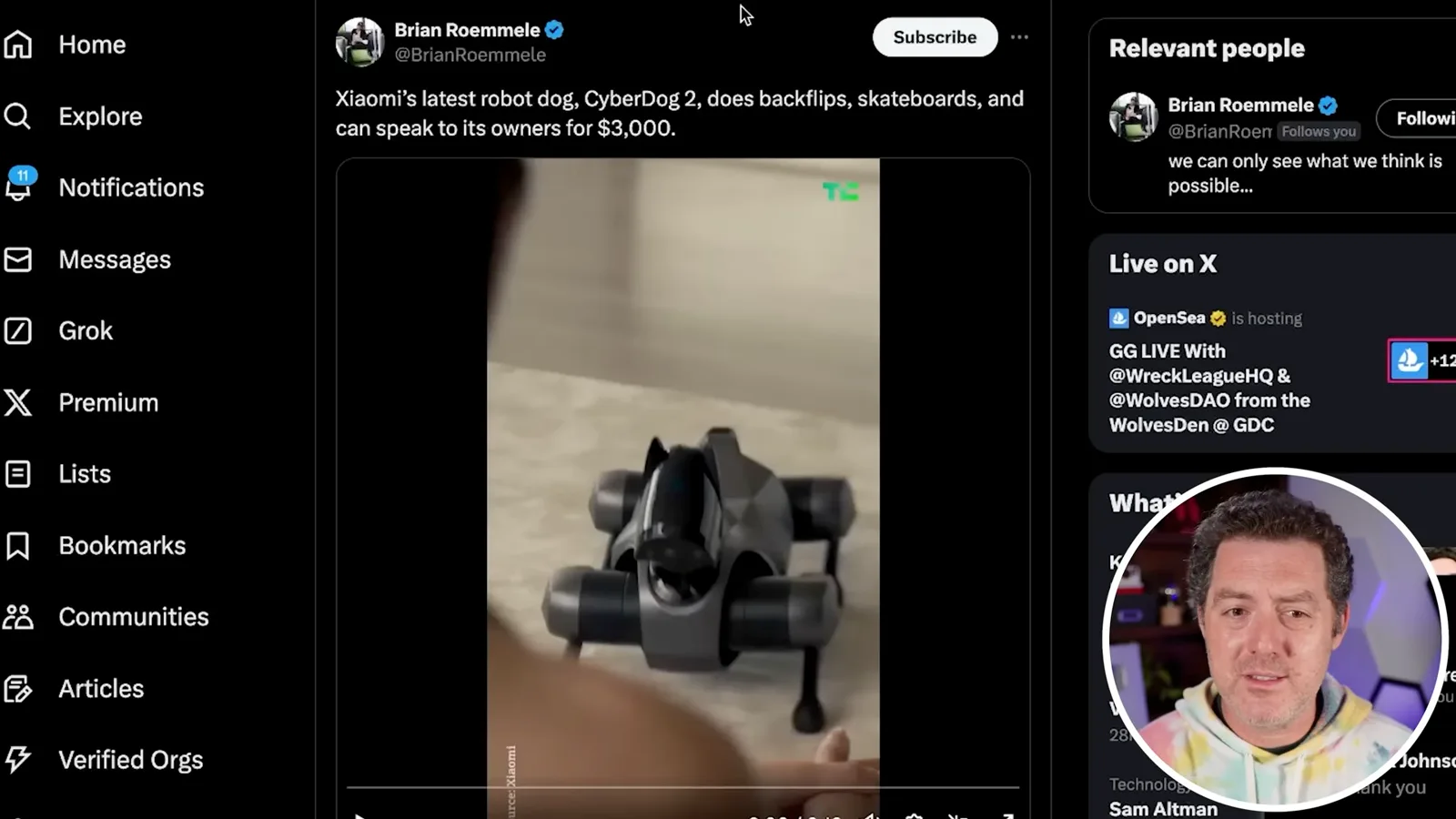
I show Xiaomi’s CyberDog 2 and cite a roughly $3,000 price seen in a post. It is a relatively accessible quadruped compared with industrial systems, though price and availability depend on market and time. A selected demonstration does not establish universal consumer availability or independent performance.
I introduce Yondu and a voice-control demonstration involving a DJI drone. A speaker asks the drone to take off, rise, turn and follow a person in a white hoodie. The clip presents a specific commanded workflow; it does not demonstrate natural-language control of every robot.
I expect robots to become easier to operate through ordinary language, though I frame that as a hope for the future. The demonstration does not prove that language instructions alone make autonomous operation reliable or safe in every setting.
Anduril and the robotics outlook
Berman plays footage of the ALTIUS-700M loitering munition and closes with his outlook for robotics.
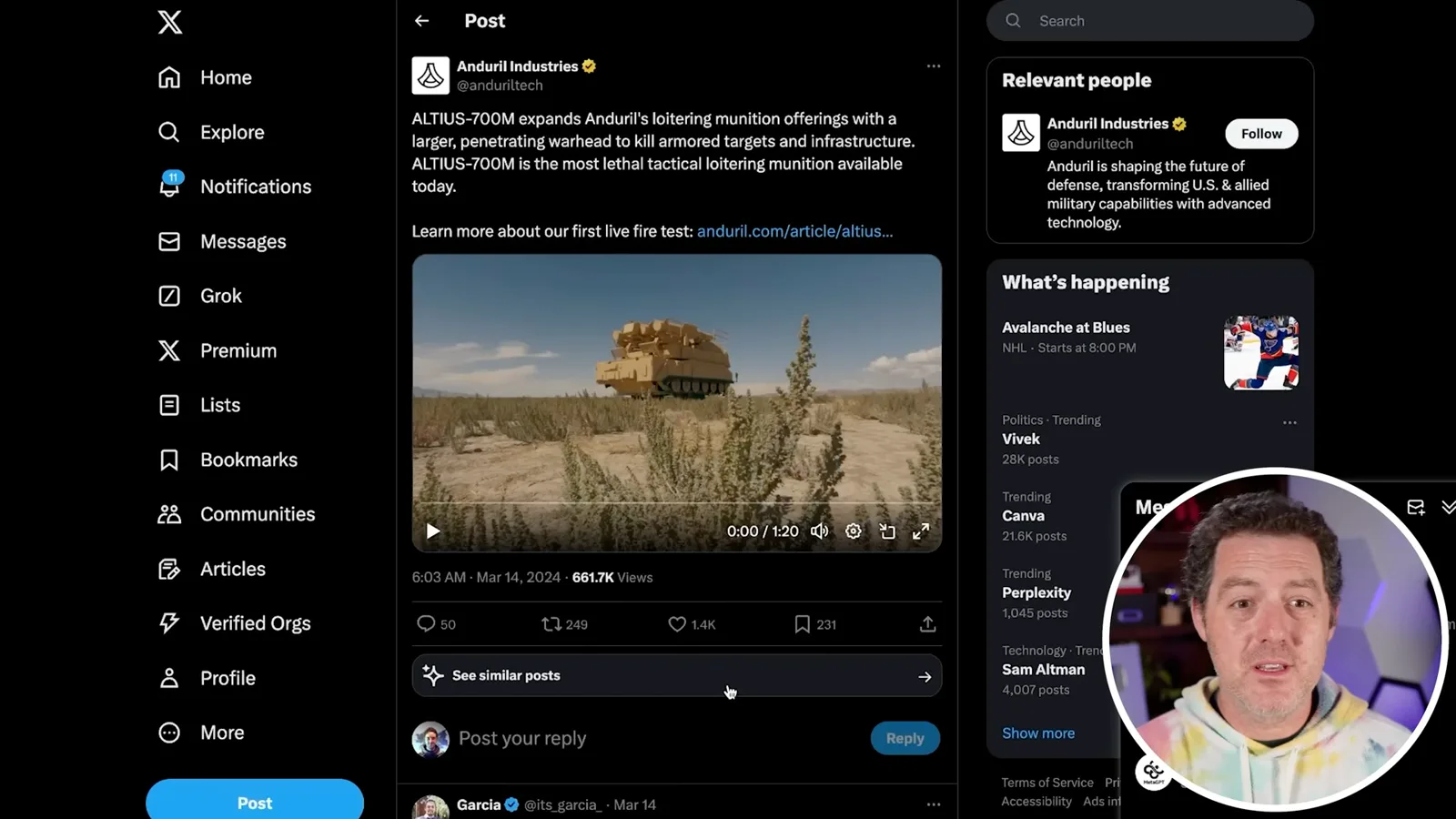
I turn to Anduril Industries, the defense contractor associated with Oculus founder Palmer Luckey, and its ALTIUS-700M. The displayed company post describes a loitering munition, not a general-purpose humanoid robot. Its claimed performance and operational autonomy are not independently established by this promotional clip.
I close excited about further humanoid developments and mention a list of companies for viewers to explore. Across these examples, there is a difference between a research objective, a company’s selected demonstration, a pilot and a commercially reliable capability; the video contains no spoken sponsorship disclosure.
同じチャンネルの記事
 34:21EN
 Matthew Berman· 2026年10月27日Matthew Berman Examines Anthropic’s IPO Filing, AI Growth and GovernanceMatthew Berman, Sam Altman · Forward FutureThe presenter reviews the S-1’s financial metrics, compute strategy and voting structure while questioning the tension between rapid AI development and safety.
 0:26ENMatthew Berman· 2026年10月25日Sam Altman on Human Values and Problem-Solving in an AI WorldSam Altman · OpenAIIn a short interview excerpt, Altman considers the enjoyment of solving hard problems and the human role in interpreting results.
 0:36ENMatthew Berman· 2026年10月25日Kimi K3.1 and a Rubik’s Cube Solver DemonstrationMatthew Berman · Forward FutureMatthew Berman shows a scrambled virtual cube being solved and gives the Kimi K3.1 test a favorable assessment.
 0:21ENMatthew Berman· 2026年10月24日An AI-Generated Kimi Benchmark Chart Used Invented ScoresMatthew Berman · Forward FutureMatthew Berman asks for a graph of Kimi K3.1 Pro benchmarks, then discovers that the displayed figures are illustrative placeholders.
 25:50ENMatthew Berman· 2026年10月24日Kimi K3.1 Pro Tested: Strong 3D Demos, Uneven Results and Competitive PricingMatthew Berman · Forward FutureMatthew Berman tests the open-weight model on coding, 3D rendering and visual explanations, then compares benchmark results and prices.
 32:20ENMatthew Berman· 2026年10月23日Who Is Local AI For? The Costs, Trade-offs and a Hybrid FutureMatthew Berman · Forward FutureMatthew Berman weighs data control and independence against hardware cost, setup complexity and inference speed.