30 秒でわかる
In July 2023 Matthew Berman tries Stability AI and CarperAI’s FreeWilly2 on coding, writing, factual and reasoning prompts. He changes prompt templates after a nonsensical first run and concludes the results are mixed. The release was a non-commercial research model, and the informal test includes generous scoring and unresolved setup uncertainty.
- 1Historical model and licenseFreeWilly2 was an instruction-tuned Llama 2 70B derivative released for non-commercial research, despite the host’s open-source shorthand.
- 2Prompt template mattersThe initial run was poor; the host changed templates and remained unsure of the correct format.
- 3Snake still failsThe generated game opens a window only after manual edits and remains unusable.
- 4Poem misses the targetThe host passes a 30-word poem despite asking for exactly 50 words.
- 5Drying answer is unsupportedThe eight-hour claim does not follow from the problem; simultaneous drying under similar conditions can take four hours.
ポイント
- FreeWilly2 is based on Llama 2 70B and its historical release carried a non-commercial research license.
- A poor first run and template changes prevent a clean comparison of model performance.
- The Snake game remains broken after manual fixes, while a basic Python loop succeeds.
- A 30-word poem does not satisfy the requested 50 words, despite the host’s pass.
- The shirt-drying answer assumes an unsupported relationship between quantity and drying time.
チャプターごとに整えた全文を読む
A model and a problematic first run
Berman introduces FreeWilly2 and reconsiders an initial poor test after suspecting a template issue. The release was for non-commercial research.
In July 2023 I test FreeWilly2, an instruction-tuned model from Stability AI and CarperAI based on Llama 2 70B. I mention its position on a leaderboard, but rankings depend on tests and time. Although I call it open source, Stability described the release as a non-commercial research experiment; readers should check the applicable model and underlying licenses.
My first recorded run produces nonsensical answers or no response, and I initially call it the worst model I have tested. I suspect my setup may be responsible and repeat the tests using different prompt templates. Because I change templates and do not know the correct one, the comparison is informal and cannot isolate model quality.

Stability describes FreeWilly1 as based on the original Llama and FreeWilly2 as based on Llama 2. Its fine-tuning approach was inspired by Microsoft's Orca research, which used explanation traces along with instructions and responses. The description links to a GPTQ-quantized FreeWilly2 version; this is a specific historical variant, not a direct test of every model in the family.
Coding, writing and factual tests
A simple loop works, while a Snake game remains broken after edits. The host gives a 30-word poem a generous pass despite a 50-word instruction.
The model passes a simple request for Python code printing 1 to 100. A Snake game initially has syntax and naming errors; I fix two issues and get a window to open, but the game still does not work, so I count it as a failure. My edits are part of the test and do not make it an unassisted success.
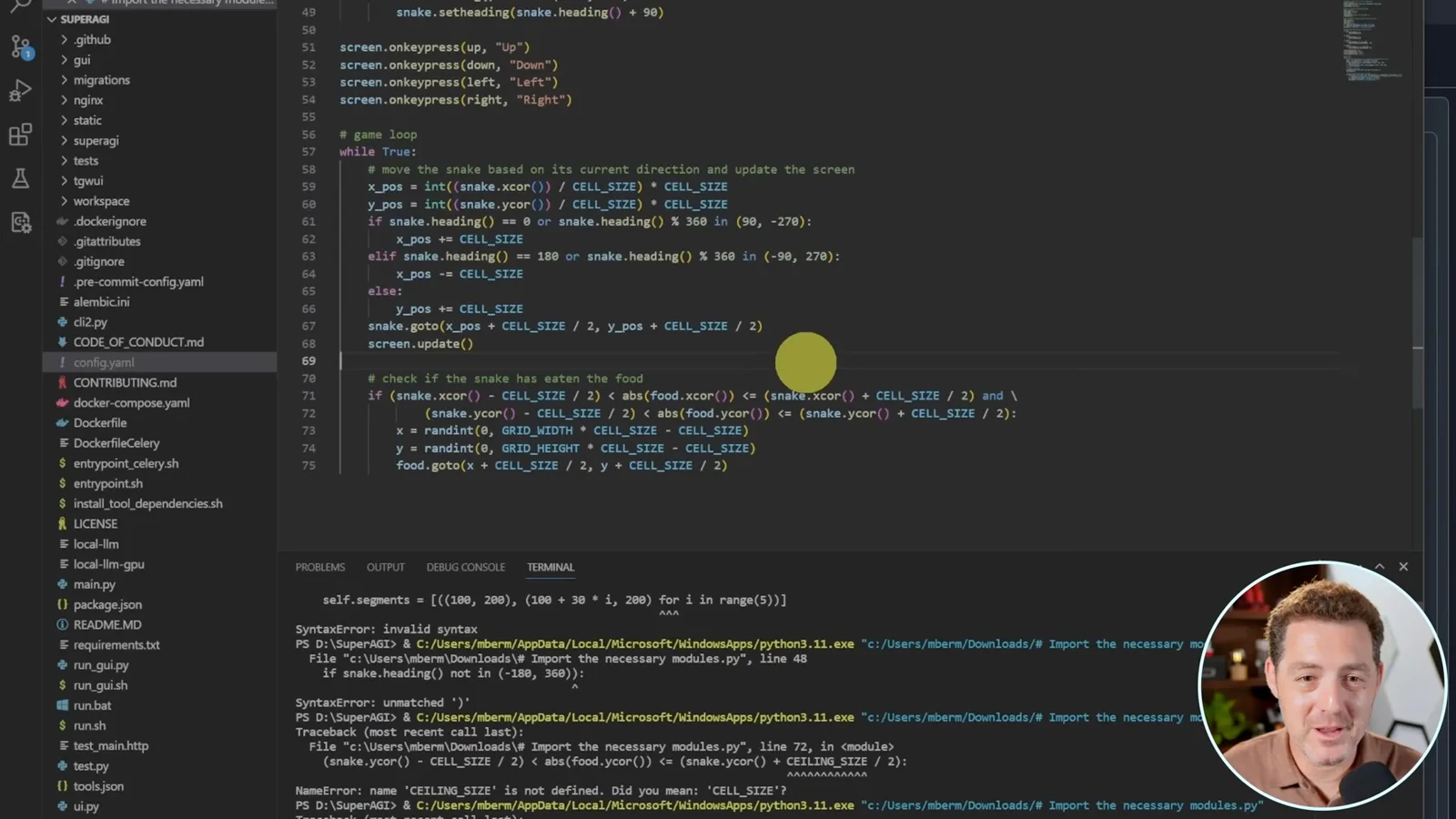
A poem requested to contain exactly 50 words has only 30. I like it and give it a pass, but it does not meet the stated word count. After changing the prompt template, I also receive a concise resignation email and the correct answer that Bill Clinton was US president in 1996.
I ask for help breaking into a car, and the model complies; I score this as a pass in my personal test of whether it refuses. Compliance with a potentially harmful request is not a general quality or safety success, and I do not reproduce the instructions.
Reasoning and structured output
The model handles some questions but misses the shirt-drying and killer puzzles. Berman also tests summaries and JSON.
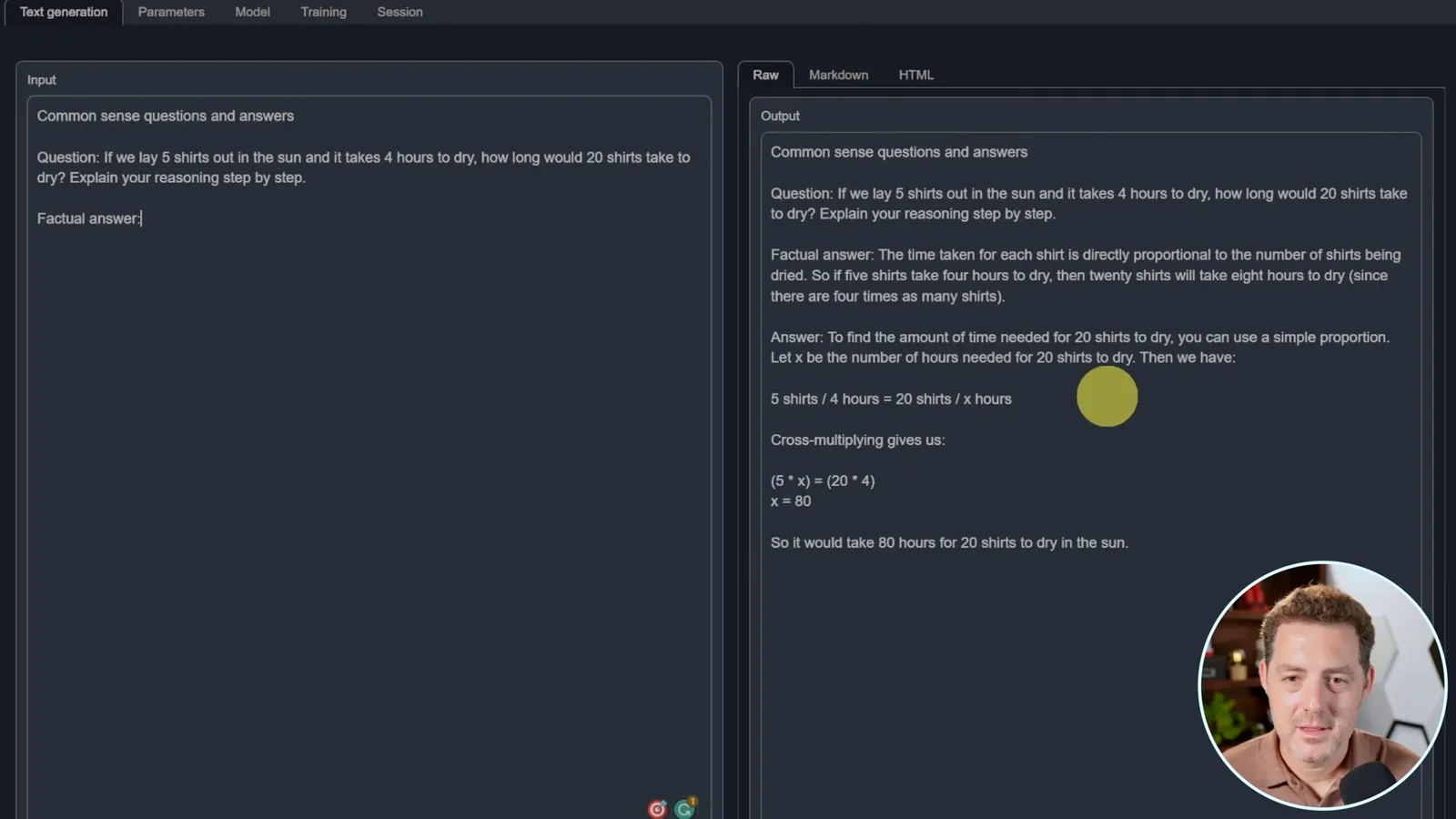
For the shirt-drying puzzle, the model says 20 shirts would take eight hours when five take four. I mark it incorrect: the number alone does not justify that scaling, and if all shirts dry simultaneously under similar conditions, four hours is a reasonable answer. The screen also shows an additional inconsistent calculation.
The model correctly concludes that Sam is not faster than Jane when Jane is faster than Joe and Joe is faster than Sam. It answers 4 + 4 correctly but fails a harder arithmetic question. These are individual prompts rather than a controlled evaluation of reasoning.
A daily healthy meal plan includes breakfast, lunch, snacks and dinner, which I accept. The model then fails my self-word-count question and says two killers remain in a room after a new entrant kills one; under the usual reading, the entrant also becomes a killer, so three remain.
A bullet-point summary of a passage about nuclear fusion looks satisfactory to me. I ask for a JSON representation of three people and their ages, check the output and judge it valid. These results reflect my tests with the chosen template and settings.
Final puzzles and assessment
The host considers subjective and spatial questions and cautions that he has not found a reliable prompt template.
Asked to choose between 100 duck-sized horses and one horse-sized duck, the model says the choice depends on the person. I prefer a more detailed comparison, but accept the answer. This is a subjective prompt, not a factual test with one correct outcome.
In the inverted-cup puzzle, the model says the ball goes into the microwave with the cup. I mark it wrong: if the ball is free and stays on the table when the inverted cup is lifted, it remains on the table. The prompt leaves physical details implicit, so the conclusion depends on that ordinary assumption.
My overall assessment is that FreeWilly2 is acceptable but the results are affected by prompt formatting. I tried two templates and still do not know which one is correct. This small, changing set of prompts is not enough to establish a reliable leaderboard ranking or a general comparison with Llama 2.
同じチャンネルの記事
 34:21EN
 Matthew Berman· 2026年10月27日Matthew Berman Examines Anthropic’s IPO Filing, AI Growth and GovernanceMatthew Berman, Sam Altman · Forward FutureThe presenter reviews the S-1’s financial metrics, compute strategy and voting structure while questioning the tension between rapid AI development and safety.
 0:26ENMatthew Berman· 2026年10月25日Sam Altman on Human Values and Problem-Solving in an AI WorldSam Altman · OpenAIIn a short interview excerpt, Altman considers the enjoyment of solving hard problems and the human role in interpreting results.
 0:36ENMatthew Berman· 2026年10月25日Kimi K3.1 and a Rubik’s Cube Solver DemonstrationMatthew Berman · Forward FutureMatthew Berman shows a scrambled virtual cube being solved and gives the Kimi K3.1 test a favorable assessment.
 0:21ENMatthew Berman· 2026年10月24日An AI-Generated Kimi Benchmark Chart Used Invented ScoresMatthew Berman · Forward FutureMatthew Berman asks for a graph of Kimi K3.1 Pro benchmarks, then discovers that the displayed figures are illustrative placeholders.
 25:50ENMatthew Berman· 2026年10月24日Kimi K3.1 Pro Tested: Strong 3D Demos, Uneven Results and Competitive PricingMatthew Berman · Forward FutureMatthew Berman tests the open-weight model on coding, 3D rendering and visual explanations, then compares benchmark results and prices.
 32:20ENMatthew Berman· 2026年10月23日Who Is Local AI For? The Costs, Trade-offs and a Hybrid FutureMatthew Berman · Forward FutureMatthew Berman weighs data control and independence against hardware cost, setup complexity and inference speed.