30 秒でわかる
In this July 2023 tutorial, Matthew Berman tries Aider with GPT-4, first building and changing a Python Snake game and then asking it to update a dependency in a Ruby on Rails project. He describes an early repository map based on Universal Ctags and shows Git-aware edits. The examples are informal and reveal an incomplete game change and a dependency version that was not actually the latest; the video’s description also adds an installation step omitted from the recording.
- 1A terminal coding assistantBerman introduces Aider and its ability to iterate on files and existing projects.
- 2Historical setupHe creates a Python environment and uses an OpenAI key; the description supplies a missing installation command.
- 3Repository mappingHe explains the early Universal Ctags map, which compresses selected code information rather than giving the model every detail.
- 4A Snake exampleThe assistant generates and edits a small game, but one requested change is incomplete.
- 5Editing a Rails projectAider suggests a Sidekiq change and Bundler workflow, but the proposed version is not the latest.
ポイント
- Aider is a terminal coding assistant that can propose edits and work with Git repositories.
- The 2023 demonstration used a hosted OpenAI API key; the software being free did not make API usage free.
- The historical repository map was a compact summary, not the complete contents of every file.
- One Snake change left the first food symbol unchanged, showing why generated edits need testing.
- The demonstrated Sidekiq 6.3.1 suggestion was not the latest release even in July 2023.
- The video description adds the omitted Aider installation step; modern setup and repository mapping have changed.
チャプターごとに整えた全文を読む
Introducing Aider and setup
Berman introduces Aider, creates an environment and discusses API access. The video description adds an installation step omitted from the demonstration.
Matthew Berman introduces Aider, a terminal-based coding assistant created by Paul Gauthier, in July 2023. He is interested in its ability to propose and iterate on code, show changes and work within an existing Git repository. The video shows small examples rather than a broad evaluation of large-project reliability.
He describes the version he is using as supporting GPT-4 and GPT-3.5 and says he hopes for open-model support in future. That reflects the 2023 release; available models and integration options have since changed. The assistant itself may be available without a software fee, but hosted model API calls can incur charges.
On his Mac, Berman creates and activates a Conda environment with Python 3.11.3, then exports an OpenAI API key and says he will revoke the demonstration key. The video description corrects an omitted step: installing Aider with pip install aider-chat or the repository requirements. These are historical instructions, not a verified current installation guide.
Mapping a repository
He explains the early Universal Ctags integration and its role in compressing repository context. A map is necessarily selective.
Berman introduces Universal Ctags as an optional aid for a large codebase. In the early version he demonstrates, it helps create a compact repository map of symbols and structure. A token-limited map is a selection or summary, not the entire codebase or a guarantee that the model understands all relevant context.
He shows installing Universal Ctags with Homebrew and checking its version. This is the workflow in the recording; Aider later described replacing the original Ctags-based repository map with a tree-sitter-based approach, so the old dependency should not be assumed necessary for current versions.
Creating and refining Snake
Berman generates a Python game, adds a score and changes the food symbol. The final change is only partially successful.
Berman creates a new folder and starts Aider with snake.py. The screen says no Git repository is present and the repository map is disabled. He asks for a Python Snake game; the assistant proposes code using curses, and he runs the resulting game successfully in this single demonstration.
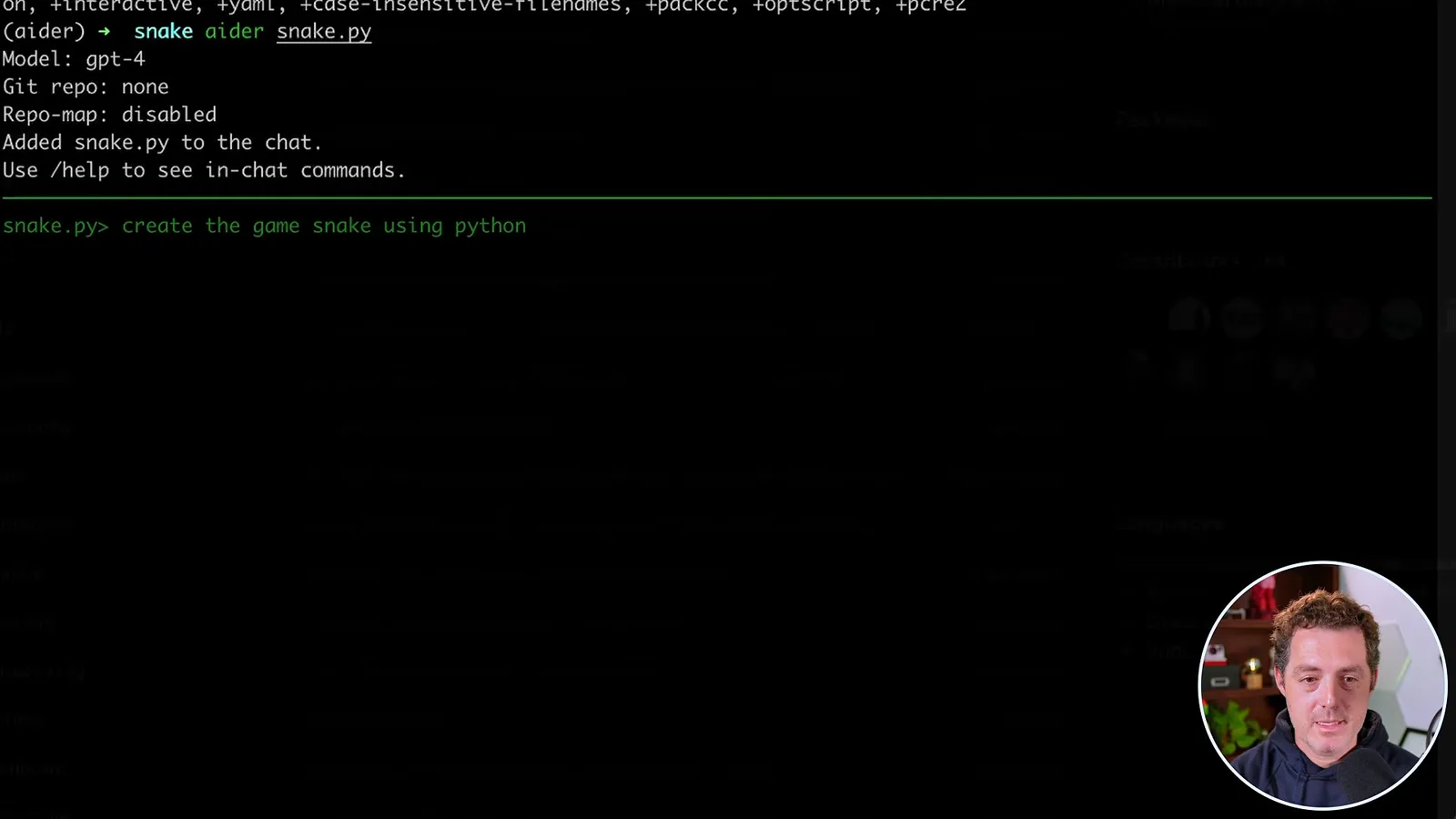
He asks the assistant to add a score showing how many pieces of food the snake has eaten. Aider displays and applies the change, and Berman runs the game again to show the score. This is one example of iterative editing and a manual check, not a comprehensive game test.
Next he asks to replace the food symbol with the number eight. On testing, he observes that the first food item still uses the original symbol while later ones use eight. He notes that another iteration could address it; the initial change did not fully satisfy the request.
Berman shows in-chat commands for adding or dropping files, viewing differences and committing, then exits and opens his existing Ruby on Rails project. This time the terminal recognizes a Git repository and shows a Universal Ctags repository map with a 1,024-token budget.
An existing Rails project
He asks Aider to update Sidekiq and reviews its proposed Gemfile and Bundler steps. The suggested version does not establish a successful latest-version upgrade.
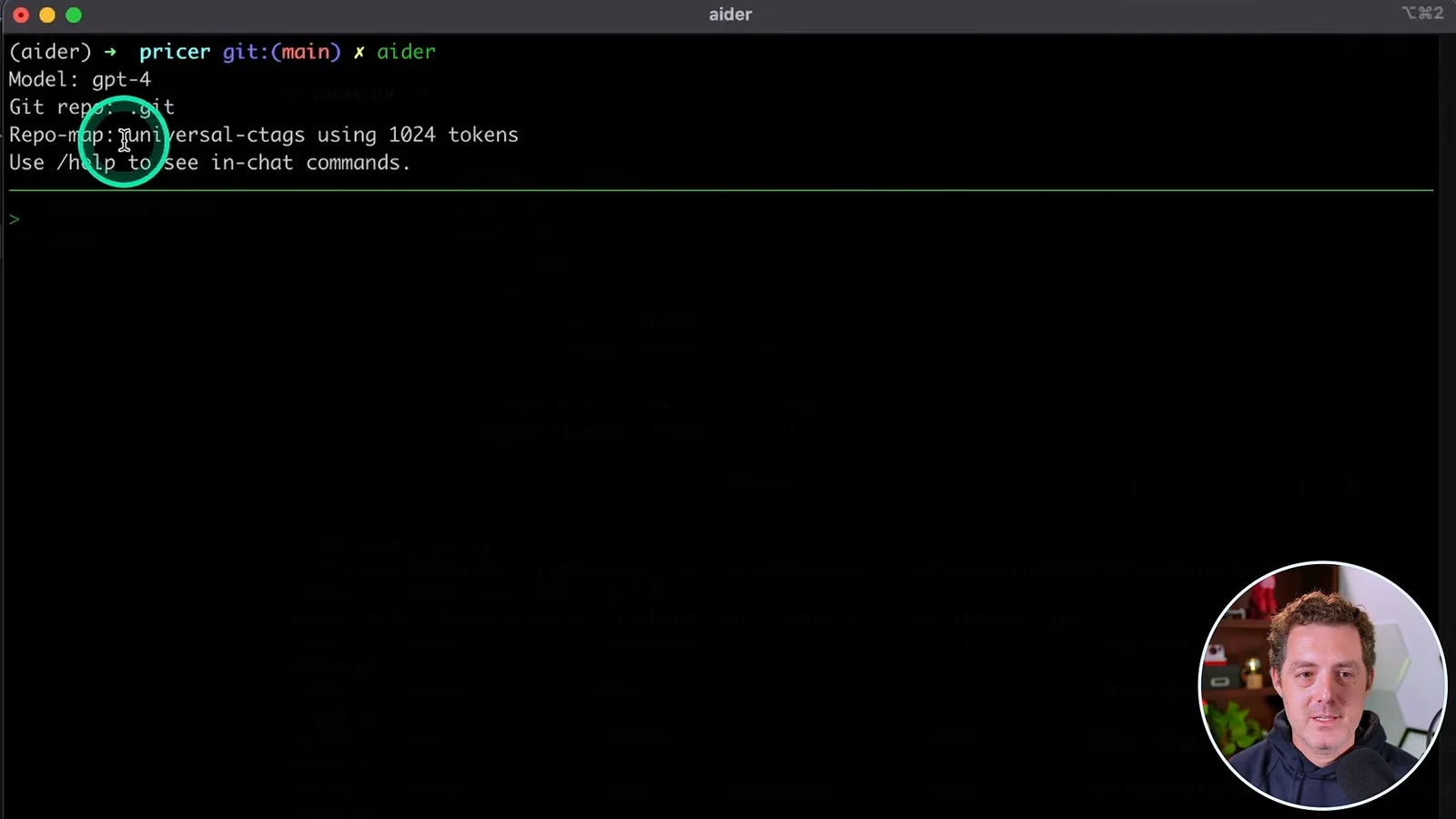
He asks Aider to upgrade Sidekiq to the latest version. The assistant requests access to the Gemfile, proposes a constraint and discusses updating Gemfile.lock with Bundler. The screen shows version 6.3.1; RubyGems had published Sidekiq 7.1.0 in May 2023, so the suggestion was not demonstrably the latest at the time.
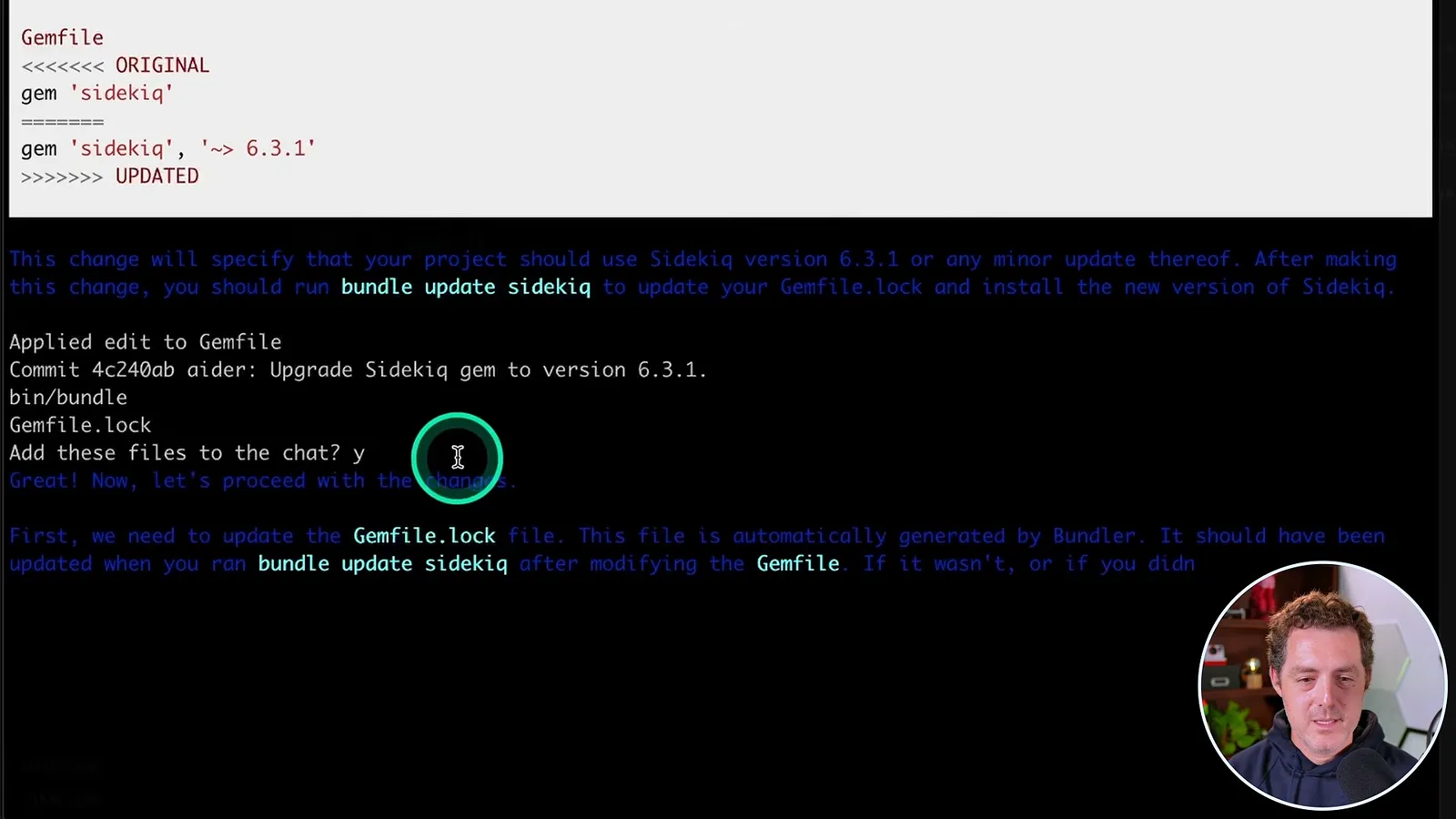
Berman appreciates that the assistant recognizes the lockfile is generated by Bundler instead of simply editing it by hand. The demonstration shows a suggested workflow, not a completed, verified dependency upgrade or compatibility test. He concludes that Aider could help him continue iterating on existing projects.
同じチャンネルの記事
 34:21EN
 Matthew Berman· 2026年10月27日Matthew Berman Examines Anthropic’s IPO Filing, AI Growth and GovernanceMatthew Berman, Sam Altman · Forward FutureThe presenter reviews the S-1’s financial metrics, compute strategy and voting structure while questioning the tension between rapid AI development and safety.
 0:26ENMatthew Berman· 2026年10月25日Sam Altman on Human Values and Problem-Solving in an AI WorldSam Altman · OpenAIIn a short interview excerpt, Altman considers the enjoyment of solving hard problems and the human role in interpreting results.
 0:36ENMatthew Berman· 2026年10月25日Kimi K3.1 and a Rubik’s Cube Solver DemonstrationMatthew Berman · Forward FutureMatthew Berman shows a scrambled virtual cube being solved and gives the Kimi K3.1 test a favorable assessment.
 0:21ENMatthew Berman· 2026年10月24日An AI-Generated Kimi Benchmark Chart Used Invented ScoresMatthew Berman · Forward FutureMatthew Berman asks for a graph of Kimi K3.1 Pro benchmarks, then discovers that the displayed figures are illustrative placeholders.
 25:50ENMatthew Berman· 2026年10月24日Kimi K3.1 Pro Tested: Strong 3D Demos, Uneven Results and Competitive PricingMatthew Berman · Forward FutureMatthew Berman tests the open-weight model on coding, 3D rendering and visual explanations, then compares benchmark results and prices.
 32:20ENMatthew Berman· 2026年10月23日Who Is Local AI For? The Costs, Trade-offs and a Hybrid FutureMatthew Berman · Forward FutureMatthew Berman weighs data control and independence against hardware cost, setup complexity and inference speed.