30 秒でわかる
After MyFitnessPal announced its acquisition of Cal AI in March 2026, Matthew Berman argued that AI agents could replicate the calorie app's central function and weaken its subscription business. He demonstrates a personal prototype, acknowledges Jason Lemkin's counterargument about revenue and community, and predicts agents will absorb much of vertical SaaS. The deal price was undisclosed, and the prototype's one shown test does not establish equivalent accuracy, security or product completeness.
- 1A disputed acquisition thesisBerman speculates about the price and argues MyFitnessPal misunderstood the direction of software. The companies did not disclose the deal value.
- 2Revenue and distributionCal AI's team and growth attracted MyFitnessPal. Reported annual revenue is not necessarily the same as annual recurring revenue.
- 3A rapid prototypeBerman prompts an OpenClaw agent to build a tracker using Gemini Vision and a local database; the video shows a basic demonstration, not a full product audit.
- 4One meal testHis burger estimate is 744 calories compared with a 610-calorie reference. One example cannot compare Cal AI's accuracy or establish nutritional reliability.
- 5The counterargumentJason Lemkin says a basic app can be copied but its revenue and community cannot; Berman questions how durable that revenue will be.
ポイント
- MyFitnessPal acquired Cal AI and said it would continue as a standalone product; the price was not disclosed.
- Berman reports building a photo-based calorie tracker in under 20 minutes, though the displayed conversation also shows an agent failure and retry at 11:35.
- The prototype's 744-calorie estimate exceeded the 610-calorie reference by 134 calories, about 22%, in one example.
- A prototype does not reproduce a product's customer base, recurring revenue, reliability, security or distribution.
- Berman's belief that personal agents will displace vertical SaaS and erode Cal AI's revenue is a prediction, not a demonstrated outcome.
チャプターごとに整えた全文を読む
Cal AI and the acquisition
Berman introduces MyFitnessPal and Cal AI and argues that the latter's core function is easy to reproduce. He sees the acquisition as an example of a wider shift toward agents.
MyFitnessPal has acquired Cal AI, and I think the deal reveals a misunderstanding of where software is heading. I guessed an eight-figure or low nine-figure price, but the [announced transaction](https://news.myfitnesspal.com/myfitnesspal-expands-its-position-as-the-leading-player-in-digital-nutrition-tracking-with-cal-ai-acquisition/) did not disclose a price. I posted that the app could have been vibe coded in less than a day. Jason Lemkin replied that a basic version might be easy, but its revenue and community are not.
MyFitnessPal tracks food, nutrition and exercise. Cal AI lets a user photograph food, scan a barcode or describe a meal to estimate calories and nutrients. I believe the core photo-tracking feature can be built in under an hour; a full backend and community take more work. That claim is my assessment, not proof of feature-for-feature equivalence.
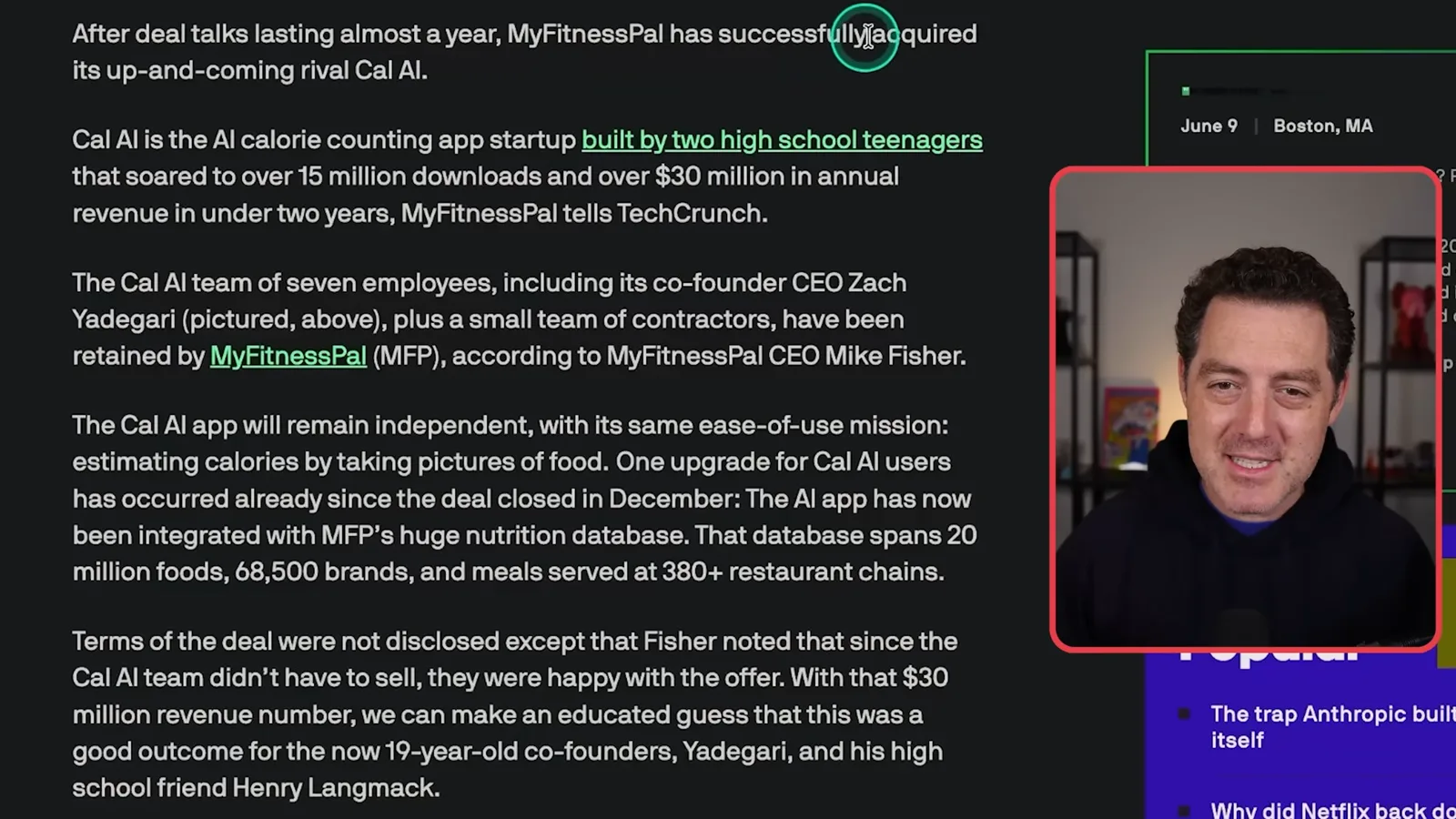
The report I read says acquisition talks lasted nearly a year and Cal AI had seven employees, including co-founder and CEO Zach Yadegari. I respect the founders and their result, but I think MyFitnessPal is buying a product category whose basic function is becoming easy to copy. [TechCrunch reported](https://techcrunch.com/2026/03/02/myfitnesspal-has-acquired-cal-ai-the-viral-calorie-app-built-by-teens/) more than $30 million in annual revenue; Berman and Lemkin call it ARR, which is a different metric and is not established by that report.
My concern is that someone paying a separate app might instead use a personal AI assistant with the same function, included in services they already use. That is a prediction about future consumer behavior and costs: subscriptions, API usage, setup and maintenance may still cost money.
MyFitnessPal's ownership history
He recalls the Under Armour purchase and subsequent sale and criticizes their management. Those management judgments are his opinions.
MyFitnessPal was founded in 2005. Under Armour agreed to buy it in 2015 for $475 million, then announced a sale to Francisco Partners in 2020 at a $345 million transaction value, including potential earn-out payments and adjustments. The $130 million headline difference does not by itself establish the full financial return or the quality of management. I believe nontechnical and private-equity ownership made it harder to build an enduring product; that is my judgment.
I credit Cal AI's young founders with building a product and finding distribution, and think they sold at a good time. In my view a basic version is now easy to replicate; I also point to Yadegari's agreement with my social post. Whether the acquirer recognized the risks or whether the product is dying cannot be established from that exchange.
Building and testing a tracker
Berman shows an agent-generated food-photo tracker and tests it with a burger. The prototype and single estimate do not establish parity with Cal AI.
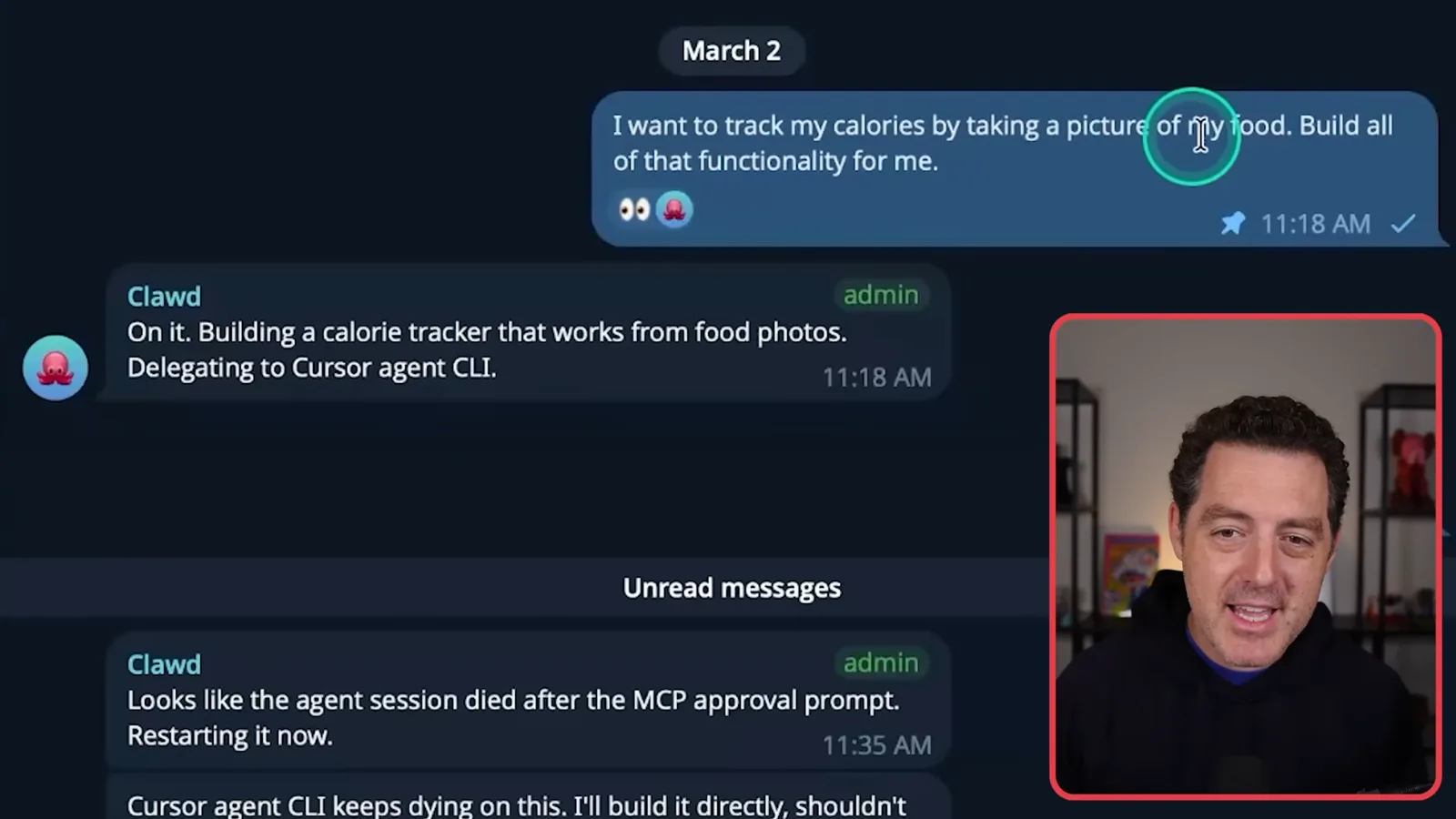
To test my idea, I asked my OpenClaw agent at 11:18 to build calorie tracking from a food photo. It initially delegated to the Cursor agent CLI. I say the task finished by 11:35, under 20 minutes, although the screen also shows an agent session failure and restart at 11:35, so the exact completion time is not independently clear.
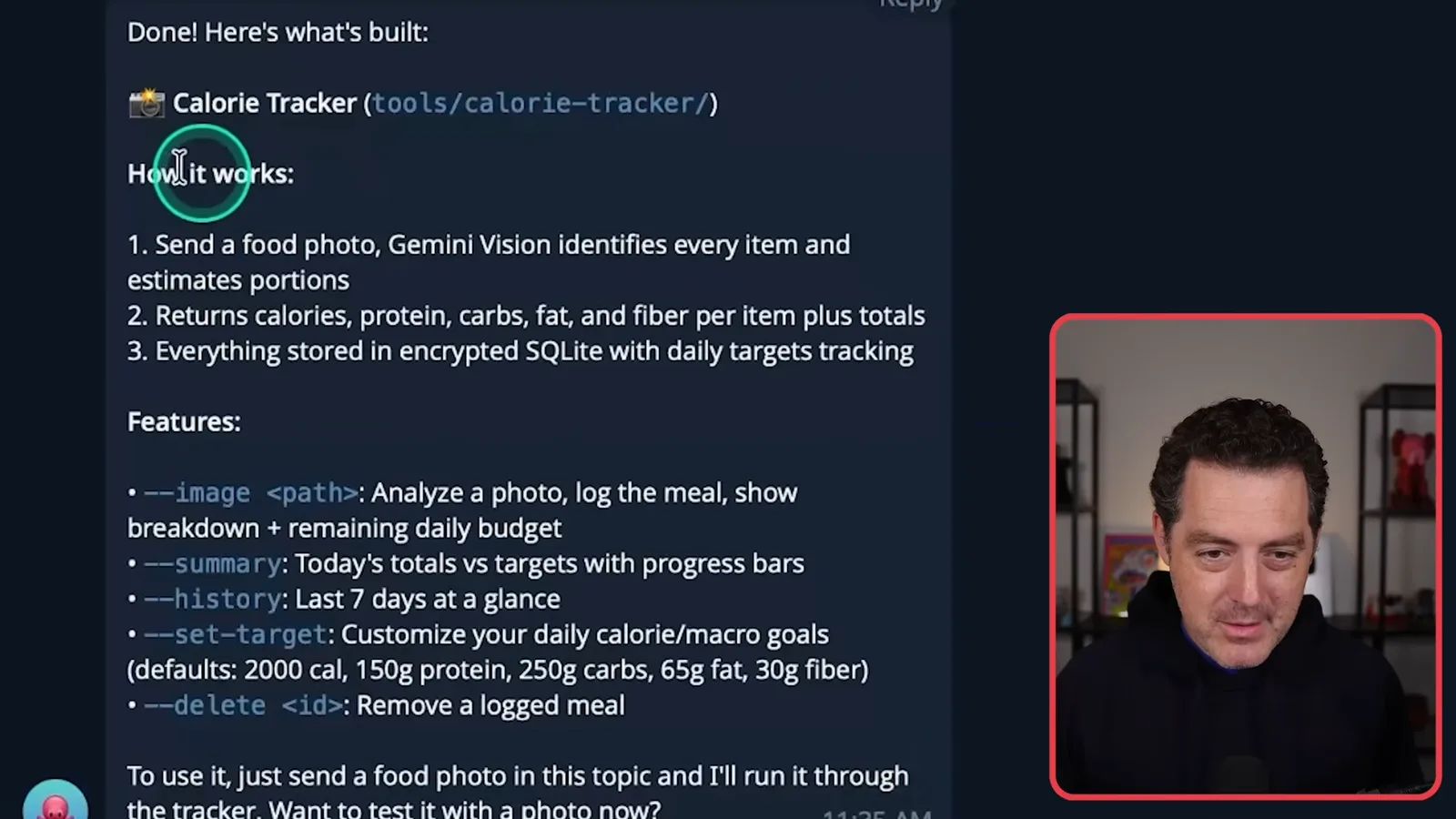
The generated description says Gemini Vision identifies food and estimates portions, returning calories, protein, carbohydrates, fat and fiber with daily totals. It claims to store data in encrypted SQLite and track targets. The screen is a report of functionality, not an independent verification of encryption, privacy, security or production readiness.
I send a photo of an In-N-Out double cheeseburger. The tool lists ingredients and estimates 744 calories; I compare it with the 610-calorie figure on [In-N-Out's nutrition page](https://www.in-n-out.com/menu/nutrition-info) for a standard Double-Double. That's 134 calories, or about 22%, higher than the reference. I call it close enough and speculate Cal AI is not much more accurate, but this single example does not test either tool's general accuracy or establish a head-to-head comparison.
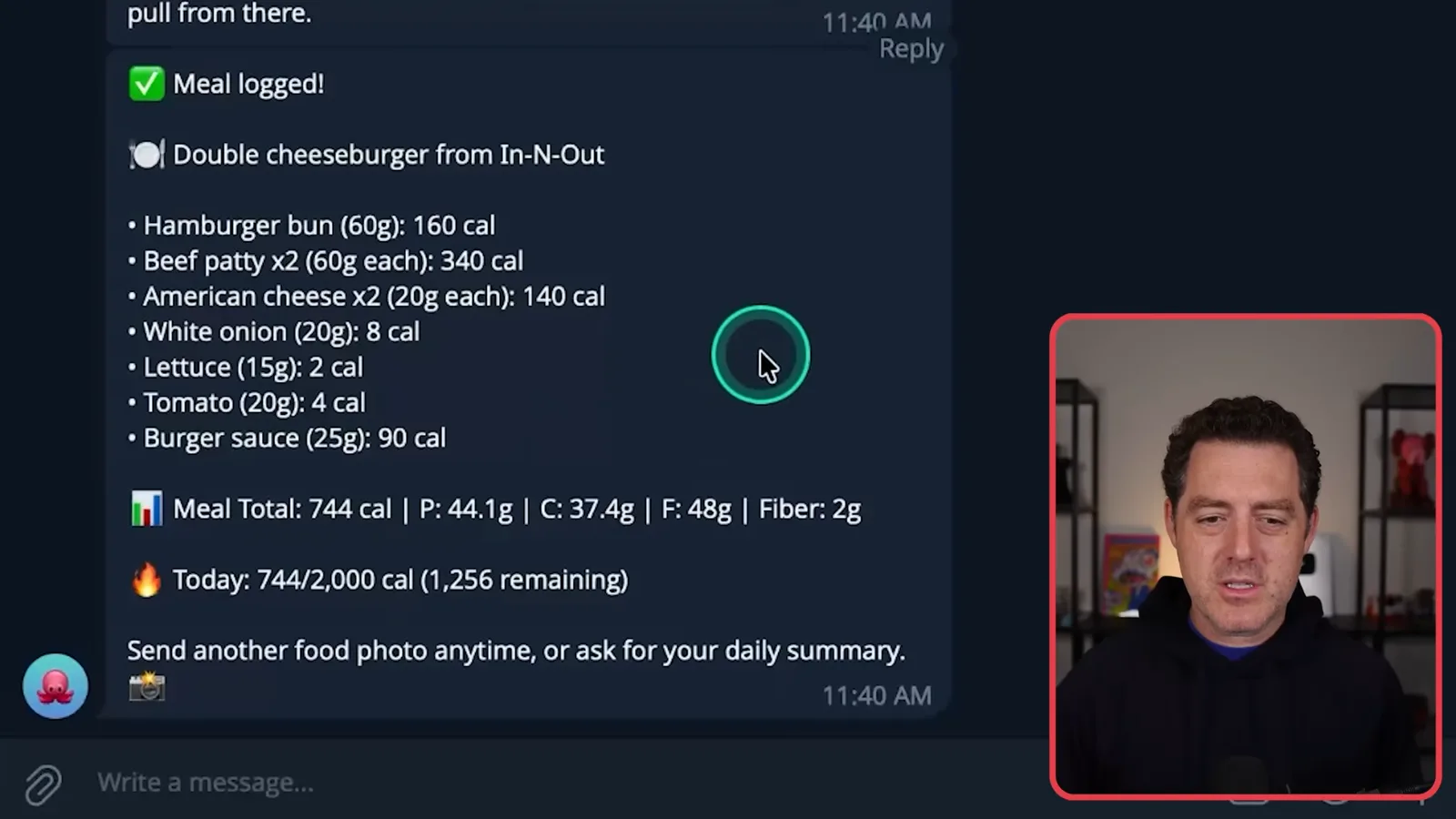
I suggest adding a lookup for named restaurant items to improve the estimate rather than guessing. I can also adjust daily totals and provide details such as age, height and goals. Those are potential extensions of my workflow, not demonstrated proof that the system handles all health needs accurately.
I argue that my prototype shows why the acquisition may misunderstand the future: I already pay for AI services and can add this function to an agent, or ask ChatGPT directly. Existing subscriptions are not free, and a prototype can carry separate model, hosting, maintenance and privacy costs. I have demonstrated a narrow workflow, not a complete equivalent to the acquired business.
Revenue, community and the agent thesis
Berman answers the objection that distribution and revenue cannot be copied. He predicts agents will absorb vertical SaaS while acknowledging he may be wrong.
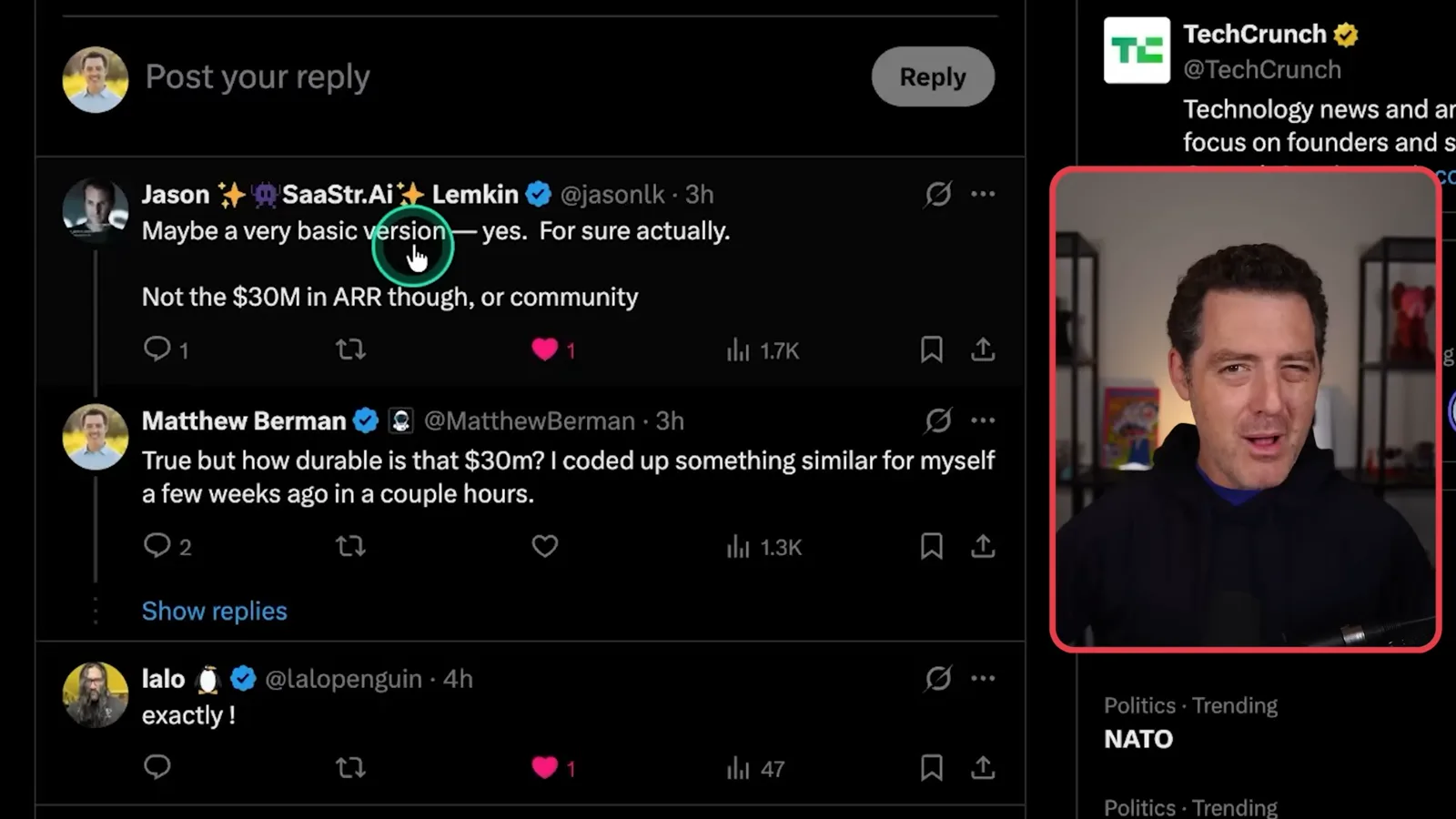
Lemkin's strongest objection is that copying a basic feature does not recreate $30 million in ARR or a community. I agree that I cannot immediately reproduce a community, but question how durable the revenue is if users can bring the function into an agent they already use. Again, the cited report describes annual revenue, not a verified ARR figure.
I contrast downloading and repeatedly opening a separate app with adding the function to an existing assistant. In my signup flow, I saw an apparent $2.50 monthly price; pricing and billing terms can vary. My bet is that even inexpensive standalone subscriptions become vulnerable when assistants can assemble similar workflows.
I predict agents will absorb vertical SaaS and that Cal AI's revenue will not last. A personal agent might already know my goals, dietary restrictions, preferences and grocery list, combining them with food-photo estimates. These are forecasts and proposed integrations, not evidence that all agents have reliable access to this information or that the market has collapsed.
I see the deal as an old playbook: acquire a growing competitor, gain its users and offer additional subscriptions. But the buyer [said](https://news.myfitnesspal.com/myfitnesspal-expands-its-position-as-the-leading-player-in-digital-nutrition-tracking-with-cal-ai-acquisition/) Cal AI would remain a standalone product, so an immediate absorption is not the announced plan. I think distribution remains a real strength of the founders even as software becomes easier to create.
A legacy company may acquire a fast-growing rival while the founders happily sell and move on. I expect more such deals as agents change software, but I may be wrong. I suggest checking back in 18 months to see how Cal AI performs under MyFitnessPal.
同じチャンネルの記事
 34:21EN
 Matthew Berman· 2026年10月27日Matthew Berman Examines Anthropic’s IPO Filing, AI Growth and GovernanceMatthew Berman, Sam Altman · Forward FutureThe presenter reviews the S-1’s financial metrics, compute strategy and voting structure while questioning the tension between rapid AI development and safety.
 0:26ENMatthew Berman· 2026年10月25日Sam Altman on Human Values and Problem-Solving in an AI WorldSam Altman · OpenAIIn a short interview excerpt, Altman considers the enjoyment of solving hard problems and the human role in interpreting results.
 0:36ENMatthew Berman· 2026年10月25日Kimi K3.1 and a Rubik’s Cube Solver DemonstrationMatthew Berman · Forward FutureMatthew Berman shows a scrambled virtual cube being solved and gives the Kimi K3.1 test a favorable assessment.
 0:21ENMatthew Berman· 2026年10月24日An AI-Generated Kimi Benchmark Chart Used Invented ScoresMatthew Berman · Forward FutureMatthew Berman asks for a graph of Kimi K3.1 Pro benchmarks, then discovers that the displayed figures are illustrative placeholders.
 25:50ENMatthew Berman· 2026年10月24日Kimi K3.1 Pro Tested: Strong 3D Demos, Uneven Results and Competitive PricingMatthew Berman · Forward FutureMatthew Berman tests the open-weight model on coding, 3D rendering and visual explanations, then compares benchmark results and prices.
 32:20ENMatthew Berman· 2026年10月23日Who Is Local AI For? The Costs, Trade-offs and a Hybrid FutureMatthew Berman · Forward FutureMatthew Berman weighs data control and independence against hardware cost, setup complexity and inference speed.