30 秒でわかる
In this April 2024 short, Matthew Berman introduces Meta’s Llama 3 release and shows two quick experiments: generating a Python Snake game and requesting an image of a robotic llama in Meta AI. The demonstrations are individual examples, not a systematic benchmark or proof that the Llama language model itself generates images.
- 1The initial releaseBerman introduces Meta’s 8B and 70B Llama 3 pretrained and instruction-tuned models.
- 2Training scaleHe cites Meta’s description of the training data and GPU clusters.
- 3Two quick demonstrationsHe runs generated Snake code and requests an image; these examples are not standardized model evaluations.
ポイント
- Meta introduced 8B and 70B Llama 3 models in pretrained and instruction-tuned variants in April 2024.
- Meta said training used more than 15 trillion tokens and runs on two 24,000-GPU clusters.
- Berman reports that his generated Python Snake game worked in his demonstration.
- The robotic-llama image is a Meta AI product demonstration and does not establish native image generation by the released text models.
- Llama 3 weights were available under Meta’s community license, which includes conditions and restrictions.
チャプターごとに整えた全文を読む
Introducing Llama 3
Berman reads Meta’s description of the first Llama 3 models and their training scale. The available weights were governed by Meta’s community license.
Matthew Berman introduces Meta’s Llama 3 release on April 18, 2024. Meta announced 8-billion- and 70-billion-parameter models in pretrained and instruction-tuned versions. Their weights were made available under the Llama 3 Community License, whose conditions include an additional license requirement for certain very large services; “open weights” does not mean unrestricted use.
Berman cites Meta’s description of training on more than 15 trillion tokens and using two custom-built clusters of 24,000 GPUs. Those are Meta’s reported details of the initial release. The video’s title refers to benchmarks, but the short does not present a benchmark comparison or establish a general ranking.
Trying code and image generation
Berman asks for a Python Snake game and reports that it runs. He then requests a robotic llama image through Meta AI.
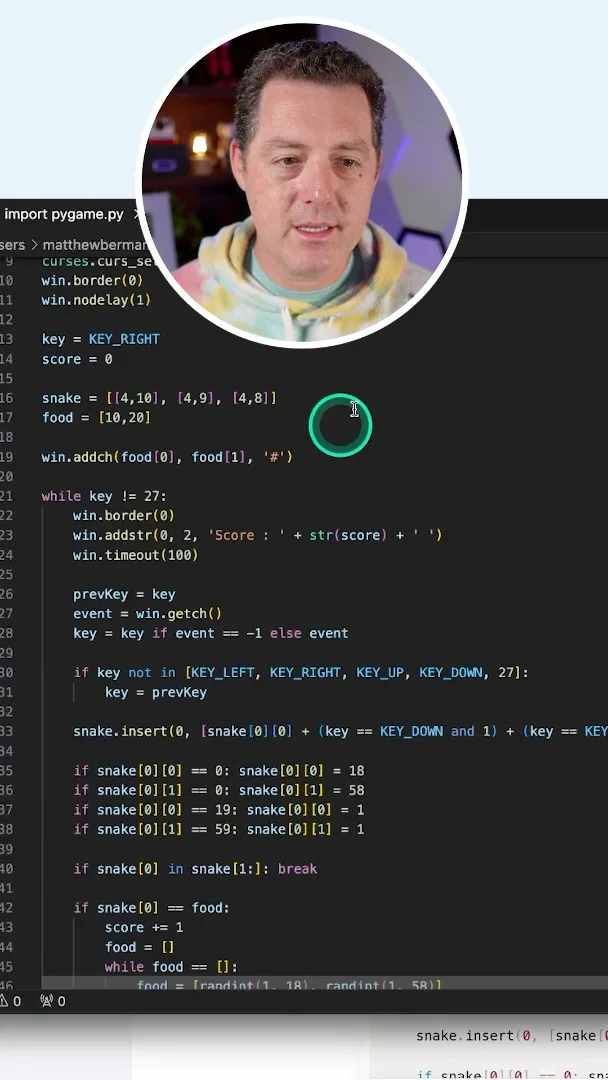
For a quick test, Berman asks the assistant to write Snake in Python, copies the generated code and runs it. He says the resulting game works and calls it one of the more complete examples he has seen. This is one informal demonstration, not a controlled assessment of coding reliability.
Berman next asks Meta AI for an image of a robotic llama and reacts favorably to the result. This demonstrates the assistant’s image feature; it should not be taken as evidence that the released Llama 3 text model itself is an image generator.
同じチャンネルの記事
 34:21EN
 Matthew Berman· 2026年10月27日Matthew Berman Examines Anthropic’s IPO Filing, AI Growth and GovernanceMatthew Berman, Sam Altman · Forward FutureThe presenter reviews the S-1’s financial metrics, compute strategy and voting structure while questioning the tension between rapid AI development and safety.
 0:26ENMatthew Berman· 2026年10月25日Sam Altman on Human Values and Problem-Solving in an AI WorldSam Altman · OpenAIIn a short interview excerpt, Altman considers the enjoyment of solving hard problems and the human role in interpreting results.
 0:36ENMatthew Berman· 2026年10月25日Kimi K3.1 and a Rubik’s Cube Solver DemonstrationMatthew Berman · Forward FutureMatthew Berman shows a scrambled virtual cube being solved and gives the Kimi K3.1 test a favorable assessment.
 0:21ENMatthew Berman· 2026年10月24日An AI-Generated Kimi Benchmark Chart Used Invented ScoresMatthew Berman · Forward FutureMatthew Berman asks for a graph of Kimi K3.1 Pro benchmarks, then discovers that the displayed figures are illustrative placeholders.
 25:50ENMatthew Berman· 2026年10月24日Kimi K3.1 Pro Tested: Strong 3D Demos, Uneven Results and Competitive PricingMatthew Berman · Forward FutureMatthew Berman tests the open-weight model on coding, 3D rendering and visual explanations, then compares benchmark results and prices.
 32:20ENMatthew Berman· 2026年10月23日Who Is Local AI For? The Costs, Trade-offs and a Hybrid FutureMatthew Berman · Forward FutureMatthew Berman weighs data control and independence against hardware cost, setup complexity and inference speed.