30 秒でわかる
In April 2024, Matthew Berman reviews Vinod Khosla’s twelve optimistic predictions for 2035–2049. He welcomes the prospect of affordable expertise, personalized services and cleaner technology, while questioning robot timelines, resource abundance and the consequences for jobs. These are forecasts and opinions, not established outcomes; the video description promotes Pinecone but does not explicitly identify a sponsorship.
- 1Expertise and workKhosla imagines near-free AI doctors and tutors. Berman expects more accessible knowledge while recognizing job displacement and the difficulty of physical automation.
- 2Programming and entertainmentThe speakers foresee natural-language software creation and personalized media; Berman speculates that programmers could eventually disappear.
- 3Agents as an internet filterBerman welcomes personal agents that act and filter information, while worrying about the biases and opacity of those filters.
- 4Transport and energyForecasts include shared autonomous transit, Mach 5 travel and fusion or geothermal energy. These are possibilities, not established capabilities.
- 5Obstacles to the forecastsKhosla lists regulation, entrenched interests, technical failures, market conditions and unexpected events as potential delays.
ポイント
- Khosla’s twelve proposals describe plausible futures for 2035–2049, not evidence that those outcomes will happen.
- Berman expects AI to make some expertise cheaper but also raises questions about accuracy, access and displaced work.
- A billion robots, personalized medicine and mostly agent-mediated internet access are forecasts with major technical and social uncertainties.
- The video’s assumption that a model file contains essentially all human knowledge overstates what model weights encode and can reliably deliver.
- Tesla’s robotaxi concept was unveiled in October 2024, after the August date mentioned in the video; a presentation does not prove large-scale autonomous deployment.
- Fusion power, Mach 5 travel and carbon removal at the scale described require further technical and economic development.
チャプターごとに整えた全文を読む
A venture capitalist’s optimistic forecasts
Berman introduces Khosla and his horizon of 2035–2049. The forecasts are aspirational and uncertain.
Venture capitalist Vinod Khosla has published twelve predictions about technology and abundance. In April 2024 I want to walk through them and explain where I agree, where I am uncertain and what the downsides could be. Khosla Ventures has invested in companies including DoorDash, Stripe and OpenAI; its financial interests are relevant context for his optimistic forecasts.
Khosla presents these as plausible futures for 2035–2049, not a guarantee ([Khosla Ventures](https://www.khoslaventures.com/posts/ted-12-predictions-for-the-future-of-technology)). I am generally optimistic about technology too, but the timing, costs, social effects and technical feasibility of each prediction remain open questions.
Expertise, labor and programming
Predictions include near-free AI expertise, a billion robots and many more natural-language programmers. Berman discusses displacement and automation limitations.
First, Khosla predicts nearly free expertise, including around-the-clock AI doctors and tutors. I think AI could make some knowledge and assistance much more accessible, including in software and creative work. But my suggestion that a small model file essentially contains all human knowledge is an overstatement: model outputs can be incomplete or wrong, and access to a model is not the same as qualified clinical or teaching care.
If expertise becomes cheaper, people might solve problems that previously required a specialist, while professionals face changes to their work. I still expect a role for discovery and frontier expertise. Whether AI replaces or complements particular occupations depends on reliability, accountability, economics and how people use it.
I contrast knowledge work with physical work. Flexible manipulation remains difficult for robots, and I recall Elon Musk’s admission that excessive automation at Tesla was a mistake. That example supports caution about a particular factory effort; it does not prove that every manual task is safe from automation or that every knowledge job has already been replaced.
Second, Khosla imagines a billion bipedal and other robots taking on undesirable jobs. I doubt that scale will arrive within ten years, though I am more open to the longer end of his horizon. More productive automation might raise output, but robots require capital, energy, maintenance and oversight; they would not literally provide cost-free labor.
I wonder whether higher productivity could help address economic pressures, including US public debt. That is a possibility, not a demonstrated solution: fiscal outcomes also depend on distribution, taxes, spending and many other choices. I am also unsure what displaced workers would do or how people would find income and purpose.
Third, Khosla predicts more than a billion people programming in human language and computers adapting to people. I think natural-language interfaces could broaden participation. I go further and speculate that programmers might eventually no longer be needed, with AI translating requests into computation; that is my forecast, not an established trajectory.
I also imagine machines using highly compact internal representations that humans cannot easily read, with a translation layer for people. This is conjecture. If software or agent behavior becomes harder to inspect, understanding, testing and accountability could become more important, not less.
Entertainment, agents and medicine
Khosla imagines personalized media, agents mediating internet access and precision medicine. Berman weighs potential benefits against bias and uncertainty.
Fourth, Khosla predicts abundant personalized music, entertainment and design, while expecting celebrity–fan relationships to persist. I imagine content generated dynamically for an audience of one, including games or films. I am less certain about celebrity relationships: shared stars may remain important, or personalized characters could change how audiences relate to them.
Fifth, Khosla expects internet access to be mediated largely by agents that perform tasks and filter marketers or bots. I see the appeal of an assistant sorting an overwhelming flow of information, but worry that the filter itself may introduce bias. Open models can make some components inspectable, though openness alone does not guarantee an understandable, unbiased system.
I point to the Rabbit device as an early glimpse of task-oriented interfaces, not evidence that it can reliably complete every task. My broader prediction is that agents will increasingly retrieve information and act on our behalf. How much people will actually delegate and who controls those agents remain unresolved.
Sixth, Khosla imagines precision medicine tailored to an individual’s biological data, including simulations for treatments and doses. I like the idea of individualized research and care, although I have not thought through the details. Clinical validation, privacy, equitable access and professional oversight remain necessary; the prediction is not evidence that a complete virtual patient can already safely prescribe treatment.
Food, transport and energy
Predictions cover alternative proteins, shared autonomous transit, faster aviation and new energy. Berman distinguishes his enthusiasm from areas he knows less about.
Seventh, he predicts improved alternative proteins and fertilizers. I am open to plant-based, cultivated or other alternatives because conventional meat has environmental impacts, but I prefer the taste of meat to the products I have tried. Whether future alternatives surpass conventional products on taste, nutrition, cost and sustainability remains an open question.
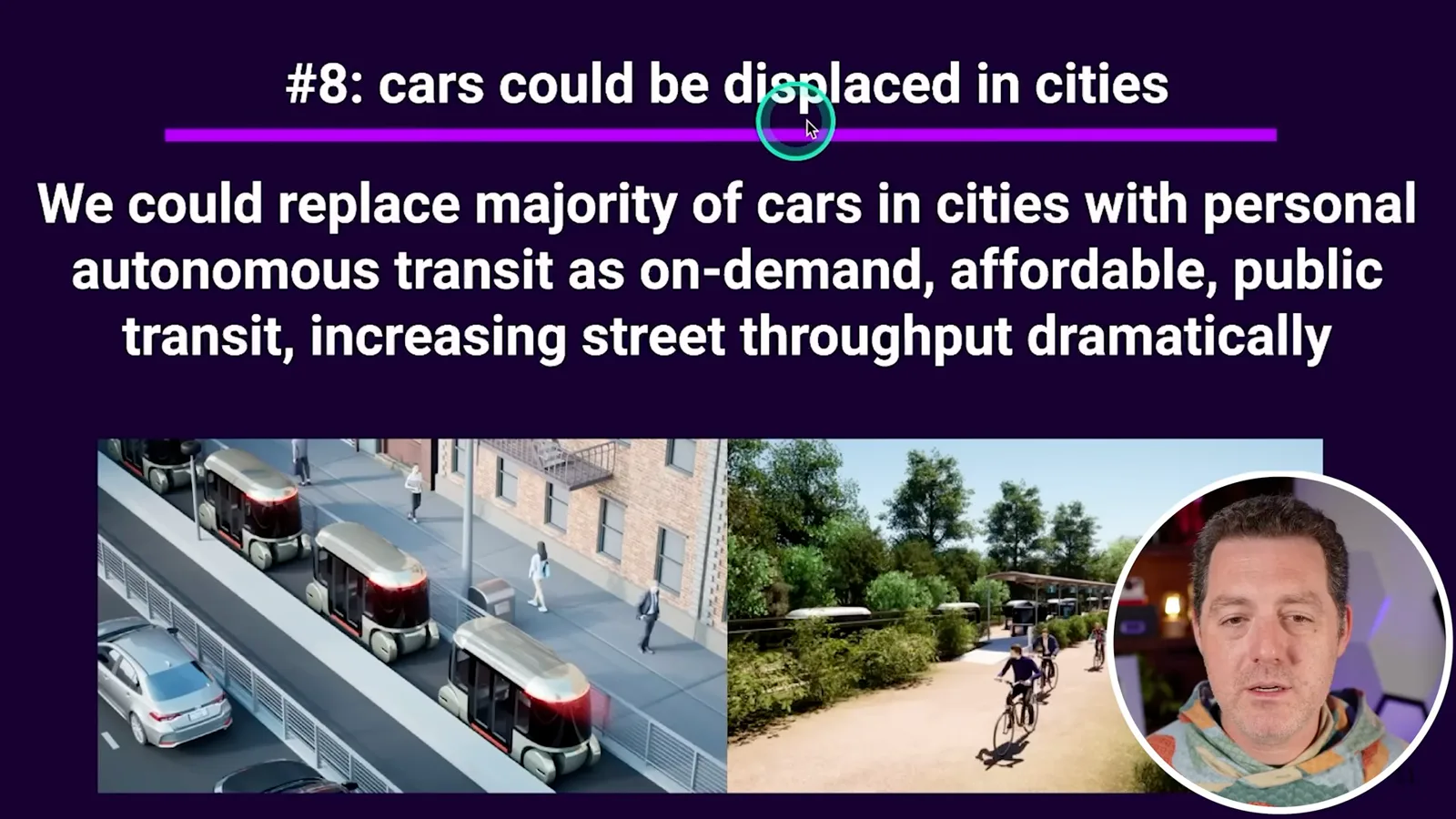
Eighth, Khosla sees shared autonomous transit replacing many city car trips. I think higher vehicle utilization could be useful and note Waymo’s service in San Francisco. I mention a Tesla robotaxi reveal planned for August 2024; the event was later delayed, with the Cybercab presented in October ([AP](https://apnews.com/article/a00d063f2ffc67125889a6635a0a607e)). A concept unveiling alone does not establish safe, widespread driverless service.
Ninth, Khosla predicts Mach 5 aircraft that could fly from New York to London in 90 minutes on sustainable fuel. I would welcome faster travel but do not know enough to judge its feasibility. Concorde’s retirement reminds me that speed must also be weighed against cost, fuel, noise and other operational constraints.
Tenth, Khosla expects clean dispatchable power by 2050, including fusion boilers and enhanced geothermal. I expect AI data centers to need more electricity and speculate that small modular nuclear plants could be built nearby. These are forecasts: fusion ignition experiments have not by themselves demonstrated a commercial grid power plant, and deployment depends on engineering and economics ([Lawrence Livermore](https://lasers.llnl.gov/sites/lasers/files/2024-06/the-bridge-fusion-ignition.pdf)).
Resources, climate and obstacles
Khosla predicts more resource availability and climate technologies, while listing forces that could slow progress. Berman ends with his own views on technological optimism and entrepreneurship.
Eleventh, Khosla forecasts discovery of more resources than society consumes, including lithium, cobalt and copper. I am doubtful because discovery and extraction have costs and environmental effects. Battery and storage demand makes the question important, but neither abundant supply nor an unavoidable shortage follows automatically from the prediction.
Twelfth, Khosla expects entrepreneurs to develop and scale solutions for emissions in cement, steel, agriculture, transport, power and direct air capture. I am optimistic that technology can help, while recognizing that electric vehicles and other alternatives have their own problems. The size, cost and speed of deployment remain uncertain.
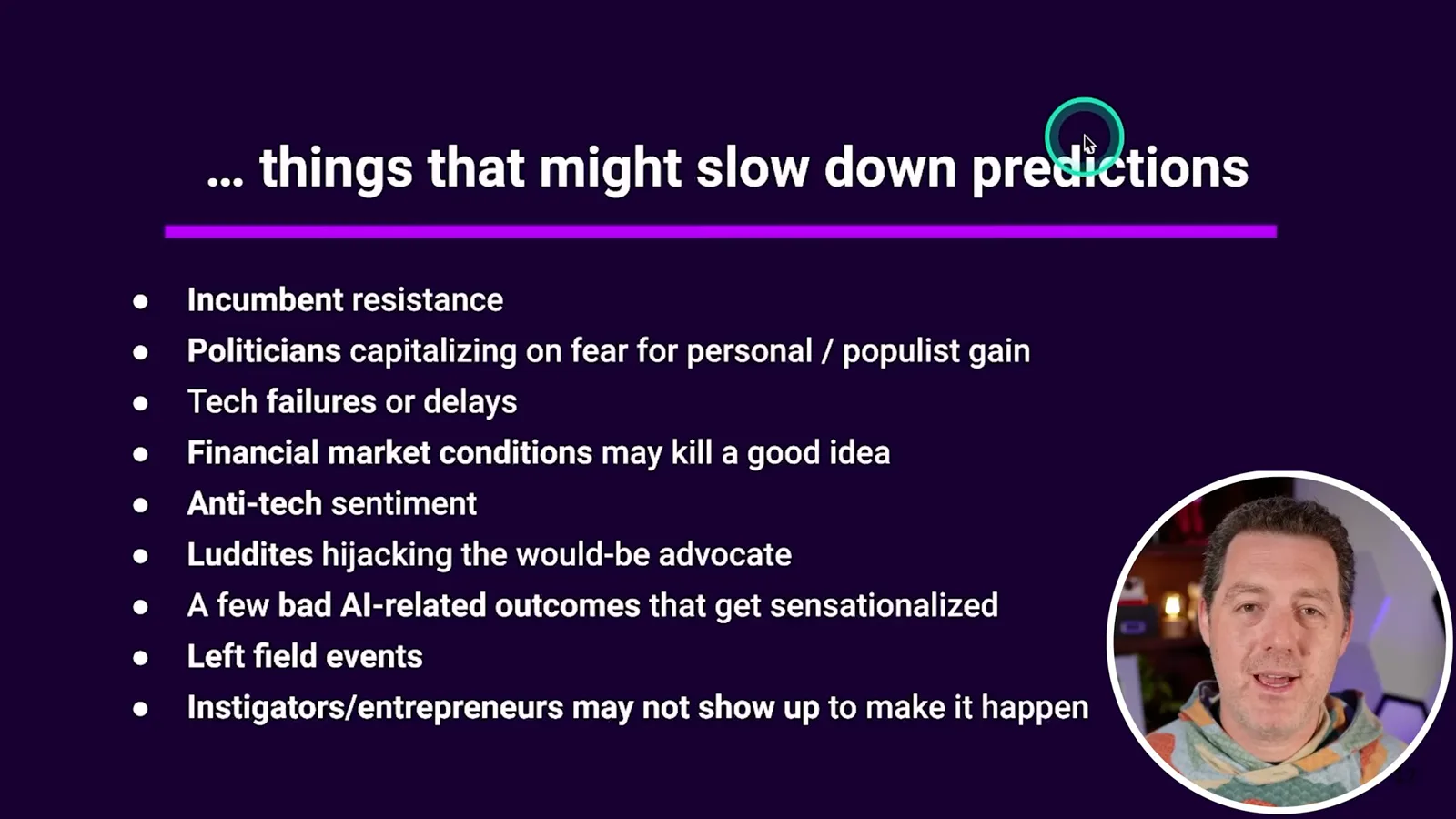
Khosla lists possible obstacles: resistance from incumbents, political incentives, technical setbacks, market conditions, anti-technology sentiment, adverse AI outcomes, unexpected events and a shortage of entrepreneurs. I think failures should already be included in a realistic forecast rather than treated only as delays. Regulation and public concern may affect adoption, but their effects depend on the specific rules and risks.
I am bullish on entrepreneurship and encourage people to pursue ideas that can create value. The overall exercise is a vision of what might be possible, not a timetable on which any particular outcome can be taken for granted.
同じチャンネルの記事
 34:21EN
 Matthew Berman· 2026年10月27日Matthew Berman Examines Anthropic’s IPO Filing, AI Growth and GovernanceMatthew Berman, Sam Altman · Forward FutureThe presenter reviews the S-1’s financial metrics, compute strategy and voting structure while questioning the tension between rapid AI development and safety.
 0:26ENMatthew Berman· 2026年10月25日Sam Altman on Human Values and Problem-Solving in an AI WorldSam Altman · OpenAIIn a short interview excerpt, Altman considers the enjoyment of solving hard problems and the human role in interpreting results.
 0:36ENMatthew Berman· 2026年10月25日Kimi K3.1 and a Rubik’s Cube Solver DemonstrationMatthew Berman · Forward FutureMatthew Berman shows a scrambled virtual cube being solved and gives the Kimi K3.1 test a favorable assessment.
 0:21ENMatthew Berman· 2026年10月24日An AI-Generated Kimi Benchmark Chart Used Invented ScoresMatthew Berman · Forward FutureMatthew Berman asks for a graph of Kimi K3.1 Pro benchmarks, then discovers that the displayed figures are illustrative placeholders.
 25:50ENMatthew Berman· 2026年10月24日Kimi K3.1 Pro Tested: Strong 3D Demos, Uneven Results and Competitive PricingMatthew Berman · Forward FutureMatthew Berman tests the open-weight model on coding, 3D rendering and visual explanations, then compares benchmark results and prices.
 32:20ENMatthew Berman· 2026年10月23日Who Is Local AI For? The Costs, Trade-offs and a Hybrid FutureMatthew Berman · Forward FutureMatthew Berman weighs data control and independence against hardware cost, setup complexity and inference speed.