30 秒でわかる
Meta engineers describe one AI teammate per on-call rotation, connecting alerts, tickets, deployments and past incidents into an investigation with evidence. It starts by suggesting, can draft fixes for approval and may handle selected low-criticality work after demonstrating reliability. Critical decisions stay human-owned and code still goes through review. The team says early signs are promising but has not yet quantified time saved in a rigorous study.
- 1One teammate connects clues held in separate toolsThe design brings alerts, tickets, deployments and incident history into one investigation.
- 2Autonomy grows from investigation to selected low-risk actionsHigher-criticality production decisions remain with people.
- 3Triage, recovery and handoff are separate loopsThe system routes new work, detects stuck runs and prepares shift summaries.
- 4Time savings remain to be measured rigorouslyThe speakers describe promising early signs without assigning a measured savings figure.
ポイント
- Connect incident signals before asking a person to decide.
- Grant autonomy by action, based on the cost and detectability of mistakes.
- Keep critical decisions and ordinary code-review gates with humans.
- Share useful team knowledge across shifts and retire stale memory.
- Measure actual time saved rather than relying on usage counts.
チャプターごとに整えた全文を読む
Connect the clues behind an on-call page
The team contrasts a reactive assistant with a teammate that prepares an investigation. Their 2 a.m. example is illustrative.
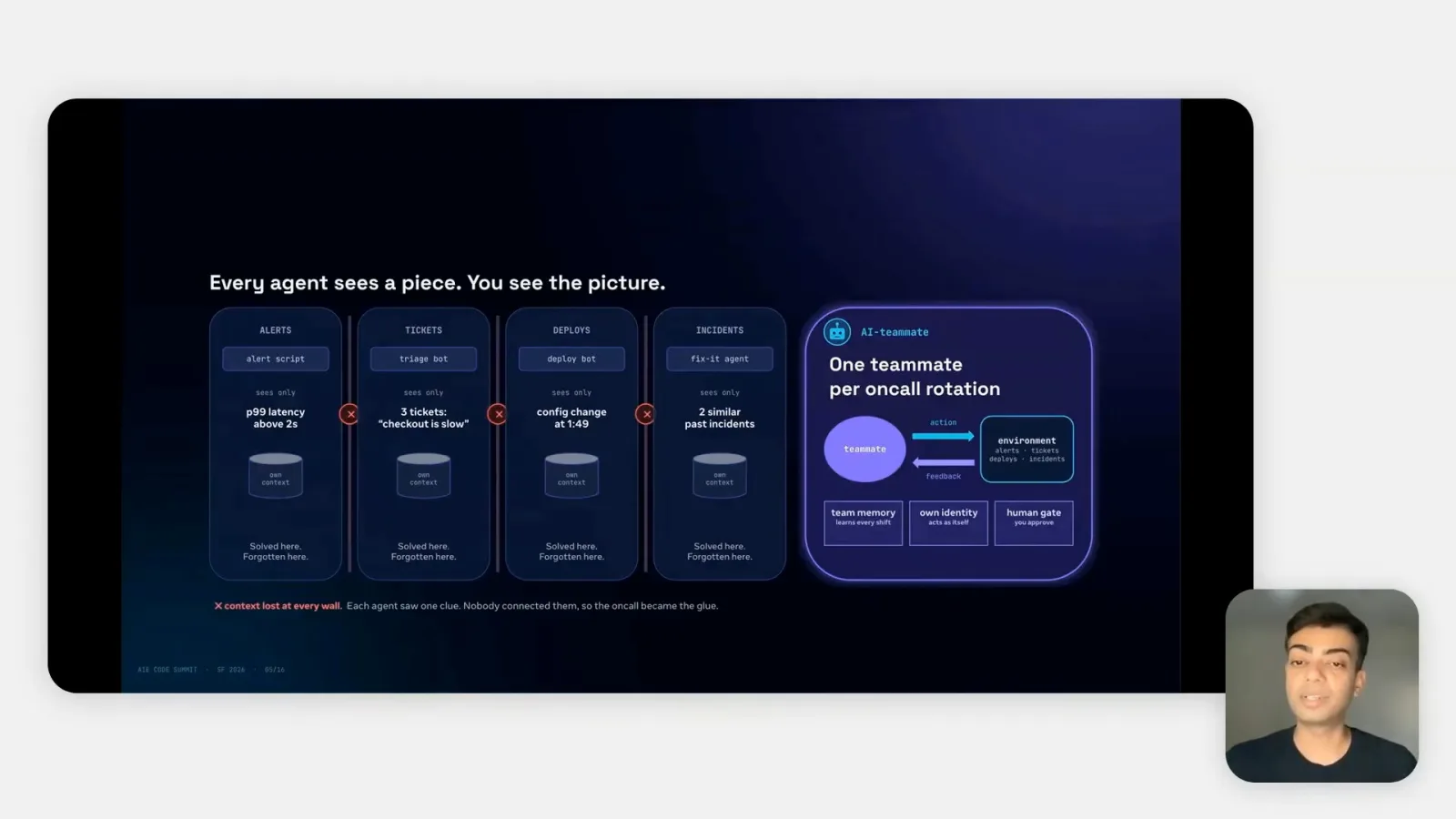
Meta engineers Chinmay Gandhi, Swaapnika Motapothula and Vlad Tsvang describe an AI teammate for on-call rotations. Their aim is to connect alerts, tickets, deployments and incident history so engineers receive evidence and a decision to make.
In an illustrative 2 a.m. incident, twelve alerts arrive together. A conventional assistant can investigate when asked, but the engineer still chooses every next step and connects the findings. The proposed teammate starts triage earlier and prepares a hypothesis, evidence and a possible fix.
Separate alert, ticket, deployment and incident tools each hold part of the context. The team proposes one teammate per rotation, with its own identity, shared team memory and a human approval gate.
Earn autonomy based on risk
The agent progresses from investigation to drafting and selected low-criticality actions. People retain critical decisions and review.
The autonomy ladder begins with investigation and suggestions only. At the next level the agent drafts a fix for human approval. A third level handles selected lower-criticality work while high-criticality production decisions remain with people.
An action earns more autonomy only when an error is inexpensive and easy to catch, and the agent has a track record on that particular action. Code changes still pass through normal review and continuous integration.
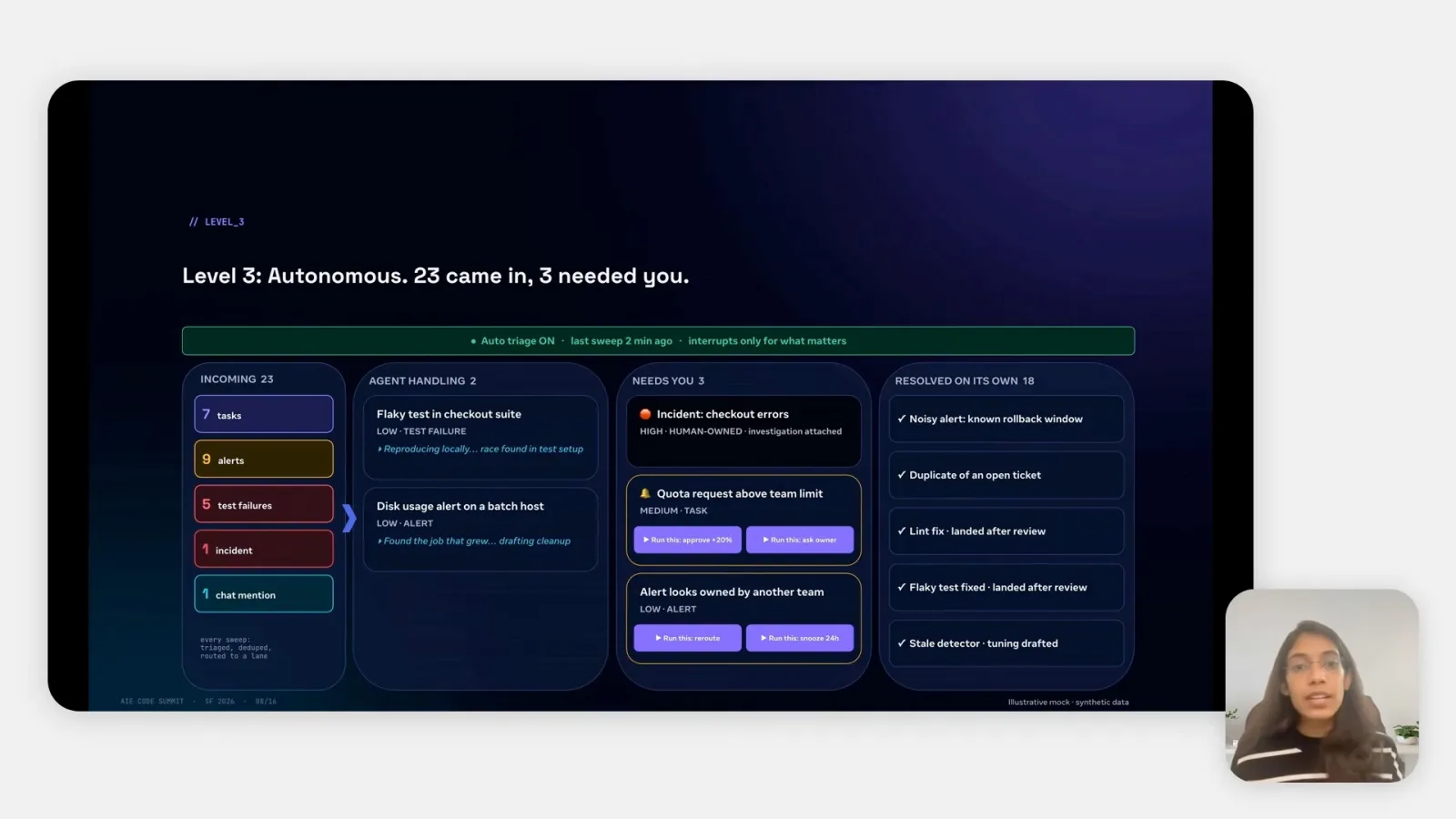
An illustrative board shows 23 incoming items, with three requiring a human decision, two in progress and 18 handled. The speakers use synthetic example data; they do not claim these figures as measured production savings.
Triage, recover and hand off
Automation routes signals, checks for stuck work and summarizes shifts. Teams can provide their own skills and runbooks.
Three automation loops triage incoming signals, look for stuck or failed runs, and prepare shift handoffs. The system can route an alert, task or test failure to an appropriate investigator and notify a person when it needs help.
Teams can supply their own agents, skills and runbooks. Runs are logged so another engineer can inspect the trajectory or resume the conversation instead of starting from scratch.
Share memory and measure the results
Team-owned memory carries corrections between shifts. The team plans a rigorous study of time saved.
The teammate belongs to the rotation rather than an individual. Its team-owned identity has only the access the team grants, and shared memory carries useful decisions and corrections between shifts.
Memory must remain useful as circumstances change: entries can be scored, promoted or retired. When someone corrects an answer, the work can reopen and the correction becomes new evidence for the team.
The team says early signs of reduced on-call load are promising but reserves a numerical savings claim for a rigorous study. Next steps include improving accepted mitigations, incorporating feedback and measuring time saved.
同じチャンネルの記事
 38:50EN
 AI Engineer· 2026年11月10日LinkedIn’s self-improving agent first had to fix its judgesZiwei Guo, Saloni Gandhi · LinkedInA prompt-optimization loop improved a career agent, but unreliable evaluators required human calibration first.
 12:48ENAI Engineer· 2026年11月10日Brian Douglas: Turn agent corrections into reusable review knowledgeBrian Douglas · Paper ComputeThe Paper Compute developer captures expert pushback in coding sessions and tests ways to reuse it during review.
 12:20ENAI Engineer· 2026年11月10日Ayush Bhardwaj: Agent workarounds are feedback for your CLIAyush Bhardwaj · Allos AIAn audit of coding sessions shows where output, errors and stale instructions force agents to improvise.
 12:57ENAI Engineer· 2026年11月10日Harvey’s agents scaled until their platform and merge queue brokeJoey Wang · HarveyAfter an alert spawned 900 agents and one engineer launched 950 tasks, Harvey added deduplication and fair scheduling.
 23:00ENAI Engineer· 2026年11月10日A passing PR check needs evidence tied to the submitted codeStephen Chin, Cassandra Chin · Neo4jStephen and Cassandra Chin show how Tracetoon connects agent traces, code changes and checks before writing a reviewable pull request.
 22:49ENAI Engineer· 2026年11月10日When many coding agents share one codebase, delivery must handle concurrencyPatrick Debois · TesslPatrick Debois explains how shared planning, merge strategies and risk-based review can help teams coordinate agents.