30 秒でわかる
Amp CEO Quinn Slack says a year-long hiring constraint helped his 21-person team build an agent-centered company. Employees coordinate in shared agent threads, ship small monitored changes and handle customer problems directly. Agents help investigate reports and identify other affected users; the team also built a customer-management tool tailored to its needs. Slack says Amp is profitable with more than $100 million in annual recurring revenue, and argues that small teams with meaningful ownership can work differently from traditional software companies.
- 1Even the CEO struggled to change a 200-person companySlack says he could change Sourcegraph’s processes in theory, but found the transformation hard. He formed a small Amp team inside the company to focus on agents.
- 2A hiring freeze forced Amp to rethink its workflowThe spin-off process left Amp unable to hire or grant options for a year. Slack says the team had to work with the 21 people it brought over.
- 3Agent threads became the place where the team works togetherAmp dropped its task tracker and support system, Slack says, and put work and communication in shared agent threads. Colleagues can join a thread when someone needs help.
- 4Small, monitored pushes can reduce release riskInstead of waiting for a large change, the team can add logging, deploy incrementally and have an agent monitor the result. Slack also describes running a shadow system beside the old one to compare outcomes.
- 5Bug fixes trigger a search for everyone else affectedAn agent helps investigate a report and search logs for other users who encountered the same problem. Amp then apologizes, reports the fix and offers credits.
- 6Amp built a customer-management tool for the features it neededSlack argues that a team need not recreate all of Salesforce: an agent can build a much smaller subset and integrate it with the rest of the team’s tools.
- 7The company has one weekly meeting and broad employee ownershipSlack says everyone talks to customers, there are no product managers, and ownership encourages people to act beyond a narrow job description. He says Amp is profitable and has more than $100 million in annual recurring revenue.
ポイント
- Break releases into small changes, add logging and monitor each step before proceeding.
- Give agents concrete checks, such as comparing every frame of a loading animation, to demonstrate whether a change worked.
- After fixing a bug, search logs for other affected customers and tell them what changed.
- Consider building the small subset of an internal tool your team actually needs and integrating it with your workflow.
- Slack argues that broad ownership and direct customer contact let a small team work across traditional roles.
チャプターごとに整えた全文を読む
An agent changes Slack’s view of building software
A simple agent ran commands and checked its own work, convincing Slack that software and companies would change. He created a focused Amp team inside Sourcegraph.
In January 2025, I made a very simple coding agent before Claude Code existed. Even changing a background color amazed me: the agent ran commands, examined its own work and created feedback loops. I felt that the way we build, sell and distribute software—and form companies around it—was going to change.
I was at Frankfurt airport with my teammate Thorsten Ball, and we wanted to run toward that change without knowing where it would lead. At Sourcegraph, the 200-person code-search company where I was CEO, we decided to start building and tune out distractions such as sales calls and executive meetings.
Developers often tell me they want their companies to become more AI-forward but cannot make it happen. Even as CEO, with the theoretical power to change teams and review processes, I found the transition hard. We took about 20 people from Sourcegraph and formed a small Amp team inside the company.
Why the enterprise playbook and feature lists felt fragile
Slack argues that slow enterprise checklists can leave a product behind quickly. Features alone also offer little lasting differentiation when competitors can build them too.
In early 2025 we thought the old enterprise playbook was becoming fragile. If a company had some success and then spent months completing a checklist for the median enterprise buyer, its product could be obsolete in three months. We believed we had to stay at the frontier and make people at customer companies love the product.
Agents also make differentiation difficult to explain. Amp has features such as cloud agents and multiplayer collaboration, but if they prove valuable, competitors can build them too. When the product’s appeal is clearest through using it, a company whose product, design and engineering teams are far from customers faces a hard problem.
We decided to spin Amp out of Sourcegraph. The legal process was painful: for a year, until the previous Friday, we could not hire or grant options. We had to make do with the 21 people who came over, and everyone had ownership in both companies.
The spin-off constraint: 21 people and no hiring
Amp’s legal spin-off prevented hiring and option grants for a year, according to Slack. The constraint pushed the team to change how it operated.
That constraint forced a different way of working. We could not afford slow mandatory pull-request processes, lots of meetings or months consumed by enterprise purchasing. I think a meaningful stake in the company gives talented people a reason to grow and take responsibility for more.
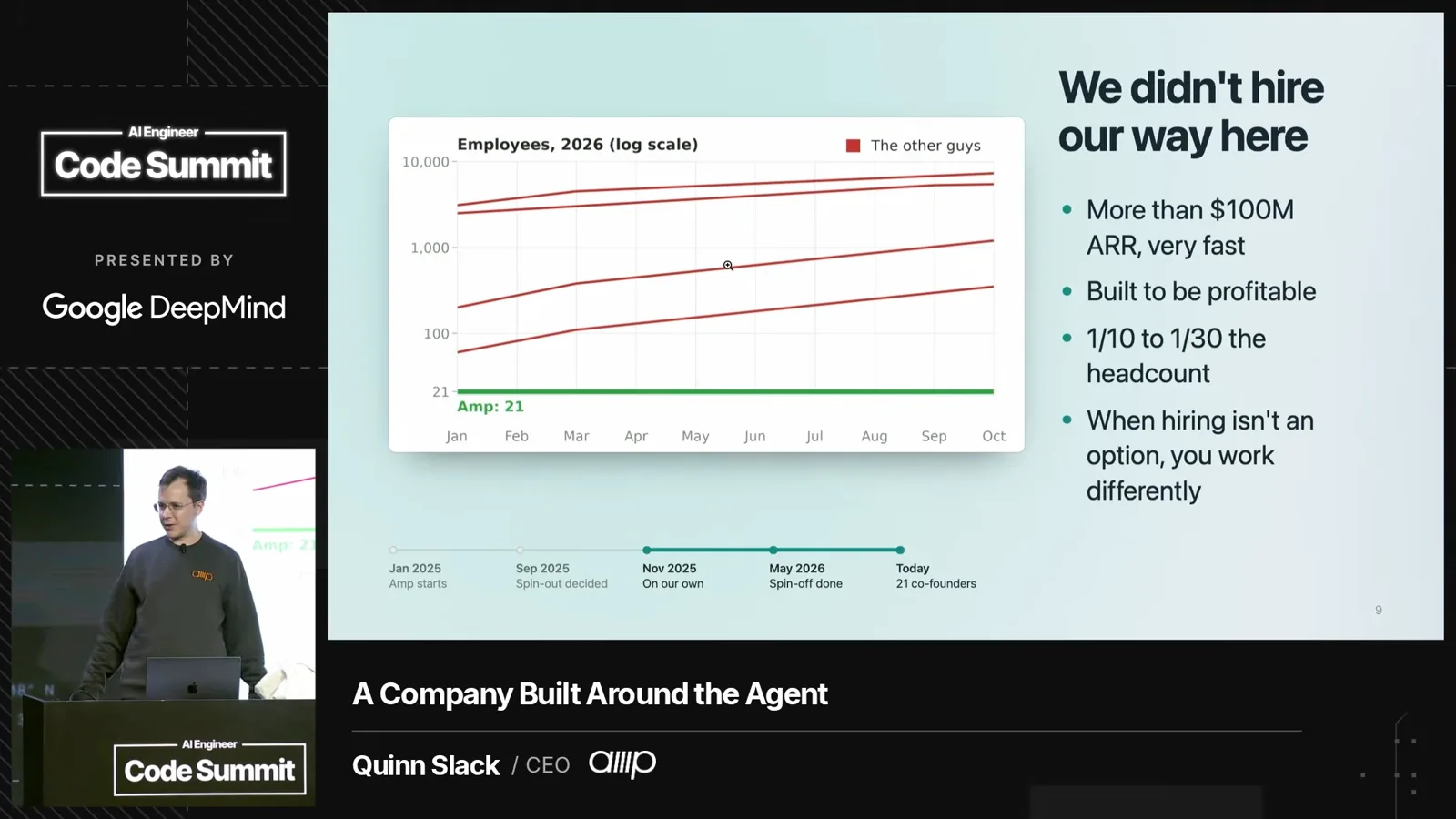
While larger competitors increased their headcount, we stayed at 21 people and had to discover how much more we could do with agents. One colleague, Hamish, even joined despite knowing he could not receive options for months. Those constraints shaped both how we worked and how we built Amp.
Do the work in shared agent threads and ship in small steps
Amp puts communication and work into agent threads. Small deployments, monitoring and parallel systems can reduce the risk of continuous change.
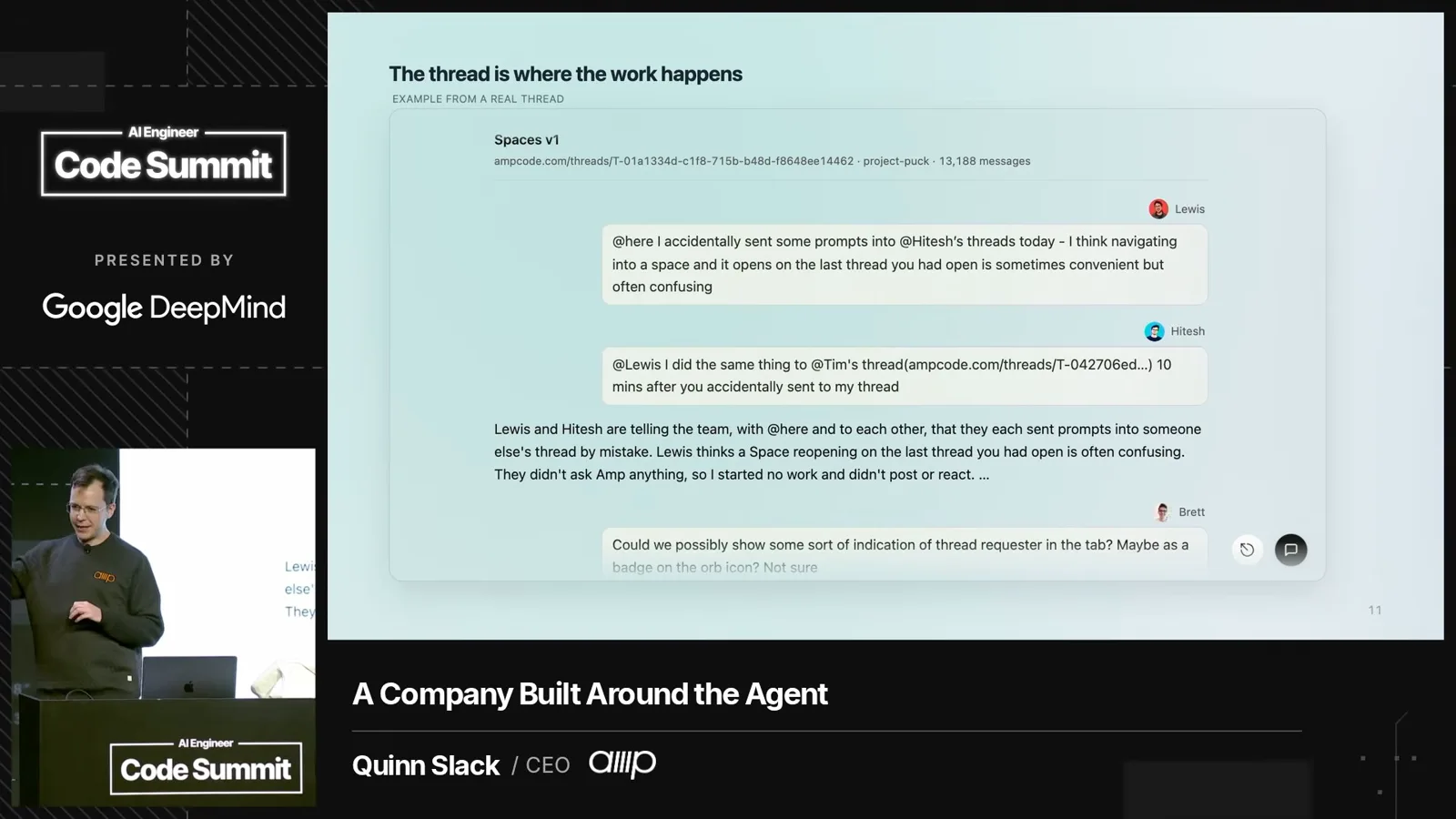
We removed many of the other tools people have to check. There is no Jira task tracker or separate support system: work and communication happen in Amp’s shared agent conversations, which we call threads. When someone reports something wrong, the agent can follow the conversation and work on a fix; a colleague can join the thread when help is needed.
We push changes very frequently, but that allows us to make them smaller. Before a big change, we can add logging to check our understanding, deploy a small piece, let an agent monitor it for an hour and then proceed. We can also run a shadow system alongside the old one to compare results case by case.
Use agents to verify changes and close the support loop
An agent can compare interface frames or generate multiple designs. For bugs, Amp investigates, fixes, identifies other affected users and follows up.
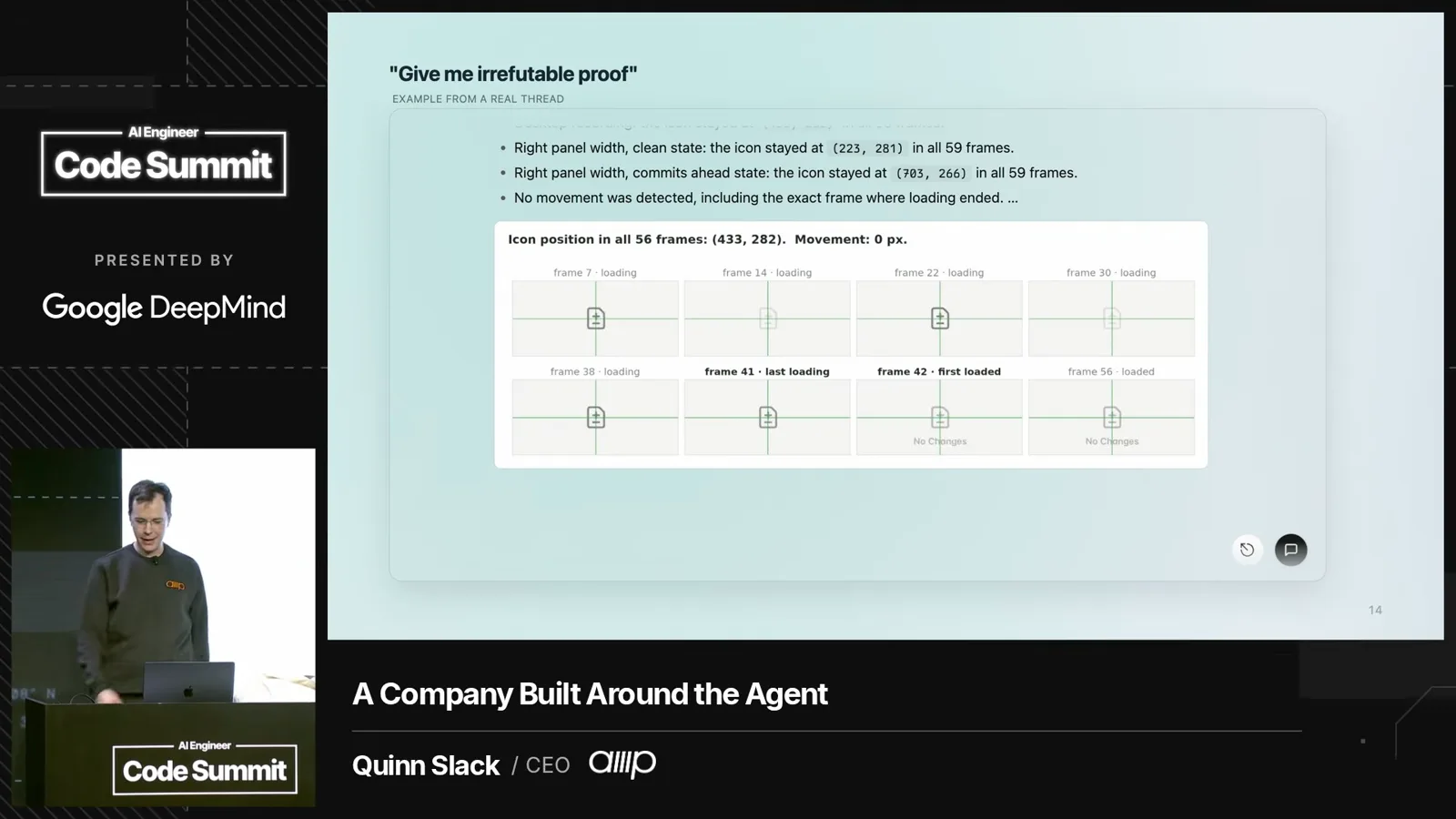
Give an agent a way to demonstrate that its work is correct. To remove visual jitter from an interface, I asked it to compare every frame of a loading sequence—more patient inspection than a person would usually perform. Agents can also produce many design variations at once; I used that approach on Amp’s dictation waveform.
Our bug-report process is a loop. When a user reports an issue, we use an agent to help investigate and fix it, then send the person an apology and free credits. We also search the logs for other people who encountered the same error, even if they did not report it, and proactively tell them that we fixed it.
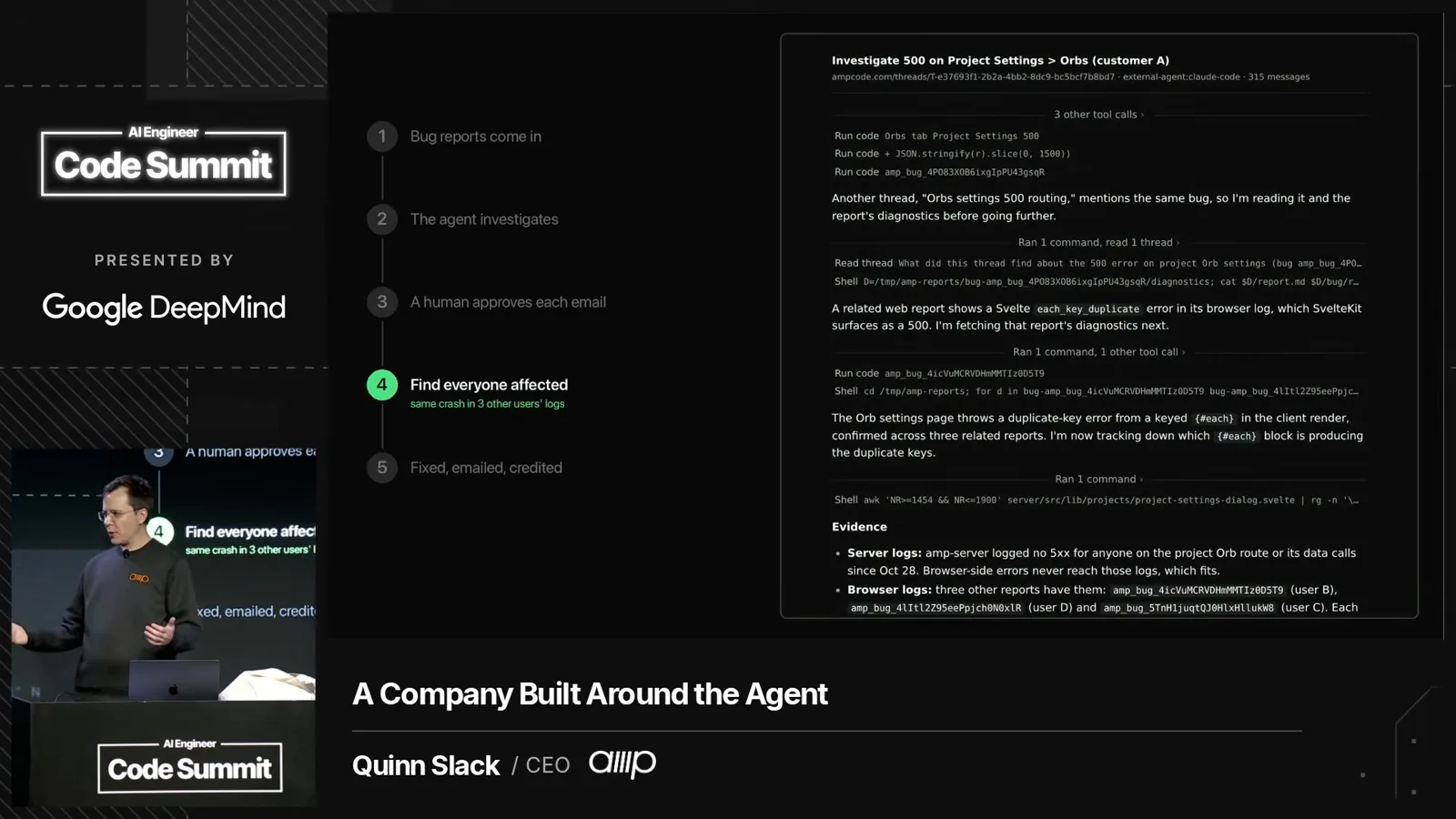
That follow-up encourages people to send more feedback because they see that we care. People sometimes dismiss software built with AI as poor quality; Amp is almost entirely built with AI, and I think this feedback loop is one reason people regard it as high quality. It would be difficult to move as quickly if each fix had to pass through separate product, engineering and design teams.
Dictation and a smaller customer-management system
Slack favors speaking to agents and building tools around actual needs. He argues that a small, integrated customer-management system can replace a fraction of a much larger product.
I recommend dictating to agents: it is a fast way to get information from your brain into the system. It can be awkward in a shared office—I was dictating near Amp co-founder Beyang Liu and it was annoying—but I think it is worth getting past the embarrassment.
We have connected our agent to many tools, and the more directly the agent uses them, the less we sometimes need the software product on the other end. For example, we built a customer-relationship management tool for Amp instead of assuming we needed a full Salesforce replacement.
A company may use only a small fraction of Salesforce. Rather than recreate the whole product, an agent can build the subset the team needs and add integrations with its existing systems. As agents improve at integration, I think making a tailored tool becomes increasingly practical, without waiting for another company’s product roadmap.
That possibility takes me back to the feeling I had when I first tried an agent. If a business can replace part of a large software subscription with its own tool, assumptions behind traditional software sales come into question: the cost of closing a deal, a long customer relationship and steady expansion are no longer as secure.
I think much smaller companies, where people can work across functions and have a real stake in the outcome, will look attractive once people see them operate. At Amp we have no product managers and everyone talks to customers. A former sales-development representative built a bank-transfer payment option for customers whose purchases were too large for a credit card.
Broad ownership and a single weekly meeting
Slack describes a company without product managers in which everyone talks to customers. He says Amp is profitable with over $100 million in annual recurring revenue.
Direct customer contact also means people can be honest about whether a deal makes sense. A colleague told a prospective customer that a complicated arrangement sounded like a poor use of everyone’s time. I value people being empowered to say that rather than relying on a salesperson paid on commission.
We have one meeting a week; otherwise the guidance is to follow your energy. I do not think most companies could run this way, but I believe a substantial ownership stake encourages people to think about the whole company, work across roles and put in the effort needed.
We are shipping much more, and I think customers love the product. Amp is profitable and has more than $100 million in annual recurring revenue; on a dollar-in, dollar-out basis I estimate it is 40 to 50 times more efficient than old-fashioned companies. I offer that as evidence that this kind of company can work.
For people who want to move their companies in this direction or start something new, I am happy to help. My advice is to stop accepting a narrow role if it prevents you from acting: let agents shape how you work, and find a company willing to change with them.
同じチャンネルの記事
 22:29EN
 AI Engineer· 2026年11月24日Jarred Sumner: Independent Tests Made Millions of Agent-Written Lines ShippableJarred Sumner · AnthropicBun’s creator explains why existing tests, three-way comparisons and repeated measurement mattered more than code volume.
 21:22ENAI Engineer· 2026年11月24日Steve Yegge's software factory hit a human bottleneckSteve Yegge · Gas TownHis game-building agents produced more changes than players could absorb, while cost, accumulated context and stalled tasks demanded active management.
 20:24ENAI Engineer· 2026年11月23日Dex Horthy: software factories still need people to review the workDex Horthy · FactoryFaster agent-written code needs checks, proportionate planning and human review, especially when a codebase must remain maintainable.
 19:56ENAI Engineer· 2026年11月22日Armin Ronacher: Build a Software Workshop Before a FactoryArmin Ronacher · EarendilAgents can start projects faster, but human attention still limits which ones become good and stay maintained.
 56:08ENAI Engineer· 2026年11月21日Ahmad Osman: Local AI Needs Better Systems, Not Just Better ModelsAhmad Osman · OsmanticThe Osmantic founder explains how hardware, tools and task-specific tests determine whether local AI is useful.
 14:28ENAI Engineer· 2026年11月20日Zach Bruggeman: Ramp Made Its Coding Agent a Shared Team ToolZach Bruggeman · RampRamp made agent sessions visible to colleagues, spreading working practices and giving reviewers evidence for changes.