30 秒でわかる
A software factory does not replace engineering discipline with a swarm of agents, says Dex Horthy: it automates implementation while preserving tests, review, rollout and monitoring. He cites Slop Code Bench's roughly 16% leading strict score as evidence that maintaining code across successive changes remains difficult. His practical advice is to automate both the start of work and the checks that improve it, plan according to the cost of rework, and keep human attention on the outcomes that matter.
- 1A benchmark tests whether models maintain code across changesHorthy reports a leading score of roughly 16% under the strict scoring criteria on Slop Code Bench, which evaluates changes made across successive checkpoints rather than a single one-off build.
- 2An agentic factory retains the existing engineering processHorthy's basic substitution is to let an agent build the change while preserving tests, pull-request review, cautious rollout and monitoring.
- 3Automate work intake and the checks that push backA production incident can trigger a proposed fix, while tests, linters and agent review improve that proposal before a person sees it.
- 4Plan according to the expected cost of reworkHorthy weighs the chance a decision will change against the difficulty of changing it, treating a database schema differently from a button color.
- 5Give the agent a way to test the real productBrowsers, screenshots, videos and a working application environment let an agent inspect and improve what it built.
- 6Slop shifts effort from the producer to the recipientHorthy says AI output becomes slop when someone passes it along without taking responsibility for its quality or the reader's experience.
- 7Review still adds value even when it moves beyond codePeople may review plans, designs or results instead of every line, but Horthy argues that automated reviewers alone are not enough.
ポイント
- Horthy recommends pairing automatic work intake with tests, review and other checks that improve results before human attention is needed.
- Scale planning to the expected pain of rework: database schemas merit more care than easily changed presentation details.
- Give agents a real way to run and inspect the product they are changing, not just instructions to write code.
- Use rough prototypes when learning is the goal, but review work in proportion to its stakes and maintainability needs.
チャプターごとに整えた全文を読む
Why Horthy still wants software factories
He likes the factory approach but cautions that unattended generated work can be difficult to maintain. A new benchmark provides evidence for his concern.
Dex Horthy introduces what he calls '12 Factor Factories' and the war on slop. Formerly CEO and co-founder of HumanLayer, he says the company has joined Factory and that his work focuses on coding agents.
Horthy says his earlier warning about software factories was not an argument against them: he likes the idea but thinks some ways of operating can make them fail. A benchmark released with researchers at the University of Wisconsin now gives him data beyond his earlier intuition.
Slop Code Bench measures how models evolve a codebase through successive checkpoints. Horthy reports a leading result of about 16%, and cites a separate study that found unreviewed pull requests and other problems. He presents those results as reasons to keep studying the quality of generated work.
Keep engineering checks around automated implementation
An agent can replace the person writing an implementation while teams retain tests, rollout and monitoring. Forward pressure starts work; back pressure improves it.
A software factory is, in his view, good engineering applied consistently. Standardize the process rather than only the output: teams have long gathered requests, built changes, run tests and linters, reviewed pull requests, rolled out cautiously and monitored production.
Customers surface bugs and request missing features; monitoring helps teams find problems before customers do. The basic agentic change is to replace a person building the implementation with an agent, while retaining the surrounding process.
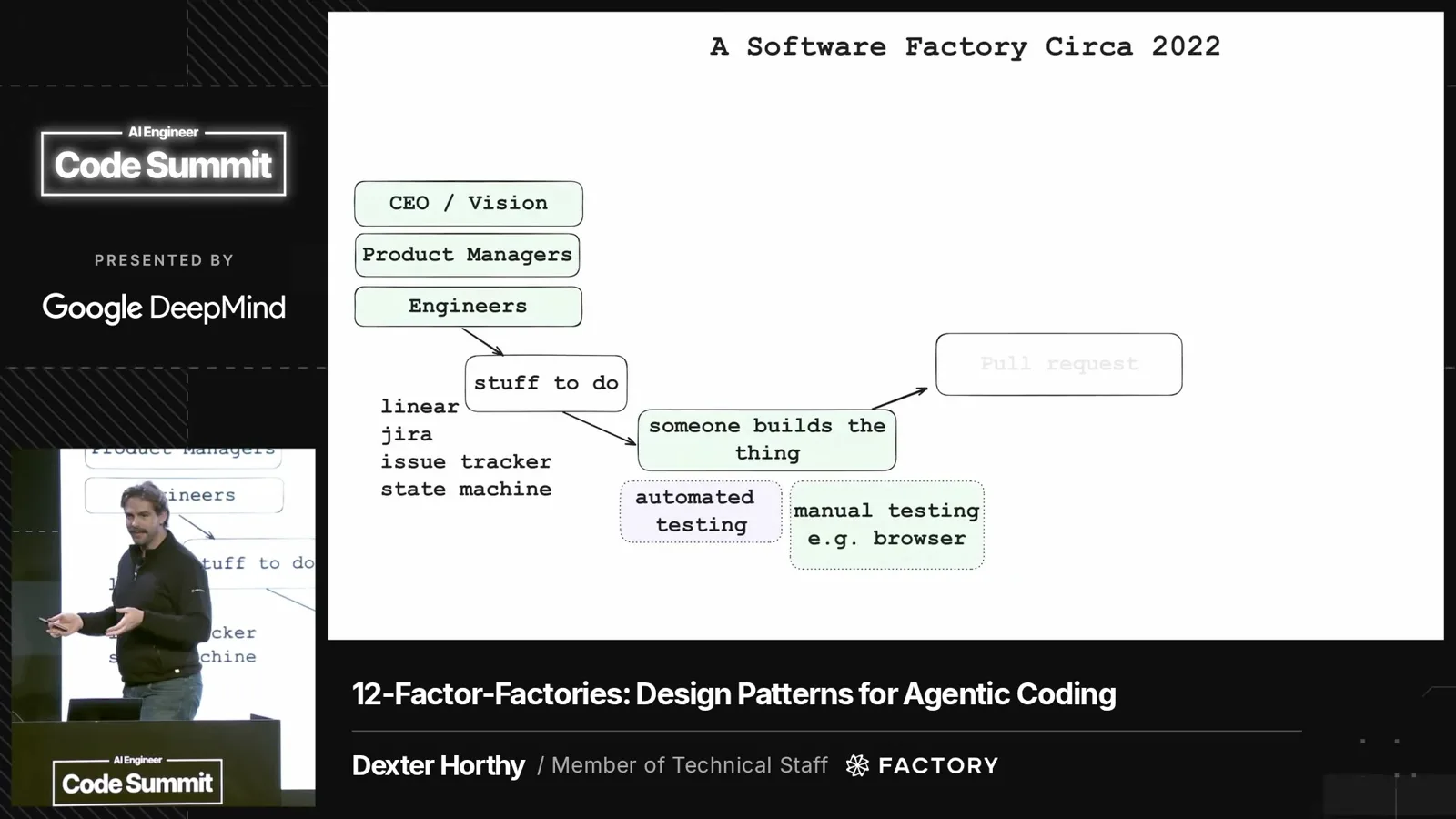
Horthy calls the force that starts work 'forward pressure.' Feature requests might enter the factory automatically, or an incident might trigger a proposed fix so that an on-call engineer sees a pull request rather than only a stack trace.
The other side is 'back pressure': mechanisms that test and improve work before it reaches a person. Agent review and testing, continuous integration, linters and even formal checks can help catch problems when implementation becomes faster than traditional review.
He suggests evaluating automation by how it initiates work and how much low-hanging correction it completes before a human must intervene. Those practical questions matter more to him than the fashion for describing everything as a loop.
Know where models struggle as code evolves
Horthy discusses a benchmark that tests successive code changes and quality metrics. He recommends maintaining an understanding of long-lived systems.
His second principle is to know the limits of unattended models. Horthy thinks they can solve individual problems but do not reliably preserve a codebase's quality over months unless people understand and direct what should improve.
The benchmark imitates real development by asking a model to add features over successive checkpoints, rather than giving it a complete specification for a one-off clone. Human developers may notice a poor abstraction along the way and refactor it; the benchmark tests whether models can evolve code similarly.
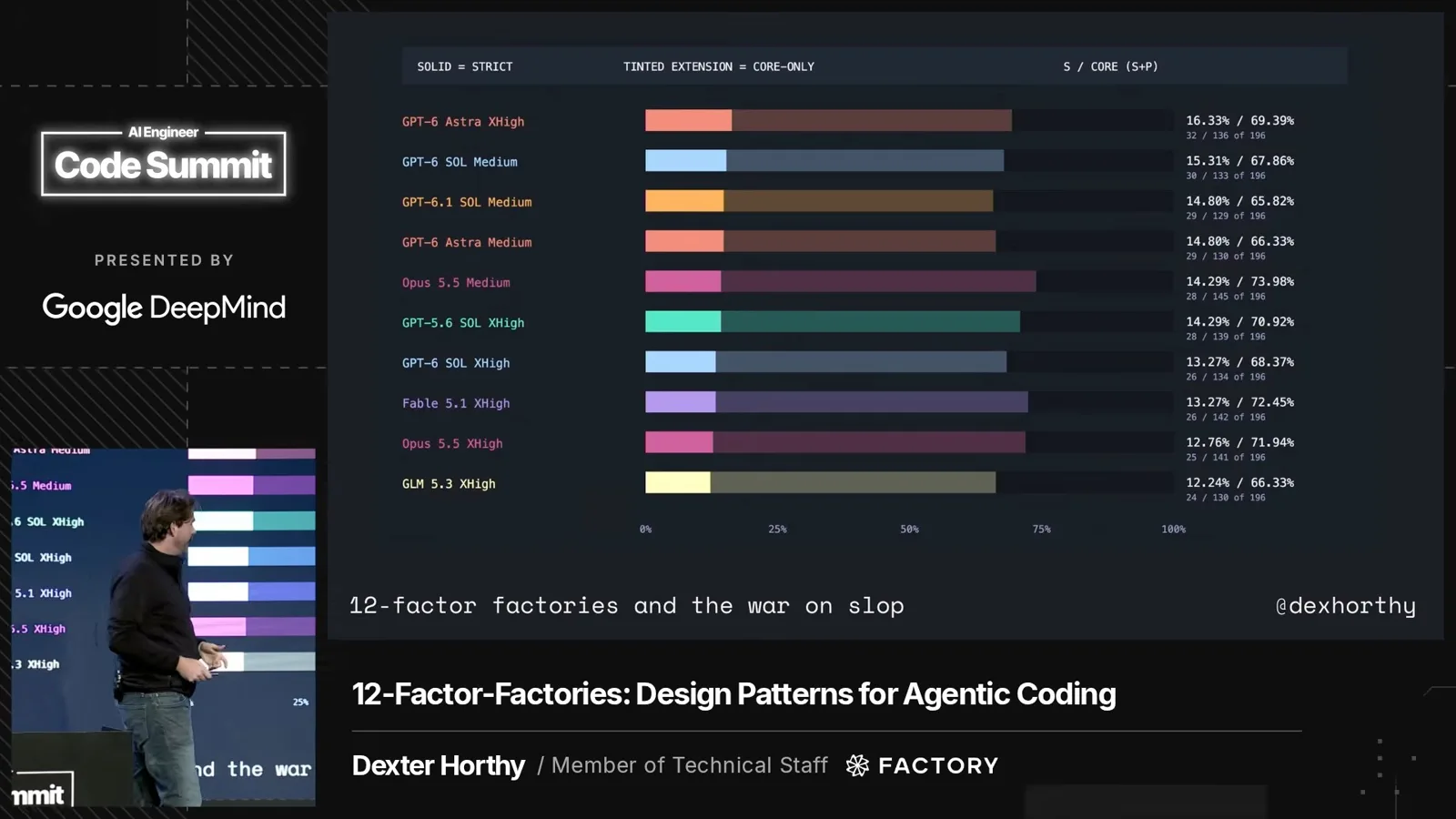
The benchmark also measures complexity and interface quality using a collection of rules. Horthy says comparisons with older repositories and previous models revealed patterns he regards as regressions, including newer models producing some Python code in an older style.
He notes that a newer model's instructions suggest telling it to take ownership of a codebase, but he had not yet tested that approach. For long-lived software, his advice is to retain an understanding of the system rather than continuously pushing features into an unattended machine.
Plan for the decisions that are expensive to reverse
The right amount of specification depends on expected rework. Visual alignment, agent-accessible tests and lint rules help turn intentions into verifiable work.
Plan before building. Teams used architecture review and sprint planning to agree on a direction before spending time implementing and reviewing it; faster code generation does not eliminate the expense of reviewing and reworking the wrong solution.
Planning itself has a cost. A short prompt may be appropriate for a small change, while a detailed specification is worthwhile when mistakes would be difficult to reverse. Horthy describes the tradeoff as the likelihood of change multiplied by the pain of changing it.
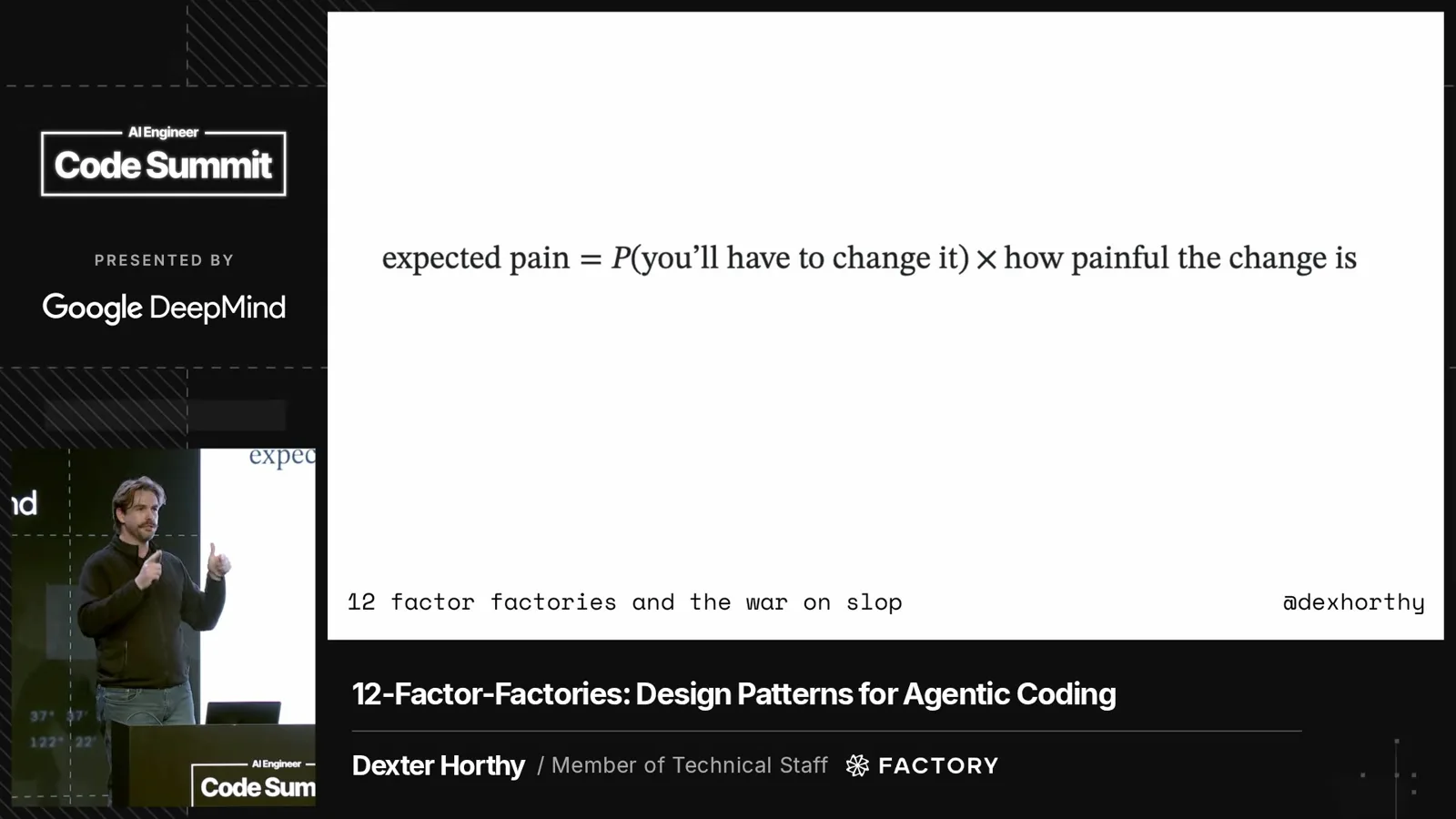
He would not spend planning time arguing over a button color, but would pay attention to database schemas because they are harder to change later. Choose the amount of planning to match the problem and codebase.
For visual alignment, Horthy describes his Show Me skill, which can produce HTML mockups, tables and charts instead of long walls of text. Visual artifacts make it easier for a person to compare expectations before implementation proceeds.
Give agents ways to test their own work: screenshots, browsers, video, curl or a working build and test environment. For an iOS app, for example, an agent needs a way to build, run and test the app in the relevant environment.
Horthy recommends encoding recurring code-quality concerns as lint rules. He points to an anti-slop TypeScript ruleset, a Factory ESLint plugin and Python checks from Slop Code Bench as examples that teams can adapt.
Use rough prototypes deliberately and keep decisions near code
Feature flags can support experiments before polishing. Teams should evaluate sessions and connect design decisions to the code they explain.
He does not argue that every line must be perfect. Quick prototypes and experiments behind feature flags can be useful when the immediate question is whether anyone wants a feature; polishing comes after that question is answered.
Give the model a feature-flag system so it can try alternatives and measure their performance. Horthy also recommends evaluating workflows and learning from past sessions so the system improves over time.
A 'unified forge' brings designs, decisions and agent sessions closer to the code. Horthy contrasts centralized code hosting with people copying agent responses between chat tools, where the reasoning behind a change becomes hard to recover.
Teams can buy or select components such as virtual machines and agent harnesses, then customize a control plane for collaboration, scheduling and events. Horthy says Factory has invested in this broader operational picture.
What a team cannot buy
Infrastructure and harnesses can be purchased or customized, but a team must understand how to verify its own code. Horthy treats a factory as a way of organizing that work.
But he does not think an outside vendor can simply sell a team complete verification of its own code. An organization knows its particular systems, standards and tests; a software factory is also a way of thinking about that work.
The Anti-Slop Manifesto and the value of review
The manifesto asks creators to take responsibility for their output and readers' attention. Horthy argues human review should scale with the stakes.
Horthy introduces the Anti-Slop Manifesto, created with other contributors. It favors outcomes over output volume, understanding over speed, independent thinking over a model's first draft, and better work over merely easier work.
The manifesto describes slop as output that imposes more effort on its recipient to understand than its producer invested. AI use does not automatically make something slop; the problem arises when a person passes along output without taking responsibility for its quality and the reader's experience.
Horthy argues that AI amplifies human judgment or its absence. The cost of producing a long pull request or document can approach zero while the cost of reviewing it remains substantial, so generation and review scale differently.
Workarounds and tools biased toward adding rather than subtracting can compound the problem. Once poor material accumulates in code, chat or a knowledge base, later agents may read and repeat it, making the system harder to improve.
The manifesto asks teams to value human attention, understand the problem and own the intent and consequences of what they ship. When sharing agent-written work, Horthy says to make that clear and check its quality first.
He also encourages recipients to push back kindly when someone sends work they have not reviewed. He acknowledges that he has been on both sides of that exchange.
Review retains value even if the object of review changes from code to a plan, design or result. Agent reviewers, linters and verifiers are useful, but Horthy says they are not sufficient on their own; how much a person reviews should depend on the stakes.
He measures success by what shipped, who uses it and how it helps, rather than lines of code, merged pull requests or the number of parallel agents. A rough one-shot prototype is not inherently bad; it becomes a problem when its quality undermines the intended outcome.
There is no single settled answer for how much review every task requires, Horthy says. Teams must calibrate their own standards as tools change, while keeping human judgment focused on producing useful outcomes.
同じチャンネルの記事
 21:22EN
 AI Engineer· 2026年11月24日Steve Yegge's software factory hit a human bottleneckSteve Yegge · Gas TownHis game-building agents produced more changes than players could absorb, while cost, accumulated context and stalled tasks demanded active management.
 19:56ENAI Engineer· 2026年11月22日Armin Ronacher: Build a Software Workshop Before a FactoryArmin Ronacher · EarendilAgents can start projects faster, but human attention still limits which ones become good and stay maintained.
 56:08ENAI Engineer· 2026年11月21日Ahmad Osman: Local AI Needs Better Systems, Not Just Better ModelsAhmad Osman · OsmanticThe Osmantic founder explains how hardware, tools and task-specific tests determine whether local AI is useful.
 14:28ENAI Engineer· 2026年11月20日Zach Bruggeman: Ramp Made Its Coding Agent a Shared Team ToolZach Bruggeman · RampRamp made agent sessions visible to colleagues, spreading working practices and giving reviewers evidence for changes.
 18:30ENAI Engineer· 2026年11月20日Zach Lloyd: Treat Coding Agents as a System You Can Measure and ImproveZach Lloyd · WarpWarp’s founder argues that teams can improve coding agents by recording their work, testing changes on real tasks and measuring cost and quality.
 19:08ENAI Engineer· 2026年11月19日Thariq Shihipar: Keep a human-readable layer in AI-built softwareThariq Shihipar · AnthropicA fighting-game experiment gives its creator readable rules to edit while an agent handles the underlying engine.