30 秒でわかる
Factory’s Nikhil Harithas describes the deployment requirements that emerged while working with a large regulated customer: control over compute, inference, identity and tenancy. Factory’s proposed Open Compute layer abstracts machine lifecycle operations behind provider-specific drivers. He walks through a gateway and outbound relay, snapshots, forks and the operational problems of provisioning. At the time of the talk, the project was in private preview and an open-source release was planned.
- 1Identity and locationHarithas says the recurring questions are who an agent acts for and where it runs.
- 2Abstract the lifecycleOpen Compute is intended to manage machines across different providers through drivers.
- 3An outbound relayThe illustrated agent daemon initiates a WebSocket connection from the customer environment.
- 4Snapshot and forkSaved state can support delegation and replacement of time-limited compute.
- 5Provisioning is distributed workLost acknowledgments, throttling and restarts require state tracking and retries.
ポイント
- Enterprise agents need clear identities and controlled execution environments.
- A compute lifecycle abstraction can support multiple cloud and sandbox backends.
- The illustrated design uses an outbound connection from the customer environment to a relay.
- Snapshots and forks can support long-running and delegated agent work.
- Provisioning requires reconciliation, retries and state tracking, not just a single API request.
チャプターごとに整えた全文を読む
Enterprise constraints and agent identity
Harithas describes a regulated customer’s deployment needs and the identity and location questions they raise.
Nikhil Harithas leads forward-deployed engineering at Factory. He describes the work as a feedback loop: learn what makes deployment difficult for complex customers and use that information to guide product development.
His example is Blackstone, a large financial institution with regulatory and security constraints. Harithas says Factory’s defaults did not fit: the customer wanted its own compute, inference and identity, with single-tenant deployment.
Factory’s coding agent, Droid, can receive a delegated task through tools such as Slack or Jira and return a pull request. That requires permissions, so the enterprise design repeatedly raised two questions: on whose behalf does the agent act, and where does it run?
Harithas argues that agents should not indefinitely borrow an individual’s identity. He frames agents as applications that can use established software and identity practices, adapted to their less deterministic behavior.
A portable compute layer
Factory proposes an abstraction for the machine lifecycle and provider-specific drivers.
Different customers wanted Kubernetes, EC2, other clouds or sandbox providers. Factory’s earlier bring-your-own-compute approach installed an agent on a machine but left customers to manage the machine’s lifecycle, which proved complicated.
Factory’s proposed answer is Open Compute, a project intended to abstract that lifecycle for arbitrary agents. At the time of the talk it was in private preview, with an open-source release planned for the following weeks.
The goal is to let the customer choose where the workload runs and apply its own security constraints inside its VPC, without necessarily moving every part of Factory’s control layer on premises. Harithas describes this as separating a compute plane from the control and data planes.
Gateway, drivers and relay
A session request provisions compute in the customer environment, which connects outward to the relay.
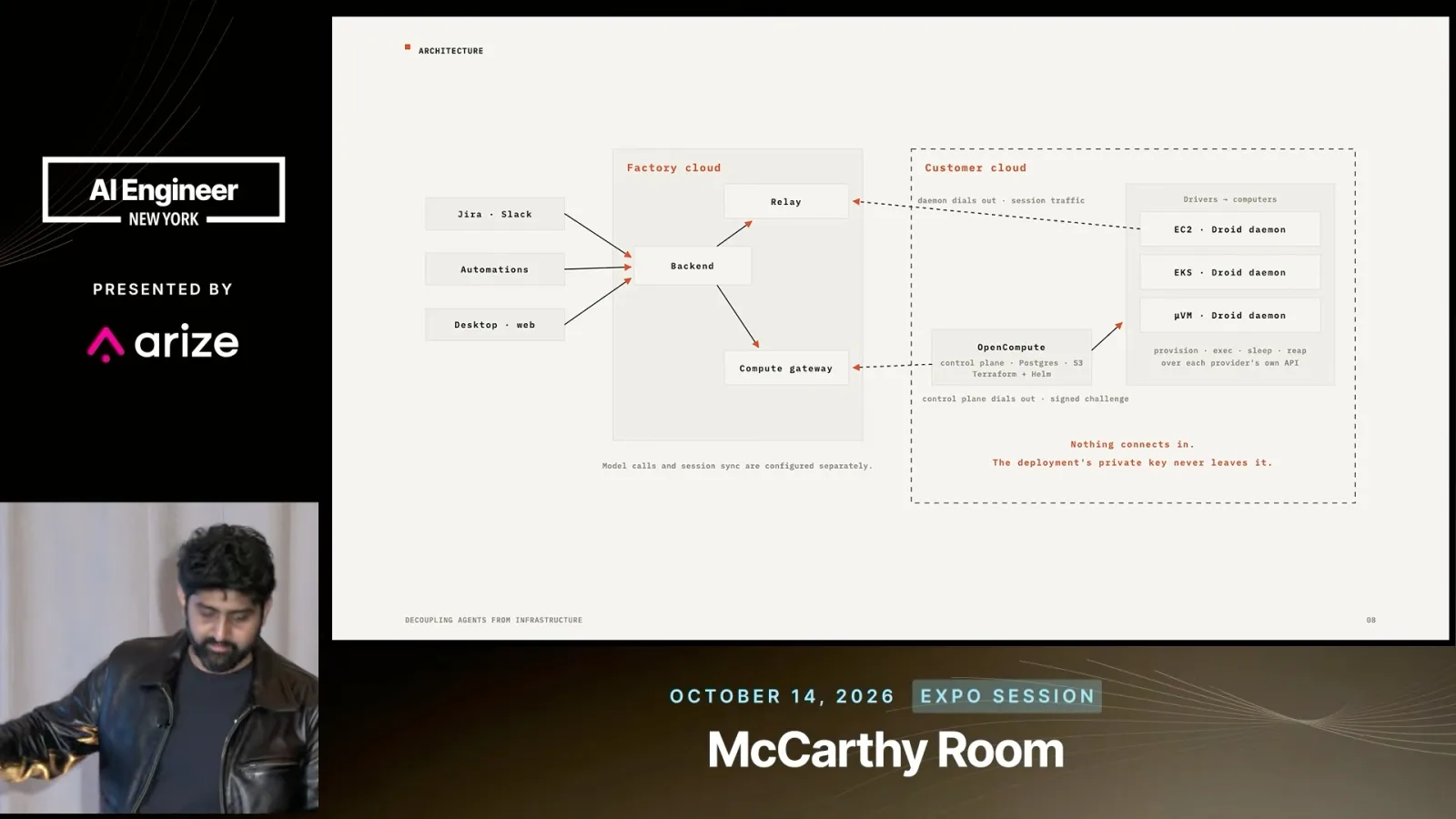
In the simplified architecture, a client sends a session request to Factory’s backend. A compute gateway asks an Open Compute controller in the customer environment to provision a machine, while a relay carries communication between the client and the agent daemon.
The controller calls a driver that wraps the chosen compute provider. An EC2 driver can launch an instance; other drivers can target Kubernetes or a sandbox provider. The agent need not implement a separate lifecycle for each environment.
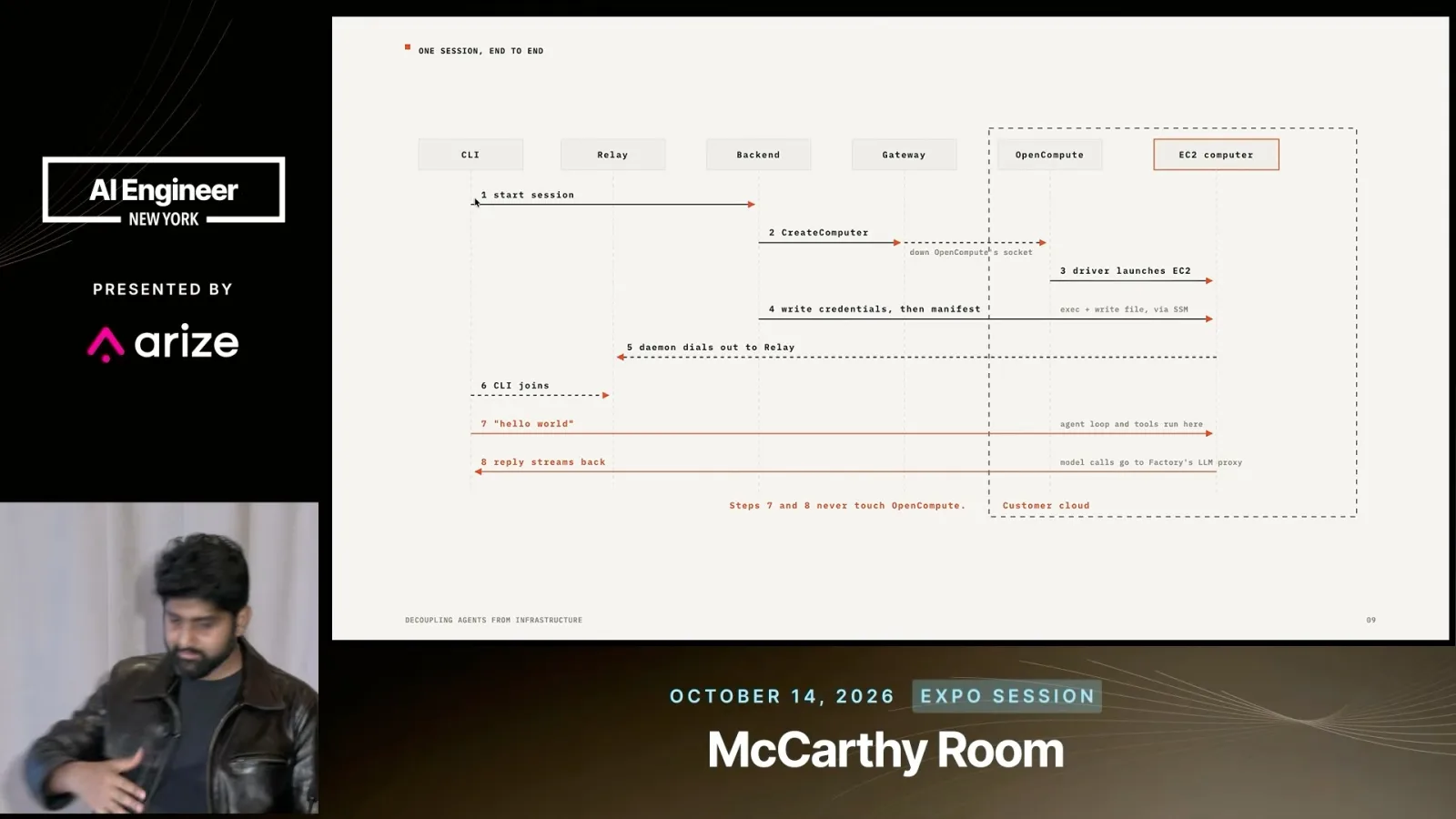
The provisioned machine establishes an outbound WebSocket connection to Factory’s relay. Harithas says this avoids requiring an inbound connection into the customer environment after setup, a distinction that matters to security teams.
The client communicates through the relay to the agent running in the customer’s environment. Model calls can be configured separately, including a bring-your-own-key arrangement with the customer’s inference service.
Harithas says this gives customers control over the agent execution environment without deploying the entire Factory product on premises. He presents customer ownership of models, evaluations and compute as a longer-term direction, rather than claiming every component is already customer-hosted.
Lifecycle operations and operational challenges
Snapshots, forks, retries and state reconciliation support long-running workloads. The project was in private preview at the time.
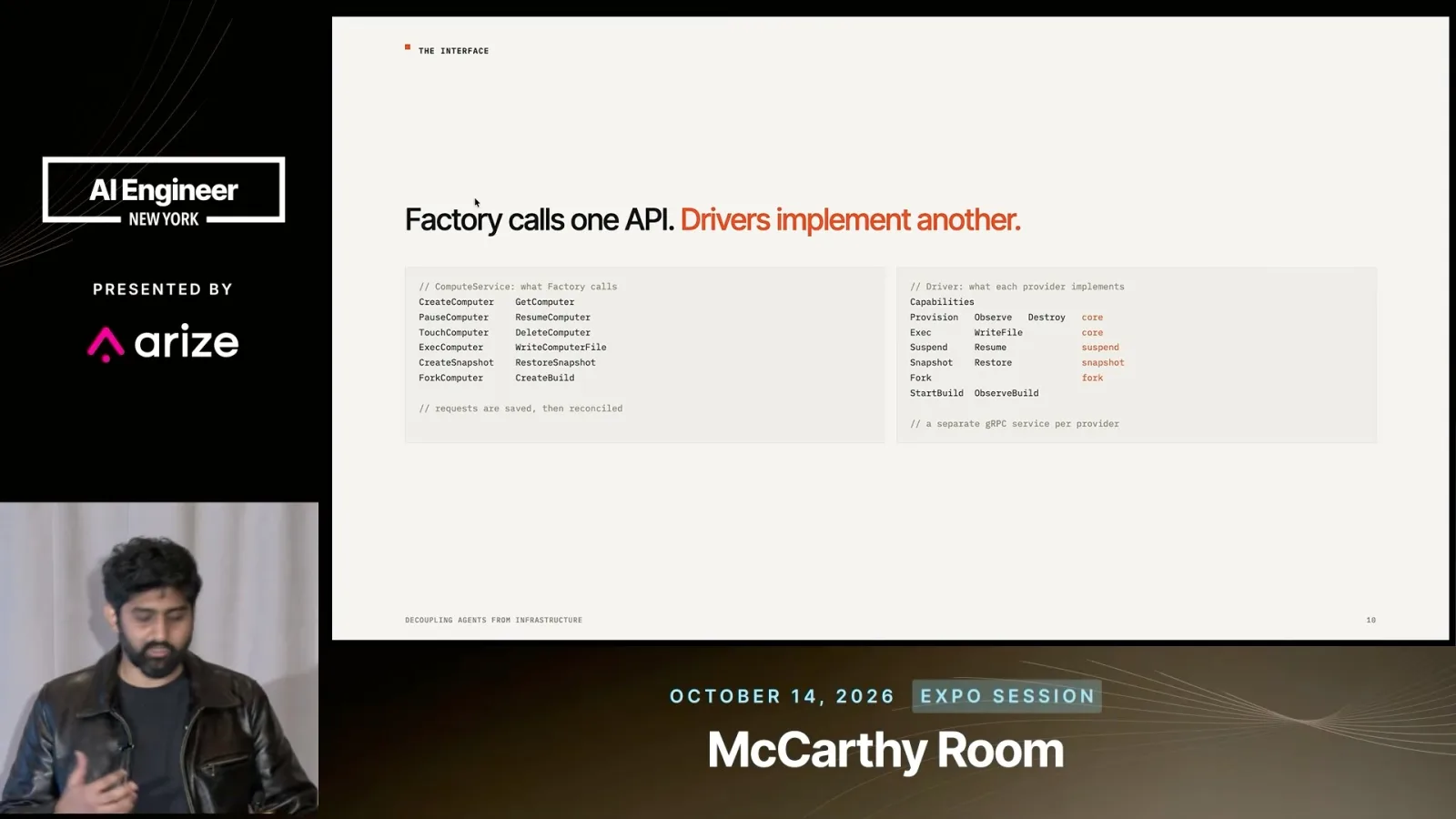
The planned interface treats the computer as the unit of work. It supports lifecycle operations such as creating, pausing, resuming and destroying compute, using templates that define installed software and build requirements.
Snapshots and forks matter for longer or delegated work. A session can preserve state, branch it and hand a subtask to another agent. Factory also envisions customer-controlled snapshot storage and integration with the customer’s secret store.
Harithas stresses that the project manages computers rather than Factory-specific sessions, making the abstraction applicable beyond its own product. Drivers implement the provider-specific side of the interface.
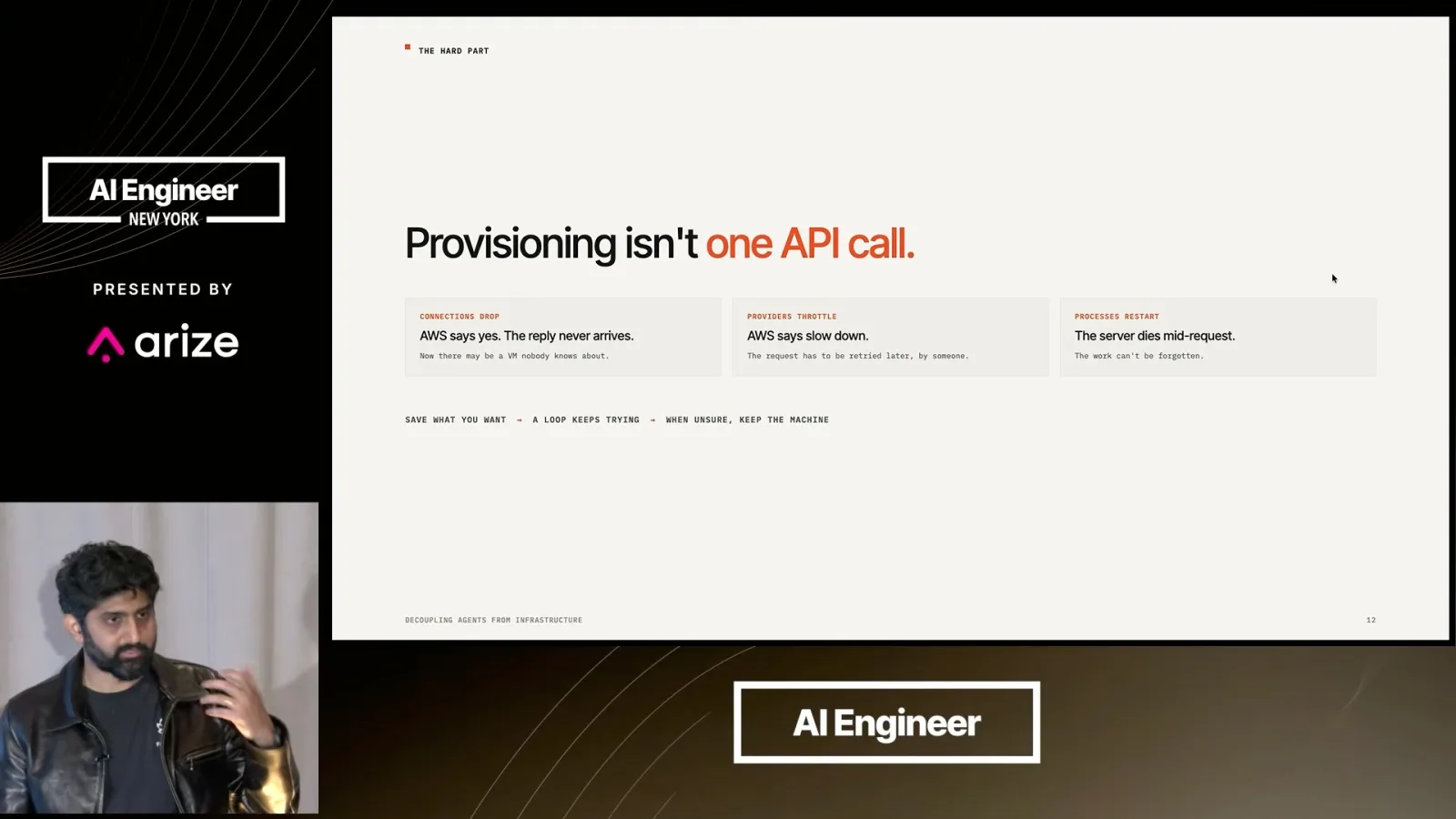
Provisioning is more than one API call: acknowledgments may be lost, providers throttle requests and processes restart. A controller must keep track of desired state, retry and route users to the correct machine.
Long-running work adds another challenge. Harithas describes replacing a time-limited sandbox by snapshotting and restoring it while a multi-day agent mission continues. He also discusses distributing versioned infrastructure packages during the private preview.
A precise driver specification can make new compute backends easier to add and test. Harithas closes with the goal of allowing agents to run across customers’ preferred environments without tying the agent itself to one provider.
同じチャンネルの記事
 19:12EN
 AI Engineer· 2026年11月4日Why AI Agents Need Reliable Processes to Scale Across a CompanyMitchell Troyanovsky · BasisBasis co-founder Mitchell Troyanovsky explains behavior specifications, trajectory forks and simulations for production agents.
 18:01ENAI Engineer· 2026年11月4日How NatWest Tests Customer-Facing AI Agents Before LaunchJonathan Osborne · NatWest GroupJonathan Osborne explains routing controls, human validation, unreliable LLM judges and shadow deployment in a regulated bank.
 19:48ENAI Engineer· 2026年11月4日Why Datasite Bought Its Document Parser Instead of Building ItAdit Abraham, Raj Bakhru · ReductoRaj Bakhru and Reducto CEO Adit Abraham discuss the engineering trade-offs behind AI for transaction data rooms.
 19:19ENAI Engineer· 2026年11月4日Approve the Application, Not the AI Model: Building Evaluation Gates for a BankDoneyli De Jesus · Langfuse by ClickHouseDoneyli De Jesus explains how a bank tested an AI agent on its own data, added a calculator and used domain experts to set production gates.
 16:51ENAI Engineer· 2026年11月3日Cristóbal Valenzuela on Interactive Video Models and Runway’s ContinuumCristóbal Valenzuela · RunwayRunway’s co-founder traces next-frame prediction from early generated film to research prototypes for interactive visual interfaces.
 19:42ENAI Engineer· 2026年11月3日What Drives AI Agent Costs: Cache Hits, Input Tokens and TurnsGeorge Cameron · Artificial AnalysisArtificial Analysis co-founder George Cameron breaks down an agent benchmark and a framework for choosing models by cost and capability.