30 秒でわかる
Doneyli De Jesus of Langfuse by ClickHouse describes an evaluation framework built with a top-five bank. A golden data set, execution traces and separate quality thresholds provide evidence for deciding whether an AI application can be deployed. In his example, a model with 97% groundedness achieved only 60% numerical accuracy; adding a calculator improved the reported result to roughly 95%. Domain experts set thresholds and review failures, and changes to the agent trigger reevaluation.
- 1Evaluate on your own dataPublic benchmarks do not establish whether a particular bank application performs well on internal tasks.
- 2Grounded does not mean numerically correctThe example model scored 97% on groundedness but only 60% on numerical accuracy.
- 3Add a calculatorA deterministic tool handled arithmetic; the reported numerical accuracy rose to roughly 95%.
- 4Every gate mattersAn average score cannot cancel out a failure in an independently required dimension such as compliance.
- 5Keep experts in the loopDomain experts review failure traces and help improve the golden data set.
ポイント
- Public model benchmarks do not replace evaluations on an organization’s own data and use cases.
- Certify the application and its configuration against separate quality and compliance gates.
- A calculator tool improved the reported numerical accuracy of the example agent from 60% to roughly 95%.
- Combine deterministic checks, path evaluation and model judges instead of relying on one score.
- Domain experts set thresholds and turn reviewed failures into better test cases.
チャプターごとに整えた全文を読む
Why the bank certifies applications
De Jesus explains why public benchmarks and model approval are insufficient for a regulated bank. The bank also needs control over deployment and data.
I lead AI engineering solutions at Langfuse by ClickHouse. We helped a top-five bank design safety gates and evaluations for shipping AI applications to production.
Public model benchmarks measure useful technical capabilities, but they do not necessarily predict performance on a bank’s internal data and use cases. Financial institutions are particularly protective of their data and the expertise embedded in their workflows.
Consider an analyst assistant that digests earnings-call transcripts for investment bankers. Summarizing the transcript alone is not enough: the application needs the firm’s context and expertise, and its output must be reliably evaluated against the bank’s requirements.
The bank’s principle was that it certifies applications, not models. A model may support many applications, each with different risks and standards for approval.
The bank also had deployment constraints: systems should run in its own environment, access should be gated, and sensitive workflows should be air-gapped. It wanted control over data even when outside providers offered retention guarantees.
From golden data to deployment gates
A representative data set and trace evidence support repeatable evaluations. Separate thresholds determine whether a configuration can be deployed.
The team needed to prove three things: that the application worked as intended, met compliance requirements, and was usable enough for people to adopt. A change to a system prompt, model or tool should trigger a decision about whether the application was still ready for production.
The anchor is a golden data set: representative test cases with inputs, expected outputs and metadata. Many banks already have test data; the missing part can be making evaluation against it repeatable and operational.
Each run produces traces that record what the application did when evaluated against the data set. Those traces become evidence, and scores across selected dimensions determine whether a given configuration passes its gates.
Fix numerical accuracy with a tool
The model was well grounded but struggled with arithmetic. A calculator tool improved the reported accuracy.
One tested model scored 97% on groundedness: its answers drew on bank data. But its numerical accuracy was only 60%. A response can be grounded in the right documents and still make mistakes when calculating financial figures.
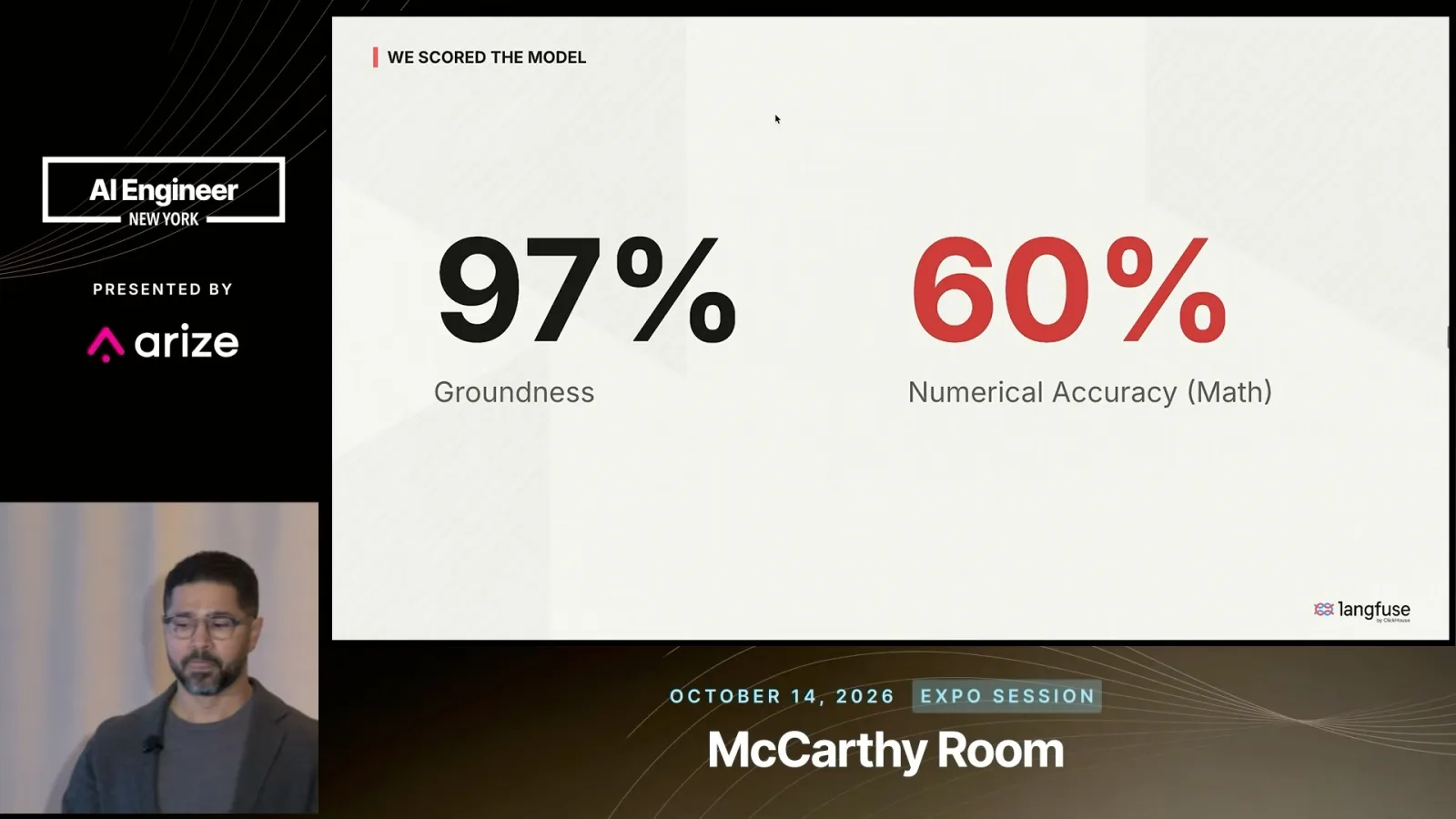
The answer was to improve the surrounding application, not merely look for a different model. The team gave the agent a calculation tool, allowing deterministic code to handle arithmetic where the model had struggled.
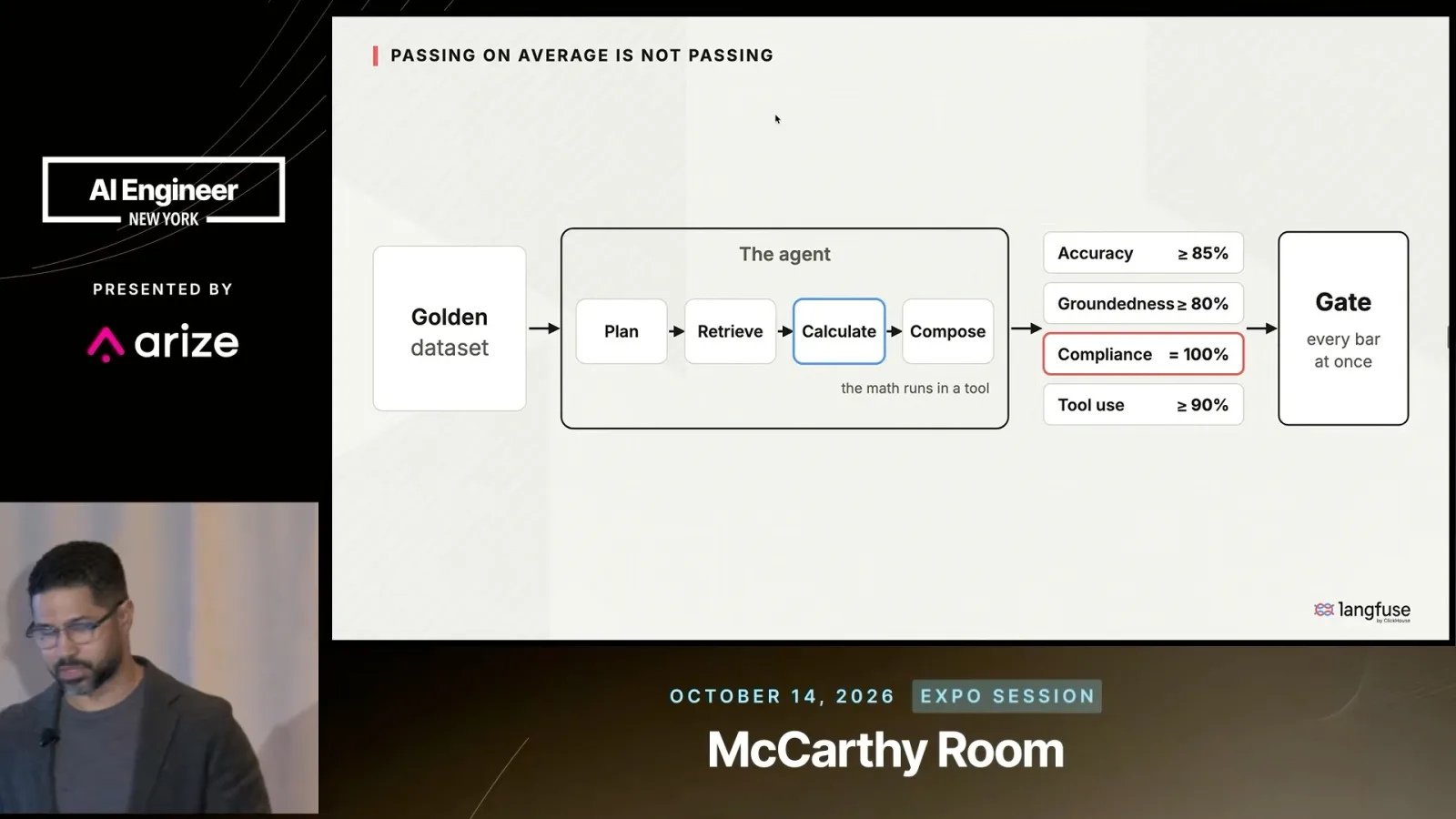
The illustrated workflow starts with the golden data set and runs through planning, retrieval, calculation and answer composition. The application is then evaluated against separate thresholds for accuracy, groundedness, compliance and tool use.
Passing on average is not enough. Each dimension can have a different minimum, and any required gate can prevent promotion to production. The bank’s rules define what must pass for that particular use case.
A test case pairs an input with an expected output and metadata. Building this private benchmark makes it possible to assess the agent’s answer, behavior and quality on work that resembles the organization’s own tasks.
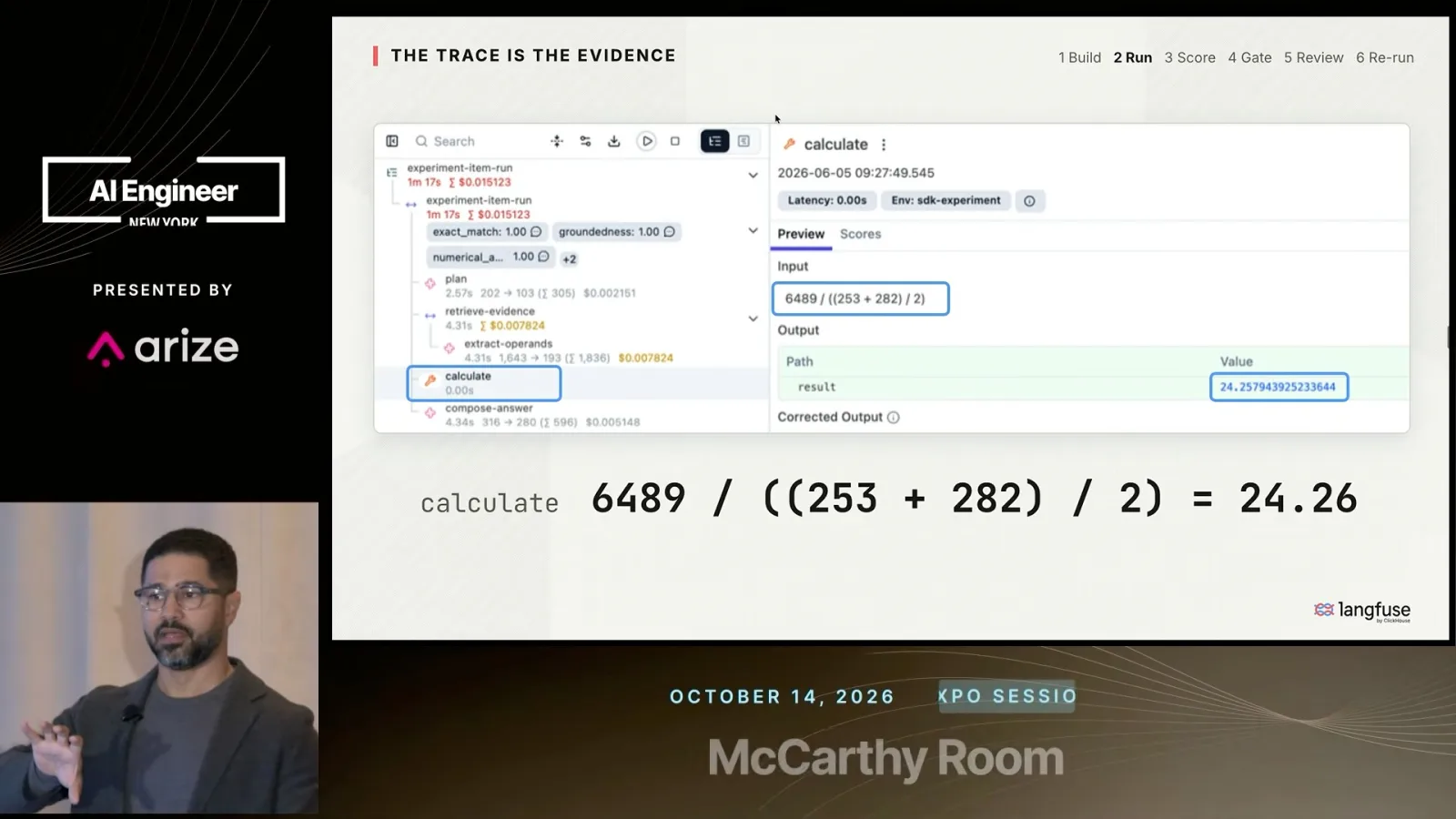
A trace of the improved agent shows the calculator receiving an expression and returning its result. De Jesus reports that giving the model this tool raised numerical accuracy from 60% to roughly 95% in the example.
Scoring and evidence
Deterministic checks, path evaluation and model judges assess different aspects of an agent. Traces connect the results to changes in configuration.
Scoring should combine approaches. Deterministic checks use code to produce the same result for the same input; the team also evaluates the path the agent took, since an apparently reasonable final answer can conceal missing or inappropriate steps.
An LLM judge can assess more qualitative aspects of an answer, but De Jesus cautions against relying on model judges alone. Together, these evaluations measured performance across dimensions and helped the application clear the bank’s 85% accuracy threshold.
The evidence also ties outcomes to configuration changes: prompts, models and tools can be associated with the traces and scores produced by each run. That makes it possible to see which change improved or degraded results.
Domain experts and the feedback loop
Experts set thresholds and review failures. Their feedback can improve test cases, while changes trigger a fresh evaluation.
Domain experts must help set the thresholds. A risk team, for example, can decide what level of performance is acceptable for an internal or customer-facing risk application; the right bar depends on the use case.
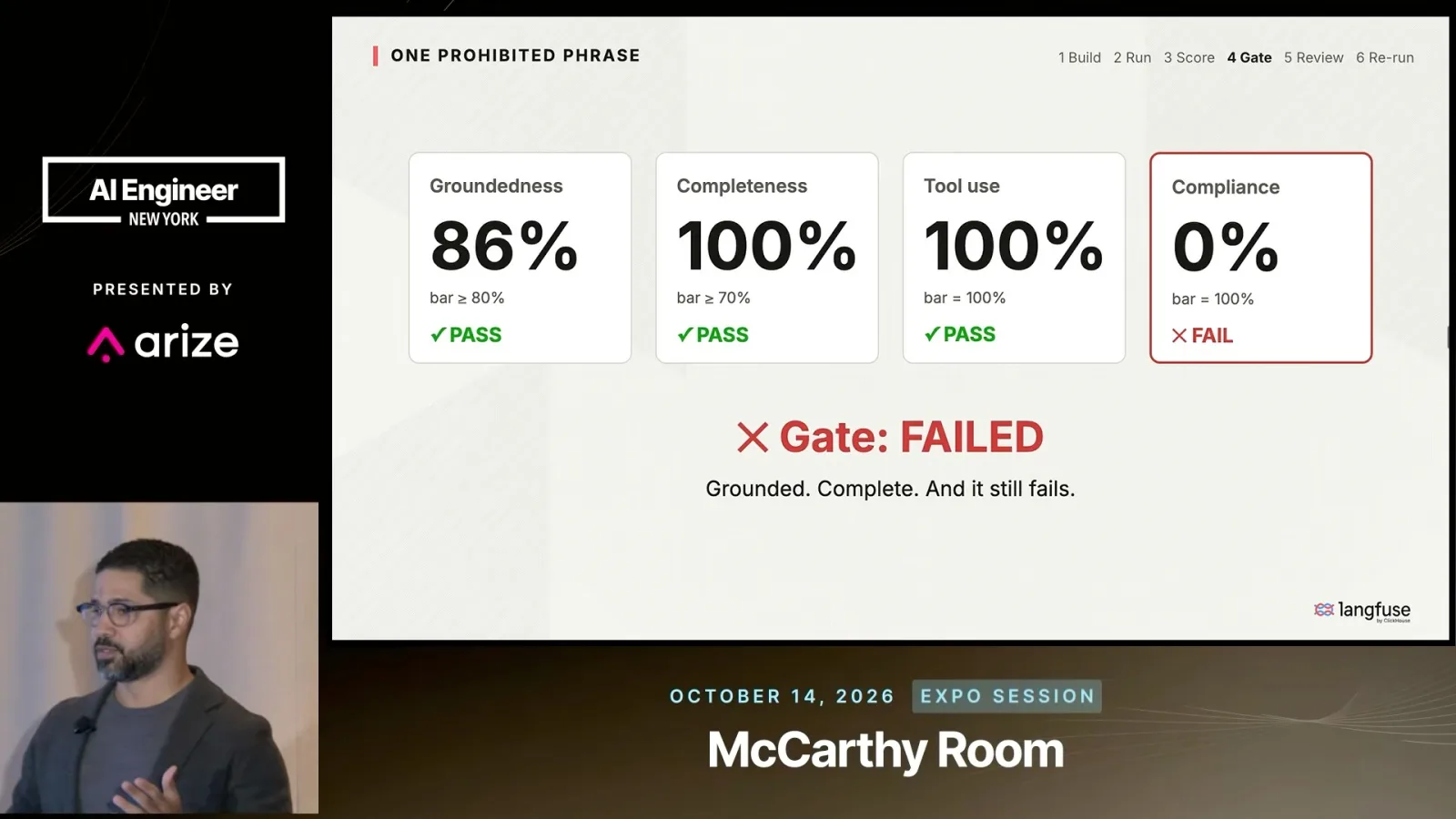
De Jesus shows evaluation runs over data sets of 150 and 1,500 questions. An application can pass on groundedness, completeness and tool use but fail compliance. For a bank, a compliance failure can shut the entire gate regardless of the average score.
Failures can be routed into an annotation queue for a domain expert. The reviewer examines the trace, identifies what happened and supplies feedback that the team can use to improve the agent.
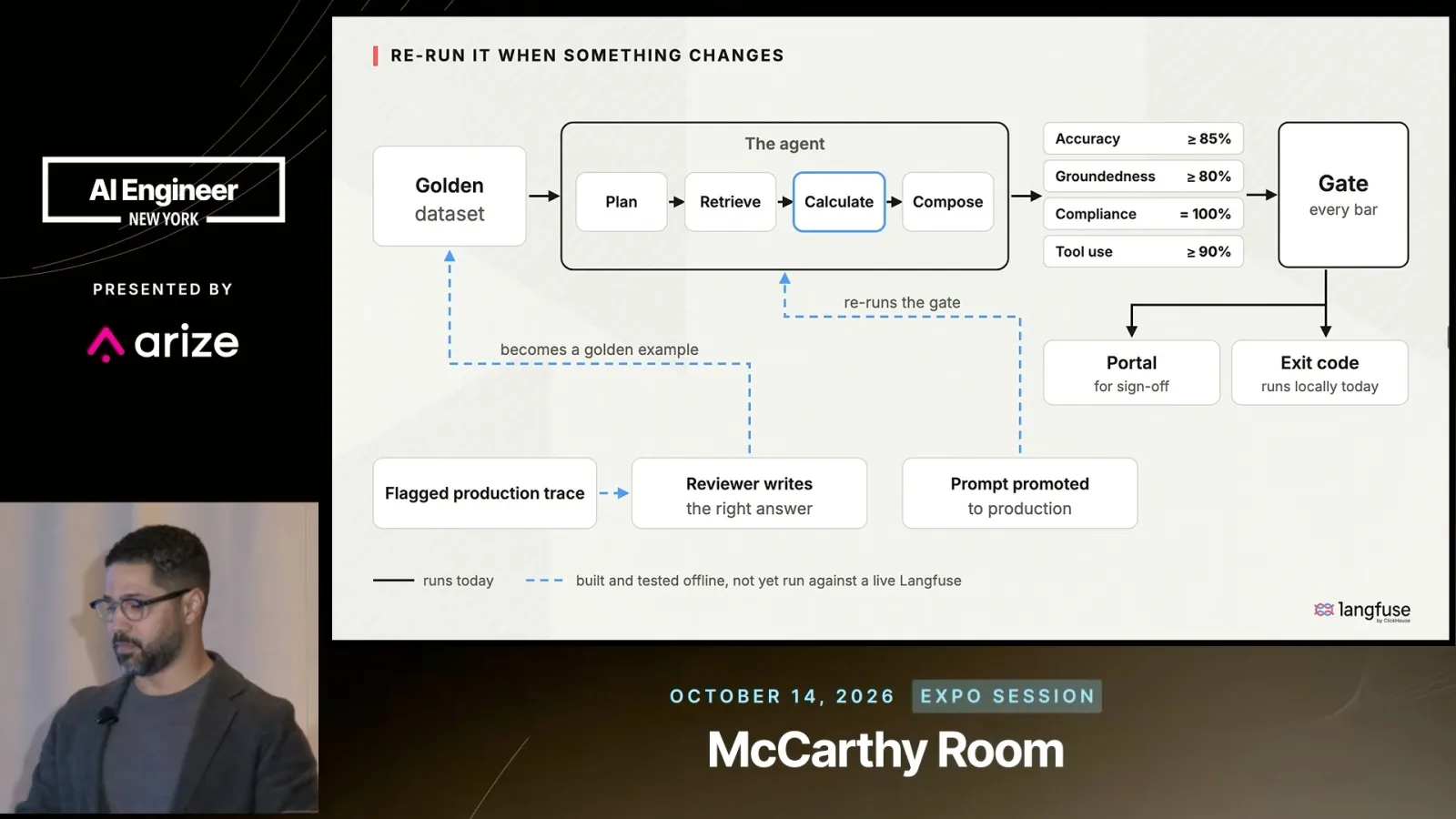
When a prompt or other configuration changes, the process reruns the evaluations. Reviewed examples can become candidates for the golden data set, so the benchmark improves as the team learns from actual failures.
De Jesus says the process helped reduce application evaluation from weeks to minutes, including use cases where risk and compliance review can otherwise take months. He stresses that the industry is still developing and there is no universal template.
His closing advice is to build a benchmark on your own data, gate the application rather than the model, and let domain experts establish the relevant thresholds. The resulting controls make model swaps easier to evaluate against the same application-specific standards.
同じチャンネルの記事
 19:12EN
 AI Engineer· 2026年11月4日Why AI Agents Need Reliable Processes to Scale Across a CompanyMitchell Troyanovsky · BasisBasis co-founder Mitchell Troyanovsky explains behavior specifications, trajectory forks and simulations for production agents.
 18:01ENAI Engineer· 2026年11月4日How NatWest Tests Customer-Facing AI Agents Before LaunchJonathan Osborne · NatWest GroupJonathan Osborne explains routing controls, human validation, unreliable LLM judges and shadow deployment in a regulated bank.
 19:48ENAI Engineer· 2026年11月4日Why Datasite Bought Its Document Parser Instead of Building ItAdit Abraham, Raj Bakhru · ReductoRaj Bakhru and Reducto CEO Adit Abraham discuss the engineering trade-offs behind AI for transaction data rooms.
 16:51ENAI Engineer· 2026年11月3日Cristóbal Valenzuela on Interactive Video Models and Runway’s ContinuumCristóbal Valenzuela · RunwayRunway’s co-founder traces next-frame prediction from early generated film to research prototypes for interactive visual interfaces.
 19:42ENAI Engineer· 2026年11月3日What Drives AI Agent Costs: Cache Hits, Input Tokens and TurnsGeorge Cameron · Artificial AnalysisArtificial Analysis co-founder George Cameron breaks down an agent benchmark and a framework for choosing models by cost and capability.
 20:35ENAI Engineer· 2026年11月3日Graph Engineering for Agents: Explicit Procedures, Memory and GovernanceZachary Blumenfeld · Neo4jNeo4j’s Zachary Blumenfeld describes three kinds of graphs and demonstrates a graph-shaped loan-review skill.