30 秒でわかる
Matthew Berman examines Google’s original Gemini Ultra, Pro and Nano announcements, their reported benchmarks and examples of multimodal reasoning. He also reviews AlphaCode 2, long-context retrieval, scientific-literature screening and image-to-code demonstrations. The video treats a promotional clip as a real-time interaction, but Google’s description of its construction shows selected still images and text prompts, with edited latency and output. The reported benchmark comparisons and demonstrations are historical, limited evidence rather than proof of superior performance in every real-world domain.
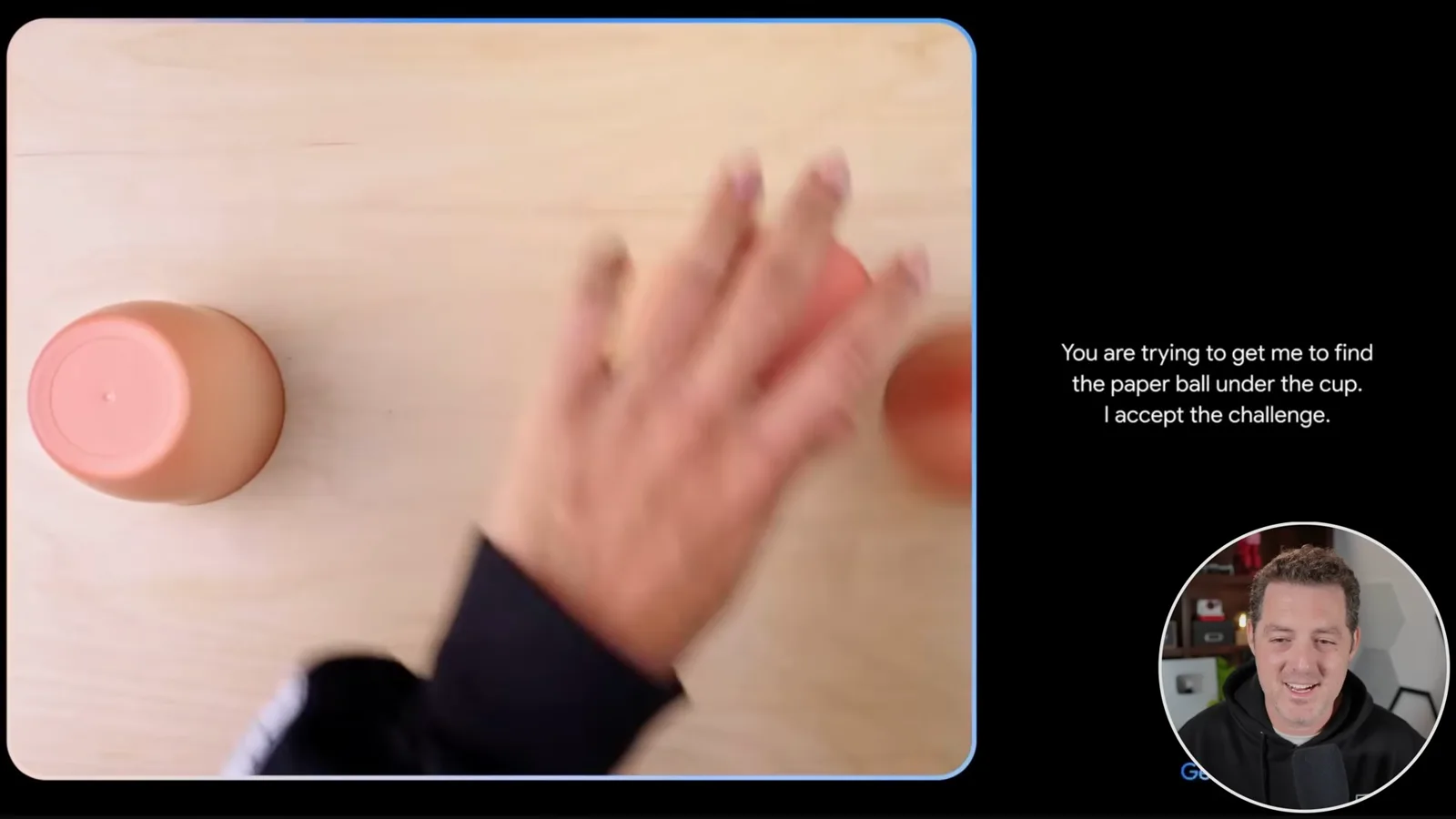
- 1The multimodal demoBerman describes the duck and cup examples as live video interaction. The underlying demo used still images and text prompts and was edited for presentation.
- 2Ultra, Pro and NanoGoogle’s original report describes three model sizes for different performance and deployment needs. Availability and device support differed by product.
- 3MMLU in contextGoogle reported 90.04% using a particular prompting and sampling approach. The result is not evidence that the model exceeds every human expert in every field.
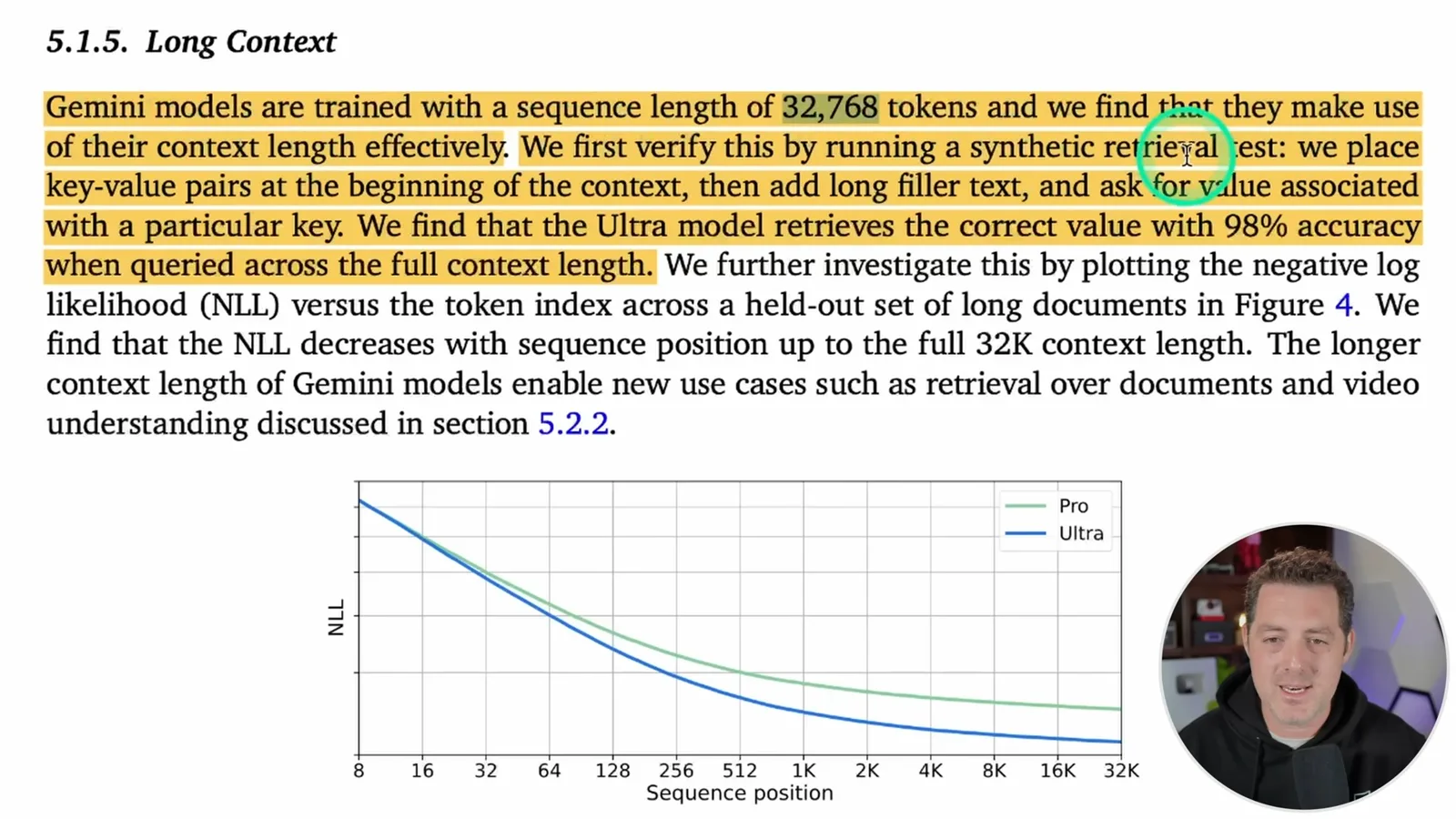
- 4Long-context retrievalThe report describes a synthetic key-value test with 98% retrieval accuracy over a 32,768-token context, not a universal guarantee.
- 5Research screeningA Google demonstration describes filtering a large corpus of genetics papers and extracting information from selected results; its completeness and accuracy are not independently established here.
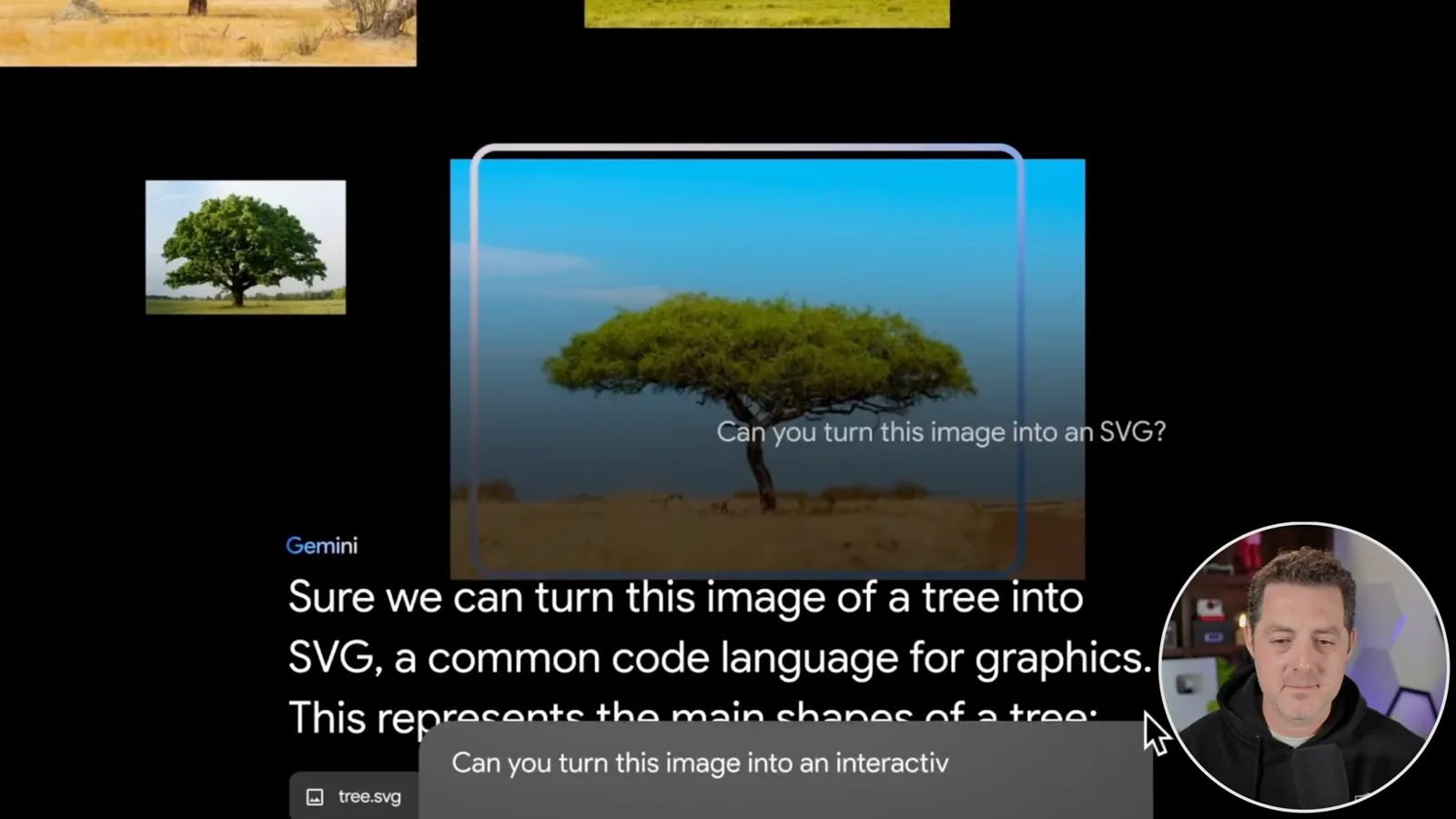
- 6Images into codeA promotional example turns a tree image into SVG and an interactive fractal-tree illustration.
ポイント
- Google introduced the original Gemini family in three sizes—Ultra, Pro and Nano—with different intended deployment settings.
- The highly edited duck and cup demonstration used selected still images and text prompts, so it does not establish the real-time video and voice interaction Berman describes.
- Google reported 90.04% MMLU for Ultra using a specific multi-sample prompting method; a test score does not prove superiority over human experts in every field.
- Google reported a 98% result on a synthetic long-context retrieval task; it does not guarantee the same accuracy on all long-document reasoning.
- AlphaCode 2 combined a specialized Gemini model with search and tools for competitive programming under its evaluation setup.
- A research demo reported filtering a large scientific corpus to around 250 papers, but the clip does not establish comprehensive full-text reading or independently verified accuracy.
チャプターごとに整えた全文を読む
Google’s multimodal promotional video
Berman reacts to a drawing, a rubber duck, a map game and a cup-tracking example. The edited demonstration was constructed from still images and text prompts rather than the real-time exchange he infers.
Google has announced Gemini, and I want to examine its research report and demonstrations against the models available in December 2023. Google describes Gemini as natively multimodal, trained to handle different kinds of information. Its benchmark claims are historical comparisons under particular settings, not proof that it beats GPT-4 at every task.
I begin with a promotional sequence in which a person draws a bird and a voice identifies it as a duck. I describe the interaction as real time, but that impression needs correction: Google’s account of how the clip was made shows that the model received selected still images and text prompts, with responses and timing edited for the presentation. The sequence is not evidence of uninterrupted live video and voice processing.
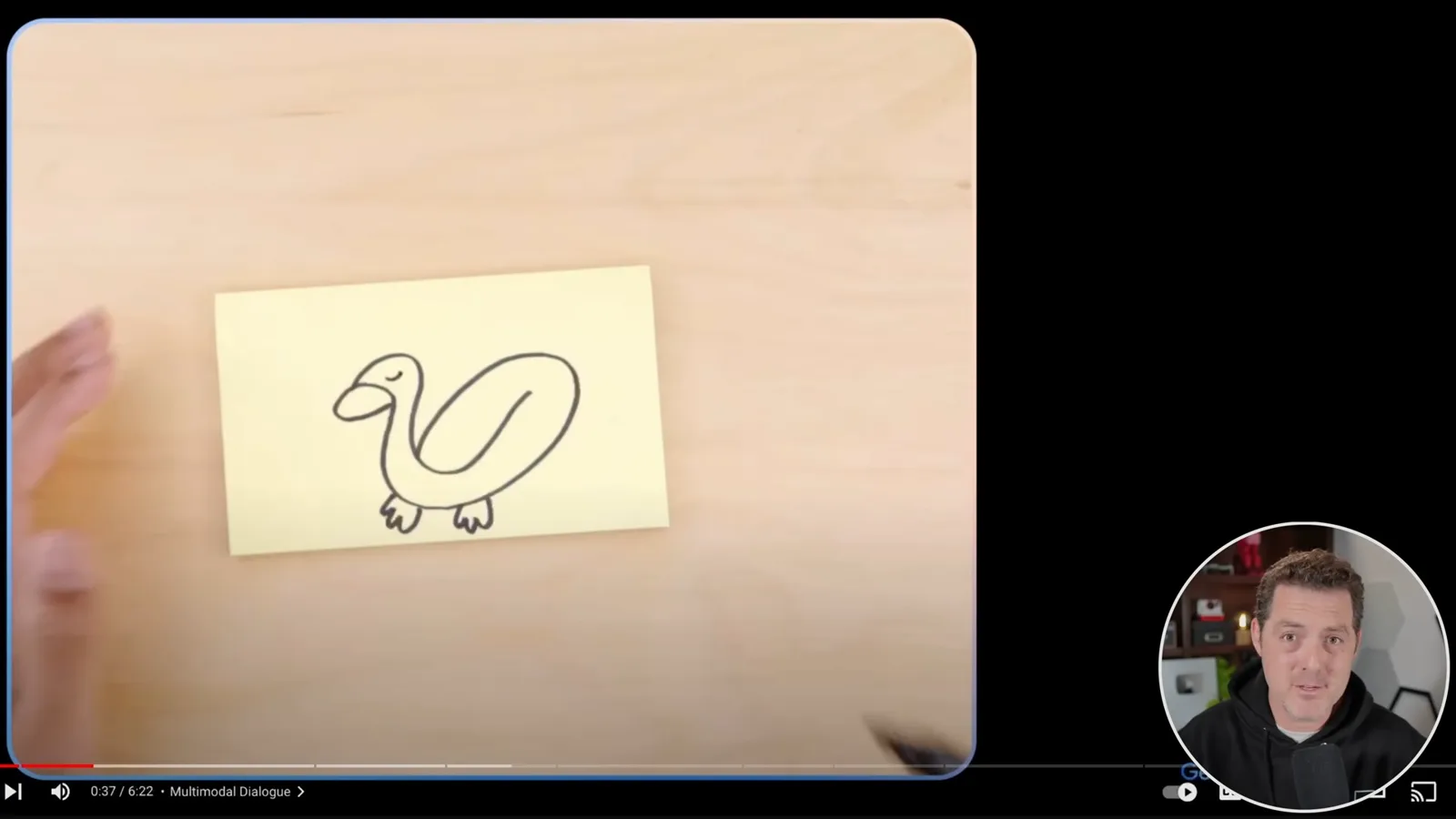
The demonstrator colors the drawing blue, then presents a blue toy duck, and the displayed response jokes about the coincidence. I enjoy the apparent personality and discuss the question of whether the toy floats. A squeak alone does not prove an object will float; the example is a selected promotional interaction, not a physical test of every toy.
The clip also shows a map-based guessing game with country clues, followed by a game tracking paper under cups. I take this as spontaneous understanding without instruction, but the construction details matter: the demonstration used selected visual inputs and text prompts. It does not show that the model independently inferred all rules from an uninterrupted video stream.
The original Gemini family and report
He discusses Ultra, Pro and Nano, a physics example and AlphaCode 2. The report describes multimodal training and different deployment targets.
Google’s original Gemini report introduces Ultra, Pro and Nano, model sizes intended for needs ranging from demanding reasoning to memory-constrained devices. Google reports leading results on 30 of 32 selected benchmarks. These are the company’s reported evaluations against the baselines and test settings in the report, rather than a guarantee for all tasks or current model versions.
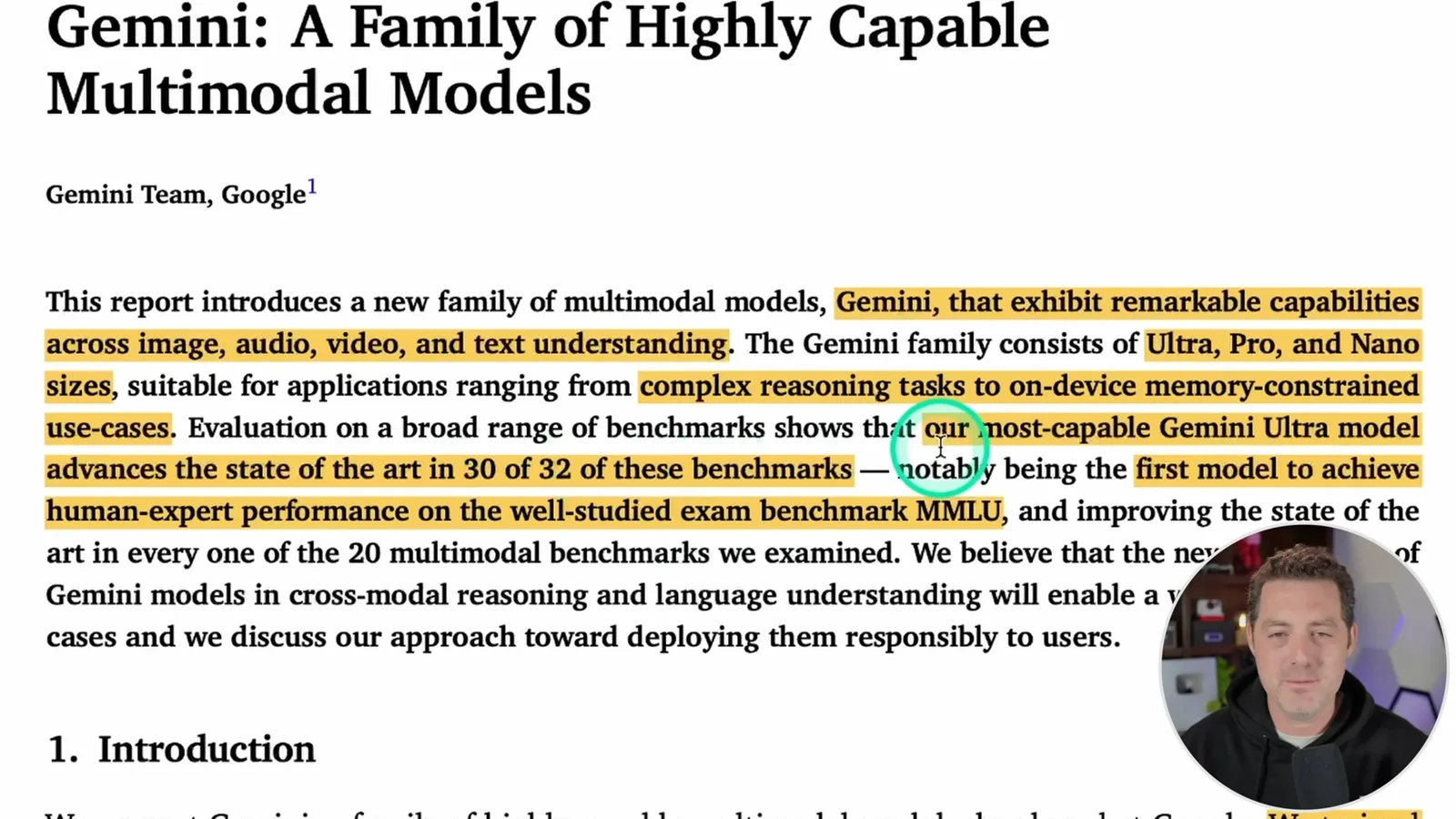
The report describes joint training on text, images, audio and video. I interpret Ultra as the largest tier, Pro as a more deployable middle tier, and Nano as the device-focused tier. My suggestion that ordinary users could simply run Pro locally is speculation; the announcement did not provide publicly downloadable Pro weights or promise that setup.
One report example asks Gemini to read a handwritten physics problem about a skier, check the student’s calculation and explain the result using mathematical notation. The displayed answer identifies an error and provides a corrected calculation. I find the combination of image reading, reasoning and formatting compelling, though a selected example does not establish reliability across all handwritten work.
The report also introduces AlphaCode 2, a competitive-programming system combining a specialized Gemini model with search and tools. Google reports a ranking within the top 15% of participants in its Codeforces evaluation, compared with roughly the top half for its predecessor. That result concerns the full system and its evaluation conditions, not a claim that a bare model or every programming task reaches that rank.
Gemini Nano is designed for on-device applications such as summarization and text completion. The report describes Nano-1 and Nano-2 at approximately 1.8 billion and 3.25 billion parameters and four-bit quantization for deployment. On-device operation can avoid a network call for supported functions, but device compatibility and whether a particular feature works offline depend on the product.
The report describes Transformer-based models served on Google’s TPU infrastructure and a 32,768-token training sequence length. Ultra is positioned for more complex work and Pro for a balance of capability, cost and latency. These are Google’s design descriptions; model access and hardware requirements were product-specific rather than a promise of local access to all tiers.
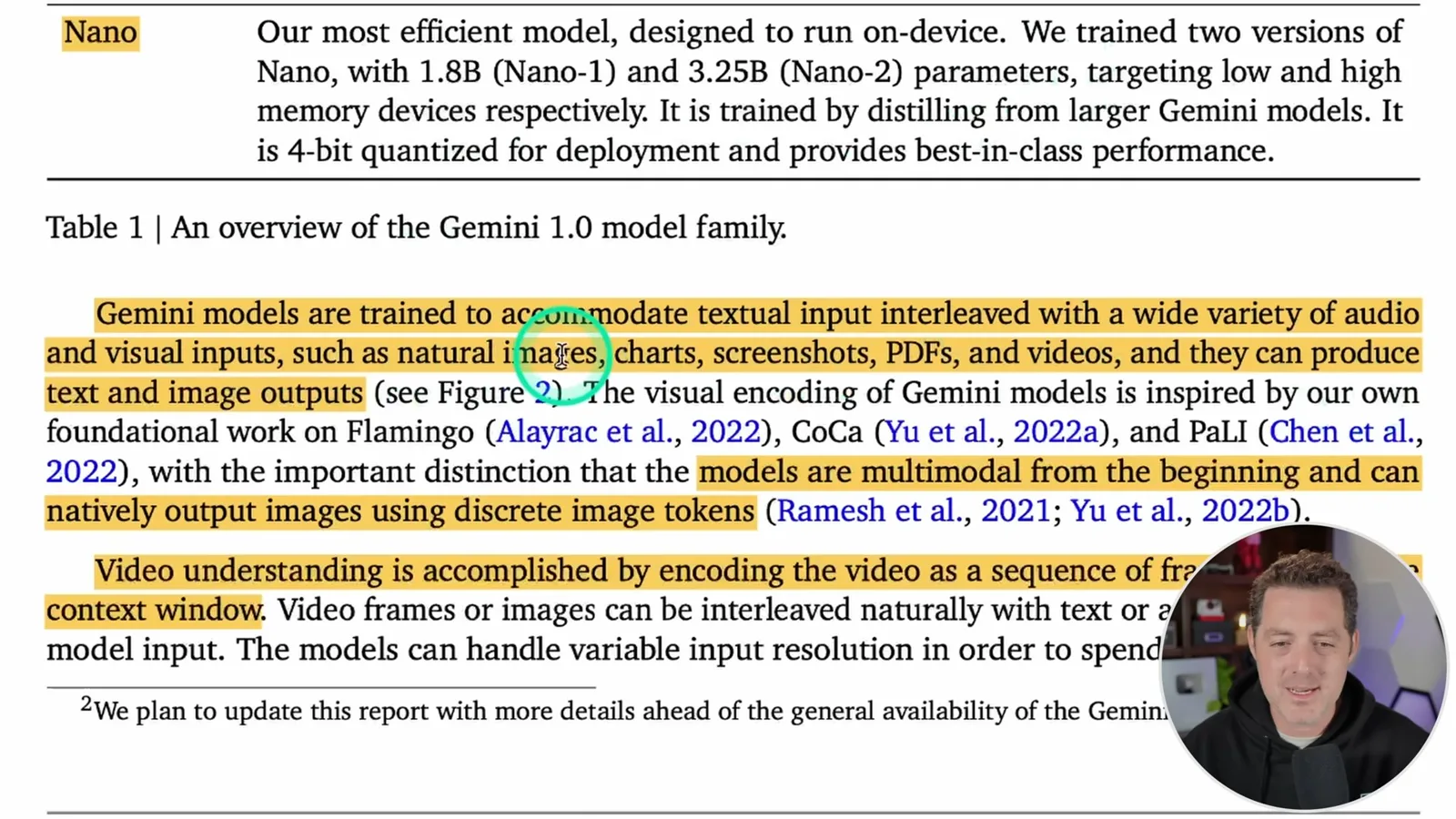
Google says Gemini can handle text interleaved with visual or audio inputs and describes text and image outputs in the research setting. It explains video understanding by encoding frames into the context window. Research capabilities, promotional examples and features available in a particular user-facing product are separate questions.
Training, benchmarks and contamination
Berman reviews the training-data description, MMLU, math and coding comparisons, and the problem of benchmark contamination. The results depend on evaluation conditions.
On training data, the report mentions web documents, books, code, images, audio and video, along with quality and safety filtering. I speculate that Google could benefit from services such as Search, Gmail and YouTube, but the report’s broad data categories do not establish that private Gmail contents were used. The exact sources and permissions are not identified in the excerpt I discuss.
The report asks whether joint multimodal training can perform well across domains compared with models specialized for one kind of task. Google reports that Gemini Pro is competitive with models available at the time and that Ultra leads on many of its selected tests. Model version, prompting, evaluation design and cost all matter when comparing those results.
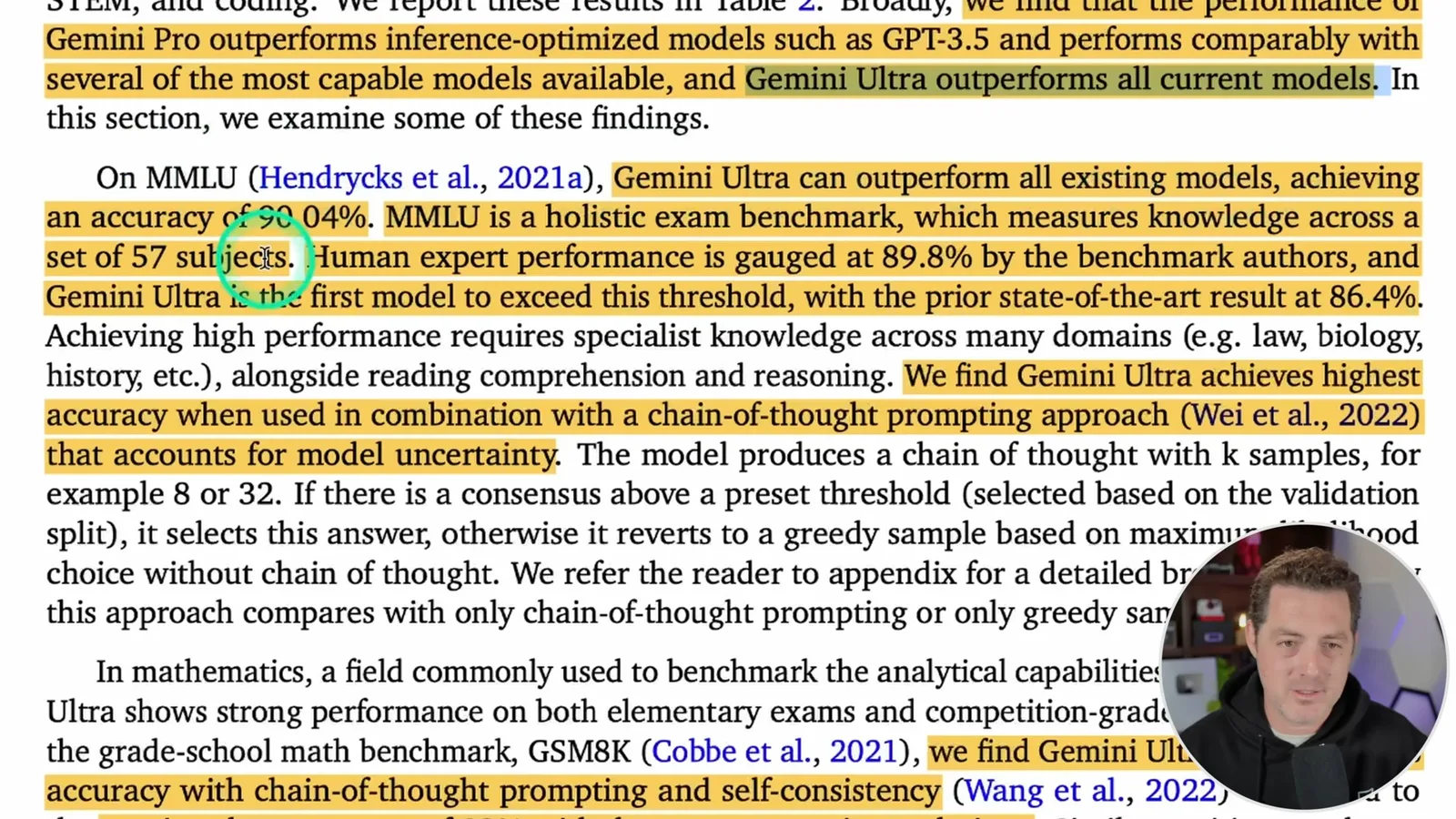
On MMLU, Google reports 90.04% for Gemini Ultra with a particular chain-of-thought and multi-sample procedure, compared with the benchmark authors’ 89.8% human-expert reference. I extrapolate that result to every expert and every domain, but that is not supported: a multiple-choice benchmark and a reference score do not establish superior real-world expertise across all fields.
Google attributes the MMLU result to a prompting approach that uses multiple reasoning samples and a confidence threshold. The report also gives 94.4% on GSM8K using chain-of-thought and self-consistency and 53.2% on the MATH benchmark under the stated prompting conditions. Comparisons are meaningful only when their methods and compute budgets are understood.
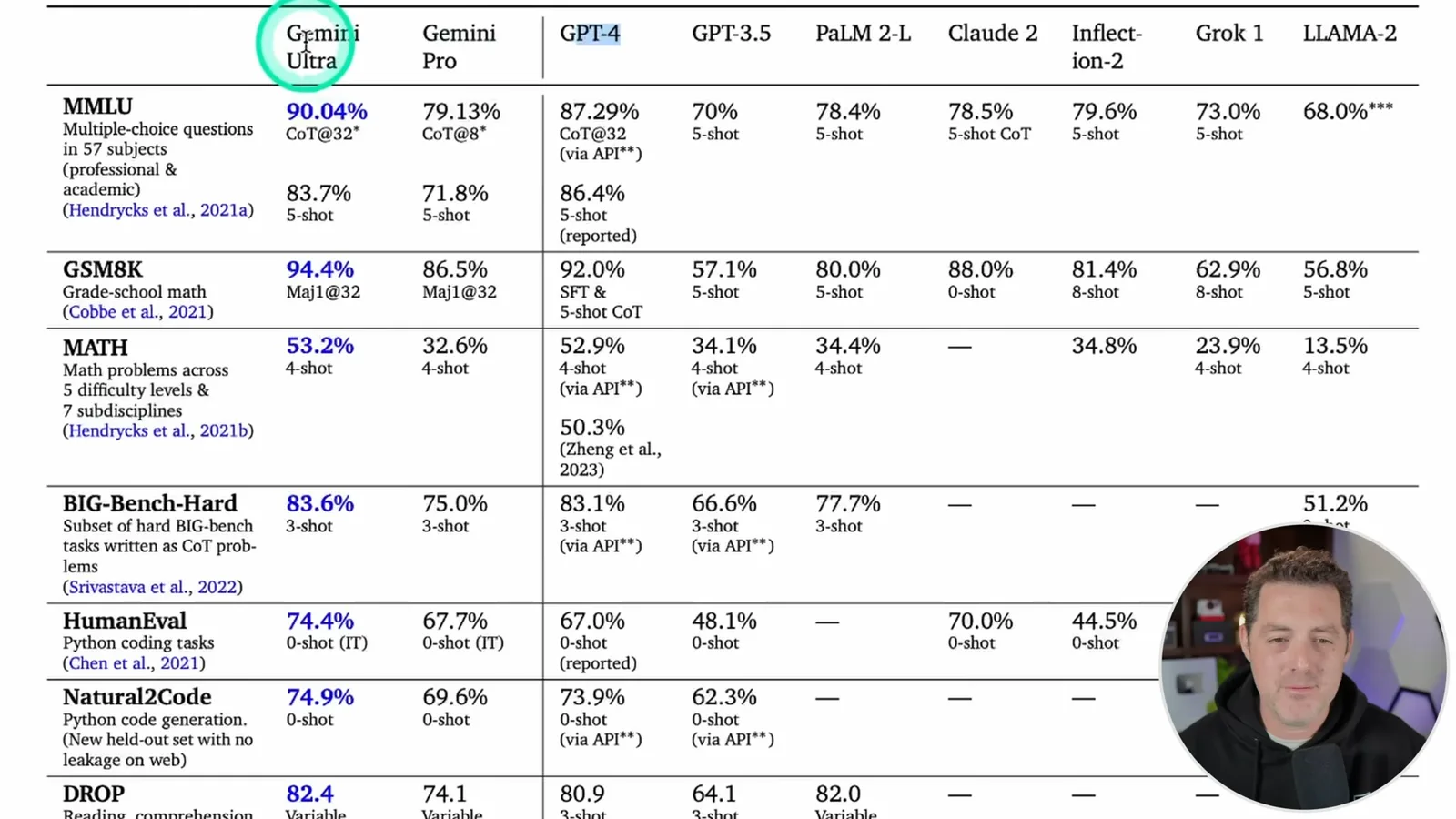
I examine Google’s text-and-reasoning benchmark table and note that GPT-4 scores higher on HellaSwag while Gemini Ultra leads on many other displayed entries. Some rows use different prompting procedures. The table provides a snapshot of selected 2023 evaluations, not a universal or permanent verdict about either model.
The report also discusses benchmark contamination: evaluation items can appear in training material, making it harder to interpret a model’s score as generalization. Google says it performed leak analysis and omitted some results where it found issues. Such checks can reduce a source of uncertainty but do not prove every benchmark is free of contamination.
Nano, long context and visual tasks
He highlights on-device models, a synthetic retrieval evaluation, image benchmarks and examples combining diagrams with code. He also imagines future personal-assistant workflows.
I am particularly interested in Nano because models running on a device could support local, potentially offline experiences. The report describes results in summarization, comprehension, factual retrieval, reasoning and multilingual tasks, often with task-specific fine-tuning. I would prefer an open release of weights and training data, but that is my preference rather than a feature Google promised.
The report includes translation results and a long-context test. Google says the original Gemini models were trained with a 32,768-token sequence length; in a synthetic task, Ultra retrieved a value paired with a key across long filler text with 98% accuracy. That result is specific to the tested retrieval setup and does not establish the same accuracy for every long document or complex reasoning task.
I return to AlphaCode 2 and the idea of combining a specialized Gemini Pro with search and tools to tackle multi-step programming problems. As someone who uses AI while coding, I welcome another potential assistant. A competitive-programming result does not by itself establish performance on everyday repositories or production software.
Google’s report compares image-understanding benchmarks and presents MMMU questions across academic disciplines. I regard the results as an encouraging launch for Google, but the reported comparisons are bounded by the models, prompts and tasks evaluated. They do not show that Gemini is better at every visual question.
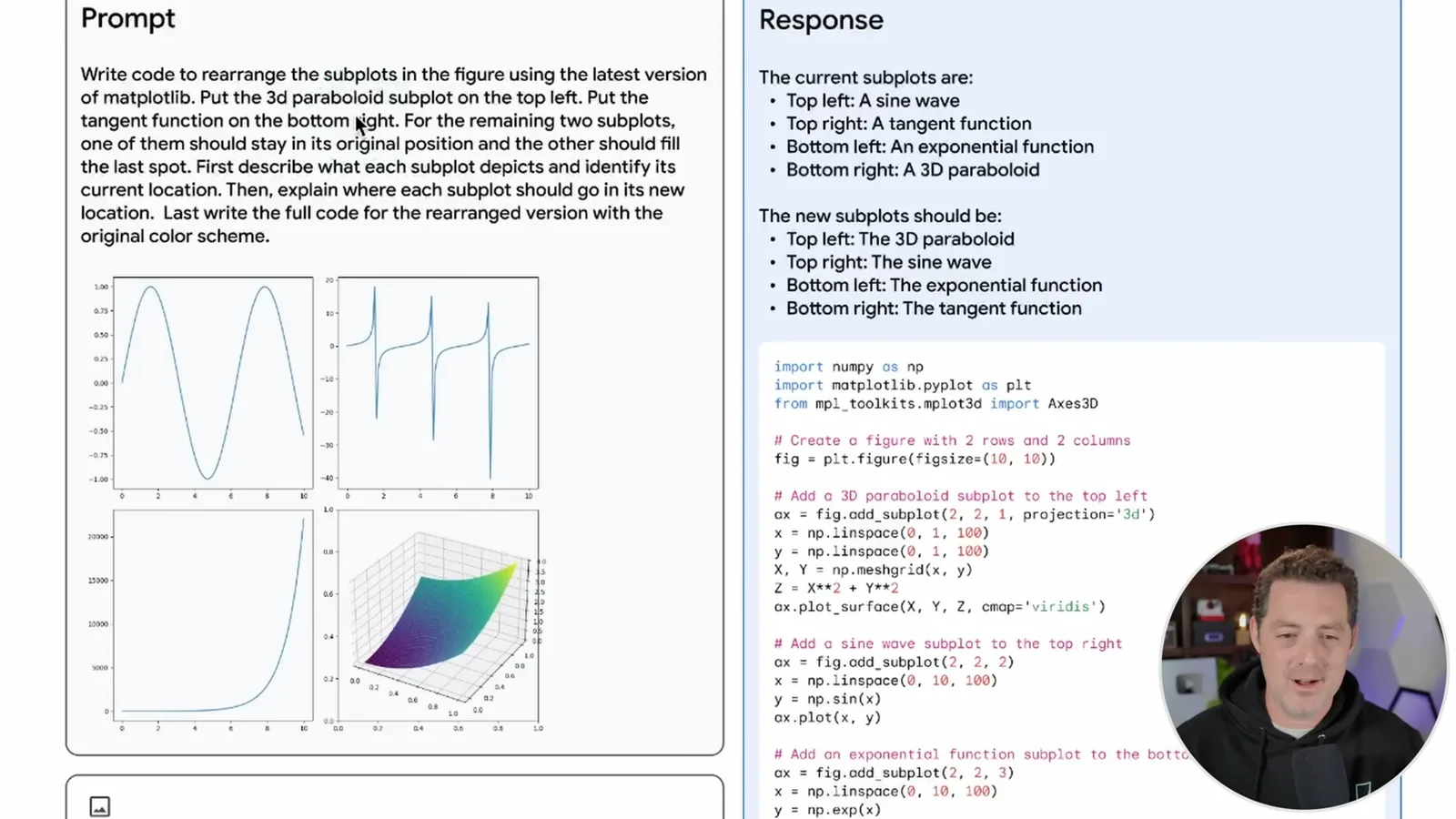
One illustrated example asks the model to identify four plotted functions and write Matplotlib code to rearrange their positions. The displayed output identifies a sine wave, tangent, exponential function and 3D paraboloid and produces code for the requested arrangement. The example combines image interpretation, instruction following and coding, but is a selected demonstration.
Other examples suggest craft ideas from colored yarn and provide step-by-step advice for a vegetable omelet from images. I imagine a personal assistant that could use such visual context, perhaps through a phone or wearable. That is my vision of a possible product, not evidence that a device continuously observes a user or that the examples work reliably in every kitchen.
Scientific research and image-to-code demos
Google researchers describe screening a genetics literature corpus and extracting selected information. Berman closes with mathematics and image-to-code promotional examples.
A Google research video describes updating a genetics literature dataset derived from a 2022 review. The researchers say more than 200,000 relevant-domain open-access papers had appeared since 2021 and demonstrate prompting Gemini to identify candidates and extract fields with annotations. This describes a workflow for one research problem, not a general replacement for scientific review.
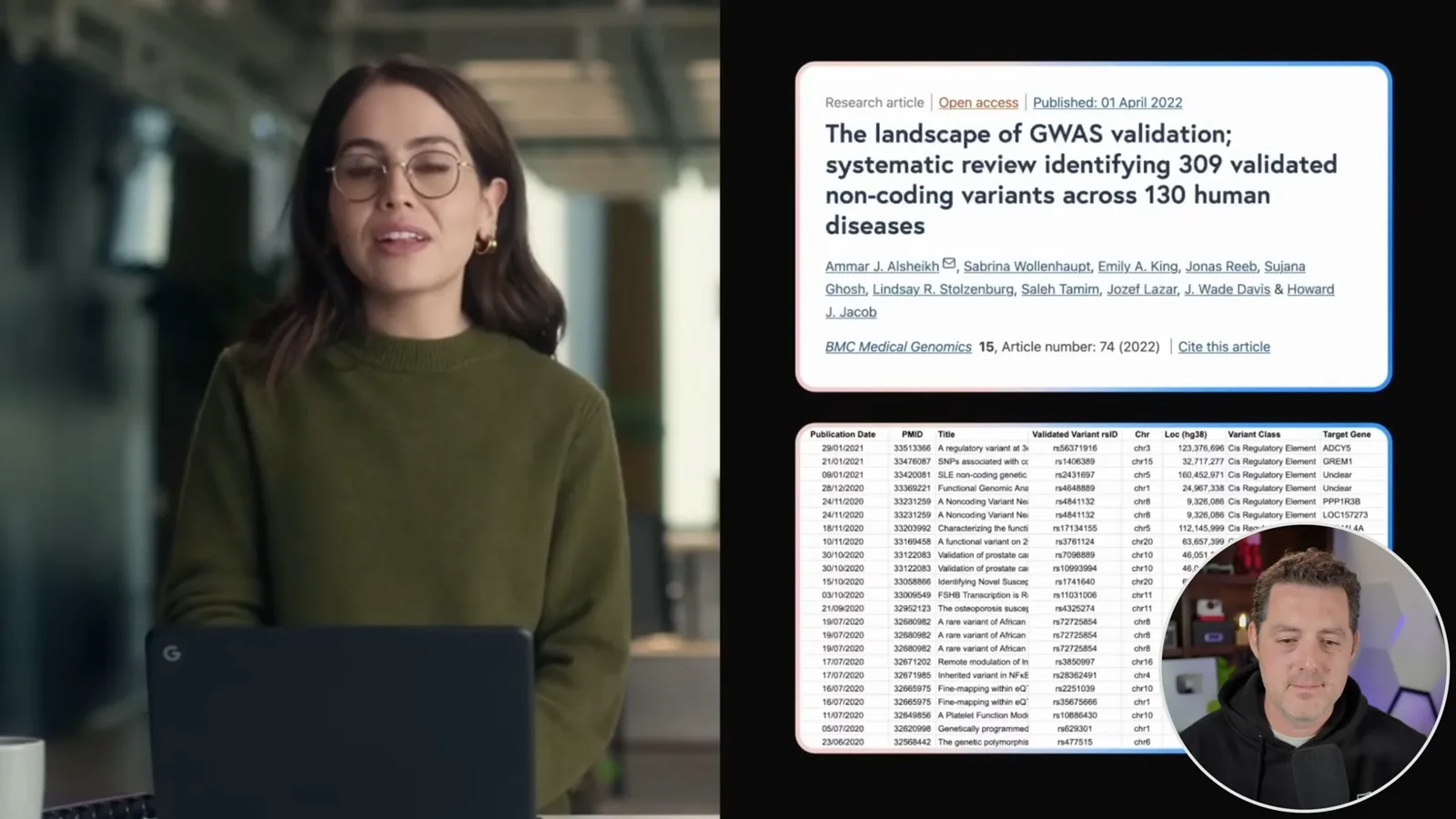
In the demonstration, Google says it ran screening at scale over a lunch break, narrowed the corpus to roughly 250 papers and extracted information from selected results. I characterize that as the model fully reading and ranking every paper in an hour, but the displayed filtering prompt includes titles and abstracts and the clip does not establish full-text reading of all 200,000 or independently validated recall and extraction accuracy.
Another promotional example shows Gemini identifying mistakes in a student’s mathematics solution and explaining the height calculation. I connect this to broader speculation about improvements in math reasoning, including Q*; the video does not establish what Q* is or how it relates to Gemini. A selected tutoring example should be checked against the underlying problem and answer.
Finally, a Google demonstration asks Gemini to turn a tree image into SVG and then generate an interactive JavaScript fractal tree with a slider. I am impressed by the movement between images and code and look forward to testing the models myself. At the time of the video, Bard was beginning to incorporate Gemini; product availability and capability should be understood in that 2023 context.
同じチャンネルの記事
 34:21EN
 Matthew Berman· 2026年10月27日Matthew Berman Examines Anthropic’s IPO Filing, AI Growth and GovernanceMatthew Berman, Sam Altman · Forward FutureThe presenter reviews the S-1’s financial metrics, compute strategy and voting structure while questioning the tension between rapid AI development and safety.
 0:26ENMatthew Berman· 2026年10月25日Sam Altman on Human Values and Problem-Solving in an AI WorldSam Altman · OpenAIIn a short interview excerpt, Altman considers the enjoyment of solving hard problems and the human role in interpreting results.
 0:36ENMatthew Berman· 2026年10月25日Kimi K3.1 and a Rubik’s Cube Solver DemonstrationMatthew Berman · Forward FutureMatthew Berman shows a scrambled virtual cube being solved and gives the Kimi K3.1 test a favorable assessment.
 0:21ENMatthew Berman· 2026年10月24日An AI-Generated Kimi Benchmark Chart Used Invented ScoresMatthew Berman · Forward FutureMatthew Berman asks for a graph of Kimi K3.1 Pro benchmarks, then discovers that the displayed figures are illustrative placeholders.
 25:50ENMatthew Berman· 2026年10月24日Kimi K3.1 Pro Tested: Strong 3D Demos, Uneven Results and Competitive PricingMatthew Berman · Forward FutureMatthew Berman tests the open-weight model on coding, 3D rendering and visual explanations, then compares benchmark results and prices.
 32:20ENMatthew Berman· 2026年10月23日Who Is Local AI For? The Costs, Trade-offs and a Hybrid FutureMatthew Berman · Forward FutureMatthew Berman weighs data control and independence against hardware cost, setup complexity and inference speed.