30 秒でわかる
Matthew Berman examines Meta’s 2023 Segment Anything Model (SAM), its research paper and the SA-1B dataset. SAM accepts prompts such as points and boxes to generate masks and can propose multiple masks when the intended region is ambiguous. He explores a web demo on a city image and an uploaded flower photograph. The paper reports more than one billion masks on approximately 11 million images and evaluates zero-shot transfer; demonstrations and dataset size do not establish universal accuracy or clinical suitability.
- 1What segmentation doesA mask identifies pixels belonging to a selected region. Naming the object or using it for a downstream task requires additional interpretation or tools.
- 2Model and datasetThe research paper reports a promptable model and SA-1B, with over one billion masks on about 11 million images.
- 3Interactive promptsUsers can add or remove points or draw a box, and SAM can propose multiple valid masks for an ambiguous region.
- 4The dataset in contextBerman shows Meta’s historical comparison with other segmentation datasets. Dataset size is not a guarantee of performance in every domain.
- 5The web demonstrationBerman explores masks on a city scene, generates candidate cutouts and uploads a photograph of flowers.
ポイント
- Image segmentation selects pixels belonging to a region or object; a mask is not necessarily a semantic label identifying the object.
- SAM can use positive and negative points or bounding boxes to produce masks, and can return multiple options for ambiguous prompts.
- SA-1B contains over one billion masks on approximately 11 million images, according to the 2023 paper.
- The project released model checkpoints and inference code as well as dataset access; their applicable licenses and terms differ.
- Precomputing an image embedding enables interactive mask prediction in the demonstrated workflow.
- The few web examples do not prove accurate segmentation of every object or safe medical use.
チャプターごとに整えた全文を読む
Segment Anything and its dataset
Berman introduces image segmentation and discusses Meta’s model, research paper and large dataset. The project is designed for promptable transfer, not automatic universal object recognition.
Meta’s Segment Anything project aims to make image segmentation more flexible across many kinds of images. In this April 2023 walkthrough, I look at the research and try the demo. A segmentation model selects image regions; that is different from automatically naming or understanding every object in a scene.
Meta’s examples show varied scenes, from underwater life to penguins and kitchen objects, with regions highlighted by masks. Potential applications include selecting a person or background region for image editing. The examples are demonstrations, not evidence that every object in every image will be correctly segmented.
Segmentation identifies which pixels belong to a selected object or region. Specialized systems have traditionally required task-specific expertise and annotated data. Scientific imagery and photo editing are possible areas of use, but a medical example is only an application idea: the demonstration does not validate SAM for diagnosis or clinical decisions.
Meta released the Segment Anything research and SA-1B dataset. The paper reports over one billion masks on approximately 11 million licensed images, collected through a model-assisted data engine. Dataset scale is impressive but does not eliminate errors, distribution differences or the need to evaluate a specific use case.
I initially say I did not see a GitHub repository or training instructions. Meta also published a Segment Anything repository with inference code, model checkpoints and examples; that is distinct from providing a complete recipe to reproduce the original training pipeline. The code, weights and dataset have their own terms.
I show a video example that selects parts of a scene around a viewer’s gaze. Segmentation can provide visual regions for a larger system, but it does not by itself give a language model full visual understanding or determine object names. Combining capabilities requires additional components.
Prompts, masks and research examples
The presentation reviews points, boxes and automatic mask generation. It shows the scale of SA-1B and dense examples from the paper.
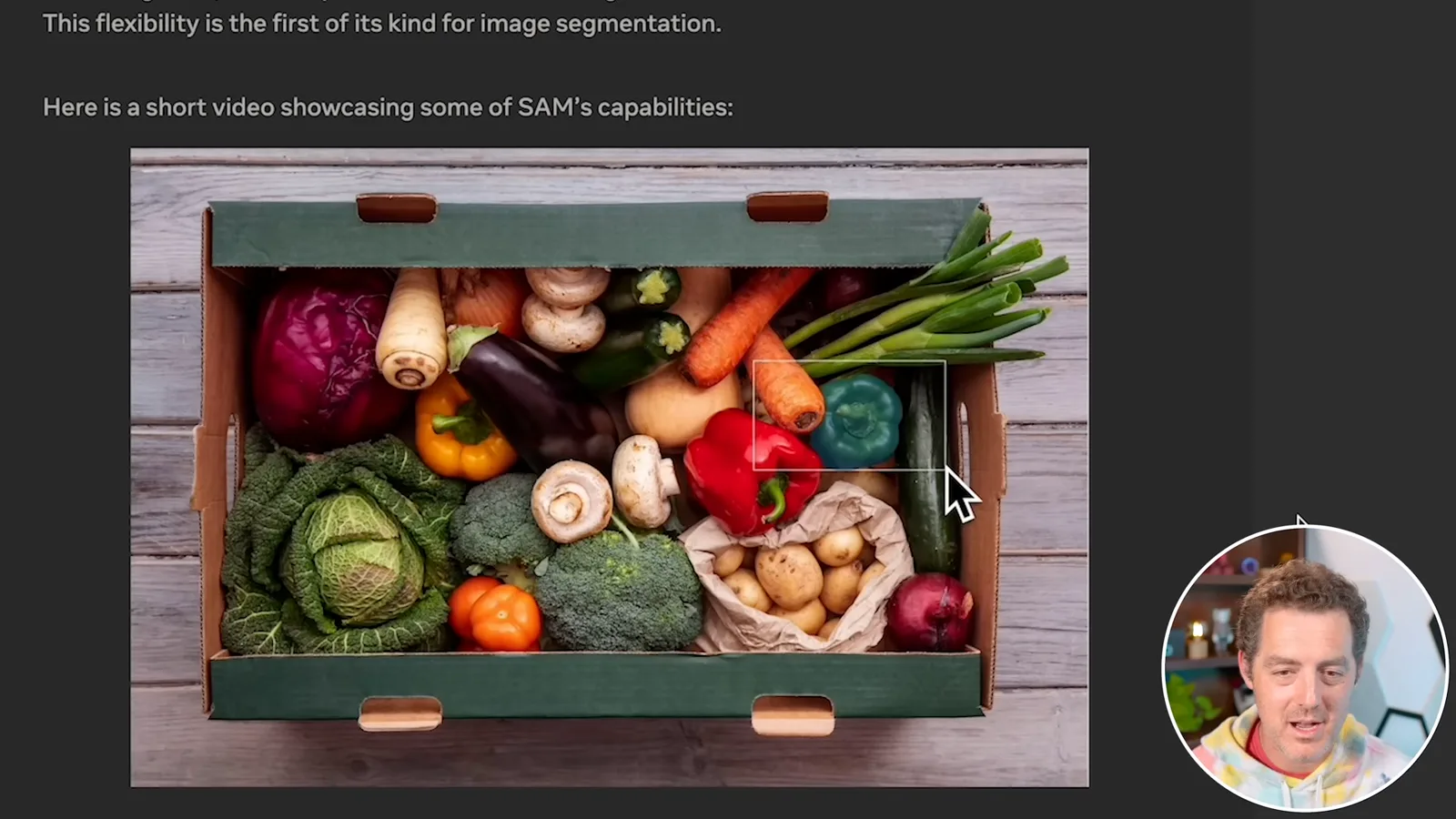
In the vegetable-box example, a user can click a point to select an object, add or exclude points to refine the selection, or draw a bounding box. Where a prompt is ambiguous, SAM can return multiple plausible masks. The user is selecting regions rather than receiving a verified label for each vegetable.
The system can also generate many candidate masks automatically. Meta describes fast interactive prediction after precomputing the image embedding, so the prompt response and the initial image processing are different parts of the workflow. Automatic masks may overlap, miss objects or include unwanted regions.
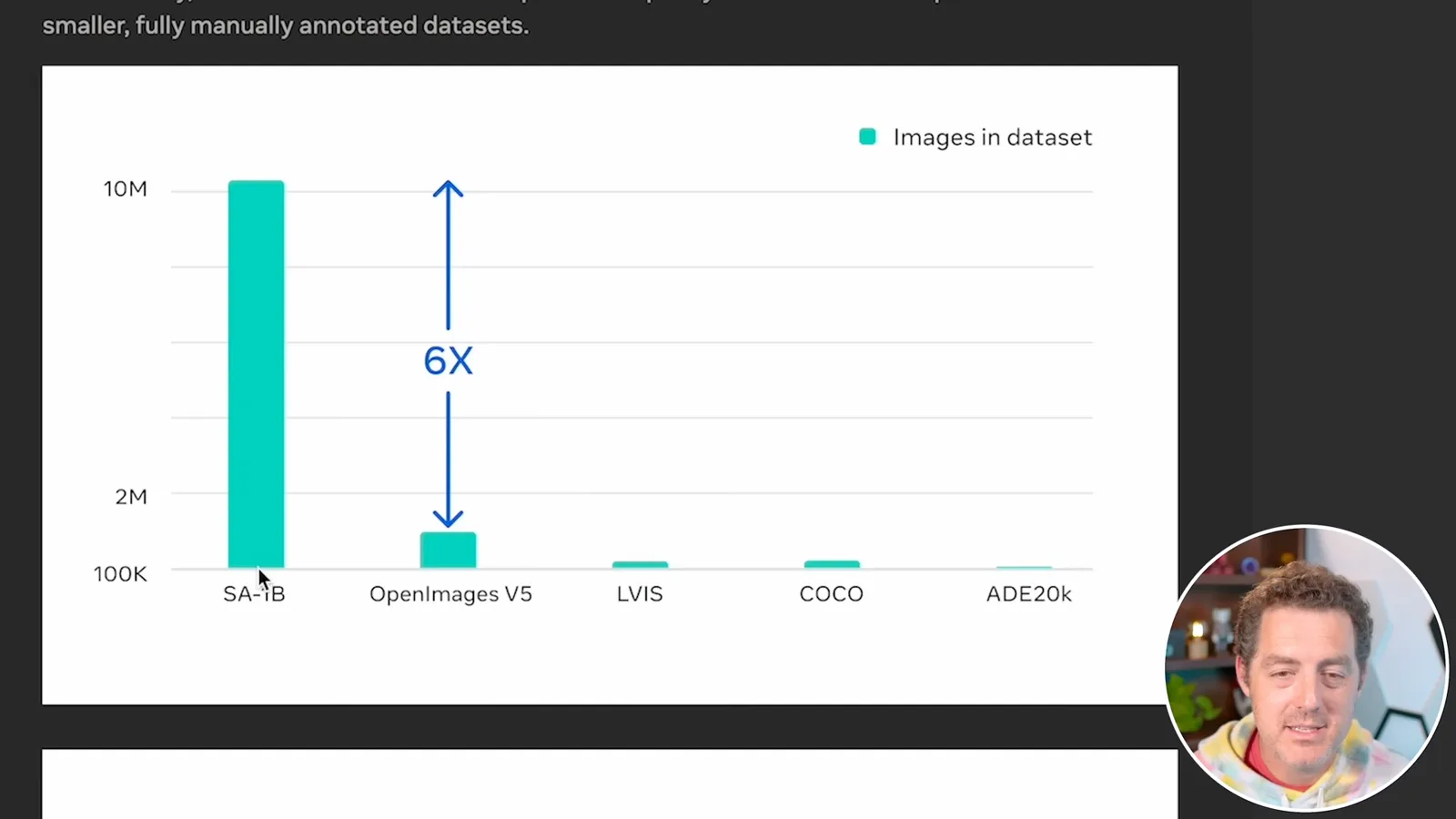
I review Meta’s comparison of SA-1B with earlier datasets, including Open Images V5. The chart illustrates a much larger image and mask collection in the comparison shown. A mask is a pixel-level region, and more masks do not by themselves establish better results on every target domain.
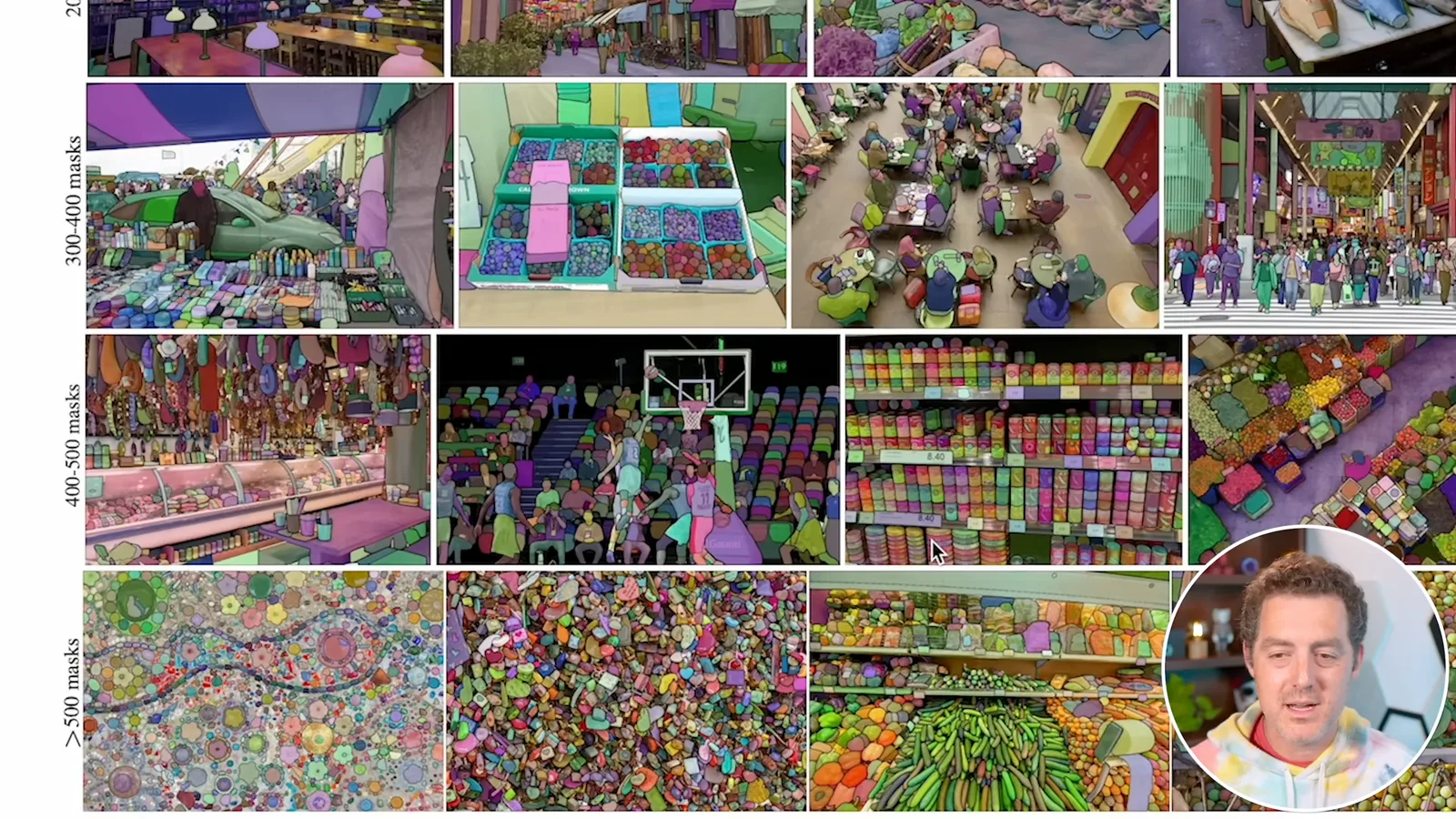
The paper shows dense mask examples in crowded street scenes, produce displays and other complex images. Many individual regions are outlined, which demonstrates the breadth of the annotations. The visual examples are selected illustrations, not a comprehensive measurement of accuracy.
Testing the web demo
Berman selects regions of a city image and tries automatic mask generation. He then uploads a flower image and considers potential applications.
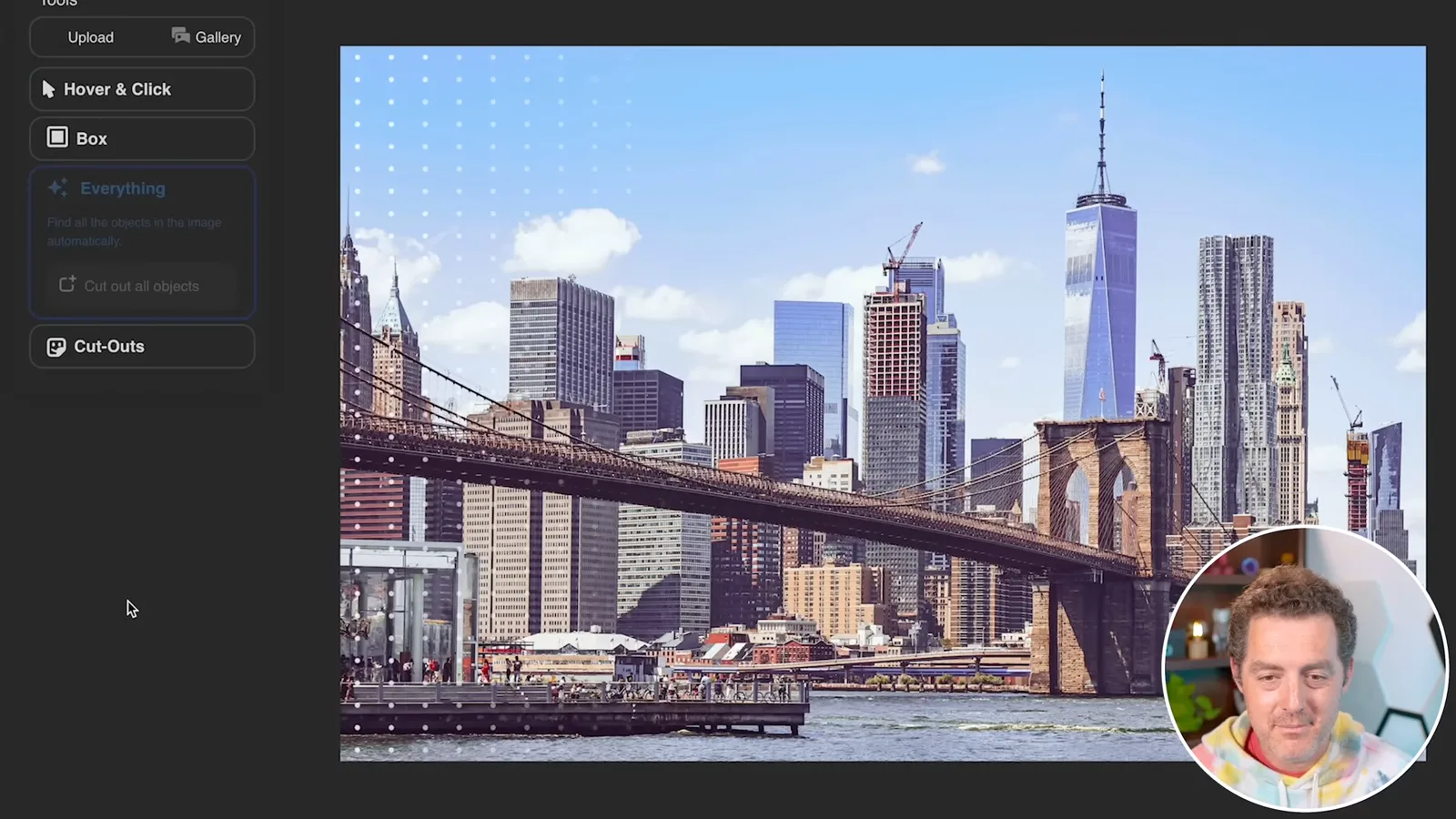
Meta makes the dataset available through its project page, subject to its terms. I then open the web demo and select a city-and-bridge photograph. Hovering previews regions such as buildings, parts of the bridge and other visible structures.
I click to add masks and use controls for removing areas. The Everything option generates a collection of proposed regions, and the cutout interface displays individual masks. I can also draw a box to select a region; the output still needs inspection when boundaries or objects are ambiguous.
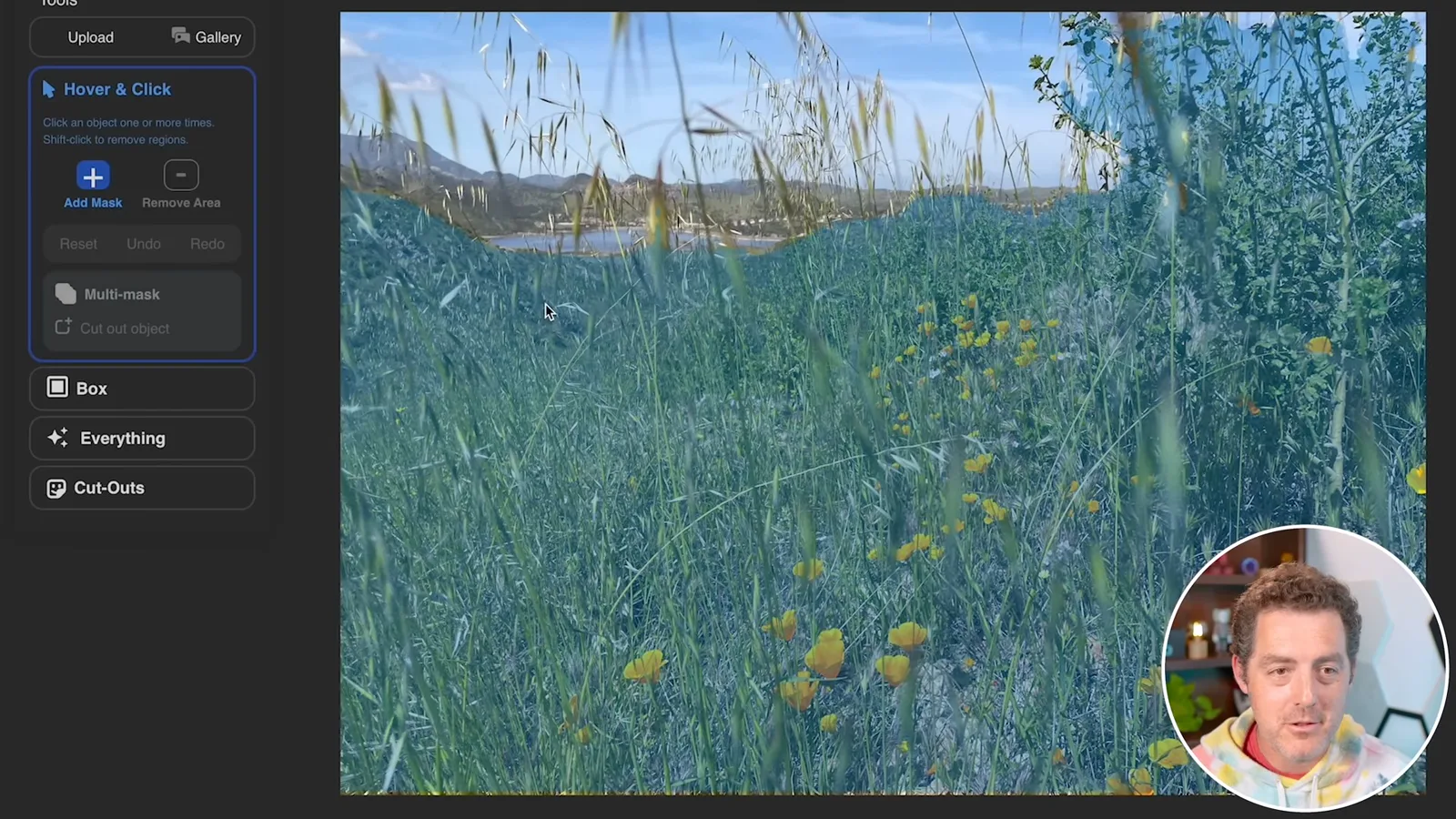
Finally, I upload a photograph of flowers and try automatic selection. The demo produces masks for portions of the scene, including flowers and background regions. I see possible uses in photo editing and visual pipelines and invite viewers to explore other applications, while recognizing that results depend on the image and task.
同じチャンネルの記事
 34:21EN
 Matthew Berman· 2026年10月27日Matthew Berman Examines Anthropic’s IPO Filing, AI Growth and GovernanceMatthew Berman, Sam Altman · Forward FutureThe presenter reviews the S-1’s financial metrics, compute strategy and voting structure while questioning the tension between rapid AI development and safety.
 0:36ENMatthew Berman· 2026年10月25日Kimi K3.1 and a Rubik’s Cube Solver DemonstrationMatthew Berman · Forward FutureMatthew Berman shows a scrambled virtual cube being solved and gives the Kimi K3.1 test a favorable assessment.
 25:50ENMatthew Berman· 2026年10月24日Kimi K3.1 Pro Tested: Strong 3D Demos, Uneven Results and Competitive PricingMatthew Berman · Forward FutureMatthew Berman tests the open-weight model on coding, 3D rendering and visual explanations, then compares benchmark results and prices.
 32:20ENMatthew Berman· 2026年10月23日Who Is Local AI For? The Costs, Trade-offs and a Hybrid FutureMatthew Berman · Forward FutureMatthew Berman weighs data control and independence against hardware cost, setup complexity and inference speed.
 1:03:37ENMatthew Berman· 2026年10月23日Matthew Berman’s Team Tests Kimi K3.1 on Animation, Games, and ChartsMatthew Berman, Alex, Brian · Forward FutureA live team AMA turns into an informal test of Kimi K3.1, from personal-agent workflows to motion graphics, a browser game, and a benchmark chart.
 0:53ENMatthew Berman· 2026年10月22日Sam Altman on AI and the Discovery of New KnowledgeSam Altman · OpenAIAltman expects progress in mathematical discovery to extend to biology, materials and energy.