30 秒でわかる
In December 2024, Matthew Berman reacted to OpenAI’s announcement of o3 and o3-mini and argued that their reported performance amounted to artificial general intelligence. OpenAI presenters and ARC Prize president Greg Kamradt described evaluations, a compute-versus-performance tradeoff and an o3-mini coding demonstration. The scores measure performance on specific tests, not the ability to perform most economically valuable work or autonomously improve AI systems. [ARC Prize’s report](https://arcprize.org/blog/oai-o3-pub-breakthrough) notes that the tested preview was trained on part of ARC’s public training set and that its high-compute result was costly; its later update says the publicly released o3 differed from that preview.
- 1Coding evaluationsOpenAI reported 71.7% on SWE-bench Verified and a 2,727 Codeforces Elo at its highest test-time compute setting.
- 2Math and science testsOpenAI presented 96.7% on AIME 2024 and 87.7% on GPQA Diamond, measures of specific test performance.
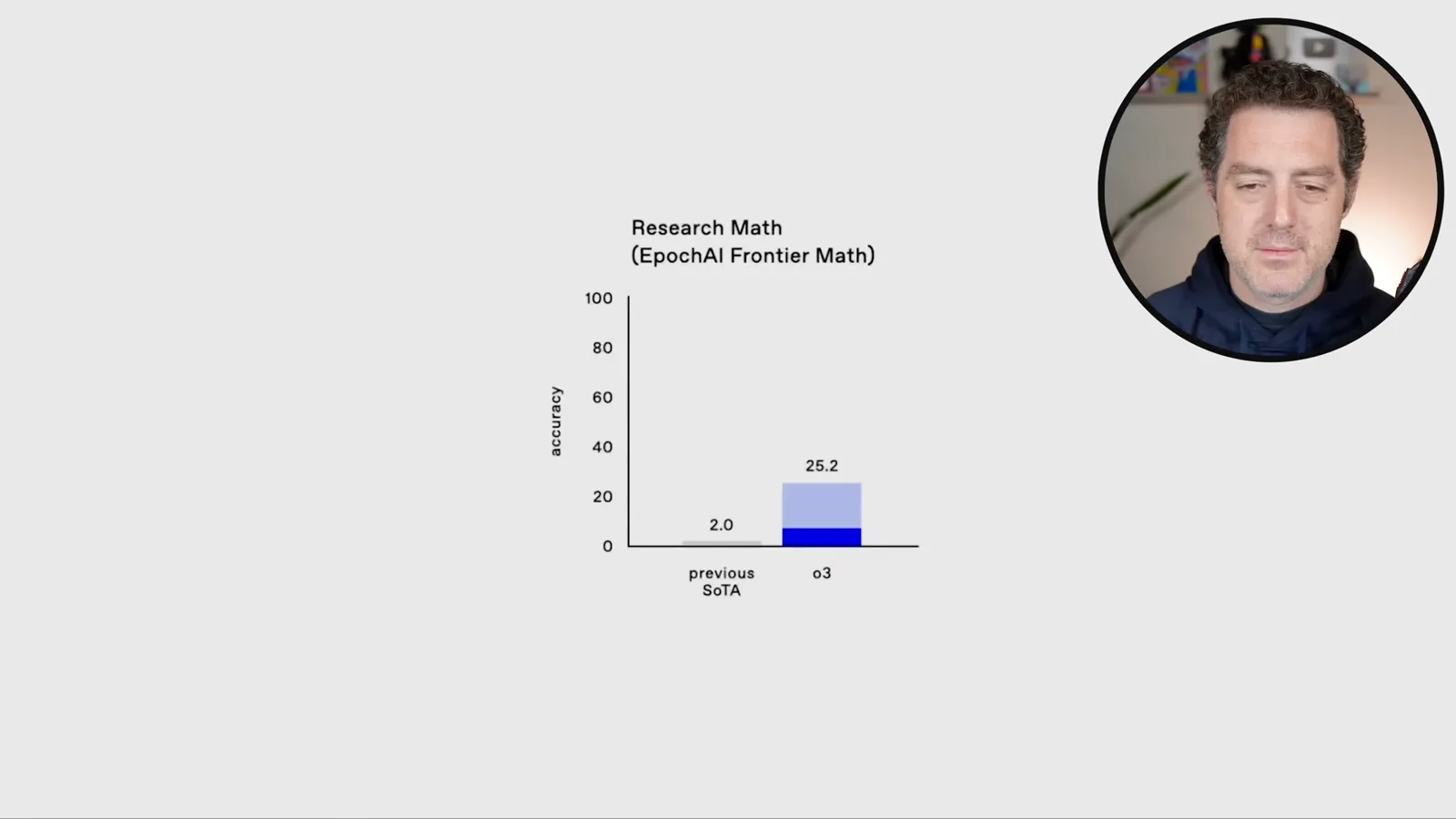
- 3FrontierMathOpenAI showed a 25.2% result on a difficult research-math benchmark at aggressive test-time compute.
- 4ARC-AGI-1 under two budgetsARC Prize reported 75.7% with lower compute and 87.5% with high compute on its semi-private set; the latter used roughly 172 times as much compute.
- 5Adjustable reasoning effortThe announced o3-mini settings let developers trade thinking time and cost against performance.
- 6A code-generation demonstrationOpenAI used generated code to build an interface and evaluate o3-mini on science questions.
ポイント
- OpenAI reported large o3-preview gains on selected coding, competition math, science and research math benchmarks in December 2024.
- ARC Prize verified 75.7% and 87.5% on its semi-private ARC-AGI-1 set under substantially different compute budgets.
- Strong test scores do not establish AGI, independent scientific discovery or recursive self-improvement.
- OpenAI said o3-mini would offer low, medium and high reasoning effort, trading latency and compute for performance.
- A live demonstration generated code to run an evaluation, illustrating a workflow rather than proving autonomous research capability.
チャプターごとに整えた全文を読む
The o3 announcement and coding results
Berman reacts to the o3 and o3-mini announcement and highlights OpenAI’s coding benchmarks. He interprets the scores as evidence of AGI, a broader claim than these tests establish.
OpenAI has announced o3, and I believe the results are evidence that we have reached AGI. I am reacting to OpenAI’s December 2024 presentation and the ARC Prize evaluation. That is my interpretation: strong scores on particular tests, including ARC-AGI, do not by themselves establish general intelligence across economically valuable work.
Sam Altman introduces o3 as the next frontier model after o1 and jokes about skipping the o2 name in deference to the telecommunications company. He announces o3 and the smaller o3-mini, intended to offer a better performance-and-cost tradeoff.
Neither model is publicly available in the announcement; OpenAI says it is opening a safety-testing application process. The presenters describe reasoning with test-time compute: allowing more computation when answering a difficult problem. The figures that follow are launch-era measurements and settings, not guarantees for every use.
Mark Chen begins with coding. OpenAI reports 71.7% on SWE-bench Verified, a set of software engineering tasks derived from real issues, compared with 48.9% for o1 in its chart. On Codeforces competition programming, it reports an estimated 2,727 Elo for o3 at an aggressive compute setting, versus 1,891 for o1.
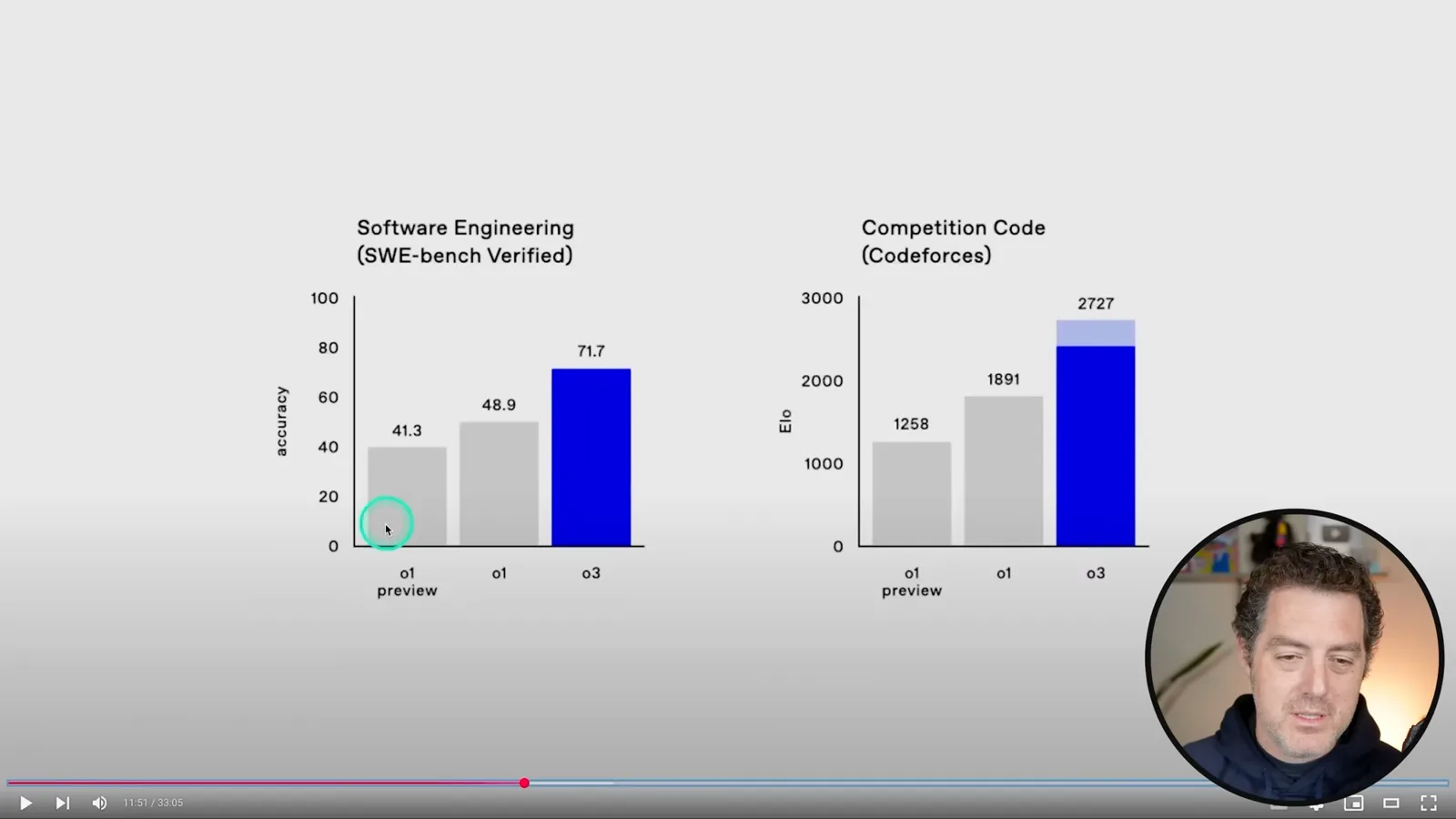
I compare the reported coding rating with the experience of Mark, a competitive programmer, and argue that this is AGI in one dimension. The comparison is striking, but a competition rating is a measure of programming contest performance, not proof that a system can outperform people across most economically valuable work. My comments about Microsoft’s access and an AGI clause are an interpretation of contractual arrangements, not a demonstrated consequence of these results.
Math, science and harder benchmarks
OpenAI presents AIME, GPQA Diamond and FrontierMath results. Berman speculates about automated research and self-improvement.
OpenAI’s chart reports 96.7% on AIME 2024 competition math, against 83.3% for o1, and 87.7% on GPQA Diamond science questions, against 78% for o1. These are company-reported results for particular question sets and configurations, rather than a direct measurement of all the work mathematicians or scientists perform.
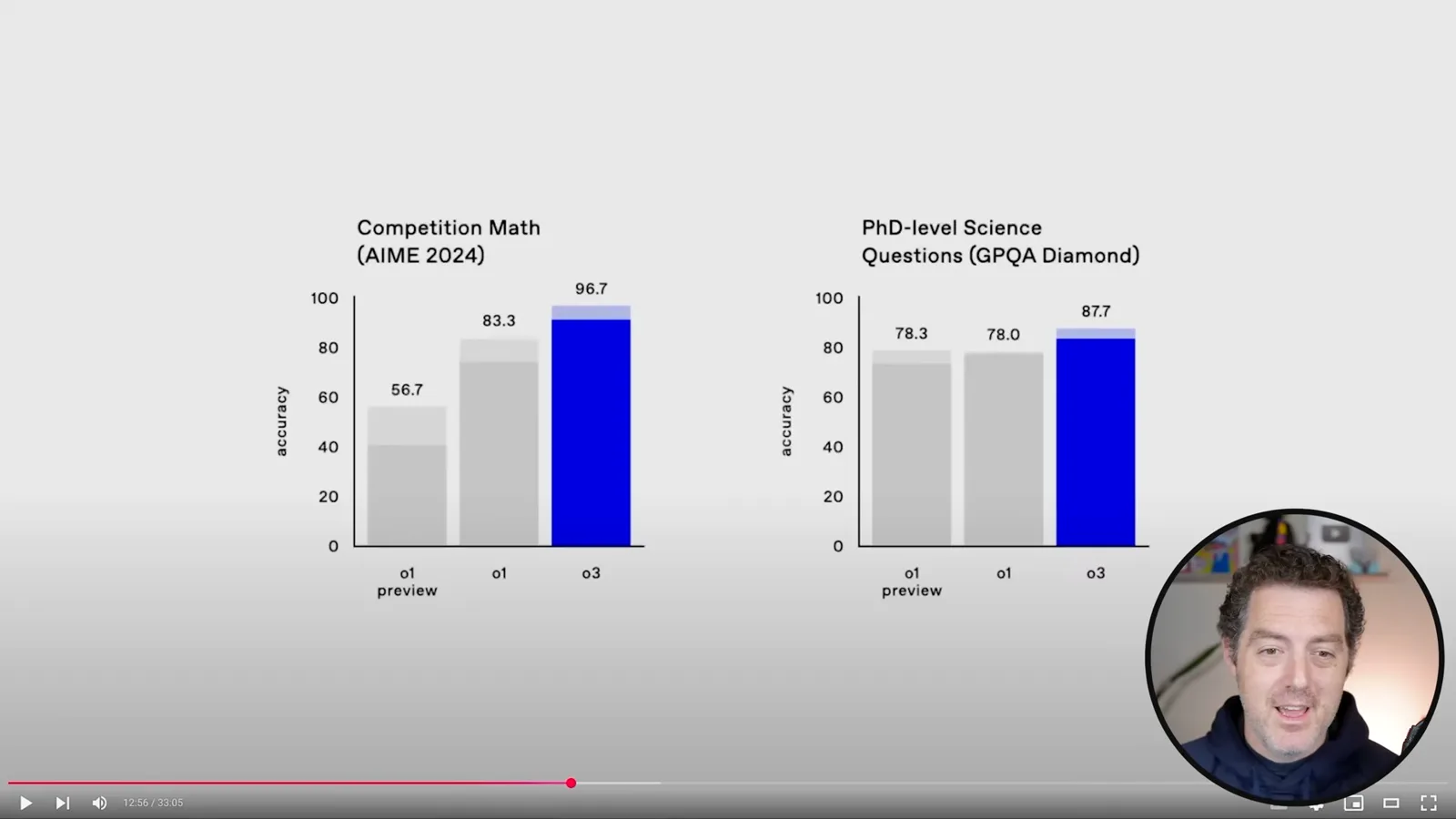
I connect those math and science scores to the idea of an intelligence explosion: an AI system could potentially conduct research, discover improvements and apply them to itself. That is a speculative scenario. These benchmark results do not demonstrate independent discovery, reliable automated research or indefinite recursive improvement.
The presenters note that several benchmarks are approaching saturation, making harder tests useful for distinguishing further progress. They introduce Epoch AI’s FrontierMath, a collection of difficult, unpublished mathematics problems, and report 25.2% for o3 under aggressive test-time compute, compared with a prior result around 2% in their chart.
The ARC-AGI result
Greg Kamradt explains the visual reasoning benchmark and reports scores under two compute budgets. Berman calls the result AGI, while the test measures a particular domain of abstraction.
Greg Kamradt, president of ARC Prize Foundation, joins to explain ARC-AGI, developed by François Chollet. Each visual puzzle supplies input-output examples; the solver must infer a transformation and apply it to a new input. One example asks the solver to complete colored shapes; another requires deriving a border from colored squares.
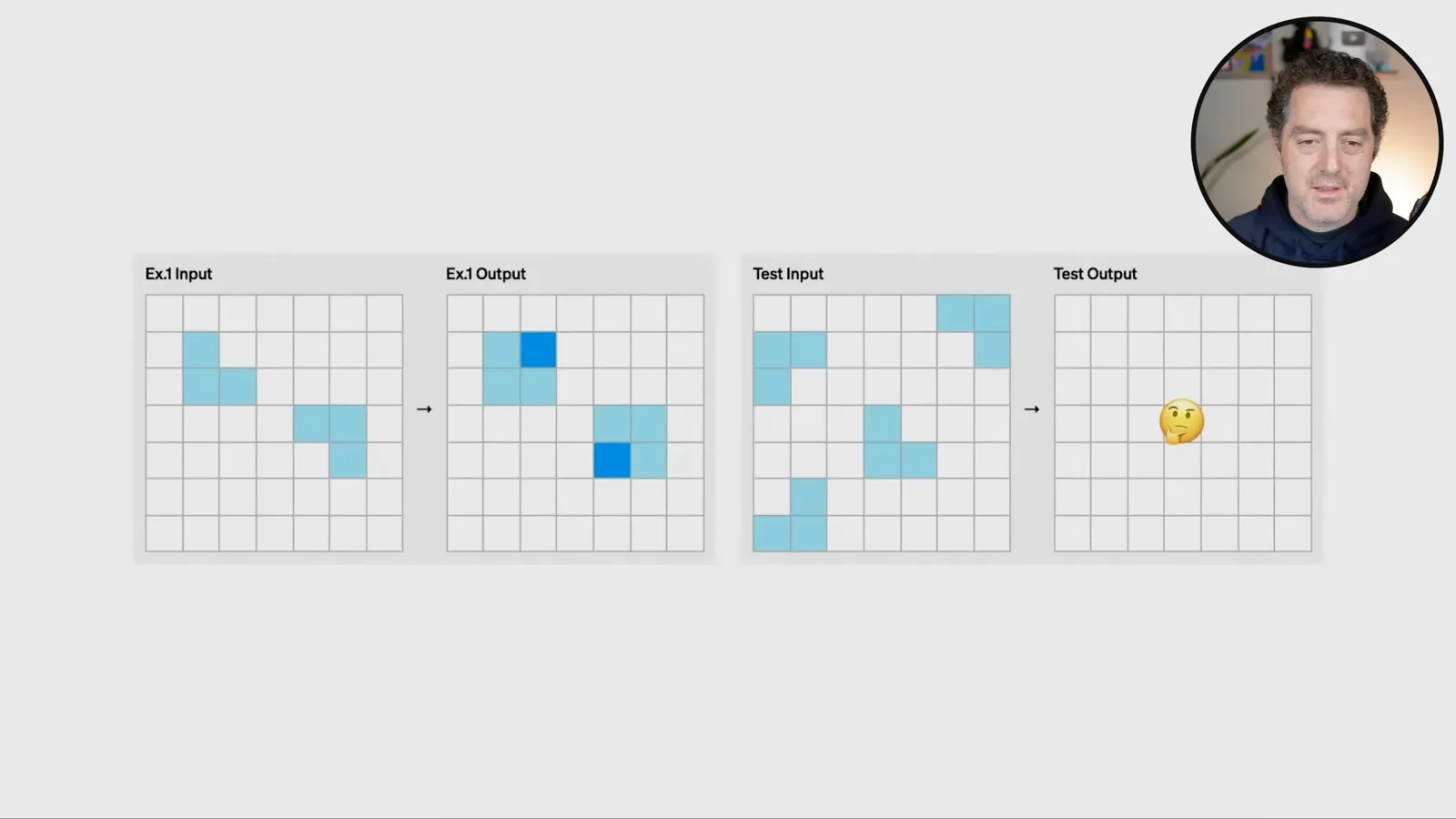
I value the benchmark because many tasks can be straightforward for people while challenging for models, and because the model must infer a rule from examples. Kamradt says tasks require distinct skills and are designed to test adaptation rather than simple repetition. This evaluates a particular form of abstraction and generalization, not every ability associated with AGI.
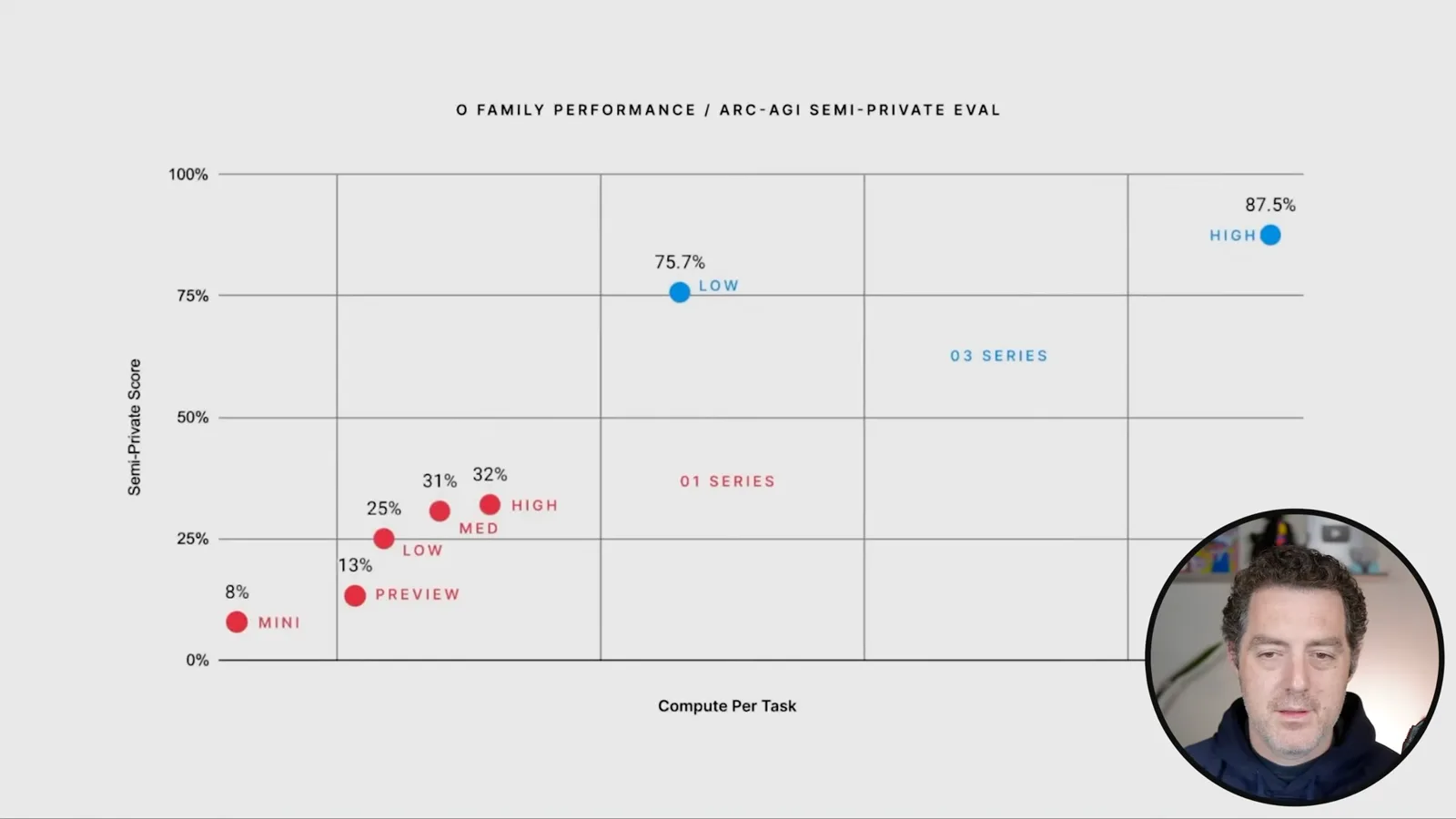
Kamradt reports that o3-preview scored 75.7% on ARC-AGI-1’s semi-private evaluation at the lower compute setting and 87.5% at the higher setting. He compares the latter with a roughly 85% human-performance threshold used in the presentation. Human baselines depend on the people, tasks and testing conditions, so that comparison is not a universal measure of human ability.
I call the ARC score, together with the math and science results, proof of AGI. The evidence supports a narrower conclusion: the tested system performed well on these benchmarks under specified conditions. ARC Prize reports that its high-compute run used roughly 172 times as much compute as the lower setting, a material part of the result.
OpenAI says it did not do specific work targeting the benchmark, and I infer that it did not train on ARC. ARC Prize’s own report adds an important correction: OpenAI told it the tested system was trained on 75% of ARC-AGI-1’s public training set. That is different from the semi-private evaluation set, but the contribution of that training was not isolated in the reported test.
Kamradt says the work of measuring progress is not over and discusses developing further benchmarks. I note the ARC Prize competition and speculate about who might win. Later, ARC Prize reported that the commercially released April 2025 o3 was not the same system as this original preview.
o3-mini and the live demo
OpenAI presents adjustable reasoning effort and cost-performance charts. A generated application then runs a model evaluation.
OpenAI researcher Hongyu Ren introduces o3-mini as a smaller reasoning model intended to improve the tradeoff between cost and performance. The announced API options are low, medium and high reasoning effort, allowing users to spend less computation on simpler requests and more on harder ones.
On the presented Codeforces chart, o3-mini improves as reasoning effort increases, with medium effort exceeding o1 in that particular evaluation. The accompanying estimated cost-versus-rating plot suggests a more efficient frontier than o1. The chart describes OpenAI’s tested settings; performance and expense depend on the actual workload.
For a live demonstration, the team asks o3-mini to write a Python code generator and executor. The generated program starts a local server with a text box, sends requests to the model API, saves the returned code and runs it. The team first tries a small task that prints a random number.
The presenters then ask the generated interface for code to evaluate low-effort o3-mini on GPQA. The script must download the data, identify questions and answer choices, query the model and grade the outputs. The live run reports approximately 61.6%, close to the 62% figure the presenter says he had measured separately.
I find it interesting that a model helped create a tool to evaluate a model, while noting concerns about models manipulating evaluations or concealing behavior. The demonstration is a constrained coding-and-evaluation workflow, not evidence that the model independently redesigned or improved itself.
Additional evaluations and safety access
Presenters discuss math, latency and API features. They explain the planned external safety-testing process.
OpenAI also shows AIME 2024 results for o3-mini at different reasoning levels and latency comparisons on anonymized o1-preview traffic. The presentation says low effort is much faster than o1-mini and medium is roughly half the latency of o1 in that comparison; these numbers are tied to that workload.
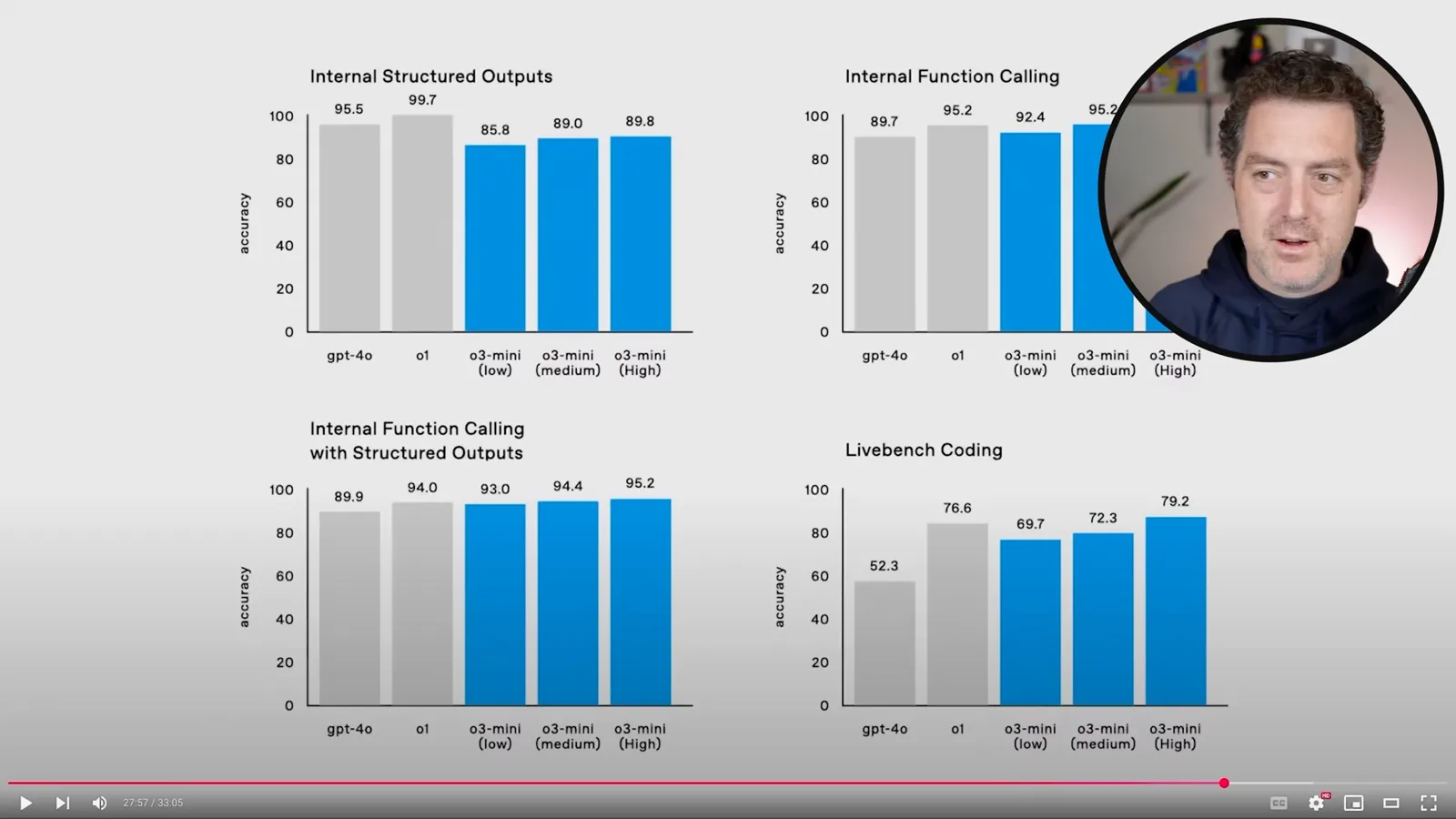
For developers, the presenters highlight function calling, structured outputs and developer messages. Their internal evaluations show strong results, though the scores vary across features and reasoning levels. These APIs can be useful when building coding tools and agents, but the chart is not a guarantee that tool calls will always be correct.
OpenAI says it is post-training the models, adding safety interventions and conducting internal tests. It invites safety and security researchers to apply for external testing of o3-mini and, later, o3, with applications closing January 10, 2025. I am excited to test the models myself and plan to examine the announcement further.
同じチャンネルの記事
 34:21EN
 Matthew Berman· 2026年10月27日Matthew Berman Examines Anthropic’s IPO Filing, AI Growth and GovernanceMatthew Berman, Sam Altman · Forward FutureThe presenter reviews the S-1’s financial metrics, compute strategy and voting structure while questioning the tension between rapid AI development and safety.
 0:26ENMatthew Berman· 2026年10月25日Sam Altman on Human Values and Problem-Solving in an AI WorldSam Altman · OpenAIIn a short interview excerpt, Altman considers the enjoyment of solving hard problems and the human role in interpreting results.
 0:36ENMatthew Berman· 2026年10月25日Kimi K3.1 and a Rubik’s Cube Solver DemonstrationMatthew Berman · Forward FutureMatthew Berman shows a scrambled virtual cube being solved and gives the Kimi K3.1 test a favorable assessment.
 0:21ENMatthew Berman· 2026年10月24日An AI-Generated Kimi Benchmark Chart Used Invented ScoresMatthew Berman · Forward FutureMatthew Berman asks for a graph of Kimi K3.1 Pro benchmarks, then discovers that the displayed figures are illustrative placeholders.
 25:50ENMatthew Berman· 2026年10月24日Kimi K3.1 Pro Tested: Strong 3D Demos, Uneven Results and Competitive PricingMatthew Berman · Forward FutureMatthew Berman tests the open-weight model on coding, 3D rendering and visual explanations, then compares benchmark results and prices.
 32:20ENMatthew Berman· 2026年10月23日Who Is Local AI For? The Costs, Trade-offs and a Hybrid FutureMatthew Berman · Forward FutureMatthew Berman weighs data control and independence against hardware cost, setup complexity and inference speed.