30 秒でわかる
In April 2026, Matthew Berman reviews DeepSeek V4 Pro and Flash, then discusses benchmarks, pricing, export controls, alleged distillation and geopolitical competition. He argues that cheaper open-weight models could influence enterprise adoption and urges greater US investment in open models and efficiency. His market, security and economic forecasts are opinions; the video does not establish training costs or prove the causes of model performance.
- 1V4 Pro and FlashDeepSeek described two open-weight mixture-of-experts preview models with one-million-token context windows.
- 2Benchmark and price comparisonsBerman sees a tradeoff between performance and price, but comparisons need verified, contemporaneous methodology.
- 3Export controls and efficiencyHe argues chip restrictions may constrain computing resources while encouraging algorithmic efficiency.
- 4Distillation allegationsBerman discusses Anthropic’s allegations and questions their interpretation; the parties’ claims and available evidence are distinct.
- 5Enterprise and geopolitical implicationsHe predicts cheaper open-weight models may influence adoption and US economic strategy, while acknowledging a future scenario rather than a measured outcome.
ポイント
- DeepSeek’s preview described V4 Pro as a 1.6-trillion-parameter mixture-of-experts model with 49 billion active parameters, and Flash as 284 billion with 13 billion active; both support a million-token context.
- Published weights and a technical report do not necessarily mean all training data and development details are public.
- Benchmark and price comparisons depend on methodology, model version, usage and date; a video chart has a source date that predates the models it compares.
- Anthropic’s February 2026 report alleged over 150,000 exchanges associated with DeepSeek; Berman questions how much they imply, but neither benchmarking nor unauthorized distillation is established solely by the count.
- Berman argues efficient models could affect enterprise choices and US competitiveness; wider economic collapse and future adoption are speculative.
- Self-hosted open weights can reduce reliance on a hosted API, but infrastructure, security and maintenance remain important considerations.
チャプターごとに整えた全文を読む
Why DeepSeek V4 matters to Berman
Berman introduces the V4 preview and frames it as a challenge to US AI leadership. He recalls the earlier R1 release and its market impact.
DeepSeek’s V4 preview prompts me to ask a broader question than how well a model performs: what happens when a Chinese lab releases powerful models with available weights and relatively low advertised prices? I see potential consequences for US AI competition, though the geopolitical and economic outcomes remain uncertain.
Berman recalls DeepSeek R1, released in January 2025, as an influential open-weight reasoning model that challenged assumptions about the gap between Chinese and US labs. He links its release to a sharp market reaction. His claim that the entire stock market fell 20% overnight is not established; declines in particular AI-related stocks should not be treated as that figure for the whole market.
He says efficient training challenged assumptions about the amount of computing needed and invokes the Jevons paradox: cheaper use can sometimes increase total demand. That is an economic possibility, not a guarantee that every reduction in model cost will increase overall spending.
Model architecture, benchmarks and cost
He reviews Pro and Flash specifications and compares selected benchmark and pricing charts. Their results and costs require careful, time-specific interpretation.
DeepSeek announced preview versions of V4 Pro and V4 Flash. Its announcement describes Pro as a mixture-of-experts model with 1.6 trillion total parameters and 49 billion active, and Flash with 284 billion total and 13 billion active. Both advertise a one-million-token context window.
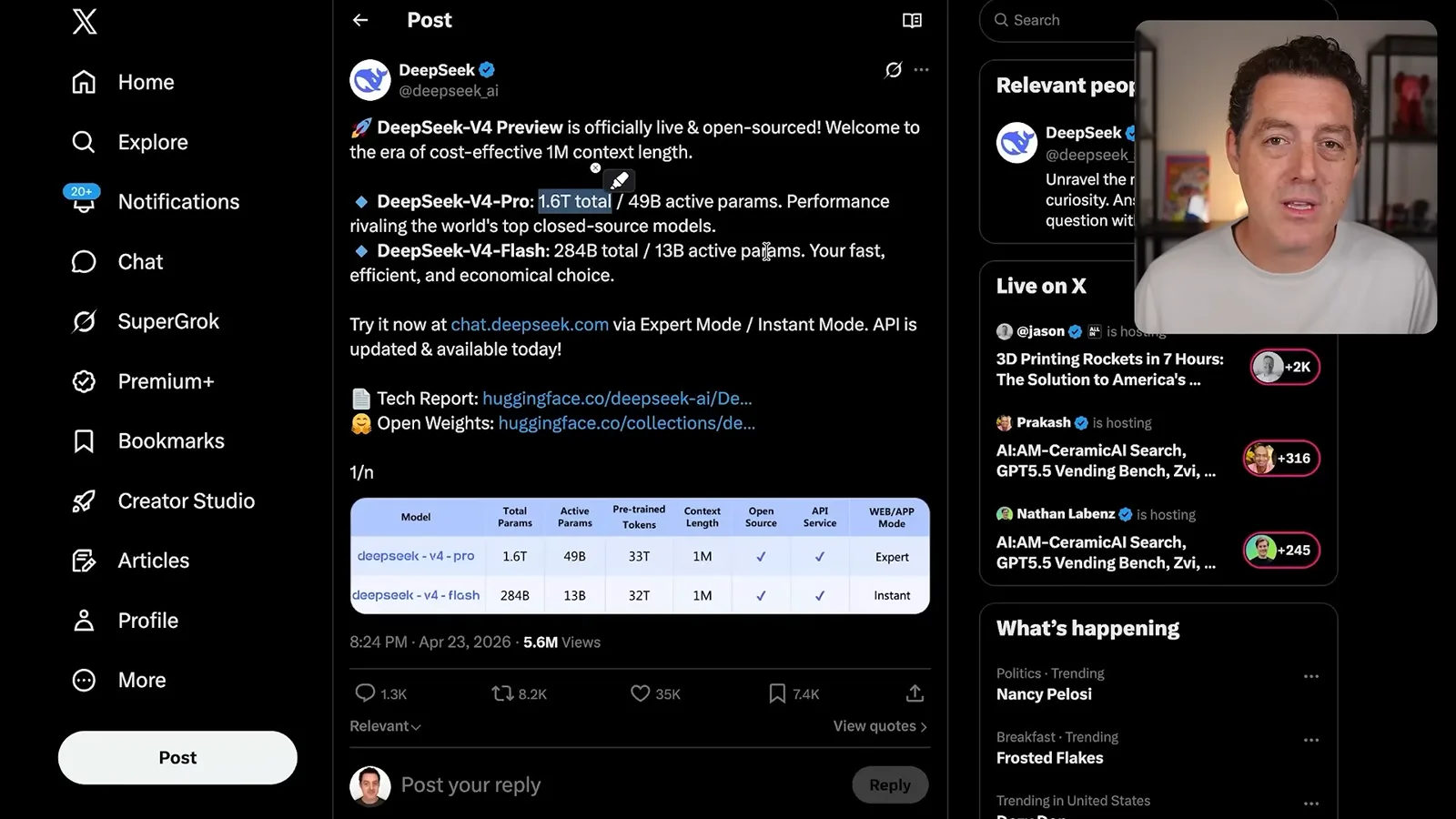
A mixture-of-experts architecture activates only a subset of parameters for a given token. The table shown in the video lists 33 trillion pretraining tokens for Pro and 32 trillion for Flash, rather than the same figure for both. The company released weights and technical documentation; that does not by itself mean every training dataset and development detail is public.
Berman discusses DeepSeek’s claims about reasoning and agentic coding, comparing them with contemporary US models. He shows selected benchmarks and sees V4 Pro as close to leading systems. Such claims depend on the exact version, test setup and task; a few benchmarks do not establish that one model matches another in all applications.
He then compares an intelligence index with token prices, arguing that V4 offers a favorable price-performance tradeoff and that Flash targets cheaper work. The video’s chart labels its sources May 2025 even though the models shown appeared in 2026, so its figures and comparisons should not be treated as verified. Actual costs depend on provider, input and output mix, caching and deployment.
Berman sketches changing performance gaps between US and Chinese models using an Arena-style ranking and says Chinese labs have repeatedly narrowed the gap. He argues many users do not need the very best result on every benchmark. Whether a model meets a particular organization’s requirements still needs testing on its own workloads.
Export controls and distillation claims
Berman considers the effect of chip controls and discusses Anthropic’s allegations about model-output extraction. He questions whether observed traffic alone proves the impact on DeepSeek’s capabilities.
Berman asks whether US export controls on advanced chips are working. He argues they restrict Chinese access to computing resources while also encouraging efficiency in algorithms and inference. He mentions reports of possible circumvention, but the video does not verify any particular shipment or establish the full amount of computing available to each country.
He notes Nvidia CEO Jensen Huang’s argument for selling US chips into China, and predicts Chinese companies will continue developing their own hardware and models. Berman sees a tension between restricting advanced technology and maintaining US participation in a growing market.
Berman turns to Anthropic’s February 2026 report, which alleged large-scale attempts by DeepSeek, Moonshot and MiniMax to extract Claude capabilities. He explains distillation as training a model using another model’s outputs, and cites a US government statement raising concerns about foreign extraction campaigns. These are allegations and official statements, not proof of the role any data played in V4.
Berman questions whether observed queries necessarily indicate improper distillation, arguing that benchmark testing can also involve querying competitors’ models. Anthropic, however, said it identified coordinated patterns and other indicators beyond simple query volume. The available count alone cannot establish intent or resolve the dispute.
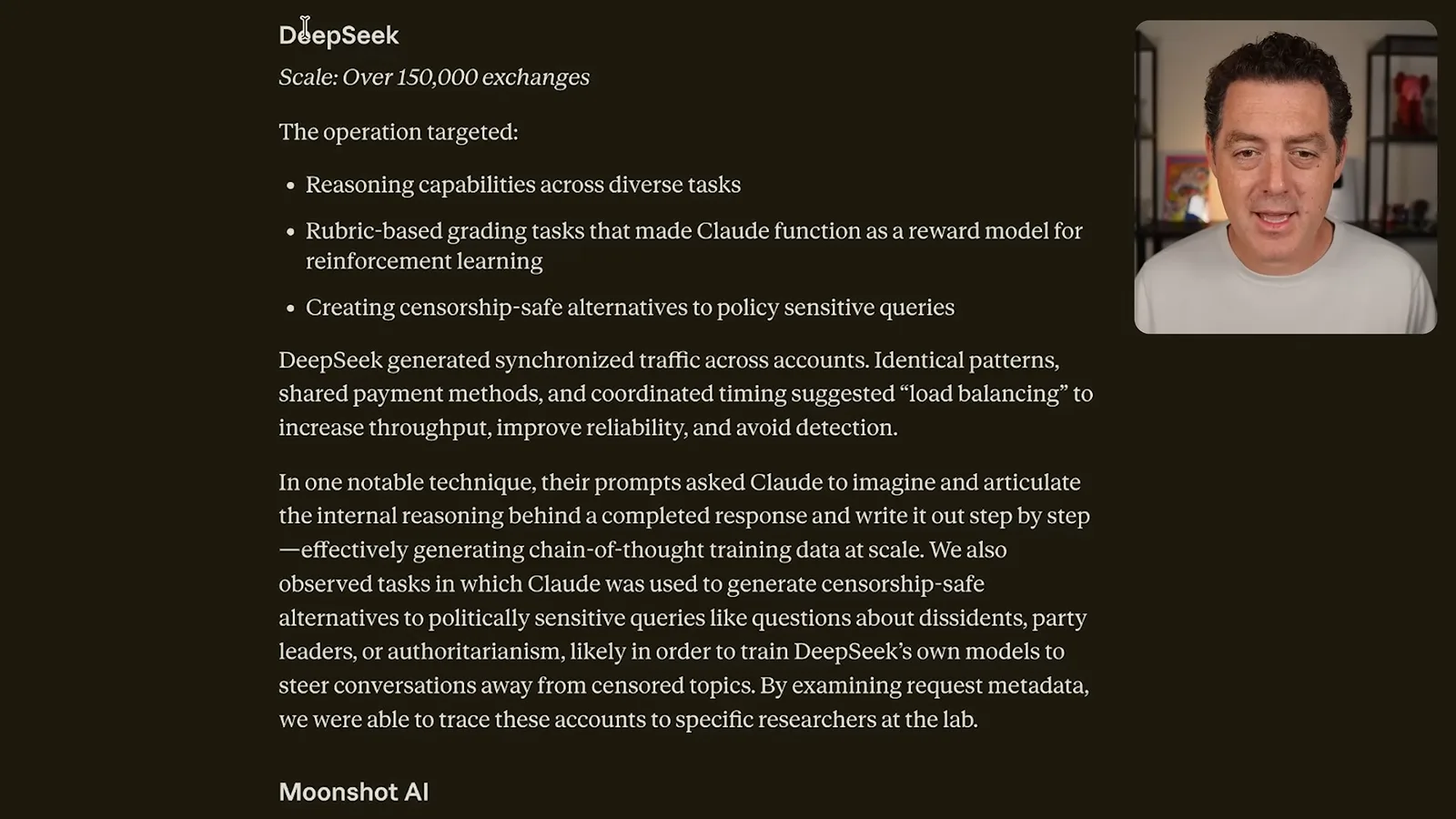
The February report attributed over 150,000 exchanges to a DeepSeek-linked operation, fewer than the millions it attributed to the other two labs. Berman argues this number alone would not explain DeepSeek’s model quality. The amount and significance of any data used for training cannot be determined solely from the exchange count.
Berman points to a DeepSeek statement that Pro service capacity was constrained and that future infrastructure might lower prices. He interprets this as evidence of compute limits and expects prices to fall. These are conditions and expectations from the 2026 launch, not promises about present-day availability or pricing.
Enterprise choices and US strategy
He argues that price and access to weights could influence deployment decisions and discusses security and economic risks. He calls for more open-weight US models and efficiency.
Berman argues that an enterprise may prefer a cheaper model that performs adequately on its own tasks over a more expensive frontier model. He also values access to model weights and the ability to adapt or host them. Actual choices depend on evaluations, deployment costs, licensing, security and operational requirements, not benchmark scores or API prices alone.
He predicts that US and allied companies may build more systems on Chinese open-weight models. He raises concerns about dependency and about providers changing access. A locally held open-weight model can continue to run without the original hosted API, although updates, infrastructure, security and support can still create dependencies.
Berman speculates that large US AI investments could face disappointing returns and that a severe economic shock is possible. He also worries that the values and restrictions embedded in widely used models could influence public discourse. These are scenarios and policy concerns, not established consequences of V4’s release.
His proposed response is for US developers to invest more in open-weight models and improve the efficiency and affordability of both open and hosted systems. He argues that competitive pricing could help businesses build on US technology. The discussion reflects his April 2026 perspective; model availability and prices can change.
同じチャンネルの記事
 34:21EN
 Matthew Berman· 2026年10月27日Matthew Berman Examines Anthropic’s IPO Filing, AI Growth and GovernanceMatthew Berman, Sam Altman · Forward FutureThe presenter reviews the S-1’s financial metrics, compute strategy and voting structure while questioning the tension between rapid AI development and safety.
 0:26ENMatthew Berman· 2026年10月25日Sam Altman on Human Values and Problem-Solving in an AI WorldSam Altman · OpenAIIn a short interview excerpt, Altman considers the enjoyment of solving hard problems and the human role in interpreting results.
 0:36ENMatthew Berman· 2026年10月25日Kimi K3.1 and a Rubik’s Cube Solver DemonstrationMatthew Berman · Forward FutureMatthew Berman shows a scrambled virtual cube being solved and gives the Kimi K3.1 test a favorable assessment.
 0:21ENMatthew Berman· 2026年10月24日An AI-Generated Kimi Benchmark Chart Used Invented ScoresMatthew Berman · Forward FutureMatthew Berman asks for a graph of Kimi K3.1 Pro benchmarks, then discovers that the displayed figures are illustrative placeholders.
 25:50ENMatthew Berman· 2026年10月24日Kimi K3.1 Pro Tested: Strong 3D Demos, Uneven Results and Competitive PricingMatthew Berman · Forward FutureMatthew Berman tests the open-weight model on coding, 3D rendering and visual explanations, then compares benchmark results and prices.
 32:20ENMatthew Berman· 2026年10月23日Who Is Local AI For? The Costs, Trade-offs and a Hybrid FutureMatthew Berman · Forward FutureMatthew Berman weighs data control and independence against hardware cost, setup complexity and inference speed.