30 秒でわかる
In January 2026, Matthew Berman reacts to Neel Somani’s report that GPT-5.2 Pro produced a solution to Erdős problem 397, formalized with Harmonic’s Aristotle and accepted by Terence Tao for the problem database. Berman sees this and other AI-assisted research as signs of a potential self-improving feedback loop. A later literature review found an equivalent full solution from a 2012 competition; the AI-generated proof’s validation is distinct from a claim of first discovery. Berman’s forecasts of unbounded intelligence and cures remain speculative. The video contains a paid HPC-AI sponsorship.
- 1A proof and its historyBerman reports Somani’s AI-assisted solution to problem 397. Tao’s later tracking page records a similar complete human solution from 2012.
- 2A proposed feedback loopBerman argues that AI-assisted scientific discoveries could improve AI systems themselves. The speed and outcome of any such loop remain uncertain.
- 3Matrix multiplicationThe video misnames AlphaEvolve as AlphaFold and generalizes a specific algorithmic result to all computation; neither follows from the reported result.
- 4Tracking different outcomesTao’s list includes complete, partial, previously known and incorrect results. Formal verification checks a formal statement and proof, not historical novelty.
ポイント
- The AI-assisted solution to Erdős problem 397 was formalized in Lean, but a later literature review identified a prior full solution from 2012.
- Erdős problems vary substantially in difficulty, and a verified proof does not by itself establish a first discovery.
- Google DeepMind’s AlphaEvolve, not AlphaFold, reported a 4×4 complex matrix multiplication improvement for a specific arithmetic setting.
- Improvements in particular algorithms and infrastructure do not mean all matrix multiplication immediately becomes faster.
- An intelligence explosion, unlimited intelligence and cures for disease are forecasts, not consequences established by these demonstrations.
- HPC-AI sponsored the video.
チャプターごとに整えた全文を読む
Erdős problem 397 and AI
Berman discusses a GPT-5.2 Pro proof prompted by Neel Somani and formalized with Aristotle. Later work identified a prior full solution, so novelty must be distinguished from validity.
Neel Somani reports that he prompted GPT-5.2 Pro to work on Erdős problem 397 and submitted a proof accepted by Terence Tao for the problem database. The proof was formalized using Harmonic’s Aristotle and checked in Lean. Berman calls it an extremely hard open problem and says the model took about 15 minutes; that timing is a report, not the complete time required for review and formalization.
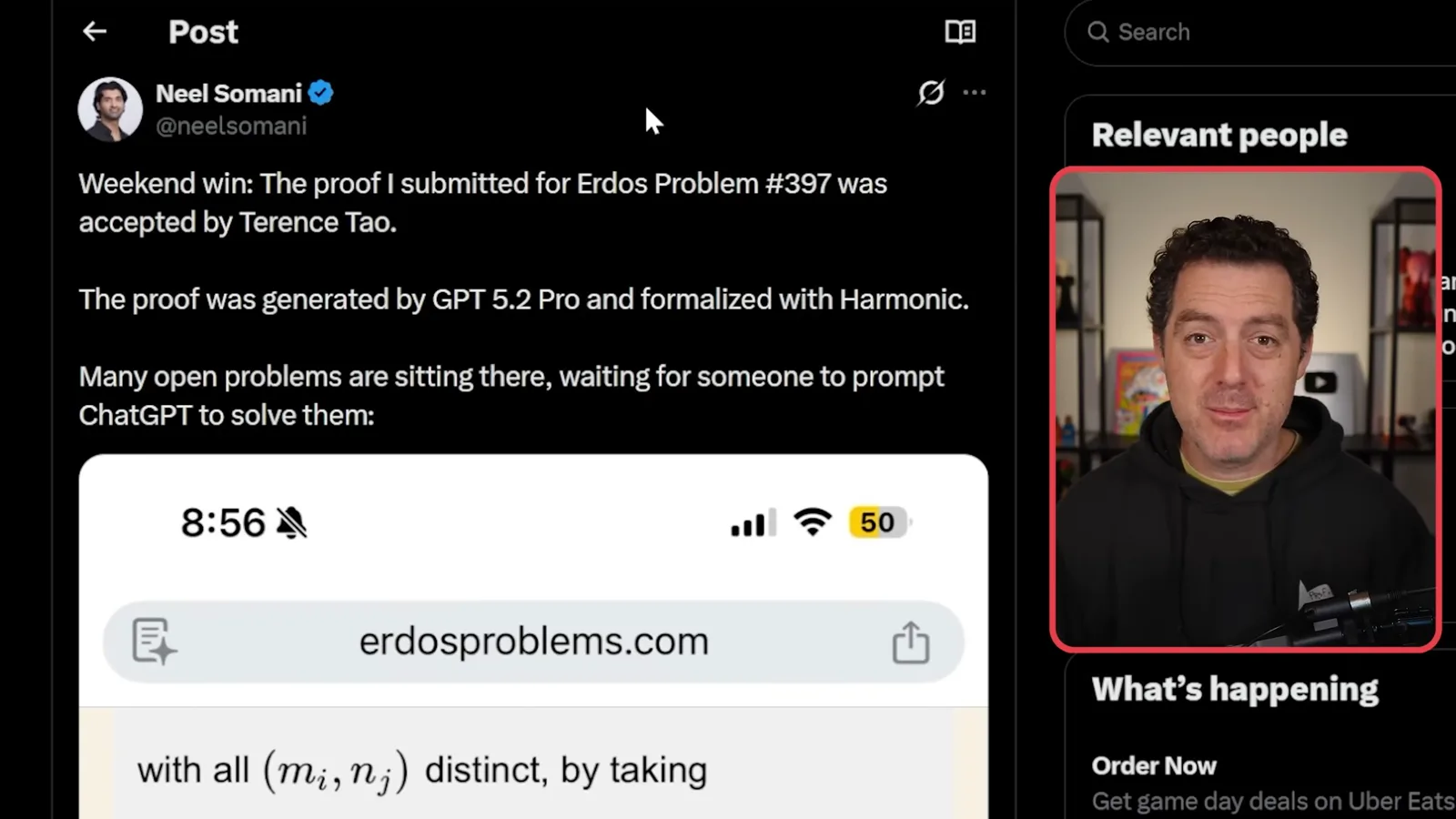
An important later correction is that Tao’s [AI contributions tracker](https://github.com/teorth/erdosproblems/wiki/AI-contributions-to-Erd%C5%91s-problems) lists the January 10, 2026 solution as complete and Lean-checked, but records a similar full human solution from a 2012 Chinese competition found on January 14. Thus it is an AI-assisted valid solution, not a demonstrated first solution to a previously unsolved problem. Erdős problems cover a wide range of difficulty.
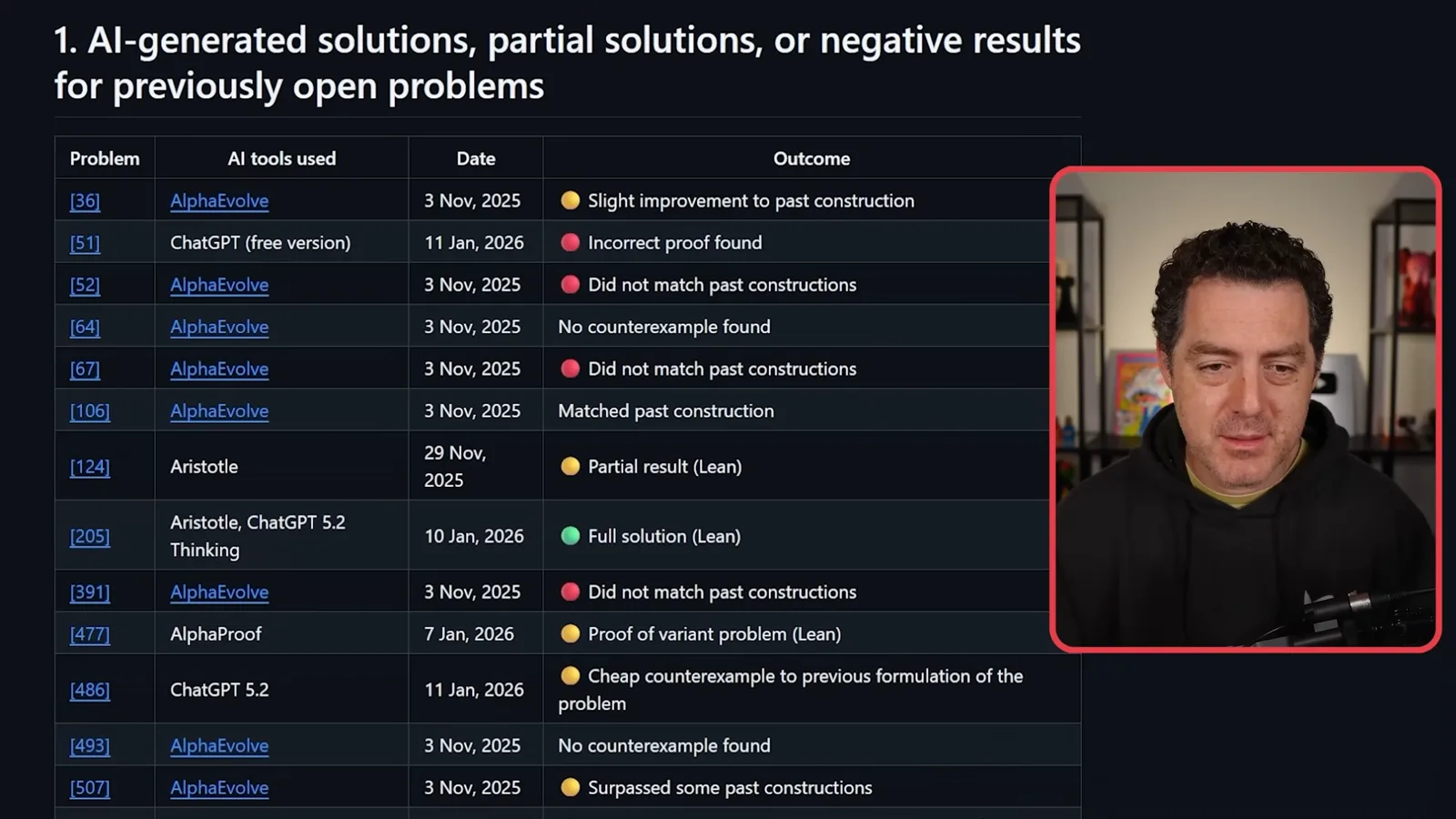
Berman points to several recent AI-assisted attempts and argues that models are beginning to contribute to frontier mathematics. Some entries in Tao’s list are full solutions, while others are partial, incorrect or later found to have prior solutions. These outcomes are not interchangeable, and a formal proof verifies the encoded statement rather than proving that no earlier result existed.
Algorithmic discoveries and self-improvement
Berman links mathematics and infrastructure improvements to a possible intelligence explosion. The illustrated future trajectory is speculative.
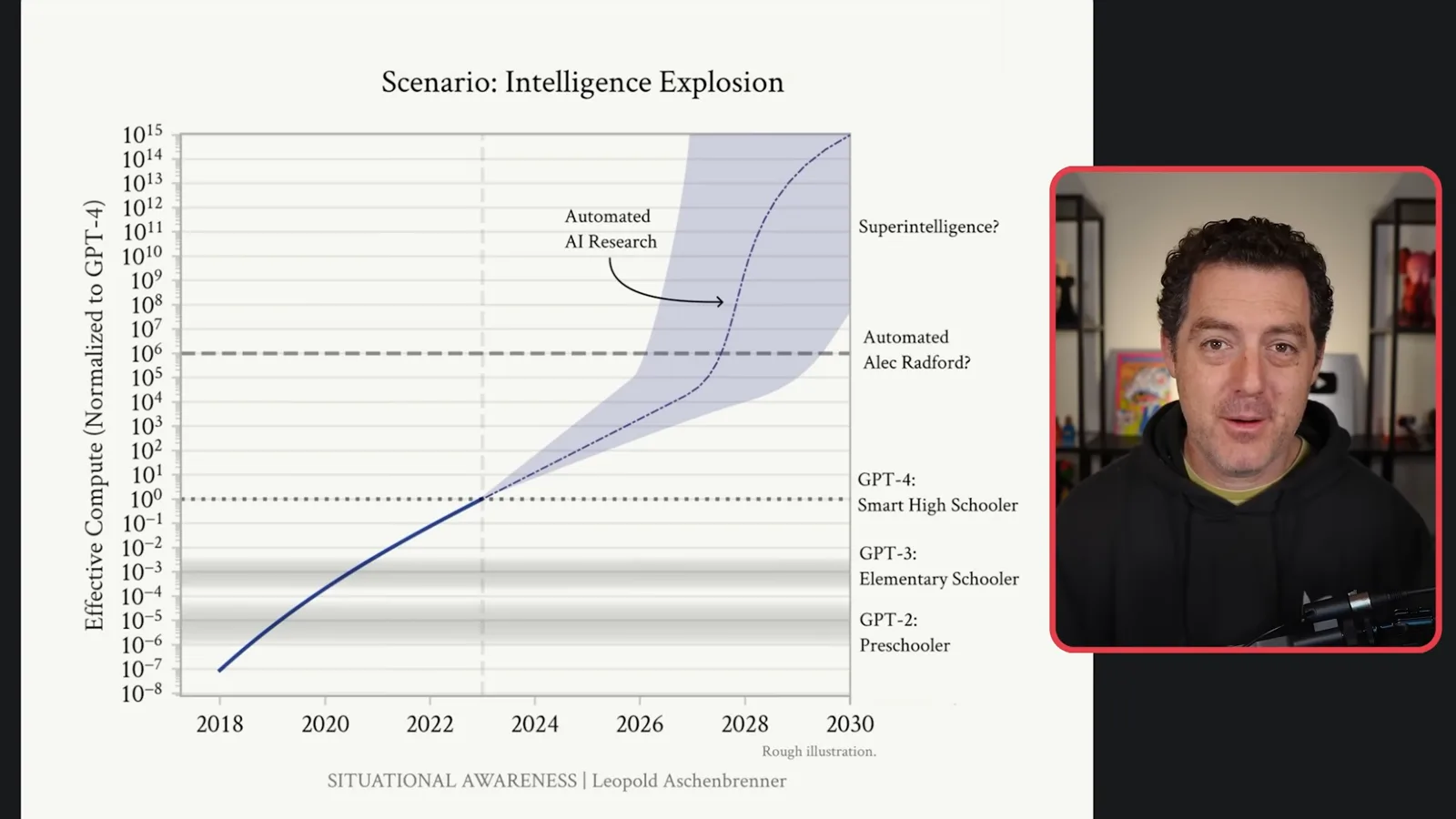
He uses an illustrative chart to describe an intelligence explosion: AI that helps discover better methods could improve future AI, creating a feedback loop. That is a possible scenario, not a measured trajectory or proof of unbounded intelligence. The speed and extent of such a loop depend on research, implementation, hardware and other constraints.
Berman points to a model reaching gold-medal-level performance on International Mathematical Olympiad problems as evidence of progress. The IMO is a mathematics competition, not a coding competition. Competition performance and research on open problems are different tests, and a medal-level score does not itself establish broad autonomous mathematical discovery.
He describes an AI-discovered matrix multiplication improvement but calls the system AlphaFold. The result shown is from Google DeepMind’s [AlphaEvolve](https://deepmind.google/blog/alphaevolve-a-gemini-powered-coding-agent-for-designing-advanced-algorithms/): its procedure found an algorithm using 48 scalar multiplications for 4×4 complex-valued matrices, compared with 49 in the cited prior method. AlphaFold concerns protein structure; AlphaTensor is another distinct matrix-algorithm system.
Berman argues that even small gains could matter at scale because matrix multiplication is central to AI. But the specific 4×4 complex result does not mean every matrix multiplication has become faster: practical performance depends on hardware, matrix sizes, numerical properties and deployment. He also discusses DeepMind’s reports that AlphaEvolve helped optimize selected data-center scheduling, TPU design and model-training operations, not the entirety of Google’s infrastructure.
Berman mentions Sakana AI’s AI Scientist as another effort to automate parts of research, and suggests that discoveries could eventually feed back into model development. The video includes a paid sponsorship for HPC-AI’s fine-tuning infrastructure and a promotional credit offer; these commercial claims reflect the time of the video.
Tracking AI mathematics
After a paid sponsor segment, he reviews Tao’s list of AI-assisted Erdős problem outcomes. He concludes with predictions about parallel research and scientific progress.
Berman shows Tao’s public tracker of AI contributions to Erdős problems. It distinguishes full solutions, partial results, failed attempts and instances where literature review later identified prior work. Some solutions combine GPT-5.2 with Aristotle and Lean, while other entries involve different systems or human contributions. A green formal-verification marker has a narrower meaning than novelty or proof that all related questions are settled.
Berman predicts that stronger mathematical reasoning and open-ended scientific discovery could eventually help solve disease and improve AI itself. These are hopeful projections, not evidence that cancer or all diseases will be solved. He argues that AI work can be parallelized, while real systems remain constrained by compute, energy, data, experimental validation and human oversight.
同じチャンネルの記事
 34:21EN
 Matthew Berman· 2026年10月27日Matthew Berman Examines Anthropic’s IPO Filing, AI Growth and GovernanceMatthew Berman, Sam Altman · Forward FutureThe presenter reviews the S-1’s financial metrics, compute strategy and voting structure while questioning the tension between rapid AI development and safety.
 0:26ENMatthew Berman· 2026年10月25日Sam Altman on Human Values and Problem-Solving in an AI WorldSam Altman · OpenAIIn a short interview excerpt, Altman considers the enjoyment of solving hard problems and the human role in interpreting results.
 0:36ENMatthew Berman· 2026年10月25日Kimi K3.1 and a Rubik’s Cube Solver DemonstrationMatthew Berman · Forward FutureMatthew Berman shows a scrambled virtual cube being solved and gives the Kimi K3.1 test a favorable assessment.
 0:21ENMatthew Berman· 2026年10月24日An AI-Generated Kimi Benchmark Chart Used Invented ScoresMatthew Berman · Forward FutureMatthew Berman asks for a graph of Kimi K3.1 Pro benchmarks, then discovers that the displayed figures are illustrative placeholders.
 25:50ENMatthew Berman· 2026年10月24日Kimi K3.1 Pro Tested: Strong 3D Demos, Uneven Results and Competitive PricingMatthew Berman · Forward FutureMatthew Berman tests the open-weight model on coding, 3D rendering and visual explanations, then compares benchmark results and prices.
 32:20ENMatthew Berman· 2026年10月23日Who Is Local AI For? The Costs, Trade-offs and a Hybrid FutureMatthew Berman · Forward FutureMatthew Berman weighs data control and independence against hardware cost, setup complexity and inference speed.