30 秒でわかる
Matthew Berman discusses why people might run open models on their own computers: local processing, more control and the ability to experiment without per-use hosting fees. He also notes hardware constraints and technical complexity, and offers his view that local models are sufficient for many tasks.
- 1Run models locallyThe models a computer can run depend on its available hardware.
- 2Privacy and controlLocal processing can keep prompts on the device and allow technically skilled users to experiment with adaptation.
- 3Costs and complexityBerman highlights hardware and electricity costs and says local setup demands more technical skill.
- 4Performance tradeoffsBerman compares open models with hosted frontier models and offers an unmeasured estimate of their suitability for common use cases.
ポイント
- Compatible models can run locally, subject to available hardware resources.
- Keeping processing local can improve privacy, depending on the software and configuration.
- Access to model weights can enable experimentation and, where permitted, fine-tuning.
- Local use still incurs hardware, electricity and setup costs.
- Berman sees a performance gap with frontier hosted models but believes local models meet many needs; his 95% estimate is not substantiated in the video.
チャプターごとに整えた全文を読む
Why run a model locally?
Berman explains local execution, privacy, control and experimentation. Hardware determines which models can run.
One benefit of open models is that you can run compatible ones on your own computer. The power and size of the model you can use depend on the hardware available. Running locally is also interesting for people who enjoy experimenting with their own setup.
Local processing can improve privacy because your input need not be sent to a hosted model provider, provided the software and configuration keep it on the device. It also gives you more control: technically inclined users can experiment with techniques such as fine-tuning and reinforcement learning, where the model and its license permit.
Cost and tradeoffs
Local use avoids hosted per-use fees but still involves hardware and electricity. Setup and model quality can be tradeoffs, although Berman considers local models adequate for many tasks.
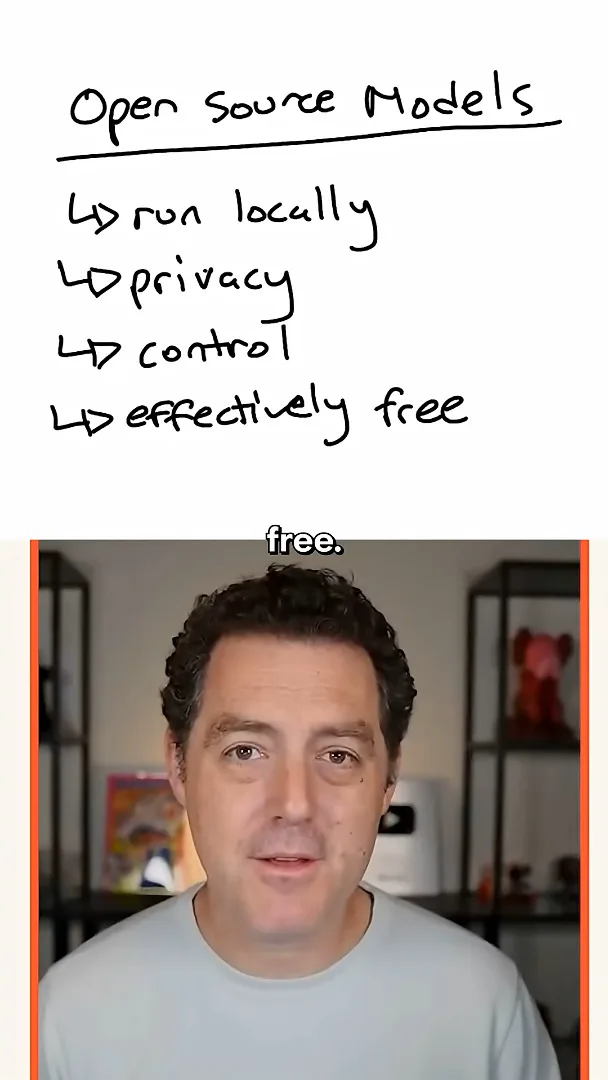
I consider local use effectively free in the sense that there may be no per-use hosting fee, although you still pay for hardware and the electricity that powers it. There are drawbacks: setup usually takes more technical knowledge than visiting a hosted chatbot.
I think open models generally lag the leading hosted models in capability, although the comparison depends on the models and tasks. In my view they are sufficient for many uses; I estimate 95%, but I do not present evidence for that figure in this video.
同じチャンネルの記事
 34:21EN
 Matthew Berman· 2026年10月27日Matthew Berman Examines Anthropic’s IPO Filing, AI Growth and GovernanceMatthew Berman, Sam Altman · Forward FutureThe presenter reviews the S-1’s financial metrics, compute strategy and voting structure while questioning the tension between rapid AI development and safety.
 0:36ENMatthew Berman· 2026年10月25日Kimi K3.1 and a Rubik’s Cube Solver DemonstrationMatthew Berman · Forward FutureMatthew Berman shows a scrambled virtual cube being solved and gives the Kimi K3.1 test a favorable assessment.
 25:50ENMatthew Berman· 2026年10月24日Kimi K3.1 Pro Tested: Strong 3D Demos, Uneven Results and Competitive PricingMatthew Berman · Forward FutureMatthew Berman tests the open-weight model on coding, 3D rendering and visual explanations, then compares benchmark results and prices.
 32:20ENMatthew Berman· 2026年10月23日Who Is Local AI For? The Costs, Trade-offs and a Hybrid FutureMatthew Berman · Forward FutureMatthew Berman weighs data control and independence against hardware cost, setup complexity and inference speed.
 1:03:37ENMatthew Berman· 2026年10月23日Matthew Berman’s Team Tests Kimi K3.1 on Animation, Games, and ChartsMatthew Berman, Alex, Brian · Forward FutureA live team AMA turns into an informal test of Kimi K3.1, from personal-agent workflows to motion graphics, a browser game, and a benchmark chart.
 0:53ENMatthew Berman· 2026年10月22日Sam Altman on AI and the Discovery of New KnowledgeSam Altman · OpenAIAltman expects progress in mathematical discovery to extend to biology, materials and energy.